
 1,2
1,2- 1Department of Earth and Geoenvironmental Sciences, University of Bari Aldo Moro, Bari, Italy (a.motlhasedi@phd.uniba.it)
- 2Agenzia Spaziale Italiana (ASI), Rome, Italy
Abstract
The Makgadikgadi Basin in Botswana represents one of the largest evaporitic systems on Earth and is considered an important terrestrial analogue for Martian playa and hypersaline environments [1;2]. The basin is characterised by evaporitic crusts, authigenic clay minerals, polygonal fractures, layered deposits and groundwater-controlled geomorphological processes comparable to those observed in Martian paleolake basins and playa environments [1;3;5]. This study investigates the surface mineralogy of the Makgadikgadi Pans using hyperspectral remote sensing data from the ASI (Agenzia Spaziale Italiana) PRISMA (PRecursore IperSpettrale della Missione Applicativa) mission and compares the results with hypersaline environments on Mars analysed using Compact Reconnaissance Imaging Spectrometer for Mars (CRISM) data. The mineralogical analysis focuses on the identification and distribution of clay minerals and evaporitic phases within the pans. Preliminary spectral analysis reveals the presence of clay minerals including montmorillonite, illite, glauconite, and evaporites such as thenardite and trona, which are associated with hypersaline depositional conditions and groundwater activity within the basin [2;4].
Introduction
Terrestrial hypersaline environments are considered fundamental analogues for understanding aqueous and evaporitic processes on Mars. The Makgadikgadi Basin is located within the central Kalahari Basin in Botswana and consists of a system of salt pans formed from the desiccation of the paleo-Lake Makgadikgadi [2;3]. The basin is characterised by arid to semi-arid climatic conditions, high evaporation rates, seasonal flooding and groundwater-controlled sedimentary processes [1;3]. The study focuses mainly on the Ntwetwe and Sua pans, where previous studies identified evaporitic minerals, authigenic clays and geomorphological features analogous to Martian playa deposits [1;2]. These environments provide ideal conditions for investigating clay mineral formation and preservation within hypersaline systems.
The Makgadikgadi Basin is characterised by layered mounds, inverted channels, polygonal fractures and evaporitic crusts, suggesting prolonged interactions between groundwater, evaporation and sedimentary processes [1;2]. Moreover, this Basin is characterised by authigenic clay formation associated with alkaline closed-basin depositional environments [4]. Previous studies indicate that the clay fraction is dominated by smectite-rich assemblages together with illite, kaolinite and glauconite minerals [4]. Evaporitic minerals including trona and thenardite are also common within the basin and are associated with hypersaline conditions and seasonal evaporitic processes [1].
Similar hydrated minerals and phyllosilicates have been identified on Mars using CRISM data in locations such as Jezero Crater and Gale Crater [4;6;8]. These clay minerals are of significant astrobiological interest because they indicate past aqueous activity and may preserve biosignatures [4]. This study therefore aims to compare the clay mineralogy of the Makgadikgadi Pans with Martian hypersaline environments using PRISMA and CRISM hyperspectral datasets.
Mineralogical Investigation from PRISMA and CRISM
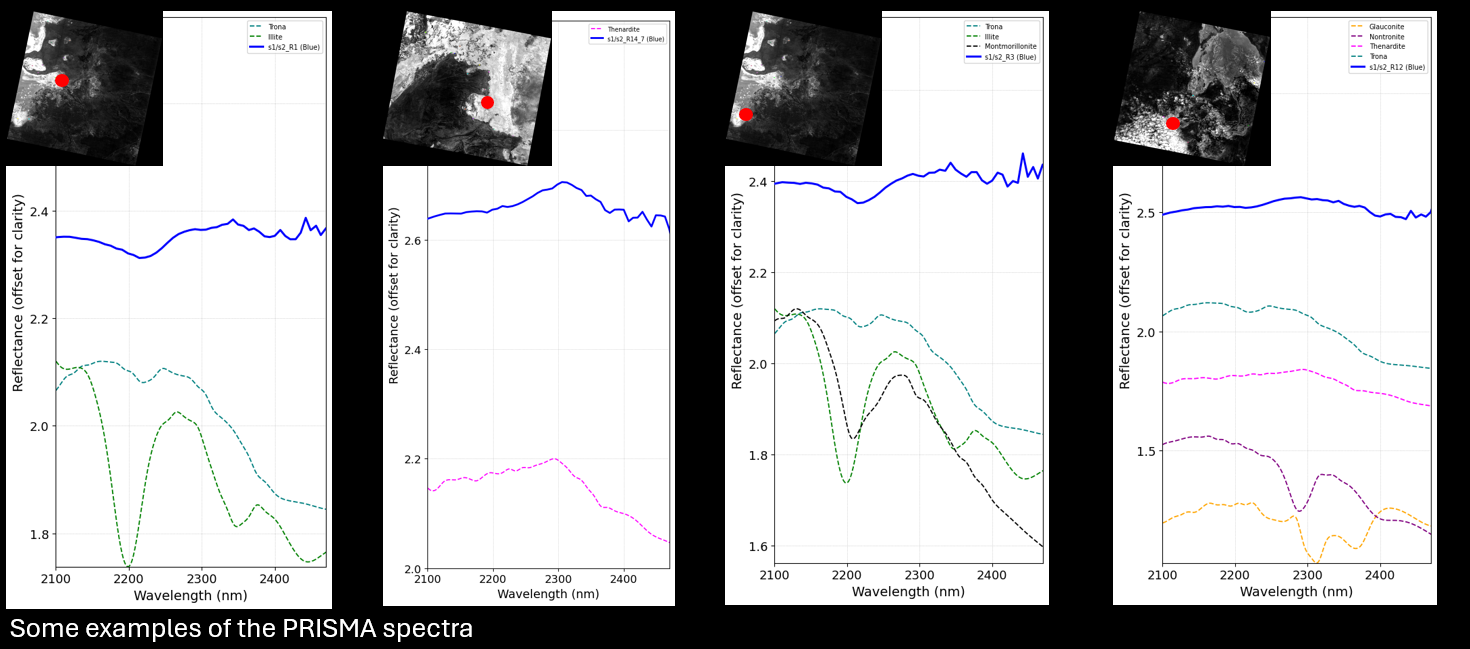
PRISMA hyperspectral data were processed and analysed in ENVI to identify diagnostic spectral absorption features associated with clay minerals and evaporitic phases within the Makgadikgadi Pans [F1]. Clay mineral distribution maps were generated to investigate mineralogical variations across the basin and their relationship to evaporitic and hydrological processes. Particular attention was given to authigenic clay-rich associated with groundwater upwelling and evaporitic crust development.
CRISM data from Martian paleolake environments, including Jezero Crater and Gale Crater, were then analysed for comparison with the terrestrial spectral signatures obtained from PRISMA. Previous studies identified Fe/Mg smectites, carbonates and hydrated minerals within these Martian environments [5;6;7;8], providing an important framework for comparative hyperspectral analysis between Earth and Mars.
Conclusions
Preliminary PRISMA spectral analysis of the Makgadikgadi Pans indicates the presence of hydrated clay minerals and evaporitic phases associated with hypersaline depositional environments. Minerals identified include montmorillonite, illite, glauconite, thenardite and trona, which are important indicators of aqueous alteration and evaporitic processes. The production of clay mineral distribution maps improve our understanding of spatial mineralogical variations within the basin and their relationship to groundwater activity and evaporitic processes.
Comparative analysis with CRISM data from Jezero Crater and Gale Crater will contribute to understanding the formation and preservation of hydrated minerals within Martian paleolake systems. This study strengthens the role of the Makgadikgadi Basin as an important terrestrial analogue for Martian hypersaline environments.
References
[1] Franchi, F., MacKay, R., Selepeng, A.T., Barbieri, R., 2020. Layered mound, inverted channels and polygonal fractures from the Makgadikgadi pan (Botswana): Possible analogues for Martian aqueous morphologies. Planetary and Space Science 192, 105048.
[2] Kahsay, T.H., Asrat, A., Franchi, F., 2024. The astrobiological potential of the Makgadikgadi Basin, Botswana: Field analogue for planetary exploration. Planetary and Space Science 249, 105943.
[3] Franchi, F., Cavalazzi, B., Evans, M., Filippidou, S., Mackay, R., Malaspina, P., et al., 2022. Late Pleistocene-Holocene palaeoenvironmental evolution of the Makgadikgadi Basin, central Kalahari, Botswana: new evidence from shallow sediments and ostracod fauna. Frontiers in Ecology and Evolution 10, 818417.
[4] Zinzi, A., Manzari, P., Camplone, V., Ammannito, E., Sindoni, G., Zucca, F., Polenta, G., 2025. Terrestrial and Martian Paleo-Hydrologic Environment Systematic Comparison with ASI PRISMA and NASA CRISM Hyperspectral Instruments. Remote Sensing 17, 758.
[5] Du, P., Yuan, P., Liu, J., Ye, B., 2023. Clay minerals on Mars: An up-to-date review with future perspectives. Earth-Science Reviews 243, 104491.
[6] Horgan, B.H.N., Anderson, R.B., Dromart, G., Amador, E.S., Rice, M.S., 2020. The mineral diversity of Jezero crater: Evidence for possible lacustrine carbonates on Mars. Icarus 339, 113526.
[7] Rampe, E.B., Ming, D.W., Blake, D.F., Bristow, T.F., Chipera, S.J., Grotzinger, J.P., et al., 2017. Mineralogy of an ancient lacustrine mudstone succession from the Murray formation, Gale crater, Mars. Earth and Planetary Science Letters 471, 172-185.
[8] Motlhasedi, A.J., Tognon, G., Baschetti, B., Franchi, F., Pondrelli, M., Komatsu, G., in press. Investigation of a potential endorheic basin on Mars in the Terra Cimmeria. Icarus.
Figure 1 [F1]
How to cite: Motlhasedi, A., Franchi, F., and Manzari, P.: Comparative Mineralogy of the Makgadikgadi Pans And Martian Hypersaline Environments using PRISMA and CRISM Hyperspectral Data, Europlanet Science Congress 2026, The Hague, The Netherlands, 7–11 Sep 2026, EPSC2026-1096, https://doi.org/10.5194/epsc2026-1096, 2026.


