
 1
1- 1European Space Agency, Villanueva de la Cañada, Spain (michael.kueppers@esa.int)
- *A full list of authors appears at the end of the abstract
By the classical definition, Long-Period Comets (LPCs) are comets with an orbital period longer than 200 years. With the exception of Comet 153P/Ikeya-Zhang, all known long-period comets have been observed at one perihelion passage only. Currently, long-period comets are typically discovered a few months or a year before perihelion.
Comet Interceptor is the first Fast (F-class) mission in ESA’s Cosmic Vision program, and the first mission targeting an LPC, ideally a dynamically new one that enters the solar system for the first time. Those comets have changed little since the formation of the solar system and contain information about the formation conditions of the solar system. Comet Interceptor is also the first rapid response mission: It will be launched in the second half of 2028 or the first half of 2029 into a halo orbit around the Sun-Earth Lagrange point L2, and wait there on the right moment to start the transfer to the target comet. The encounter will then take place close to earth’ orbit, generally at one of the ecliptic nodes of the cometary orbit.
The rapid response concept of waiting in space allows the target to be discovered even after the spacecraft is launched. However, with a typical transfer time from L2 to the comet encounter of 1-3 years, in most cases the detection is still too late for Comet Interceptor to get to its target. Here is where the Vera Rubin telescope comes in: According to simulations, the median time between discovery and perihelion of a Long-Period Comet increases to 4-6 years, allowing to detect most comets in time (Fig. 1).
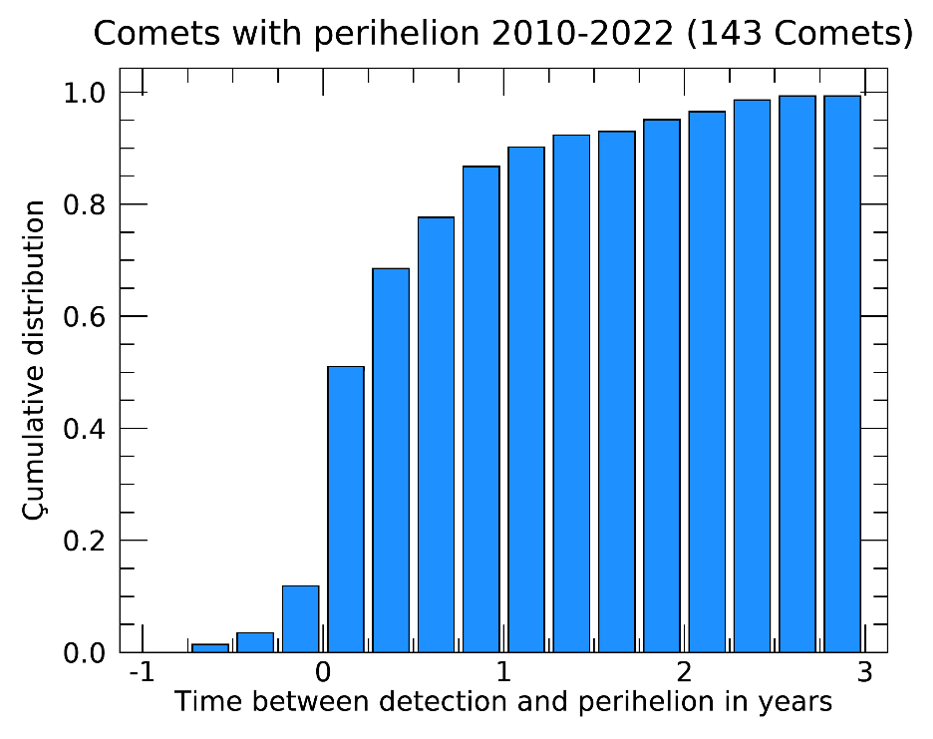

Figure 1: Time between detection and perihelion for comets with a perihelion distance inside 2 AU. Left: Observed comets with perihelion between 2010 and 2022. Right: Simulation of LSST performance (Source of simulation: Comet Interceptor proposal).
Early target discovery with LSST may enable further rapid response missions, like planetary defence missions to small asteroids passing near earth or a Comet Interceptor like mission to an Interstellar Object. Comet Interceptor would be capable of flying by an Interstellar Object, however, the likelihood that a reachable one will be found is low. A similar mission with a larger delta-v capability could be considered to encounter an Interstellar Object, with its target likely being found by LSST.
Hideyo Kawakita, Neil Bowles, Hanna Rotkaehl, Martin Rubin, Nicolas Thomas, Satoshi Kasahara, Naoya Sakatani, Kazuo Yoshioka, Vania Da Deppo, Mihkel Pajusalu, Antti Näsilä, Uli Auster, Vincenzo della Corte, Marina Galand, Pierre Henri, Ayako Matsuoka, Shingo Kameda, Luisa Maria Lara, Sonia Fornasier, Elena Martellato, Colin Snodgrass, Seiji Sugita
How to cite: Küppers, M. and the Comet Interceptor Science Working Team: LSST: Discovering the Target of the Comet Interceptor mission, Europlanet Science Congress 2026, The Hague, The Netherlands, 7–11 Sep 2026, EPSC2026-110, https://doi.org/10.5194/epsc2026-110, 2026.


