
 1,1,2,1,1,1,1,
- 1INAF - IAPS, Rome, Italy
- 2Department of Physics, University of Rome Tor Vergata, Rome, Italy
Introduction
Cryovolcanic eruptions occurring on icy satellites, as observed on Enceladus [1-6] and suspected for Europa [7,8], offer a unique opportunity to study the interior of such objects and the origin of ejected volatiles. On Enceladus, plumes outgas from surface fractures [1], and originate from the salty subsurface ocean [9]. On Europa, a similar activity was observed. Here, we present the Smoothed Particle Hydrodynamics (SPH) [10] to characterize the behavior of volatile emissions, used for Enceladus [11] and applicable to Europa plumes.
Smoothed Particle Hydrodynamics model for volatile emissions
Enceladus plumes. Our SPH model describes the volatile release from a surface fracture on Enceladus [11]. It integrates hydrodynamic equations and provides the evolution of density, velocity, and energy. We consider phase transitions between vapor and icy-grains and their viscous interaction. The thermal interaction with the surface, the solar radiation and radiative equilibrium, the gravitational attraction, and tidal limitations are also considered. We predict the mass loss and the surface ice accumulation which result consistent with literature [3,5].
Europa plumes: setup and modeling challenges. The model is applicable to the suspected cryovolcanism on Europa [7,8]. Here, the emission mechanisms are not constrained by observations [12]. The Jovian plasma environment is important for detection, but a second-order effect for the plume structure as only a small fraction of material is involved in the plasma-plume interaction [12]. The icy shell thickness determines the depth of a potential subsurface liquid interface, where ocean evaporation occurs. In addition, from the perspective of source mechanisms such as liquid pockets or diapirism [12], the extent of the reservoir is highly uncertain. Furthermore, the unknown temporal modulation of plume activity suggests episodic events, with wall deposition as a possible mechanism for fracture sealing [13]. By applying our model, we can characterize the episodic emission by investigating the relationship between the ejected mass and the release timescale. This depends on source and subsurface physical properties, which we can explore to provide predictions useful for interpreting the future observations of Europa Clipper and JUICE missions (Figure 1).

Figure 1. Schematic representation of workflow to investigate ejected mass and release timescale according to source and subsurface conditions.
Preliminary simulation of Europa plumes show a similar behavior of the two-component (vapor-ice) flow as obtained for Enceladus activity, where we considered different icy-grain sizes, a quantity that affects the viscous drag coupling. This process shapes the dynamics within the fracture, yielding a slower flow for larger grains (100 micron) and increasing the release time. Larger grains produce a more collimated icy plume, also affecting a small fraction of the vapor plume. Small grains (1 micron) are initially driven by vapor, where density is higher. This occurs on top of the venting area, where we get a plumper plume (Figure 2).
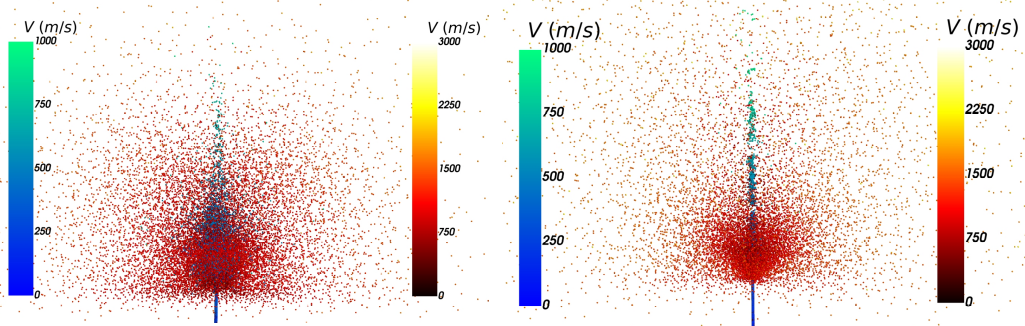
Figure 2. Velocity distribution (grains: blue-green shades; vapor: red-yellow-shades) at t~10 s after emission for 1-micron (left) and 100-micron (right) sized icy grains for Europa plumes simulation. Larger grains show a higher collimation, while small grains present a broader low-velocity distribution above the venting area. Vapor expands in all directions, although for the large grain simulation, it also shows some degree of collimation where ice is present.
To enhance the quality of our model and yield more robust predictions, we are improving the phase transition treatment to better describe the thermal effects of the latent heat of sublimation and to simulate the evaporation process. A definitive numerical solution for latent heat transfer in SPH simulations is still missing. Here we present a numerically stable procedure to the latent heat problem in vapor–ice phase change. We show benchmark tests validating the implementation based on analytical considerations and energy conservation. We also discuss the challenges introduced by simulating the evaporation process, generating new SPH particles.
Conclusions and perspectives
Preliminary results show that our SPH model is applicable to Europa plumes. It offers an advanced tool to investigate the episodic release of volatiles, in particular to characterize the ejected material and the release time relationship, according to source and subsurface properties. To this aim, we are performing preliminary simulations and refining the considered processes to improve the description of the two-phase flow. In the future, we plan to account for the thermal interaction with fracture walls and the sealing of fractures via ice deposition, taking advantage of the SPH formalism and Eulerian models for thermophysical characterization [14]. Finally, our model can be applied to volatile emissions occurring on various objects of the Solar System. These include cometary activity [15], drilling-induced release of volatile-dust mixtures on Mars [16-17] and the evolution of vaporized ejecta resulting from impacts of hydrated objects, with the possible accumulation within Permanently Shadowed Regions on the Moon and Mercury [18].
References
[1] Hansen et al. 2006, Science 311, 1422.
[2] Schmidt et al. 2008, Nature, 451, 685.
[3] Kempf et al. 2010, Icarus, 206, 446-457.
[4] Dong et al. 2011, J. Geophys. Res., 116.
[5] Teolis et al 2017, Astrobiology, 17, 9.
[6] Postberg et al. 2018, Nature, 558, 564.
[7] Roth et al. 2014, Science, 343, 171.
[8] Sparks et al. 2016, ApJ, 829, 121.
[9] Spencer & Nimmo 2013, Annu. Rev. Earth Planet. Sci. 41, 693.
[10] Monaghan 2005, Rep. Prog. Phys. 68, 1703.
[11] Teodori et al. 2026, Icarus, 443, 116765.
[12] Vorburger & Wurz 2021, JGR Space Physics, 126, e2021JA029690.
[13] Boccelli et al. 2025, PSS, 263, 106136.
[14] Formisano et al. 2024, PSS, 251, 105969.
[15] Rinaldi et al. 2025, EPSC-DPS2025-1556.
[16] Maggioni et al. 2025, MNRAS, 543, 3310.
[17] Maggioni et al. 2026, PSS, 272, 106244.
[18] Teodori et al. 2025, EPSC-DPS2025-323.
Acknowledgments
This work has been developed under the “ASI-INAF agreement n. 2023-6-HH.0”, the "ASI-INAF agreement n. 2023-3-HH.0", by ISSI within the project “Thermophysical Characterization of Ice-Rich Areas on the Surface of Specific Planetary Bodies: Conditions for the Formation of a Transient Exosphere” and INAF MiniGrant “PLUMES-Planetary fractures Lagrangian simUlations for Multi-component EmissionS”.
How to cite: Teodori, M., Maggioni, L., Magni, G., Formisano, M., De Sanctis, M. C., Altieri, F., D'Aversa, E., Ciarniello, M., and Piccioni, G.: Investigating Europa plumes with Smoothed Particle Hydrodynamics: preliminary analysis, simulation setup and current challenges, Europlanet Science Congress 2026, The Hague, The Netherlands, 7–11 Sep 2026, EPSC2026-1101, https://doi.org/10.5194/epsc2026-1101, 2026.


