
 1,2,1,1,2,1,3,1,
- 1German Aerospace Center (DLR), Institute of Space Research, Berlin, Germany (carianna.herrera@dlr.de)
- 2Universität Münster, Institut für Mineralogie, Corrensstraße 24, 48149 Münster, Germany
- 3Telespazio UK for ESA, European Space Astronomy Centre (ESAC), Villanueva de la Canada, Madrid, Spain
INTRODUCTION
Venus’ magmatic history remains unconstrained since its geologically young surface causes major uncertainties in the planet’s mantle rheology, volatile content, and long-term cooling history. Recent evidence of ongoing volcanic activity on Venus (Herrick & Hensley, 2023) suggests magmatism still plays a key role, but reconstructing the past to understand why Venus and Earth evolved differently despite their similarities is a key challenge in planetary sciences. Global climate models suggest Venus could have had mild temperatures and liquid water until <1 Ga (Way et al., 2016, 2020), but other studies suggest that a hot surface, possibly hotter than today (Noack et al.,2012), persisted for most of its history (Figure 1). Surface temperature is linked to the magmatic and outgassing history, but the mantle volatile content is unclear. While some studies suggest that Venus’ interior may be intrinsically dry (Constantinou et al., 2024), others propose that volatiles could persist in the lower mantle (Smrekar & Sotin, 2012), affecting mantle dynamics.
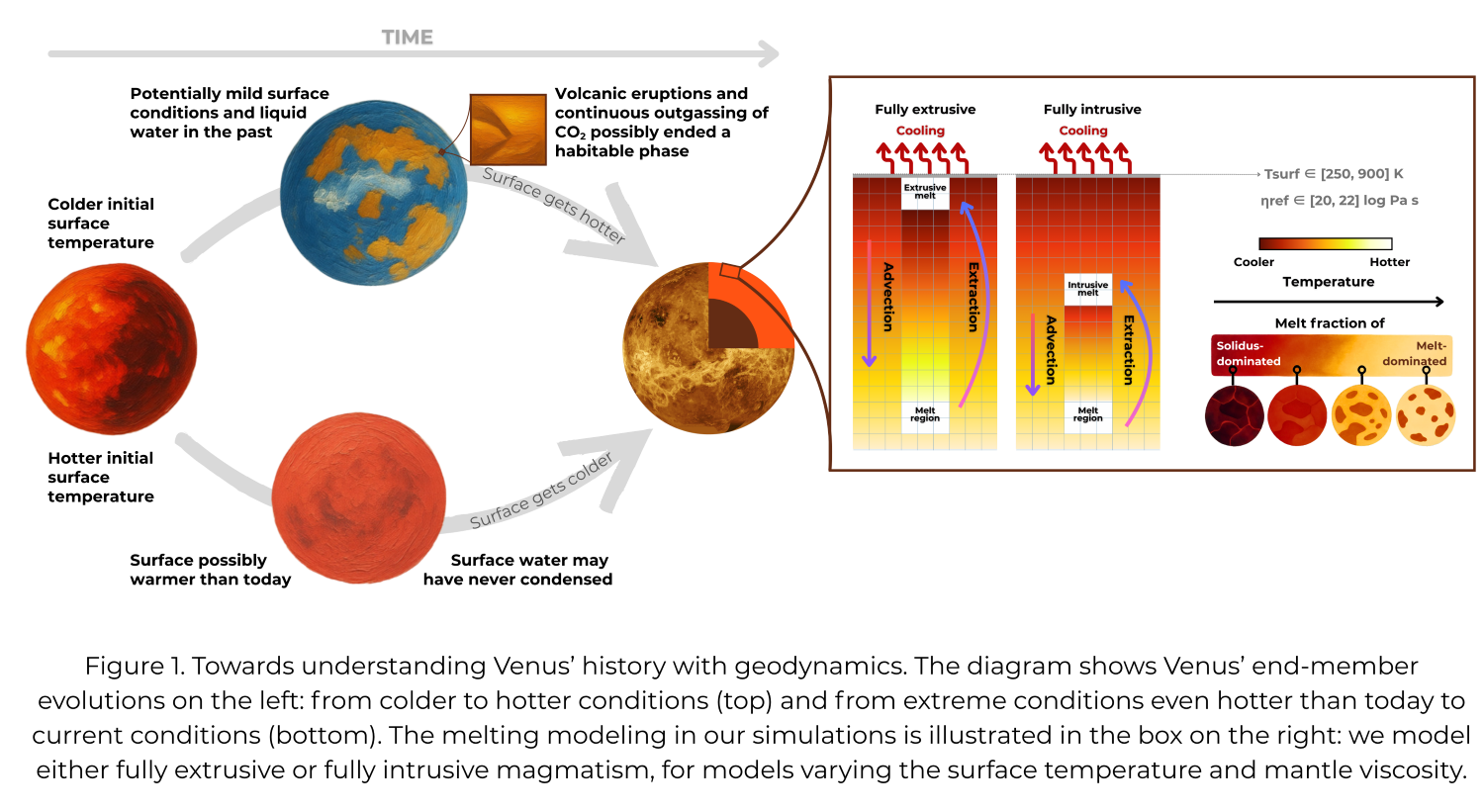
Venus’s geodynamic regime and surface tectonics are poorly constrained. Several scenarios including catastrophic resurfacing, episodic plate tectonics, and stagnant lid regime were proposed. Early geodynamic models considering magmatism mostly assumed eruption-dominated (extrusive) magmatism known as the heat-pipe regime (Moore & Webb, 2013), but more recent studies explored intrusion-dominated (intrusive) magmatism known as the plutonic-squishy regime (Lourenco et al., 2020).
A global perspective of the intrusive-to-extrusive ratio is still unclear. The >85,000 volcanoes (Hans & Byrne, 2023) reflect Venus’ volcanic nature, however, ~740 coronae (Gülcher et al., 2025), features related to plume-mantle interactions, and interpretations from gravity-topography data (Maia et al., 2023) reveal that intrusions also take place. Geodynamic models constrained from observational data point to a highly intrusive magmatism (Herrera et al., 2024; Maia et al., 2025); however, how this could have differed in the past if the planet had different surface and lithospheric conditions is poorly understood. Therefore, we analyze the effect of the end-member magmatic styles (i.e. ‘fully intrusive’ vs. ‘fully extrusive’ magmatism).
We explore the relative roles of these magmatic styles for the planetary evolution under varying surface temperatures and mantle viscosities, aiming to understand how surface and mantle conditions influence the melt production rate and the pressure and temperature conditions at which melts are first generated on Venus.
METHODS
We use the geodynamic code GAIA in 2D spherical annulus geometry (Hüttig et al.,2013; Fleury et al.,2024). We assume a temperature- and depth-dependent viscosity (Hirth & Kohlstedt,2003), pressure- and temperature-dependent thermal conductivity and expansivity (Tosi et al.,2013), radiogenic heat decay (Moroz et al., 1980), core cooling (Steinbach & Yuen, 1994), and melting curves from thermodynamic models (Stixrude et al.,2009; Jennings et al., 2025). Figure 1 illustrates our melting modeling. Melt extraction occurs instantaneously (Condomines et al., 1988). Extrusive melts instantaneously cool to surface temperature while intrusive melts, placed at 30 km depth, cool adiabatically. Magmatic intrusions also evolve according to the rheological critical melt fraction (Arzi, 1978) depending if they are in a solid- or melt-dominated regime, which respectively reduce the viscosity as a function of the melt fraction or increases the thermal conductivity to capture the effect of small-scale convection in the melt.
RESULTS
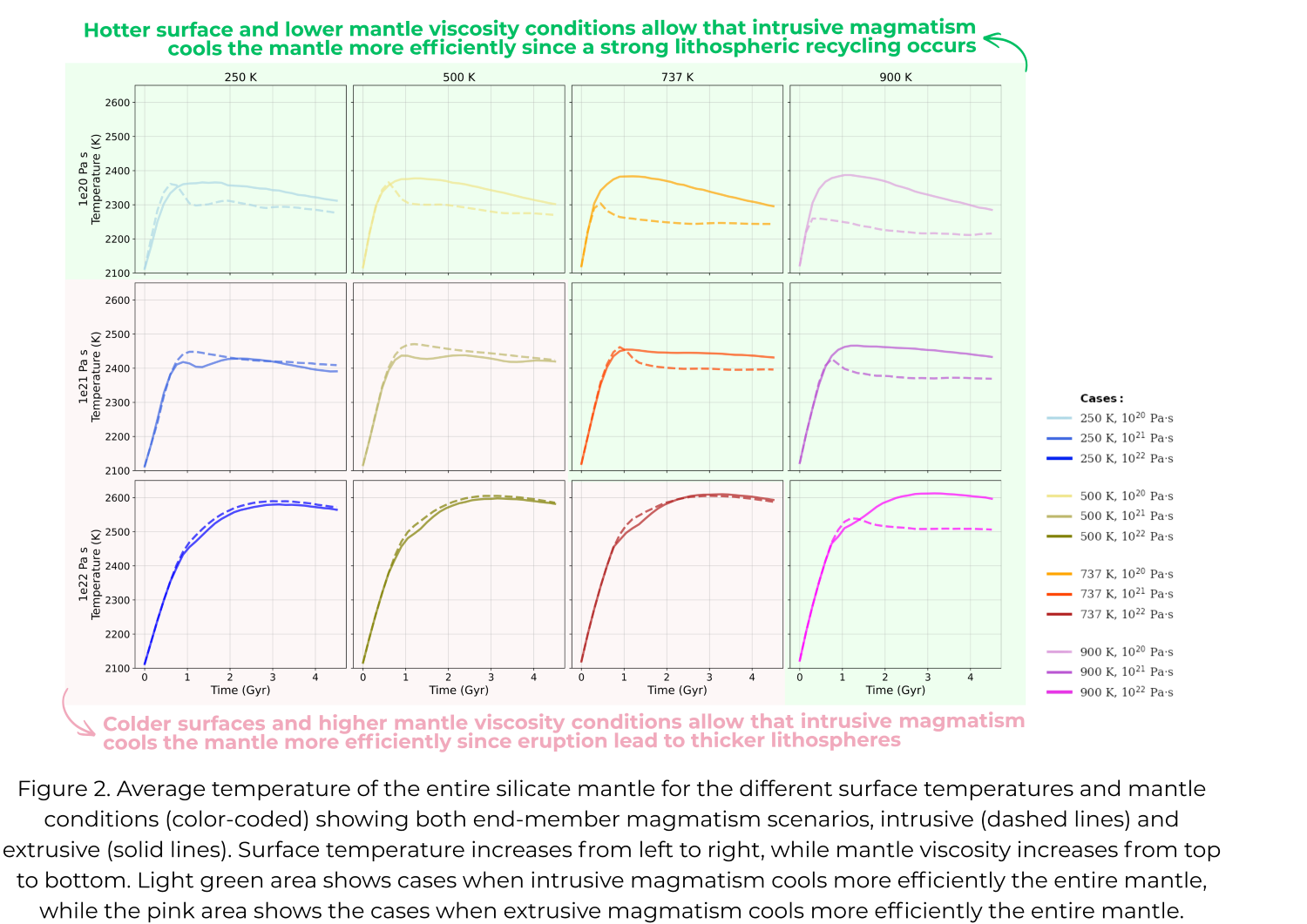
Our results highlight surface-mantle feedbacks as a key control on magmatic and cooling history, which may be reflected in the surface composition as well as shape the inner mantle structure: hot surfaces favor a more efficient mantle cooling if intrusive magmatism dominates, and vice versa; while the mantle viscosity modulates this effect (Figure 2). Intrusive magmatism efficiently cools the mantle when an efficient lithospheric recycling occurs, and such process influences crustal and lithospheric conditions, affects volatile redistribution in the mantle, and boosts melt production that, consequently, increases outgassing and impacts atmospheric composition.
Constraining the surface temperature evolution depends on interior-surface-atmosphere feedback that remains to be studied. As a first-order approximation that allows us to analyze the effects of a surface temperature variation on the magmatism, we impose an abrupt temperature increase until today’s surface temperature (737 K) to mimic a catastrophic event that ended a phase with milder conditions. Similarly, we model the other end-member scenario in which an initially hotter surface temperature decreases until the modern-day temperature is reached. We analyze the implications of such changes in temperature in terms of the melt generation on Venus, and how this affects mantle and lithospheric properties for both magmatic styles.
For all our cases, we compare the depth and temperature of the melt sources with thermodynamical models that explain the surface composition measured by Venera 14 and Vega 2 (Jennings et al., 2026) to study the link between our melt sources and present-day surface compositions, potentially helping to constrain the magmatic evolution on Venus.
SUMMARY
Surface temperature and mantle viscosity are key factors in determining the efficiency of planetary cooling for different magmatic styles (intrusive or extrusive), as well as have a direct influence on when, where, and how much melt is produced in the mantle. Changes in the region (pressure and temperature) of the melt sources through time could be linked to the evolution of melt composition, that could be connected to present-day observations of surface composition. Our findings could provide insights on the differences in the cooling pathways of early Earth vs. Venus, and give perspectives for potential habitability of exo-Venuses.
How to cite: Herrera, C., Plesa, A.-C., Jennings, L. A., Maia, J., Breuer, D., and Klemme, S.: Evolution of melt production and melting region on Venus influenced by surface-mantle feedbacks, Europlanet Science Congress 2026, The Hague, The Netherlands, 6–11 Sep 2026, EPSC2026-1108, https://doi.org/10.5194/epsc2026-1108, 2026.


