
- 1Imperial College London, Royal School of Mines, Department of Earth Science and Engineering, London, United Kingdom of Great Britain – England, Scotland, Wales (alexjsokolowska@gmail.com)
- 2Department of Earth, Environmental and Planetary Sciences, Brown University, Providence, RI, USA
- 3University of New Mexico, Albuquerque, NM, USA
- 4University of Boston, MA, USA
Introduction. New impact craters on Mars, discovered during spacecraft observation, are identified by their extensive "blast zones" of disturbed dust [1]. Distinct albedo features within these blast zones include quasi-spherical halos [2], extensive ejecta rays, and arcuate rays/scimitars [3]. We present a detailed analysis of a new type of feature now termed blast zone (BZ) streaks [4], which differ from the aforementioned. BZ streaks are elongated, unidirectional, and asymmetrical with respect to the crater center. They also have diffuse edges and low albedo compared to the pre-impact surface. Since these features resemble wind streaks formed by wind interaction with topographical obstacles like crater rims [5], we refer to them as "streaks." However, as they are significantly wider and longer relative to the crater rims than typical wind streaks, we hypothesize other formation mechanisms.
In addition to local wind origins, we test other origins related to the projectile, the impacted target, and various shock wave fronts. Our analysis suggests that BZ streaks are likely of impact origin and indicate the direction of impact.
Methods. Image data analysis. We analyzed map-projected RED images of 1,203 new impact sites on Mars [3] from HiRISE [6]. Using JMARS [7] and QGIS [8], we measured the azimuthal orientations of various features and the lengths of the streaks.
Local winds. We extracted annual average wind speeds at impact sites through JMARS map sampling [9] and obtained global circulation model data from the Mars Climate Database [10] for a representative climate scenario.
Proxy for prevalent winds. We identified sites where wind streaks or spire streaks [5], indicating strong wind directions, are near the BZ streaks and measured the angles between them to assess alignment.
Proxy for impact direction. Ejecta asymmetry indicates impact direction [11]. We identified sites where the impact direction could be approximated using ejecta asymmetry and measured the angles between the downrange direction and the streak direction.
Entry & touchdown model. Using the CTH shock physics code for modeling impact and airburst phenomena [12], we simulated a 66-cm diameter meteoroid entering the Martian atmosphere at a 15-degree angle from horizontal. The simulation accounted for meteoroid ablation and surface-atmosphere interactions, excluding crater excavation. We analyzed the geometry and scalar quantities of resulting wind speeds and surface pressures.
Results. Feature identification. Among the 503 craters classified as “single” (indicating an intact projectile) [3], we confirmed BZ streaks at 106 sites (21%). We identified 54 sites (32%) as possible streaks based on diffuse asymmetric albedo features, despite lacking clear elongation. In clusters formed by projectile fragmentation, we found streaks at 76/700 sites (11%). We also noted 20 sites with wind/spire streaks near BZ streaks. Of the 106 single sites with streaks, 36 exhibit asymmetric ejecta, with 16 showing asymmetries allowing us to determine the impact direction within 30deg.
Local winds. No relationship was observed between map-sampled annual average wind speeds and BZ streak lengths, nor between BZ streak length and wind speeds from the Mars Climate Database. Figure 1b shows a lack of alignment between the directions of nearby wind streaks (proxies for prevalent winds) and BZ streaks.
Impact geometry. Lengths of BZ streaks correlate with crater diameter (Figure 2a). The distribution of differences between vectors indicating downrange impact direction and streak direction falls within half a quadrant (Figure 2b). Despite measurement uncertainties (5°-10° for BZ streak azimuth and within 30° for impact direction), the results suggest that BZ streaks predominantly point downrange from the impact direction.
Simulated winds. CTH simulations demonstrated that a vaporized jet from an ablated projectile can couple with the ground and travel over a significant distance. The wind pattern on the surface resembles the BZ streaks (Figure 3). Surface winds reach speeds of several hundred m/s, exceeding the typical wind speeds from the Mars Climate Database(tens of m/s).
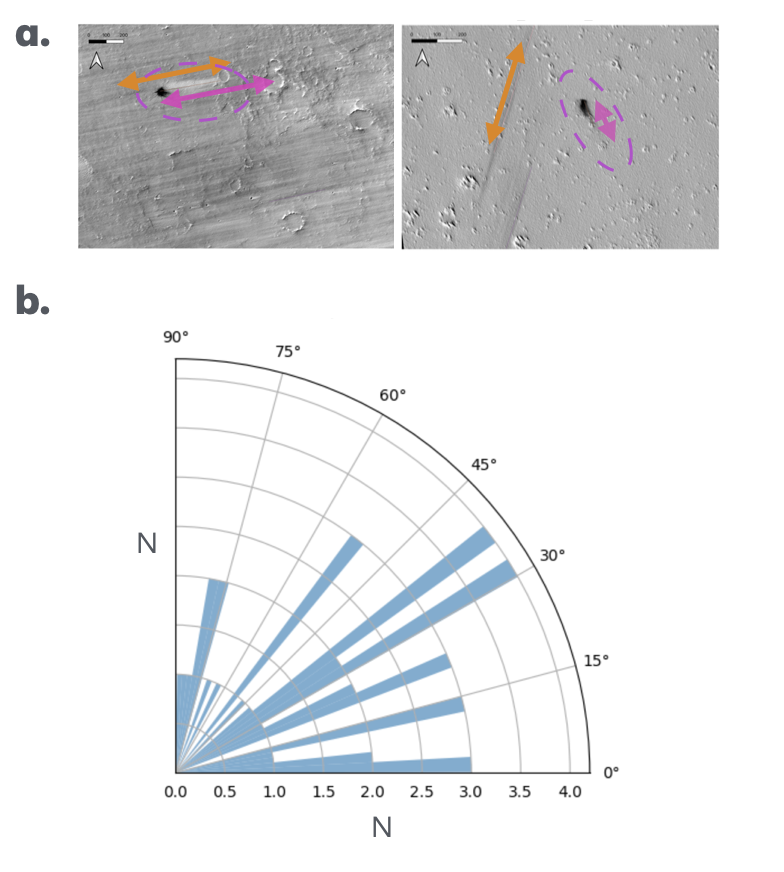
Figure 1.a. Examples of local wind-driven streaks (orange) near BZ streaks (pink,ellipses). Arrows indicate directions.(Image: NASA/JPL/University of Arizona).b.The histogram of minimum angular differences between the directions of these features.
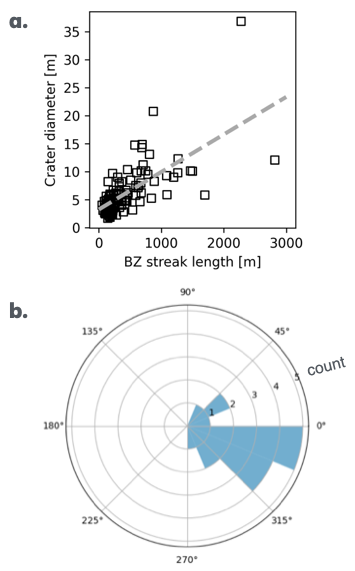
Figure 2.a. Crater diameter and streak length are correlated. b. The histogram of the angular difference between the azimuths of downrange impact direction and BZ streaks.
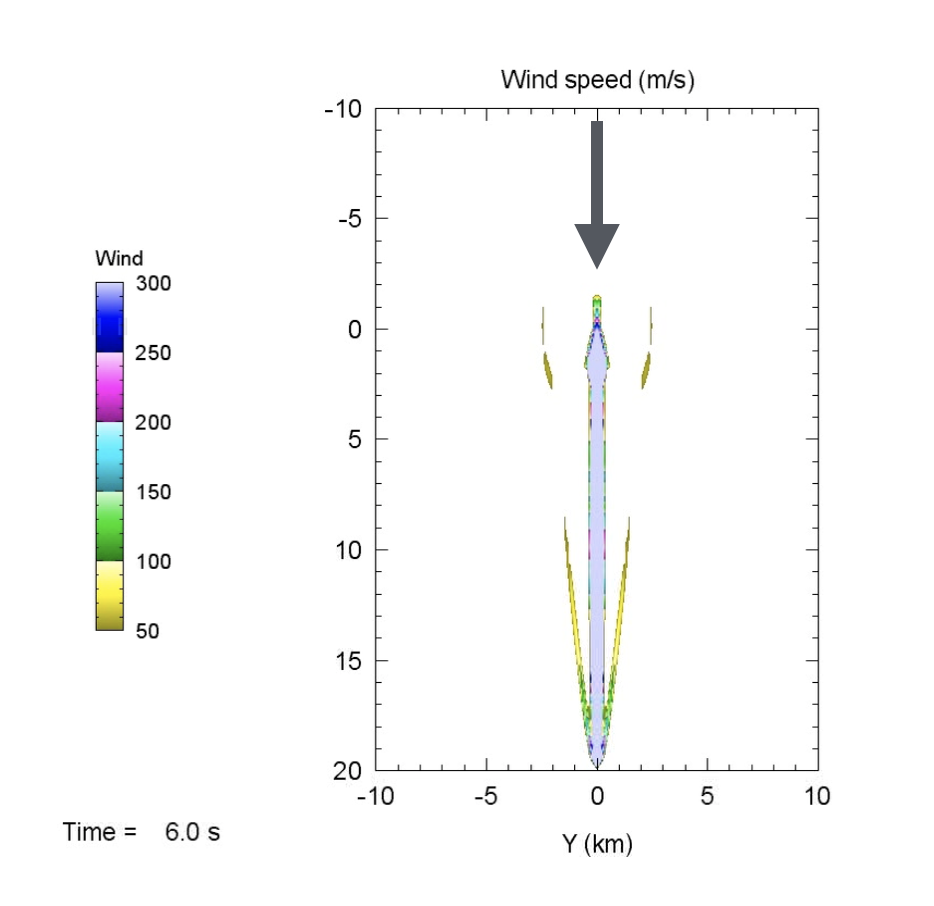
Figure 3. CTH wind speeds at the surface level . The arrow points downrange to the impact point (0,0).
Conclusions.
Local wind theory. We found no relationship between the lengths of BZ streaks and average wind speeds, nor any clear alignment between the line directions of BZ streaks and nearby wind/spire streaks. Our results indicate that local winds are not the primary drivers of the BZ streaks.
Impact / projectile theories. The correlation between crater diameter and the length of the BZ streak implies an impact origin for the BZ streaks. This may be explained by larger impact energies generating stronger winds. Several potential sources of “impact wind” exist, including the quasi-hemispherical blastwave, the uprange wave shock behind the incoming projectile, and bow shock ahead of a projectile / a vaporized jet from a projectile coupling with the ground. However, the shape and proportions of the surface feature (i.e. pointy, narrow and long) along with their downrange direction, are all consistent with the bow shock or vapor jet dynamics. Our simulation also confirmed that winds generated from this origin can be stronger than local winds. Nevertheless, it remains possible that local wind fronts and “impact wind” fronts may interact with one another.
Implications. Our results indicate that the direction of the BZ streaks may offer a novel method for determining the impact trajectory. This approach is particularly valuable in cases where ejecta blankets are relatively axisymmetrical, obscured by other blast zone features, or influenced by topographic obstacles. Our findings also reveal that blast zone streaks are common, occurring at 21-32% sites, and due to their extended nature, BZ streaks play a significant role in enhancing impact detectability.
References: [1]Malin et al.(2006),10.1126/science.1135156 [2]Bart et al.(2014), j.icarus.2019.03.004 [3]Daubar et al.(2022),10.1029/2021JE007145 [4]Gao et al.(2023), 54th LPSC,2806 [5]Cohen-Zada et al.(2016),10.1002/2016JE005242 [6]McEwen et al.(2007),10.1029/2005JE002605 [7]Chistensen et al.(2009), AGUFMIN22,2009,IN22A-06 [8]QGIS.org [9]Adler et al.(2016),47th LPSC,2981 [10] Forget et al.(1999),10.1029/1999JE001025 [11]Schultz (1992),10.1029/92JE01508 [12]McGlaun et al.(1990),10.1016/0734-743X(90)90071-3
Acknowledgements.A.S. is funded by a UKRI Fellowship EP/Z003180/1.
How to cite: Sokolowska, A., Daubar, I., Ramanathan, L., Boslough, M., and Gao, A.: The origin of asymmetric "blast zone streaks" formed by small impacts on Mars, Europlanet Science Congress 2026, The Hague, The Netherlands, 7–11 Sep 2026, EPSC2026-1114, https://doi.org/10.5194/epsc2026-1114, 2026.


