
 1,1,1
1,1,1- 1INAF-Institute for Space Astrophysics and Planetology, Roma, Italy (salvatore.buoninfante@inaf.it)
- 2Institut de Physique du Globe de Paris, Université Paris Cité, CNRS, Paris, France
Introduction
The surface of Mercury is heavily shaped by large impact basins, which have been studied and characterized through the analysis of topographic, morphological, and gravity data (e.g., [1,2,3,4]). However, there is still significant uncertainty on how many impact events occurred during the early phase of the Solar System on Mercury and inner planets. Image products derived after MESSENGER have been widely used to detect impact basins on Mercury and provide a consistent database [2, 3]. Previous work has already shown the presence of peak-ring basins and estimated their size (e.g., [1]), utilising topography and morphological data. Baker et al. [1] also provided a power-law relationship between the peak ring diameter and rim crest diameter for peak-ring basins and protobasins ≥90 km in diameter. More recently, Mercury’s gravity anomalies have been used to update this catalogue [4]. The modelling of gravity and crustal thickness data can be indeed a powerful approach in detecting hidden impact basins and estimating the diameters of their rim and peak rings [5]. Neumann et al. [6] already showed that large basins on the Moon are characterized by central gravitational anomalies, whose size is consistent with the diameter of the peak ring, while the main rim is approximatively twice the diameter of the peak ring. Buoninfante et al. [5] developed a new approach to estimate the peak ring and rim crest sizes for the Moon and Mars, based on the analysis of gravity and crustal thickness data. This approach was used to update the basin catalogue of the Moon and Mars, and is here used to investigate selected impact basins on Mercury in the northern hemisphere, based on the resolution of available gravity data. In this work we show preliminary results on peak-ring size estimates of 15 Mercury’s impact basins larger than 100 km located in the northern hemisphere, while waiting for the BepiColombo data that will be used to extend the work to the southern hemisphere.
Methods
Here we model Bouguer gravity anomalies of Mercury using the MESS160A gravity field model [7] to properly estimate the size of peak rings of selected impact basins in the northern hemisphere (Fig. 1). As first step we quantify a regional background value of the Bouguer gravity anomaly, which is defined as the average value obtained from azimuthally averaged profiles in the spatial range of 3-4 crater radii, and excluding the contributions of any other basins, in the same spatial range, which may affect the final estimates. The size of the Bouguer gravity high is then derived as the radius where the profiles first intersect the regional values (Tab. 1). The uncertainties are derived as the ±1σ values of the regional values considered at the same distances. We performed tests on filtered GRAIL gravity data, consistently with the spatial resolution of Mercury’s gravity field, to understand how the resolution affects the size estimates of certain lunar basins [6]. While for Mars we found that this method can be used to quantify the size of basins with peak ring diameters ≳ 230 km with acceptable accuracy, for Mercury reliable results are provided for peak ring diameters ≳ 70 km when considering the highest gravity resolution.
Conclusions and future work
Preliminary results are provided for selected certain impact basins and for putative or uncertain basins [2, 3, 8] in the northern hemisphere of Mercury, where the current gravity data is characterized by higher resolution. The results corroborate the existence of the investigated certain and putative basins, and provide updated estimates of peak ring sizes for 15 Mercury impact basins.
We will use the presented method to detect potential unknown impact basins on Mercury, provide an updated power-law relationship between the peak-ring and main-rim diameters, and re-evaluate the existing basin databases. We will also assess the existence and number of multi-ring basins on Mercury, together with a structural analysis approach. The approaching ESA-JAXA BepiColombo mission will provide higher-resolution gravity data in the southern hemisphere, leading to significant updates in the estimation of basins size globally. Finally, the updated database will be used to better constrain the impact rate estimates of the early Solar System.
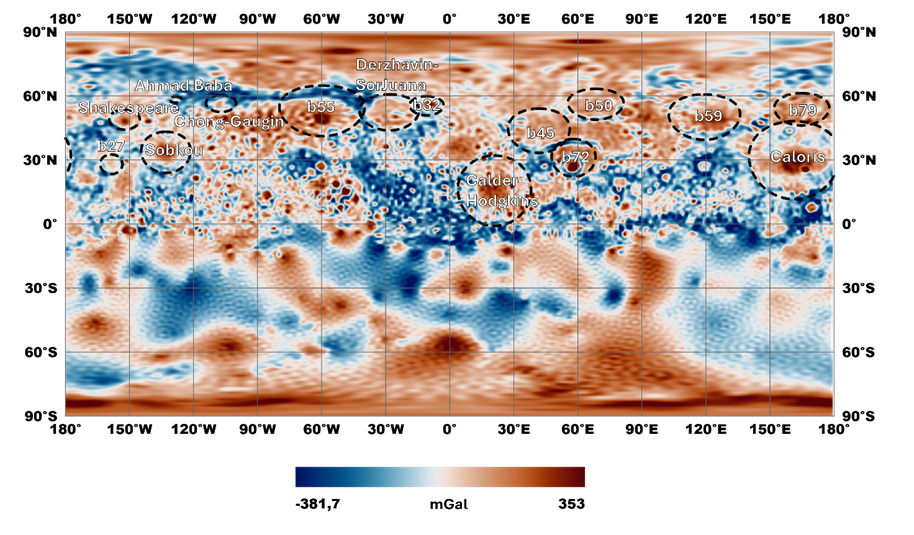
Figure 1. Bouguer gravity anomaly of Mercury and selected impact basins taken from [2,3,8], used in this work and indicated in black dashed lines in the northern hemisphere.
Table 1. Certain and putative impact basins (from [2,3,8]) investigated in this work and respective topographic rim, and Bouguer ring diameters estimated.
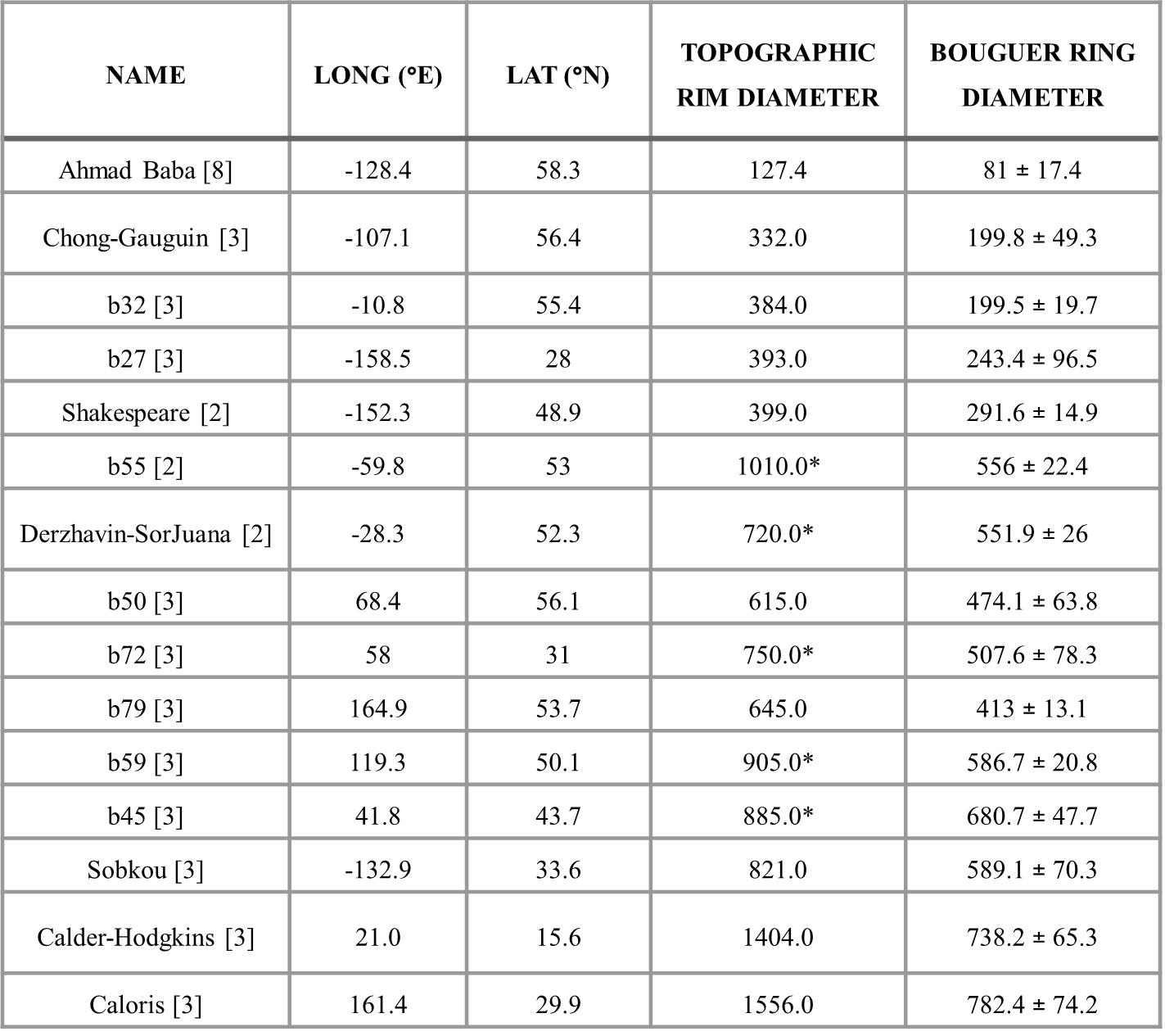
(*): Rim diameters visually taken from USGS DEM.
References
[1] Baker D. M. H. et al. (2011). Planet. Space Sci., 59(15).
[2] Fassett C. I. et al. (2012). JGR: Planets, 117(E12).
[3] Orgel C. et al. (2020). JGR: Planets, 125(8).
[4] Szczech C. C. et al. (2024). Icarus, 422.
[5] Buoninfante S. et al. (2025). EPSC-DPS2025-1563.
[6] Neumann, G. A. et al. (2015). Sci. Adv., 1(9).
[7] Konopliv A. S. et al. (2020). Icarus, 335.
[8] Hall G. P. et al. (2021). JGR: Planets, 126(9).
Acknowledgements
We gratefully acknowledge funding from the Italian Space Agency (ASI) under ASI-INAF agreement 2024-18-HH.0.
How to cite: Buoninfante, S., Wieczorek, M. A., Galluzzi, V., Schmidt, G. W., and Palumbo, P.: Quantifying the size of impact basins on Mercury through gravity data modelling., Europlanet Science Congress 2026, The Hague, The Netherlands, 7–11 Sep 2026, EPSC2026-1117, https://doi.org/10.5194/epsc2026-1117, 2026.


