
 1
1- 1Astrophysics Group, Imperial College London, London, UK
- 2School of Physics and Astronomy, Cardiff University, Cardiff, UK
- 3Jodrell Bank Centre for Astrophysics, University of Manchester, Manchester, UK
We will present summarised findings from our JCMT-Venus project, a long-term disc-integrated monitoring programme using the 15-metre James Clerk Maxwell Telescope (JCMT), a single-dish telescope operating at millimetre and submillimetre wavelengths, to probe the upper mesosphere of Venus at altitudes of approximately 90–110 km. The region probed marks the dynamical transition between superrotation and subsolar-to-antisolar flow, and is also a photochemically active layer central to Venus’ chemical cycles. The variability of key chemical species in this region has been relatively poorly characterised. Existing observations used to probe this region have important limitations: occultation measurements are often restricted to specific Local Solar Time (LST) or latitude ranges, while millimetre and submillimetre observations generally have sparse temporal sampling [1,2].
With the main aim of following up our detection of phosphine (PH3), whose presence implies chemical disequilibrium and is therefore of potential biological interest [3], the project has since expanded into a broader investigation of Venus’ upper mesosphere. The wide spectral bandwidth of the observations provides simultaneous coverage of several important species, including H2O (via HDO), SO2, SO, H2SO4, OCS, and HCO+. To date, four multi-week observing campaigns have been completed, with a fifth approved for July 2026. These campaigns sample complementary LST ranges, covering dayside and nightside and different stages of the solar cycle for comparison. Together, they provide invaluable insights into the simultaneous variability of species that are important for understanding the chemistry and the dynamics of this region. The talk will include three main parts, 1) a study of the daily variability of H2O and SO2, 2) daily constraints on SO, H2SO4, and OCS, and 3) the re-detection of PH3.
The first part of the talk will discuss the variability of H2O and SO2, which are key species in Venus’ photochemical cycles leading to the formation of the global sulphuric acid cloud and haze layers. Their variability in the upper mesosphere is poorly understood, mostly because at least two of the short-term, LST-dependent, spatial, and potential long-term effects were entangled in individual studies. Combining independent observations is also challenging, since even observations made over similar periods can produce very different results, possibly because of differences in instrumentation and data reduction [1,4]. We apply a consistent reduction method to all campaigns, with particular attention to standing-wave removal, a common issue in Venus mm/submm spectroscopy. We have four main findings. First, SO2 exhibits long-term variability (Fig. 1) and appears to follow the long-term cycle observed near the cloud-top altitude [5], further constraining any upper-mesospheric SO2 reservoir to be linked to the supply of SO2-related species from below. Second, H2O also exhibits long-term variability in the form of an anti-correlated response to the long-term change in SO2, likely because higher SO2 abundance consumes more H2O through H2SO4 formation (Fig. 1). Third, in the absence of long-term effects, SO2 shows a clear LST-dependent trend that can be reproduced using an independent model (Fig. 2) [6]. Finally, H2O variability is broadly consistent with the noise level over each campaign, although individual excursions are present in the form of sudden depletion events.
The second part will report results for other major sulphur-bearing species, including SO, OCS, and H2SO4. These species are investigated in temporal parallel with the daily variations of H2O and SO2, providing benchmark data for photochemical models and constraining existing models of the SO2 inversion profile [7,8]. The third part will discuss the new PH3 detection and its robustness.
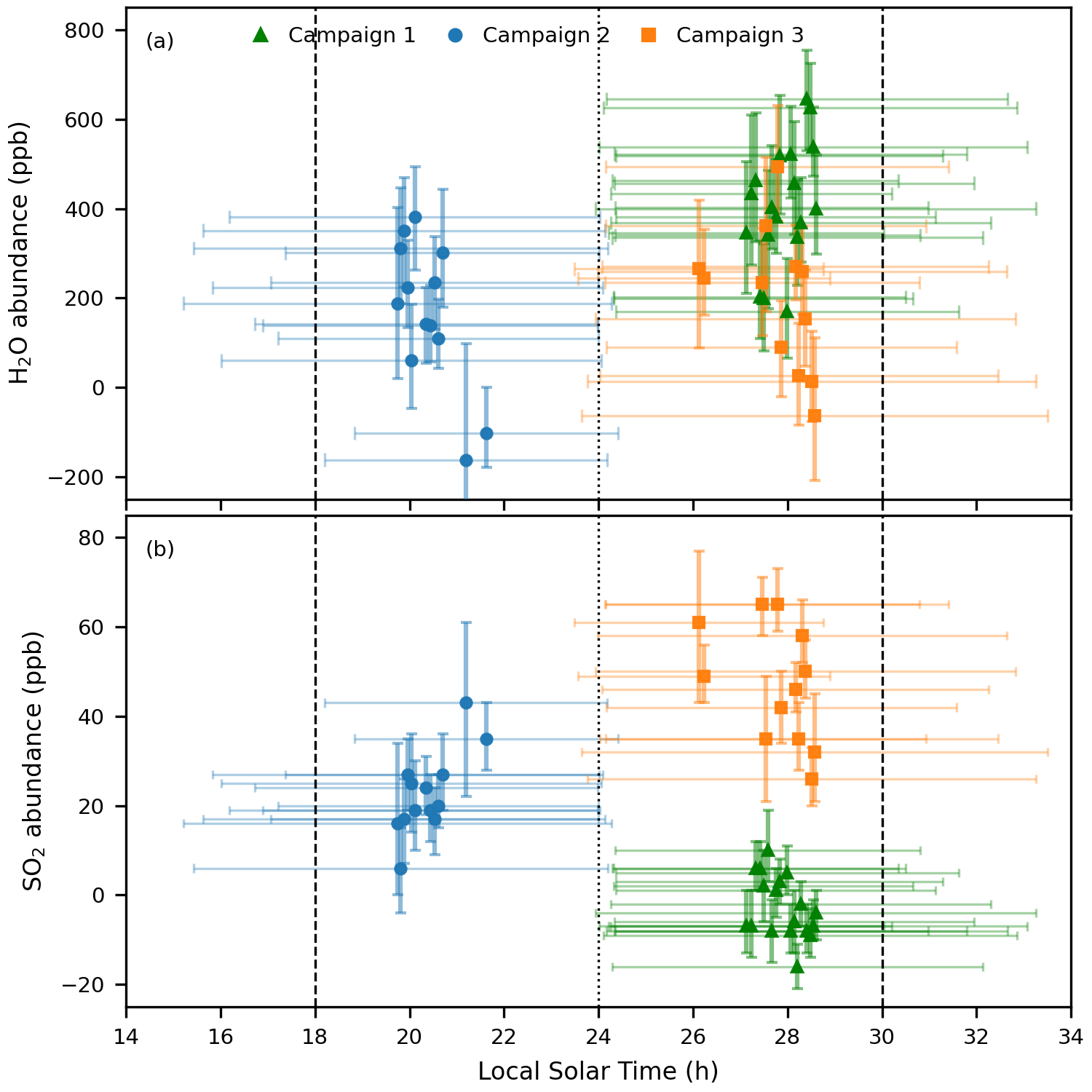
Figure 1: Disc-integrated SO2 and H2O abundances as a function of sampled LST for the first three campaigns in February 2022, July 2023, and August-September 2023. SO2 is broadly absent in Campaign 1 but detected in Campaigns 2 and 3, indicating long-term variability. H2O is largely stable between Campaigns 2 and 3, but is higher in Campaign 1, likewise indicating a long-term effect.
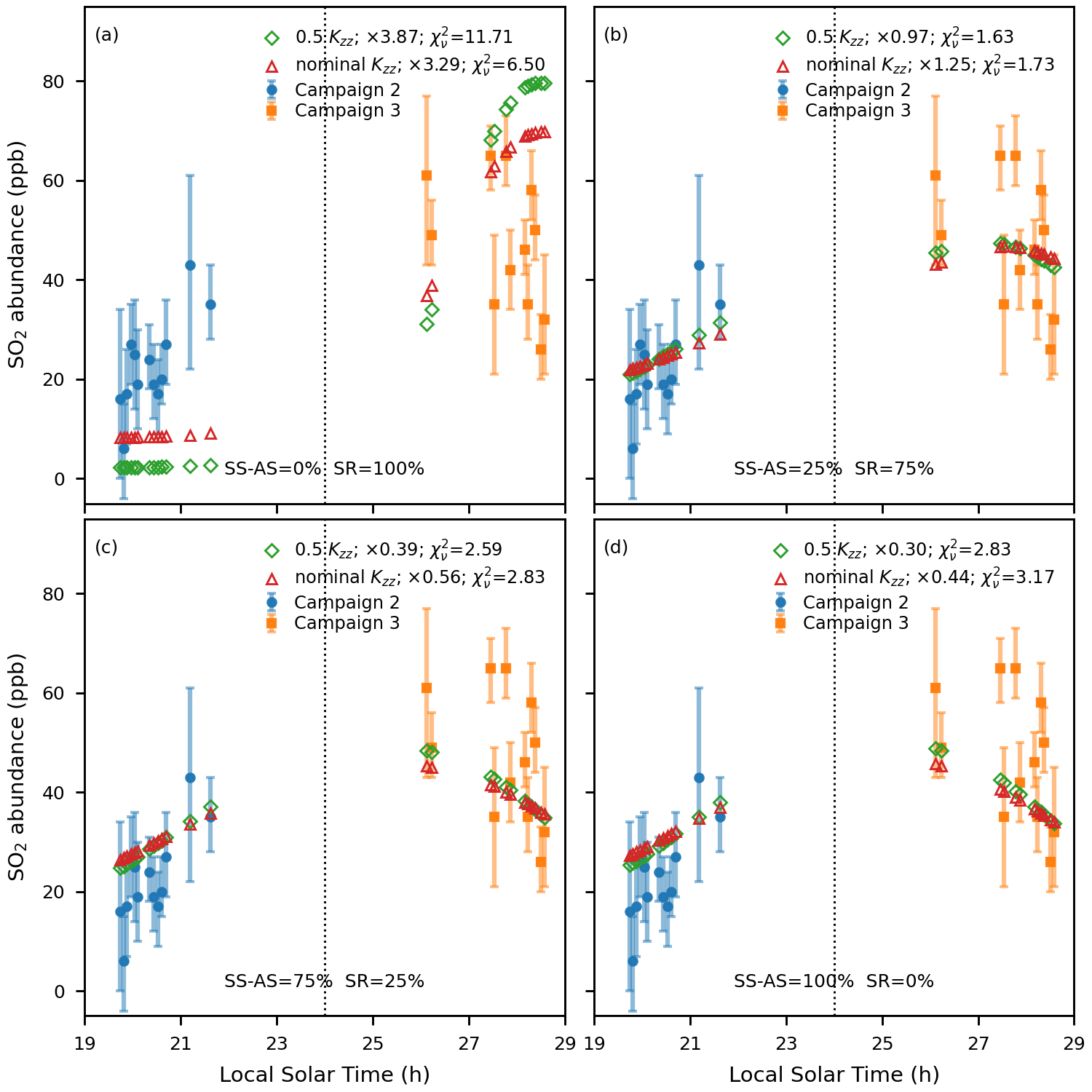
Figure 2: Daily SO2 abundances as a function of LST in Campaigns 2 and 3, compared with independent LST model predictions for different Kzz values and dynamical-component weightings [6]. The best agreement is obtained for a mixed dynamical case with 75% superrotation and a 25% subsolar-to-antisolar contribution, suggesting that, in the absence of long-term effects, SO2 variability in Venus’ upper mesosphere is primarily LST-dependent.
References:
[1] Sandor B. J. & Clancy R. T., 2005, Icarus, 177, 129.
[2] Chamberlain S. et al., 2020, Icarus, 346, 113819.
[3] Greaves J. S. et al., 2021, Nature Astronomy, 5, 655.
[4] Gurwell M. A., Melnick G. J., Tolls V., Bergin E. A. & Patten B. M., 2007, Icarus, 188, 288.
[5] Encrenaz T. et al., 2025, A&A, 703, A219.
[6] Shao W. D., Zhang X., Mendonça J. & Encrenaz T., 2022, The Planetary Science Journal, 3, 3.
[7] Zhang X. et al., 2010, Nature Geoscience, 3, 834.
[8] Zhang X. et al., 2012, Icarus, 217, 714.
How to cite: Tang, W., Clements, D., Greaves, J., Richards, A. M. S., and Peel, M.: JCMT-Venus: Long-term Monitoring of Chemical Variability in Venus' Upper Mesosphere, Europlanet Science Congress 2026, The Hague, The Netherlands, 7–11 Sep 2026, EPSC2026-1119, https://doi.org/10.5194/epsc2026-1119, 2026.


