
 ,,,
,,,- IBeA Research Group, Department of Analytical Chemistry, Faculty of Science and Technology, University of the Basque Country (UPV/EHU). Barrio Sarriena s/n, 48940, Leioa, Spain (leire.coloma@ehu.eus)
Several approaches are currently available for investigating the composition of Mars and the Moon, including in situ analyses performed by rovers and landers, orbital observations, and laboratory investigations of meteorites collected on Earth. In the case of Mars, missions such as the Perseverance rover from the Mars 2020 mission [1] and the future Rosalind Franklin rover from the ExoMars mission [2] provide in situ geochemical and mineralogical analyses, while orbital studies are carried out by spacecraft such as the Mars Reconnaissance Orbiter [3]. Similarly, the Moon is being investigated through surface missions involving rovers such as the Yutu-2 [4], and the Pragyan rovers [5], together with orbital measurements acquired by missions including the Lunar Reconnaissance Orbiter [6]. Complementary information about these planetary bodies can also be obtained through the analysis of Martian and Lunar meteorites recovered on Earth. Their study also helps to better understand the limitations and constraints associated with different analytical techniques when applied to such complex and heterogeneous materials.
Meteorite samples are commonly prepared as polished subsamples suitable for non-destructive spectroscopic analyses. However, different preparation and preservation procedures can be applied, ranging from polished standalone pieces to subsamples embedded in resin blocks for improved mechanical stability and long-term preservation [7]. In this work, Martian and Lunar meteorites (LAR 12011, MIL 090036, MIL 05035 and EET 79001) prepared following these different methodologies were analyzed using micro-Raman spectroscopy, near-infrared (NIR) imaging, and micro-Energy Dispersive X-ray fluorescence (µED-XRF) in order to evaluate the influence of sample preparation on the measurements obtained with each analytical technique and to study and understand the limitations of these techniques.
Particular attention was given to mapping modalities that allow the acquisition of hyperspectral data cubes. The role of spatial resolution, one of the most critical parameters in the spectroscopic characterization of heterogeneous planetary materials, was investigated. In fact, depending on the selected spatial resolution, the analyses may either provide information representative of the bulk matrix composition or enable the identification of minor mineral phases and mesostasis components present in lower abundances within the meteorites. To gain a clearer understanding of how spatial resolution affects each analytical technique additional experiments were conducted on a reference matrix of a terrestrial igneous analogue with chemical alterations with a similar composition than the studied meteorites. An example of Raman images obtained with different spatial resolution can be seen in Figure 1.
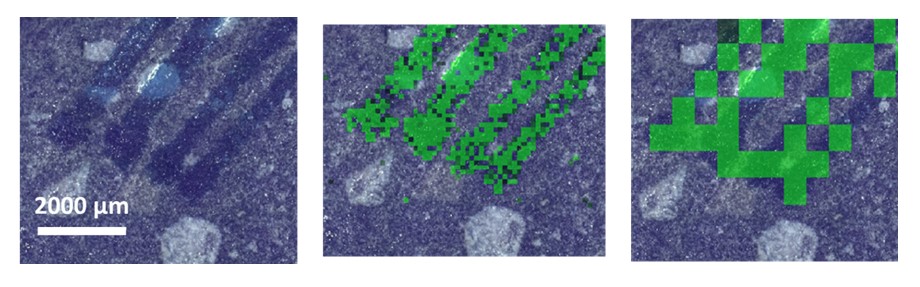
Figure 1. Raman images in the terrestrial analogue with different spatial resolution parameters. The central image was obtained using a step size of 105 µm, whereas the image on the right was acquired with a step size of 600 µm.
The results highlight the importance of optimizing the spatial resolution according to the analytical objective and of combining complementary spectroscopic techniques to achieve a representative and comprehensive characterization of the heterogeneous mineralogical and chemical composition of Martian and Lunar meteorites, as each method provides distinct information on the samples. Guidelines are also provided to help avoid misinterpretation of observed features and ensure consistency between measured signals and actual sample characteristics.
Acknowledgements
Meteorites were provided by the US Antarctic Meteorite Program, through the loan agreement between NASA’s JSC and the UPV/EHU. This work has been supported through the PAMMAT project “Alteration processes in Mars and Moon meteorites, and Terrestrial Analogues at different environments: Mars2020, Rosalind Franklin and Returned Samples from Mars and Moon” (Grant No. PID2022-142750OB-I00), funded by the Spanish Agency for Research MCIN/AEI/10.13039/501100011033/FEDER-UE, and the Strategic Project “Study of Alteration Processes in Terrestrial and Planetary Materials” (Grant No. UPV/EHU PES 21/88).
References
[1] T. Fouchet, J.-M. Reess, et al., The SuperCam infrared spectrometer for the Perseverance rover of the Mars 2020 mission, Icarus 373 (2021) 114773. https://doi.org/10.1016/j.icarus.2021.114773.
[2] J.L. Vago, F. Westall, et al., Habitability on Early Mars and the search for biosignatures with the ExoMars rover, Astrobiology 17 (2017) 6-7. https://doi.org/10.1089/ast.2016.1533.
[3] R.W. Zurek, S.E. Smrekar, An overview of the Mars Reconnaissance Orbiter (MRO) science mission, J. Gephys. Res. Planets 112 (2007). https://doi.org/10.1029/2006JE002701.
[4] C. Li, D. Liu, et al., Chang’E-4 initial spectroscopic identification of lunar far-side mantle-derived materials, Nature 569 (2019) 378-382. https://doi.org/10.1038/s41586-019-1189-0.
[5] S.V. Vadawale, N.P.S. Mithun, et al., Chandrayaan-3 APXS elemental abundance measurements at lunar high latitude, Nature 633 (2024) 327-331. https://doi.org/10.1038/s41586-024-07870-7.
[6] R. Vondrak, J. Keller, G. Chin, J. Garvin, Lunar Reconnaissance Orbiter (LRO): Observations for Lunar Exploration and Science, Space Sci. Rev. 150 (2010) 7-22. https://doi.org/10.1007/s11214-010-9631-5.
[7] R. Harrington, K. Righter, Polished sample preparation without epoxy, 50th Lunar and Planetary Science Conference (2019) 2132.
How to cite: Coloma, L., Gorla, G., Sánchez-Goyenaga, M., Alberquilla, F., Aramendia, J., Arana, G., and Madariaga, J. M.: Challenges in Achieving Representative Multispectroscopic Analyses of Martian and Lunar Meteorites: Effects of Sample Preparation, Heterogeneity, and Spatial and Spectral Resolution, Europlanet Science Congress 2026, The Hague, The Netherlands, 7–11 Sep 2026, EPSC2026-1121, https://doi.org/10.5194/epsc2026-1121, 2026.


