
 1,2,1,2,1,2,2,
- 1Freie Universität Berlin, Institute of Geological Sciences, Department of Earth Sciences, Berlin, Germany
- 2Institute of Space Research, German Aerospace Center (DLR), Rutherfordstrasse 2, 12489 Berlin, Germany
- 3German Aerospace Center (DLR), Markgrafenstrasse 37, 10117 Berlin, Germany
Introduction
Despite similarities between Earth and Venus in size and bulk composition, Venus is currently one of the most enigmatic planets in the Solar System, with its surface shrouded by a dense CO2-rich atmosphere. Obtaining data from Venus’ lower atmosphere below the planetary boundary layer (PBL) has been a challenge. In the coming decade, several missions to Venus are planned (e.g. [1]) that aim to image Venus nightside thermal emission in the NIR spectral windows [2] from orbit and in addition to future descent probes (e.g. [3]) that will measure lower atmospheric properties including species abundance, temperature, pressure, and wind speed. Until such data becomes available in the next decade, we have to rely on Atmosphere Radiative Transfer Modelling (ARTM) and existing measurements to expand our understanding and prepare for future data processing.
Venus’ high pressure and temperature conditions require us to consider absorption line broadening effects. Since these effects are poorly understood for such environments, they are usually accounted for by implementing a modified molecular absorption line profile (CO2 and H2O). An additional continuum opacity is often required to match observations (NIR ARTM) which we assume is due to collision induced bands and far wing contributions of allowed CO2 transitions, seemingly varying with square of number density (e.g., [4-8]). Calculation of such a term depends on the temperature – pressure relationship used in the ARTM. The temperature structure of the lower atmosphere is contested – the failure of thermal sensors on Pioneer Venus probes resulted in no details of the PBL making their way to the Venus International Reference Atmosphere (VIRA [9]) which is widely used in the community as a standard temperature- pressure profile. Contrary to this, the VeGa-2 [10] descent probe’s higher resolved observations are often considered impractical as they point to a temperature lapse rate exceeding the adiabatic lapse rate. However, Lebonnois and Schubert (2017) have shown that such a structure is plausible through a vertical gradient of N2, resulting in an almost pure CO2 atmosphere close to the surface [11].
In this work we apply our ARTM to different temperature-pressure profiles (VIRA and VeGa-2) and study their effect on the of continuum opacity required to match the model with data from Venus Express.
SPICAV dataset from Venus Express:
The Spectroscopy for the Investigation of the Characteristics of the Atmosphere of Venus (SPICAV) suite on board Venus Express (VEX) made spectrally relatively high-resolution observations of Venus’ nightside in the spectral range of 0.65–1.7 µm. The synthetic radiance generated by our ARTM is compared to SPICAV IR night-side observations on VEX orbit 34 [12] and additional processing by [13].
Radiative Transfer Model
Our ARTM is a combination of several open-source tools – Helios-k [14] to compute line by line absorption cross sections ofCO2 using HITEMP 2025 [15] with a sub-Lorentzian line shape identical to [16], the HITEMP 2010 database for H2O with a super-Lorentzian lineshape, Python for Computational ATmospheric Spectroscopy (Py4CATS) [17] to calculate Rayleigh contributions according to [18], and DISORT [19] implementation [20] to solve the radiative transfer equation. Our cloud model follows that detailed in [21]. Continuum coefficients are free parameters and are adjusted until modeled radiance matches that of the SPICAV observation.
Preliminary results
The figure below shows modeled Venus’ night-side radiances for near nadir geometry using VIRA and VeGa-2 temperature profiles. The continuum opacities have been fitted at each spectral window (consistent with future spectrometers observing in NIR) and the particle density of the lowest cloud layer [21] has been scaled by a suitable factor in order to reproduce radiances found in the SPICAV IR dataset. The assumed emissivity is consistent with that of a basalt sample measured in the laboratory [22].
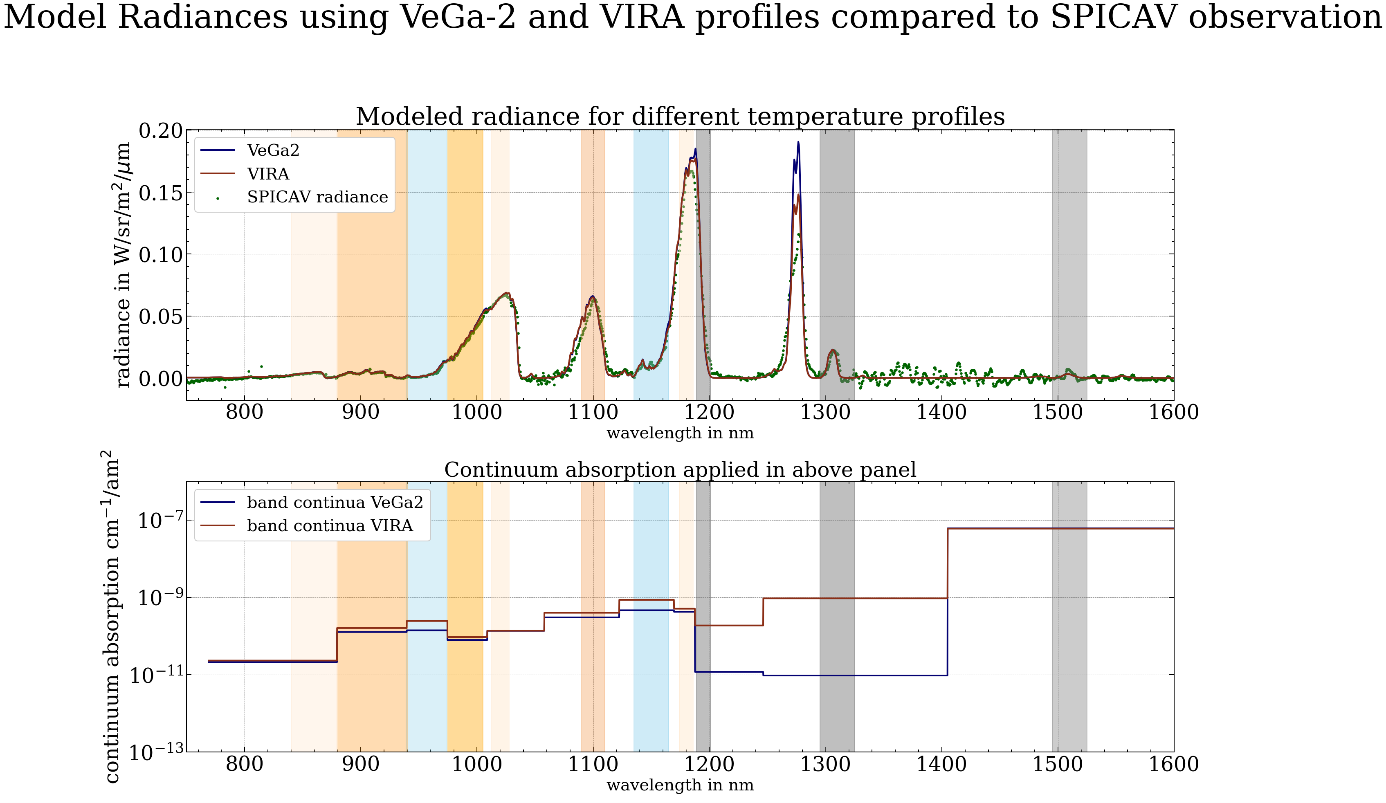
Figure 1: Venus’ night-side NIR radiances produced by our ARTM compared with SPICAV radiances for VIRA and VeGa-2 temperature profiles, assuming isoprofiles of gas abundances. Shaded ranges indicate wavelengths corresponding to planned future observations.
Our current ARTM produces a good fit to the SPICAV spectrum for both assumptions of temperature structures. We note that the continuum opacity required to fit the model is significantly lowerin the VeGa-2 case (notice the logarithmic representation in Fig. 1). As part of this work, we aim to implement varying CO2 abundances as hypothesized by [11] and investigate the continuum coefficient necessary to fit the data.
The order of magnitude difference in derived continuum at 1.31 µm between the VIRA and VeGa-2 profiles suggests that it would be possible to confirm the existence of a VeGa-2 like lapse rate globally with instruments on the Venus missions in development, if both the surface emissivity and the CO2 opacity were constrained with sufficient accuracy.
Bibliography
[1] Smrekar S. + (2022) IEEE Aerospace Conference (AERO) pp. 1-20
[2] Allen D. A. + (1984) Nature, 307, 222–224
[3] Garvin J. B. + (2022) PSJ, 3(5), 117
[4] Pollack J. B. + (1993) Icarus, 103, 1–42
[5] Bézard B. + (2011) Icarus, 216(1), 173–83
[6] Arney G. + (2014) Journal of Geophys. Res.: Planets, 119 (8), 1860-1891
[7] Fedorova A. + (2014) Planetary and Space Science, 113-115, 66-77
[8] Mueller N. T. + (2020) Icarus, 335, 113400
[9] Seiff A. + (1985) Advances in Space Research, 5(11):3–58
[10] Seiff A. + (1987) Advances in Space Research, 7(12), 323–328
[11] Lebonnois S. and Schubert, G. (2017) Nature Geoscience, 10(7):473–477
[12] Korablev O. + (2006) J. Geophys. Res. 111(E9)
[13] Kappel D. + (2016) EGU General Assembly Vol. 18, EGU2016-7578-1
[14] Grimm J. S. and Heng, K. (2015) ApJ 808 182
[15] Hargreaves R. J + (2025) J. Quant. Spectrosc. Radiat. Transfer 333
[16] Bezard B. + (2009) Journal of Geophysical Research 114
[17] Schreier F. + (2019) Atmosphere, 10(5), 262
[18] Sneep M. & Ubachs W. (2005) Journal of Quantitative Spectroscopy and Radiative Transfer, 92(3), 293–310
[19] Stamnes K.+ (1988) Applied Optics, 27(12), 2502-2509
[20] Buras R. + (2011) Journal of Quantitative Spectroscopy & Radiative Transfer, 112(12), 2028–2034
[21] Haus R. + (2013) Planetary and Space Science, 89, 77-101
[22] Helbert, J. + (2021). Science Advances, 7(3).
How to cite: Das, A., Müller, N., Kappel, D., Rauer, H., Plesa, A.-C., Alemanno, G., and Grenfell, J. L.: Impact of Venus lower atmosphere temperature profile on derived atmospheric continuum in the near infrared, Europlanet Science Congress 2026, The Hague, The Netherlands, 7–11 Sep 2026, EPSC2026-1124, https://doi.org/10.5194/epsc2026-1124, 2026.


