
 1,1,2,
- 1Agricultural University of Athens, Department of Natural Resources Management & Agricultural Engineering, Athens, Greece (ibaziotis@aua.gr)
- 2Natural History Museum Abu Dhabi, Abu Dhabi, United Arab Emirates
- 3Westfälische Wilhelms-Universität Münster, Institut für Mineralogie, Correnstrasse 24, 48149 Münster, Germany
- 4Division of Geological and Planetary Sciences, California Institute of Technology, Pasadena, California, USA
Introduction
The L type ordinary chondrites preserve a complex record of impact processing. Preservation of High pressure (HP) minerals is not controlled solely by peak shock pressure, but also by the post-shock pressure–temperature–time (P–T–t) evolution during decompression and cooling [1]. To evaluate the factors controlling HP phase preservation and understand why HP phases are so common in L-chondrites, we studied three meteorites with contrasting shock records: Northwest Africa (NWA) 4137 (L6), Homestead (L5), and Kunashak (L6).
Materials and Methods
We investigated one polished thin section of each meteorite. The Kunashak and Homestead samples were provided by the Natural History Museum Vienna (NHMW). Optical microscopy, SEM, EPMA, and Raman spectroscopy were used to fully characterize the melt veins (MVs).
Results
All meteorites preserve shock-related features including irregular and planar fractures, undulatory extinction, mosaicism, and MVs, indicating heterogeneous shock conditions ranging from S2 to S4. NWA 4137 (Figure 1) is characterized by a coarse-grained groundmass crosscut by a network of MVs, including a prominent MV (MV1) up to ~300 μm wide and a few thinner MVs up to 100 μm wide. The groundmass consists mainly of olivine (Fo69–74), orthopyroxene (En73–76Fs21–25Wo1–4), clinopyroxene, plagioclase, Fe-Ni metal, troilite, chromite, and phosphates. Using EPMA and Raman spectroscopy, we identified within MV1 the HP phases wadsleyite, majorite, albitic jadeite, tuite, and xieite.
Irregular wadsleyite up to ~20 μm in size show characteristic Raman peaks near ~722 and ~918 cm–1 (Figure 2). Majorite, confirmed by the characteristic ~927 cm–1 peak (Figure 3), occurs as isolated euhedral crystals and as equigranular clusters with ~120° triple junctions within the MV groundmass, suggesting crystallization from melt. Majorite composition yields a ~23 GPa pressure estimate [2], consistent with experimentally produced majorite in the range of 17–23 GPa. Irregular albitic jadeite up to ~50 μm across show the characteristic jadeite-family Raman peak at ~700 cm–1 (Figure 4) but have a composition by EPMA rich in vacancies, (Na0.61-0.64Ca0.08K0.02-0.05□0.25)M2(Al0.76-0.83Si0.12-0.17Fe0.02-0.08Mg0-0.15)M1Si2O6. Tuite and xieite were identified within MV1 through their characteristic Raman spectra: tuite has peaks at ~412, ~578, and 975 cm–1 (Figure 5), while xieite has a peak at ~607 cm–1 (Figure 6). Collectively, the observed HP assemblage defines shock pressures of approximately ~11–23 GPa.
In contrast, Homestead and Kunashak preserve abundant MVs and shock features, but no HP polymorphs. Homestead contains a complex MV network dominated by Fe-Ni metal and sulfides, with silicate minerals occurring as isolated grains or lithic clasts within the MVs. Kunashak hosts thick MVs up to ~900 μm wide composed of quenched silicate melt with olivine, pyroxene, plagioclase, Fe-Ni metal grains, and troilite droplets.
Discussion
The contrasting mineralogical records, despite similar shock stage and likely similar peak conditions, indicate that preservation of HP phases was controlled primarily by post-shock thermal evolution. In NWA 4137, the coexistence of majorite, wadsleyite, xieite, tuite, and albitic jadeite indicates crystallization under transient HP conditions followed by rapid quenching during decompression [3-5]. Experimental studies and thermal models demonstrate that MV cooling rates strongly depend on vein thickness, with thinner veins cooling on millisecond timescales. The ~100–300 μm wide MVs in NWA 4137 cooled rapidly enough to preserve metastable HP assemblages before complete pressure release [1, 6].
Conversely, the absence of HP phases in Homestead and Kunashak suggests decompression during a prolonged period at elevated post-shock temperature. Homestead preserves extensive metal–sulfide melting and pervasive thermal overprinting, indicating elevated post-shock temperatures and slow cooling. Such a path favors back-transformation of HP phases into low-pressure equivalents. Similar processes likely affected Kunashak, where shock deformation and MV formation occurred but thermal conditions during decompression inhibited preservation of HP minerals.
Conclusions
HP phases in the studied meteorites record local P–T–t paths within impact-related MVs. MVs are capable of recording extreme pressure conditions but may later be erased during thermal overprinting. Therefore, the absence of HP phases in shocked ordinary chondrites should not be interpreted as evidence of lower shock pressures. Instead, preservation depends strongly on the thermal trajectory during pressure release and cooling. The contrasting records preserved in NWA 4137, Homestead, and Kunashak confirm that impact processing within the L-chondrite parent body was highly heterogeneous with respect to shock duration, melt generation, and cooling history.
References
[1] Hu, J., Sharp, T. G. (2022). Prog. Earth Planet. Science, 9(1), 6.
[2] Collerson K. D. et al. (2010). GCA, 74: 5939–5957.
[3] Baziotis I., et al. (2025). Am. Mineral., 110(9):1472-1480.
[4] Tomioka N., et al. (2016). Science Adv. 2: E1501725.
[5] Chen M., et al. (2008). Chinese Sci. Bull. 53:3341–3345.
[6] Baziotis, I., et al. (2018). Scientific Reports, 8(1):9851.
[7] Rauch, M., et al. (1996). Am. Mineral.:81(9–10):1289–1292
Figures
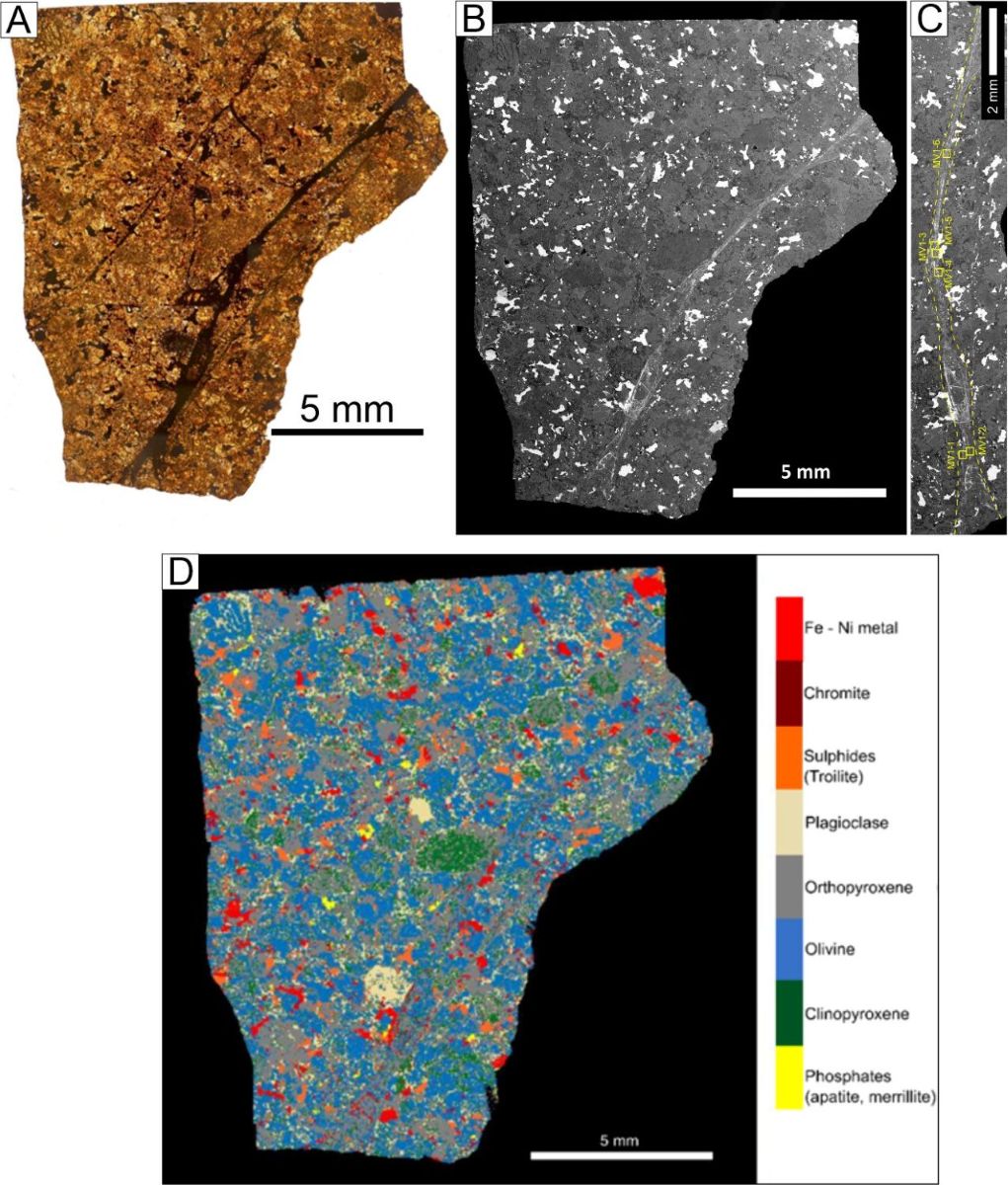
Figure 1. (A) Optical microscope mosaic and (B) BSE of the NWA 4137 section. (C) Enlarged area of the prominent MV (MV1) showing the analyzed areas (MV1-1 to MV1-6). (D) Phase map of NWA 4137.
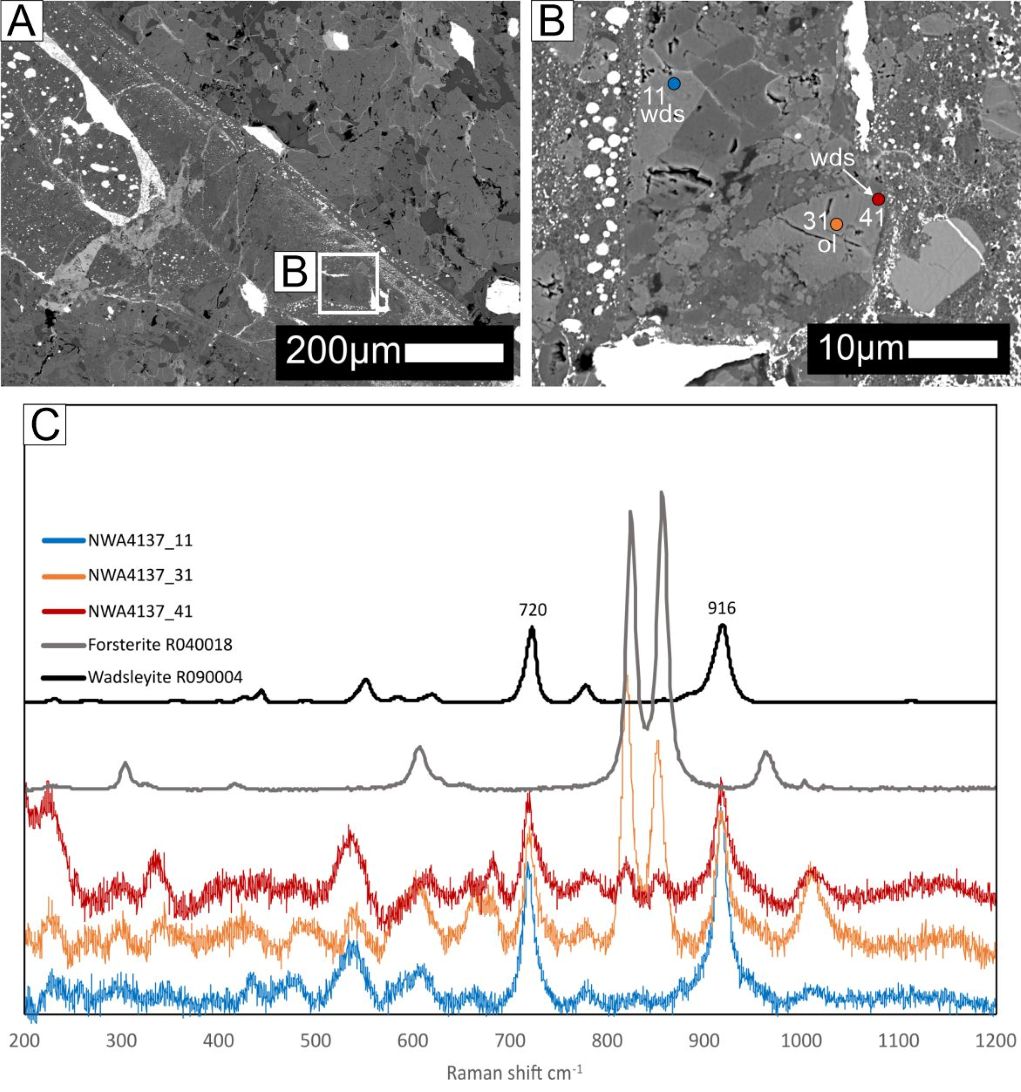
Figure 2. NWA 4137 meteorite. (A) BSE image of MV1-1. (B) Analyzed positions of the olivine and wadsleyite. (C) Raman spectra of wadsleyite compared with respective from the RRUFF database.
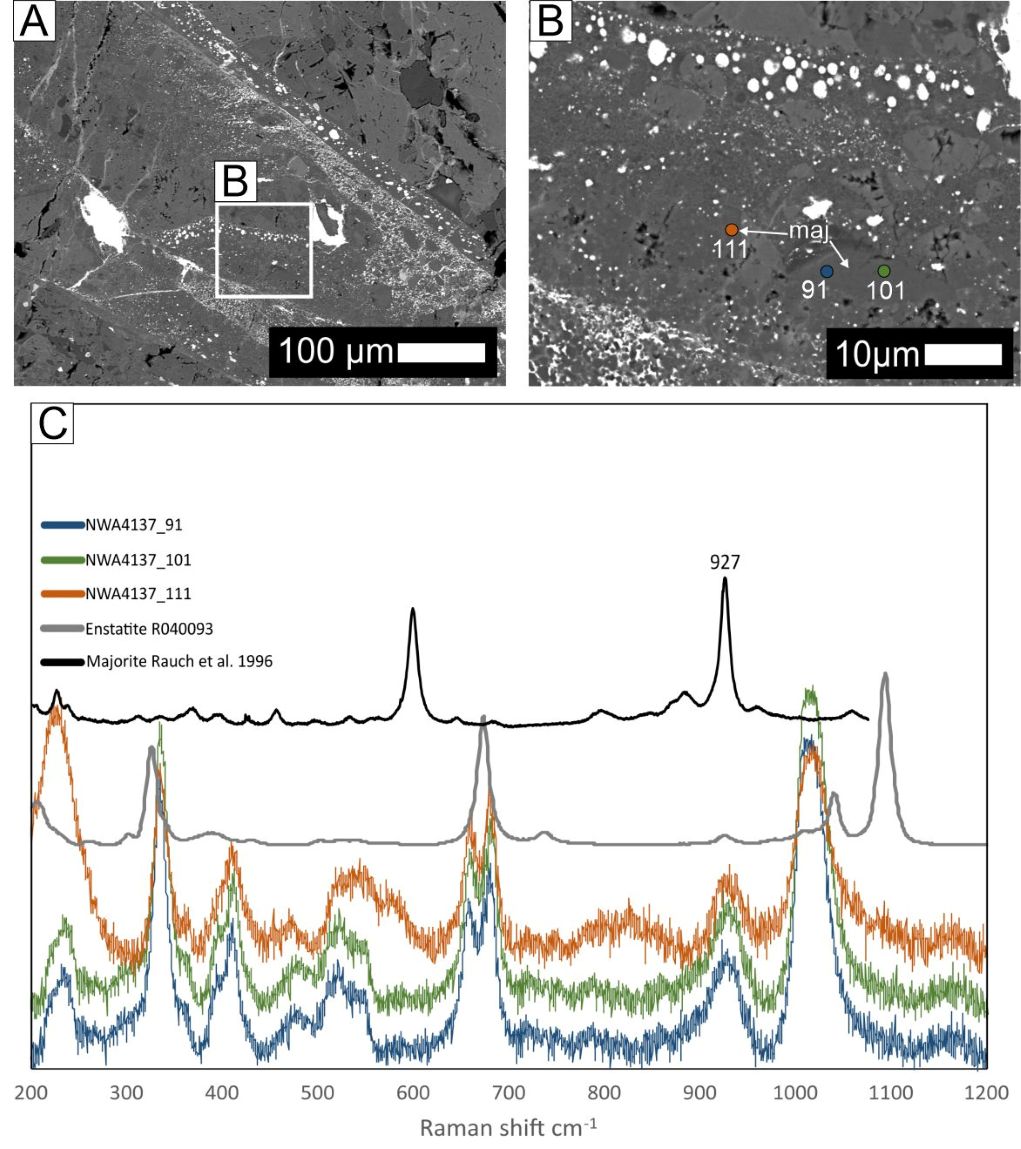
Figure 3. NWA 4137 meteorite. (A) BSE image of position MV1-2. (B) Analyzed positions of majorite. (C) Raman spectrum of majoritic garnet within MV1 compared to majorite from Handbook of Raman Spectra)[7] and enstatite (RRUFF).
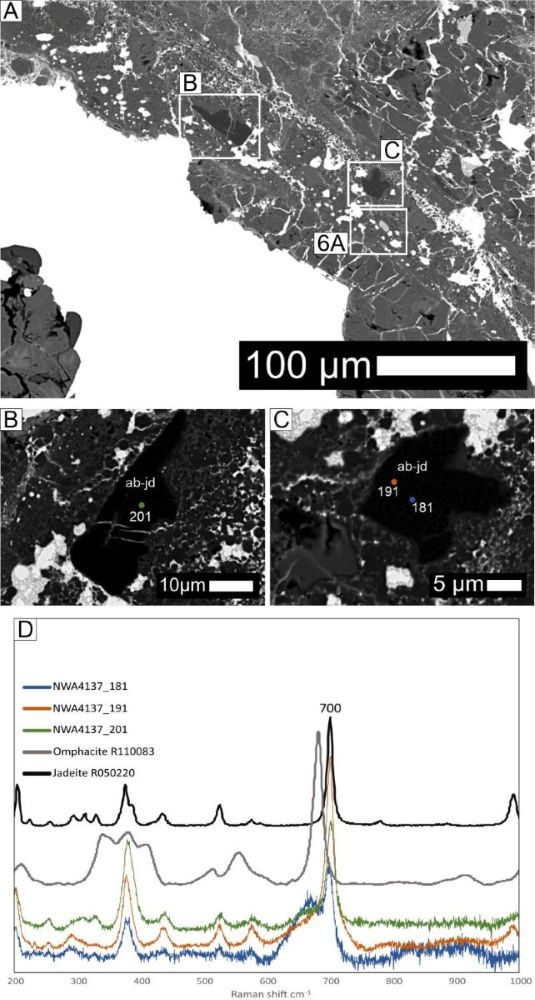
Figure 4. NWA 4137 meteorite. (A) BSE image of position MV1-3. (B, C) Irregular albitic jadeite grains. (D) Raman spectrum of albitic jadeite compared with jadeite spectrum, and omphacite (RRUFF).
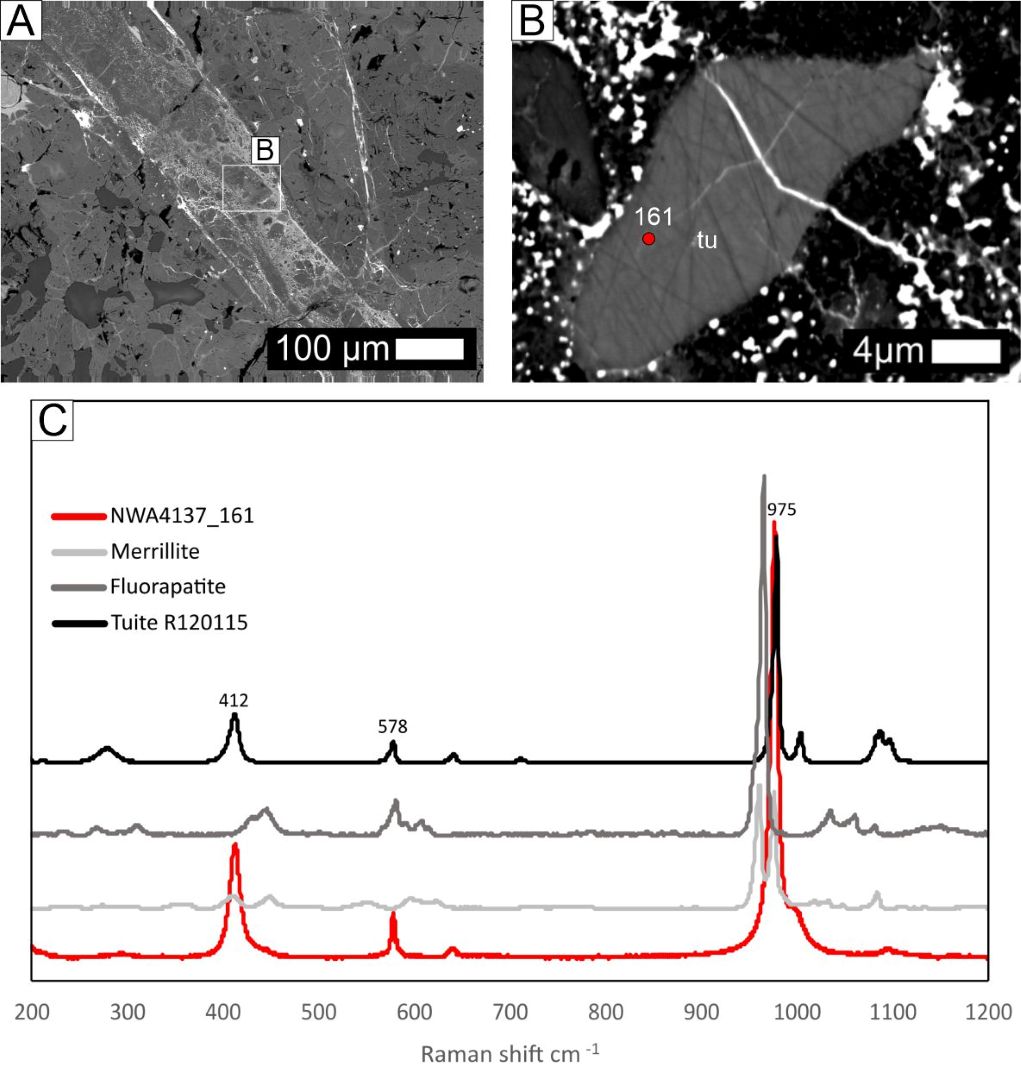
Figure 5. NWA 4137 meteorite. (A) BSE image of position MV1-6. (B) Tuite annotated for the analysed Raman position. (C) Raman spectrum of a tuite grain within MV1-6 compared with respective from RRUFF database (merrillite R150063; fluorapatite R050617.
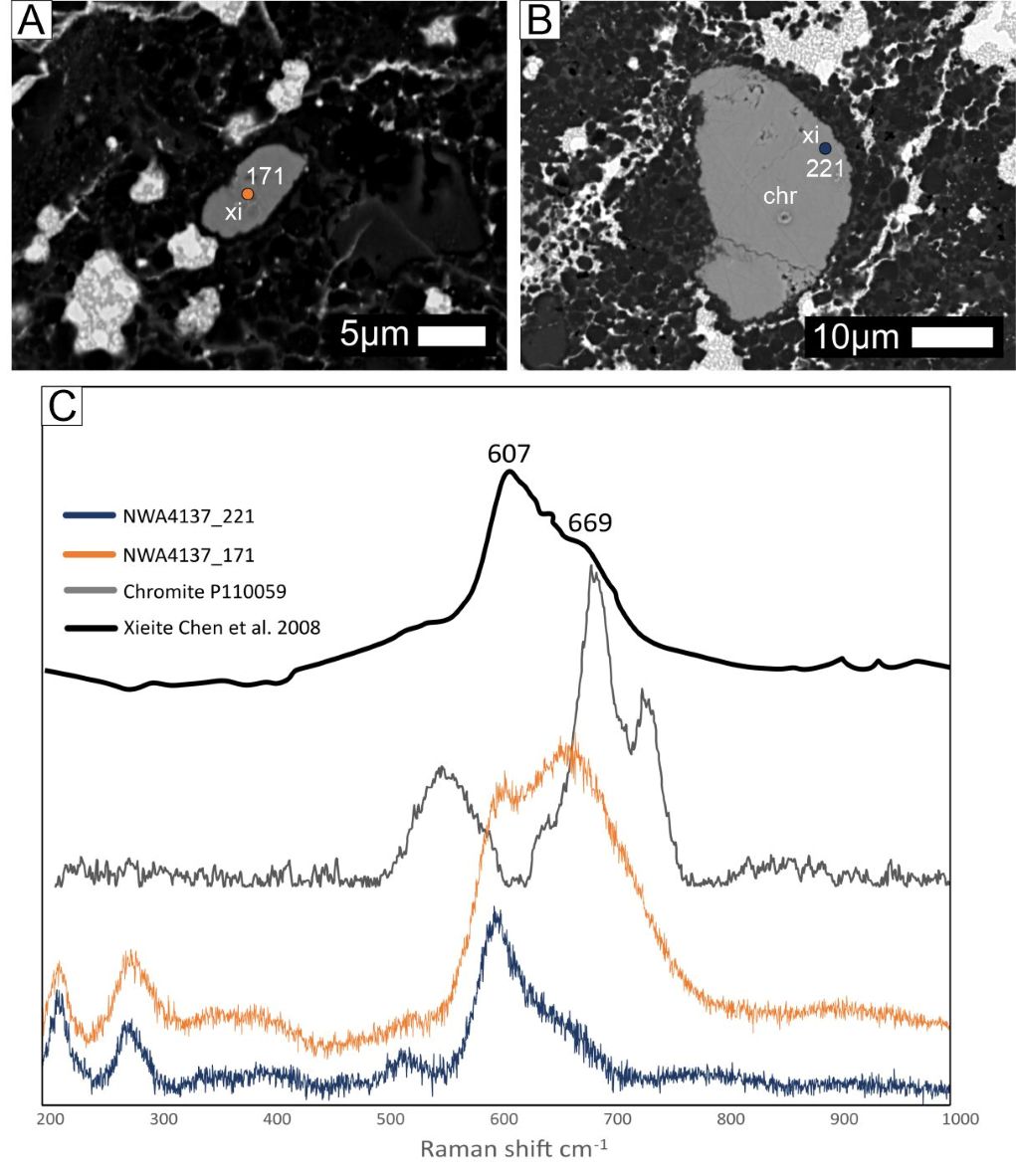
Figure 6. NWA 4137 meteorite. (A) BSE image within position MV1-5 showing the analyzed Raman spot. (B) Xieite within MV1-4 annotated for it’s Raman position . (C) Raman spectrum of xieite within MV1-4 and MV1-5 compared with Raman spectrum of xieite from [5] and chromite (RRUFF).
How to cite: Baziotis, I., Effraimidou, S., Simopoulou, M., Ferrière, L., Klemme, S., Berndt, J., and Asimow, P.: High-pressure phase preservation in L-chondrite melt veins: Evidence for control by post-shock thermal evolution, Europlanet Science Congress 2026, The Hague, The Netherlands, 7–11 Sep 2026, EPSC2026-1127, https://doi.org/10.5194/epsc2026-1127, 2026.


