
 1,1,1,2,1,
- 1National Institute for Astrophysics - Institute for Space Astrophysics and Planetology (INAF-IAPS), Rome, Italy (martina.moroni@inaf.it)
- 2Goddard Earth Sciences, Technology, and Research, Morgan State University, Baltimore, USA
Mercury’s exosphere is a complex and dynamic environment, continuously refilled and depleted by processes acting both on the surface and within the planet environment (Milillo et al., 2005). The release processes are strongly driven by external factors such as the solar irradiance, the solar wind and the micrometeoroid flux precipitating onto the surface. In order to investigate the dynamics of planet environment, since its discovery in 1985 (Potter et al., 1985), Mercury’s exospheric Na has been the most studied species both from ground-based and from space observations. However, most of these studies based the analysis on single datasets, leaving a comprehensive and simultaneous characterization of space- and ground-based observations still unrealized. In this framework, we investigate and quantify the processes driving the Mercury's Na exosphere by merging complementary information from both the Telescope Heliographique pour l’Etude du Magnetisme et des Instabilites Solaires (THEMIS) ground-based telescope observations and the NASA/MESSENGER space-based observations.
Since 2007, THEMIS has provided a large statistical database of bidimensional Na maps, revealing generally non-uniform emission patterns and showing a typical Na emission feature with two peaks located in the region of the magnetic cusp’s footprint (Fig. 1) (Potter et al., 2006; Leblanc et al., 2008; Mangano et al., 2015). These observations are complementary to in-situ measurements from MESSENGER mission (2008–2015), where data collected by the Ultraviolet and Visible Spectrometer (UVVS), part of the Mercury Atmospheric and Surface Composition Spectrometer (MASCS) onboard the spacecraft (McClintock and Lankton, 2007; Solomon et al., 2007), provided high-resolution altitude profiles and characterized the seasonal and annual behavior of the Na exosphere (Fig.2) (Cassidi et al., 2015). THEMIS and MESSENGER measurements are partially overlapped in time. By identifying high-quality joint observation windows from 2011 to 2013, while the telescope observes Mercury’s entire disk and surrounding space, providing the global view of the general status of the exosphere, the in-situ UVVS observations provide column density measurements at high resolution from which the altitude profile can be reconstructed. The derived scale heights allow estimating the release energy of exospheric particles and identifying the exospheric component distributions both in local time and latitude, as well as the dynamic evolution of the Na tail along the planetary orbit.
To investigate these joint observations, we use the exosphere generation model developed at the Institute for Space Astrophysics and Planetology (IAPS) (Mura et al. 2007) that includes all the major sources of generation and loss processes responsible for the generation of Mercury's exosphere: Photon-Stimulated Desorption (PSD), which populates high-altitude layers; Thermal Desorption (TD), concentrated around the sub-solar point; and the combined effects of Ion Sputtering and Micrometeoroid Impact Vaporization (MMIV). Starting from the MESSENGER observation geometries during each orbital pass, we reconstruct the Na altitude profile along the line of sight of the instruments aboard the spacecraft, constraining the model parameter that best reproduce the observations. The same model parameters are applied to reproduce the THEMIS Na maps by integrating simulated densities along the lines of sight of the telescope (Fig. 3).
Thanks to this work, it is possible to directly compare the different observations and derive additional information on the 3D structure of the Na exosphere. Such comprehensive and original analysis of the variability of Mercury’s Na exosphere represents an unprecedented step forward to better understand what drives the dynamics of planetary exosphere. Futhermore, this work will support the upcoming investigations by the ESA/JAXA BepiColombo mission, providing the framework necessary to interpret future multi-instrumental measurements of Mercury’s dynamic environment.
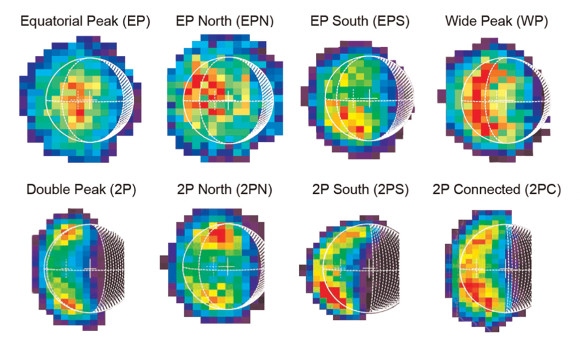
Figure 1: Examples of Na emission patterns identified in the Hermean exosphere seen during a set of images collected from 2009 to 2013 with the THEMIS solar telescope (Mangano et al. 2015).

Figure 2: Image of the UVVS observation geometry during the MESSENGER flybys of Mercury
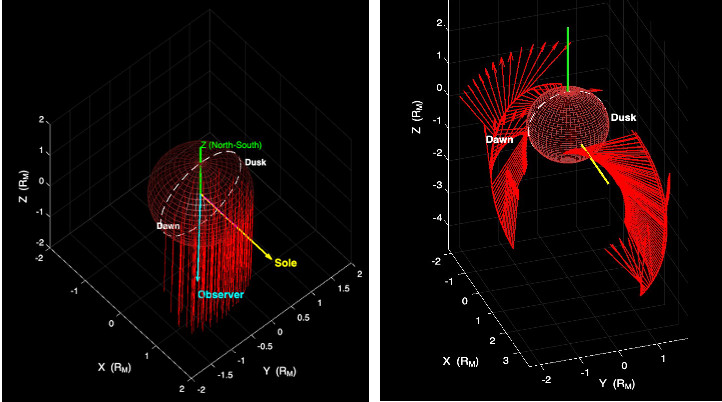
Figure 3: Comparison of observation geometries for Mercury’s Na exosphere (example for 7 June 2012): THEMIS ground-based configuration shows lines of sight from the Earth-based observer’s perspective (left); MESSENGER in-situ geometry illustrates the lines of sight during orbital passes (right)
- Cassidy, T. A., Merkel, A. W., Burger, M. H., Sarantos, M., Killen, R. M., McClintock, W. E., & Vervack Jr, R. J., 2015. Mercury’s seasonal sodium exosphere: MESSENGER orbital observations. Icarus, 248, 547-559.
- Leblanc, F., Doressoundiram, A., Schneider, N., Mangano, V., L.pez Ariste, A., Lemen, C., Gelly, B., Barbieri, C., Cremonese, G., 2008, High latitude peaks in Mercury’s sodium exosphere: spectral signature using THEMIS solar telescope. Geophys. Res.Lett.35,18
- Mangano, V., Massetti, S., Milillo, A., Plainaki, C., Orsini, S., Rispoli, R., Leblanc, F., 2015, THEMIS Na exosphere observations of Mercury and their correlation with in-situ magnetic field measurements by MESSENGER, Planet. Space Sci. 115, 102–109
- McClintock, W.E., Lankton, M.R. (2007). The Mercury atmospheric and surface composition spectrometer for the MESSENGER mission. Space Sci. Rev. 131 (1-4), 481-521
- Milillo, A., Orsini, S., Wurz, P., Delcourt, D., Kallio, E., Killen, R.M., Lammer, H., Massetti, S., Mura, A., Barabash , S., Cremonese, G., Daglis, I.A.,De Angelis, E., Di Lellis, A.M., Livi, S., Mangano, V., Torkar, K., 2005, Surface–exosphere–magnetosphere system of Mercury. SpaceSci.Rev. 117(3), 397–444
- Mura, A., Milillo, A., Orsini, S., Massetti, S., 2007. Numerical and analytical model of Mercury’s exosphere: dependence on surface and external conditions. Planet. Space Sci. 55, 1569–1583
- Potter, A.E., Morgan, T.H., 1985, Discovery of sodium in the atmosphere of Mercury, Science 229, 651–653
- Potter, A.E., Killen, R.M., Sarantos, M., 2006, Spatial distribution of sodium on Mercury, Icarus 181(1), 1–12
- Solomon, S.C., McNuttJr., R.L., Gold, R.E., Domingue, D.L., 2007. MESSENGER mission overview, SpaceSci.Rev.131, 3-39
How to cite: Moroni, M., Mura, A., Mangano, V., Massetti, S., Milillo, A., Burger, M., Brin, A., De Angelis, E., Di Bartolomeo, P. P., Orsini, S., Rispoli, R., Sordini, R., and Stumpo, M.: Dual-point observations of Mercury’s Na exosphere: cross-analysis of MESSENGER in situ and THEMIS ground-based data, Europlanet Science Congress 2026, The Hague, The Netherlands, 7–11 Sep 2026, EPSC2026-1130, https://doi.org/10.5194/epsc2026-1130, 2026.


