EPSC Abstracts
Vol. 19, EPSC2026-1131, 2026, updated on 02 Jul 2026
https://doi.org/10.5194/epsc2026-1131
Europlanet Science Congress 2026
© Author(s) 2026. This work is distributed under the Creative Commons Attribution 4.0 License.

Terrestrial planet formation in tight binary star systems: The case of HD217958 and HD176051
 1,2,3
1,2,3- 1TU Graz, Institute of Theoretical and Computationall Physics, Graz, Austria (m.zimmermann@tugraz.at)
- 2Department of Astrophysics, University of Vienna, Austria
- 3Space Research Institute, Austrian Academy of Science, Graz, Austria
Approximately 50 % of FGK-type stars are part of a binary star system, yet only about 20 % (https://exoplanet.eu/planets_binary/) of the 4,815 exoplanetary systems discovered to date hosted by such stellar system. It is therefore important to study these in more detail. Of these discovered exoplanet systems, 844 are in so-called S-type motion, i.e. they orbit one of the two stars. Figure 1 shows the different masses of the planets in S-type motion for the separation of the binary star system.
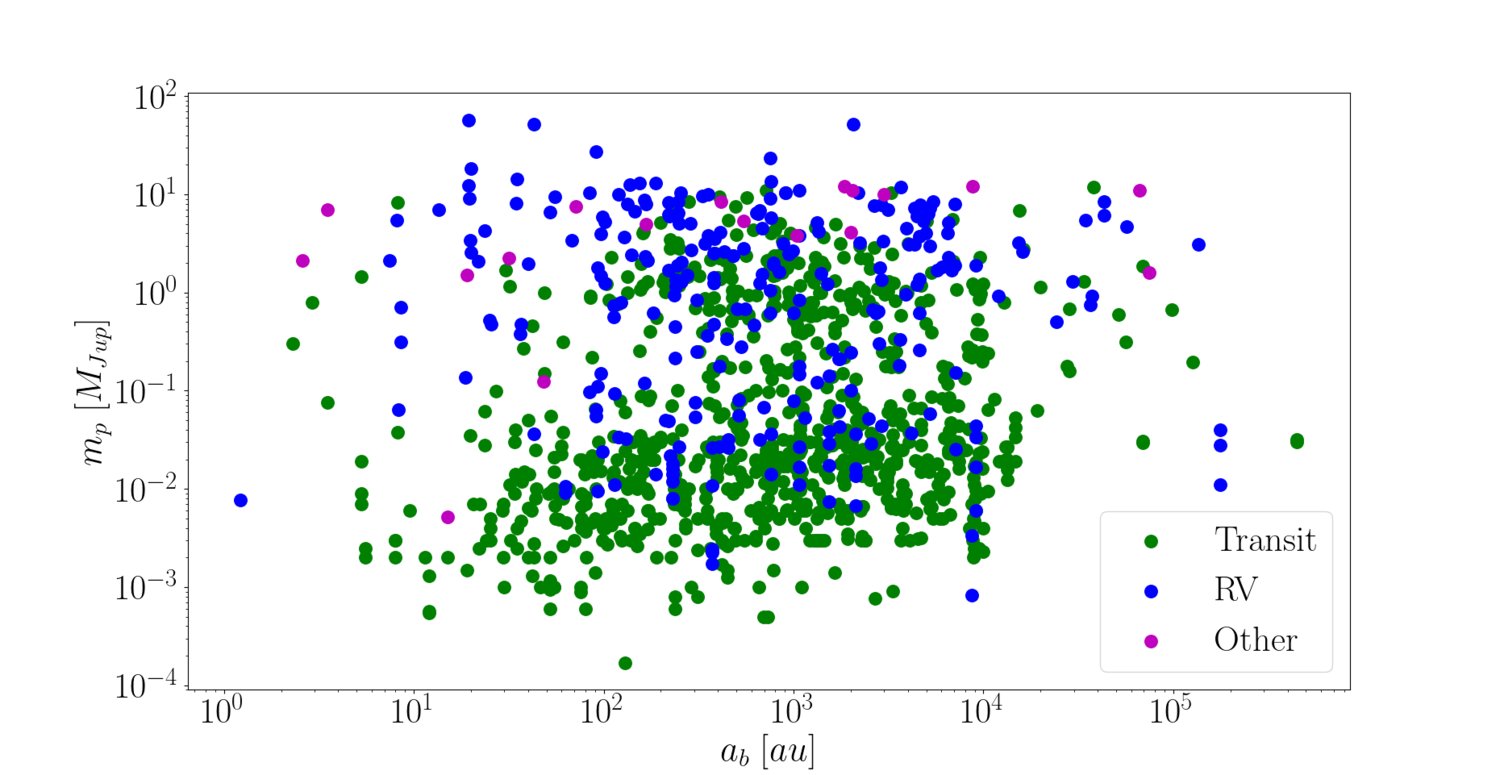
Figure 1: The distribution of planets in S-type motion in binary stars. The different colors indicate different detection methods for the planets.
The formation of planets in close binary stars (ab ≤ 30 au) is suppressed in both the formation via core accretion ([4]), as shown by e.g. [7], as well as via disc fragmentation due to gravitational instabilities ([2]), as simulations have shown that discs can only fragment at binary separations of approximately ab ~ 50 au (e.g. [1]). In a recent study, [8] propose a different formation scenario, where the secondary star forms via disc fragmentation after a "smaller" fragment—a planet-sized object—has already been formed and migrates towards the primary star.
In this study, we aim to build on the work of [8] and investigate whether it is possible for terrestrial, already harboring a gas giant, in particular, the systems HD 217958 and HD 176051. The first system has a separation of ab=25.09 au, an eccentricity of eb=0.245 and an inclination of ib=26.826°. The two stars have masses of mA = 1.08 M⊙ (G0V type) and mB = 0.077 M⊙ (M-type). A gas giant with mp = 0.524 MJ orbits the G-type star at a distance ap=3.758 au with ep=0.156 and ip = 91.357°. The HD 176051 system consists of a G0V star with mA=1.07 M⊙ and a K1V star with mB=0.71 M⊙, which have a separation of ab=19 au, an eccentricity of eb = 0.266 and are in a retrograde orbit with ib=144.16°. In this system, it is not entirely clear which component the gas giant is orbiting. Depending on the interpretation, the observations yield different masses and semi-major axes. In the case the host star is the G-type star, the parametters for the plant are mp = 2.26 MJ and ap=2.02 au. If the K-type star is the host star, the resulting parameter of the planet are mp=1.5 MJ and ap=1.76 au. For both cases, a circular retrograde orbit (ep=0) with ip=115.8° is assumed.
When considering the formation of terrestrial planets, we study the evolution, after the gas has dissipated, and therefore focus solely on gravitational interactions and collisions. We start with a planetesimal–planetary embryo disc consisting of 1000 planetesimals and about 20 planetary embryos, placed around the habitable zone of the corresponding star (HD 217958: adisk=0.7-2.0 au, HD 176051A: adisk = 0.7–1.9 au, HD 176051B: adisk = 0.4–1.5 au) which are initially dynamically cold. Fifty per cent of the total mass of the disc is contained in each the planetesimals and planetary embryos. As the orbital parameters of the gas giants contain significant errors in some cases, we checked the stability of the gas giant's motion using FLI computations ([3]). Figure 2 shows regular and chaotic motion for the system for various mutual inclinations between the gas giant and the secondary star. In order to calculate the interaction between all disc objects, the stars and the gas giants within a reasonable time, we use our GPU-parallelised N-body code GANBISS ([9]). For the two-body collisions of disk objects we assumed the perfect merging scenario. Each configuration is simulated for 100 Myr. However, after 10 Myr, the number of objects is greatly reduced, so that a parallelised N-body code is no longer necessary. Therefore, for the long-term integration (10 - 100 Myr), we switch to the rebound package ([5]) using the IAS15 integrator ([6]).
The results show that, in some configurations, the formation of one or few terrestrial planets is possible.

Figure 2: The figure shows the FLIs for the different inclinations of the gas giant in the system HD217958.
Acknowledgements
M.Z. and E.P-L want to acknowledge the support by the Austrian Science Fund FWF - project PAT3059124. The computational results presented have been achieved using the Vienna Scientific Cluster (projects 71637, 71686, 70320).
References
- [1] Kratter, K., Murray-Clay, R. and Youdin, A.: The runts of the Litter: Why Planets Formed Through Gravitational Instability Can Only Be Failed Binary Stars, The Astrophysical Journal, 710.2, pp. 1375-1386, 2010
- [2] Kuiper, G.: On the Evolution of the Protoplanets, Proceedings of the National Academy of Sciences of the United States of America, 37.7, pp. 383-393, 1951
- [3] Pilat-Lohinger, E. and Dvorak, R.: Stability of S-type orbits in binaries, Celestial Mechanics and Dynamical Astronomy 82.2, pp. 143-153, 2002
- [4] Pollack, J., Hubickyj, O., Bodenheimer, P., Lissauer, J., Podolak, M. and Greenzweig, Y.: Formation of Giant Planets by Concurrent Accretion of Solids and Gas, Icarus 124.1, pp. 62-85, 1996
- [5] Rein, H. and Liu, S.-F.: REBOUND: an open-source multi-purpose N-body code for collisional dynamics, Astronomy & Astrophysics, 537.A128, pp. A128, 2012
- [6] Rein, H. and Spiegel, D.: IAS15: a fast, adaptive, high-order integrator for gravitational dynamics, accurate to machine precision over a billion orbits, Monthly Notices of the Royal Astronomical Society, 446.2, pp. 1424-1437, 2015
- [7] Thebault, P., Marzari, F. and Scholl,H.: Planet formation in the habitable zone of α Centauri B, Monthly Notices of the Royal Astronomical Society, 393.1, pp. L21-L25, 2009
- [8] Zhang, L., Nayakshin, S., Baruteau, C., Thebault, P. and Vorobyov E.: Disc Fragmentation. III. The need for a new paradigm for formation of planets within close binary systems, eprint arXiv:2603.02395, 2026
- [9] Zimmermann, M. and Pilat-Lohinger, E.: GANBISS: a new GPU accelerated N-body code for binary star systems, Celestial Mechanics and Dynamical Astronomy 135.3, 2023
How to cite: Zimmermann, M. and Pilat-Lohinger, E.: Terrestrial planet formation in tight binary star systems: The case of HD217958 and HD176051, Europlanet Science Congress 2026, The Hague, The Netherlands, 7–11 Sep 2026, EPSC2026-1131, https://doi.org/10.5194/epsc2026-1131, 2026.


