
 1,1,1,3,4,
- 1LATMOS/IPSL, UVSQ Université Paris-Saclay, Sorbonne Université, CNRS, Guyancourt, France
- 2LEATP, Université de Reims Champagne-Ardenne, France
- 3LMD/IPSL, CNRS, Sorbonne Université, Paris, France
- 4LIRA, Observatoire de Paris, Université PSL, CNRS, Sorbonne Université, Université Paris Cité, Meudon, France
1. Introduction
Titan, Saturn’s biggest moon, has a thick atmosphere composed mainly of nitrogen and methane. Atmospheric conditions allow methane to be present in solid, liquid, and gaseous state. As a result, Titan has a methane cycle similar to Earth’s water cycle, featuring clouds, precipitation, and lakes and seas on the surface [1]. In addition to convective methane clouds forming in the troposphere, hydrocarbon clouds at the poles and high-altitude HCN clouds have also been observed [2,3]. Nevertheless, observations of Titan’s clouds remain limited, and questions persist regarding the distribution and composition of the clouds [4]. In this context, numerical climate models allow for a better understanding of the various mechanisms at work, as well as a deeper understanding of the observations. This presentation will discuss the atmospheric distribution of methane and its impact on cloud formation and evolution, as well as the impact on Titan’s climate.
2. Methane condensation and clouds in the troposphere
To tackle these questions, we use the Titan Planetary Climate Model (Titan LMDZ PCM [5]), a 3D climate model that simulates Titan’s climate at a global scale. It includes a fully coupled microphysical model in moments for haze and clouds [6]. The model takes into account the nucleation, condensation, sedimention and precipitation of six species : CH4, C2H2, C2H6, HCN, HC3N and AC6H6 [7]. Currently, the model condensates these species as ices only, and independently of each other, however some methane clouds are also likely to be formed of liquid droplets [8].
The abundance of methane in the model was previously constrained by Huygens measurements, with a minimum concentration set at 1.4%. Recent reanalysis of CIRS observations show that the Huygens measurements were atypical and that the concentration of methane in the stratosphere is generally lower, around ~1%, varying seasonally by +/-0.4% [9]. We therefore decided to remove this minimum value from the model and allow methane to evolve freely.
We find that this affects the altitude of saturation of methane and thus cloud formation in the model. Preliminary results show that the vertical and seasonal distribution of methane clouds is improved. The top altitude of methane clouds is allowed to increase. Methane clouds form in a more localised manner in the low and mid-latitudes of the summer hemisphere, which is more coherent with the observations (Fig 1).
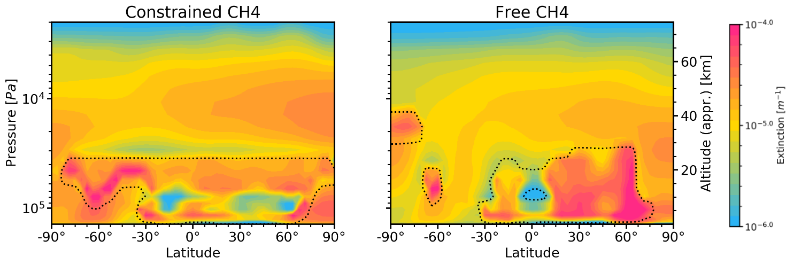
Figure 1 : Comparison between the zonally averaged cloud extinction at 0.7µm during northern summer (Ls=135°) for simulation with and without constrained methane. Methane ice presence is indicated by the black contour.
3. Methane concentration in the stratosphere
The concentration of stratospheric methane reaches 0.7% after 30 years of simulation (Fig 2). Although consistent with the lower limit of observations, these values correspond to isolated events and vary with latitude and season (see abstract by Olwen Rering). We conclude that the model lacks a mechanism that would replenish methane in the stratosphere.

Figure 2 : Modeled methane profiles at the region and period of Huygens compared to Huygens measurements.
We are currently adding to the model the latent heat release due to the condensation of condensible species. This is the main mechanism underlying the development of methane storms, that are thought to allow methane to be transported to higher altitudes [10]. Preliminary results show that the energy contribution from condensation in the troposphere, at the latitudes and periods of modeled cloud activity, is significant (Fig 3).
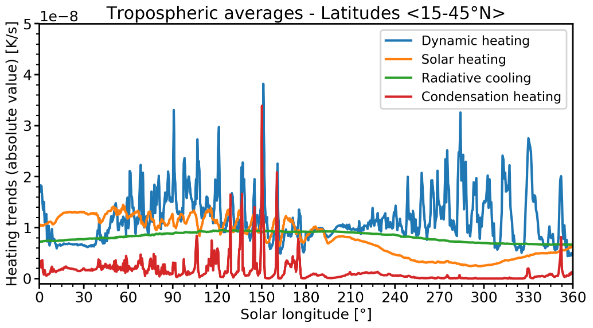
Figure 3 : Comparison between the energetic contribution (in absolute value) of the global circulation (blue), the solar heating (orange), the radiatively active species (green) and the computed contribution of condensation (red). Values are averaged from the surface to 2.10⁴ Pa for latitudes between 15 and 45°N.
References
[1] Turtle et al. « Titan’s Meteorology Over the Cassini Mission: Evidence for Extensive Subsurface Methane Reservoirs ». Geophysical Research Letters 45, no 11 (2018): 5320‑28. https://doi.org/10.1029/2018GL078170.
[2] West et al. « Cassini Imaging Science Subsystem observations of Titan’s south polar cloud ». Icarus, 270 (2016) , 399-408. https://doi.org/10.1016/j.icarus.2014.11.038
[3] de Kok et al., « HCN Ice in Titan’s High-Altitude Southern Polar Cloud », Nature 514, no 7520 (2014): 7520, https://doi.org/10.1038/nature13789.
[4] Nixon, Carrasco, Sotin, « Chapter 15 - Open questions and future directions in Titan science», In COSPAR Series, Titan After Cassini-Huygens, Elsevier (2025), Pages 473-515, ISBN 9780323991612, https://doi.org/10.1016/B978-0-323-99161-2.00012-7.
[5] de Batz De Trenquelléon et al. « The New Titan Planetary Climate Model. I. Seasonal Variations of the Thermal Structure and Circulation in the Stratosphere ». The Planetary Science Journal 6, no 4 (2025): 78. https://doi.org/10.3847/PSJ/adbbe7.
[6] de Batz De Trenquelléon et al. « The New Titan Planetary Climate Model. II. Titan’s Haze and Cloud Cycles ». The Planetary Science Journal 6, no 4 (2025): 79. https://doi.org/10.3847/PSJ/adbb6c .
[7] de Batz De Trenquelléon et al., « Origin, Evolution, and Fate of Titan’s Polar Clouds », Nature Communications, (2025), https://doi.org/10.1038/s41467-025-66955-7.
[8] Wang et al., « Methane gas stabilizes supercooled ethane droplets in Titan’s clouds », The Astrophysical Journal 712, no 1 (2010): 1, https://doi.org/10.1088/2041-8205/712/1/L40.
[9] Lellouch et al., « The Distribution of Methane in Titan’s Stratosphere from Cassini/CIRS Observations », Icarus 231 (2014): 323‑37, https://doi.org/10.1016/j.icarus.2013.12.016.
[10] Moisan et al., « Modeling Convective Methane Clouds on Titan with a Kilometer-Scale Regional Model », abstract. presented at EGU (2026) https://doi.org/10.5194/egusphere-egu26-13288.
How to cite: Rosset, L., Chatain, A., Petetin, C., Moisan, E., de Batz de Trenquelléon, B., Jaziri, Y., and Carrasco, N.: Methane cloud formation and impact on the climate of Titan with the Titan LMDZ PCM , Europlanet Science Congress 2026, The Hague, The Netherlands, 7–11 Sep 2026, EPSC2026-114, https://doi.org/10.5194/epsc2026-114, 2026.


