
 1,1,
1,1,- 1LPAP, STAR Institute, Université de Liège, Liège, Belgium (zachary.flimon@uliege.be)
- *A full list of authors appears at the end of the abstract
O2 and NO nightglow emission on Mars from NOMAD UVIS
Nightglow observations on Mars provide important insights into the chemical and dynamical processes of the Martian atmosphere. The first visible observations of nitric oxide (NO) nightglow were reported by (Bertaux et al. 2005) using the SPectroscopy for the Investigation of the Characteristics of the Atmosphere of Mars (SPICAM) instrument aboard Mars Express. Additional NO observations were later obtained with the Imaging Ultraviolet Spectrograph (IUVS) instrument aboard Mars Atmosphere and Volatile Evolution (MAVEN). These visible emissions originate from the recombination of oxygen and nitrogen atoms produced on the dayside through the photodissociation of CO₂ and N₂ and subsequently transported to the nightside by atmospheric circulation. The resulting NO nightglow emissions provide valuable information on the product of the densities of atomic oxygen and nitrogen in the upper atmosphere. In the visible it is also possible to observe the O2 Herzberg II emission, this emission was first observed by (Gérard et al. 2023; Soret et al. 2024) using the UVIS channel of the Nadir and Occultation for Mars Discovery (NOMAD) instrument.
The NOMAD spectrometer aboard the ExoMars Trace Gas Orbiter (Vandaele et al. 2018) began science operations in April 2018. In this work, we investigate limb observations from the UV‐visible (UVIS) channel of NOMAD ( Vandaele et al. 2015). Covering a wavelength range from 200 to 650 nm, UVIS enables simultaneous observation of NO δ and γ bands between 205 and 270 nm and O₂ Herzberg II emissions between 400 and 600 nm. Using dedicated observation modes, this study explores the UVIS dataset with the objective of deriving atmospheric parameters from these nightglow emissions.
The methodology consists first of retrieving the emission intensities from UVIS limb spectra. We apply the same approach as described by (Soret et al. 2024), by fitting reference spectra derived from previous missions (Venus for O2 and MAVEN for NO) to compute the total intensity at each altitude due to the nightglow emission. From the resulting vertical intensity profiles, Chapman functions are fitted to derive the volume emission rates. Using these emission rates and the corresponding chemical relationships, we retrieve the densities of atomic oxygen and nitrogen.
The altitude probed are between 20 to 80 km with the peak emission of NO on average 20 km above the emission of O2. All observations are in the polar regions and the limited number of limb profiles (around 50 from MY35 to MY 38) limit the interpretation for seasonality. An example showing the different vertical profiles can be found in Figure 1. Currently the density of N is not included in the model but new simulations should be provided allowing the comparison.
This work provides a climatology of NO and O₂ nightglow emissions observed simultaneously by NOMAD-UVIS, together with the corresponding atomic oxygen and nitrogen densities at coincident altitudes whenever possible. Finally, the retrieved densities are compared with predictions from global climate models, including GEM (Neary and Daerden 2018) and PCM (Millour et al. 2018). Overall, the modeled density profiles show good agreement with the observations.
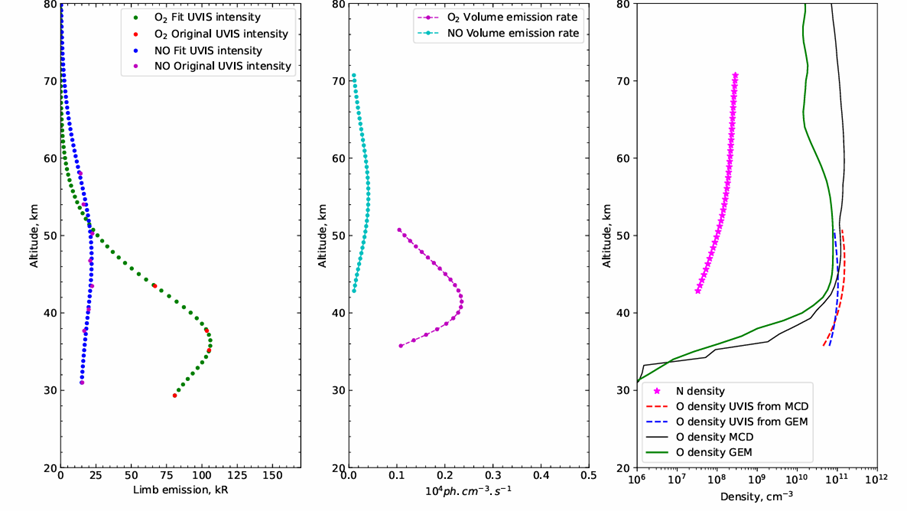
Figure 1: Vertical profiles for NO and O2 emissions on the first panel, the middle panel represents the volume emission rate and the last panel the O and N densities. In the last panel the densities for O are computed using the temperature from GEM or the MCD. In this case, the value for the O densities at the peak are similar between the models and the observations.
Bertaux, Jean-Loup, François Leblanc, Séverine Perrier, et al. 2005. “Nightglow in the Upper Atmosphere of Mars and Implications for Atmospheric Transport.” Science 307 (5709): 566–69. https://doi.org/10.1126/science.1106957.
Gérard, J. C., L. Soret, I. R. Thomas, et al. 2023. “Observation of the Mars O2 Visible Nightglow by the NOMAD Spectrometer Onboard the Trace Gas Orbiter.” Nature Astronomy 8 (1): 77–81. https://doi.org/10.1038/s41550-023-02104-8.
Millour, E., F. Forget, A. Spiga, et al. 2018. THE MARS CLIMATE DATABASE (VERSION 5.3).
Neary, L., and F. Daerden. 2018. “The GEM-Mars General Circulation Model for Mars: Description and Evaluation.” Icarus 300 (January): 458–76. https://doi.org/10.1016/j.icarus.2017.09.028.
Soret, L., F. González‐Galindo, J. ‐C. Gérard, et al. 2024. “Ultraviolet NO and Visible O2 Nightglow in the Mars Southern Winter Polar Region: Statistical Study and Model Comparison.” Journal of Geophysical Research: Planets 129 (12): e2024JE008620. https://doi.org/10.1029/2024JE008620.
Vandaele, A. C., J. J. Lopez-Moreno, M. R. Patel, et al. 2018. “NOMAD, an Integrated Suite of Three Spectrometers for the ExoMars Trace Gas Mission: Technical Description, Science Objectives and Expected Performance.” Space Science Reviews 214 (5): 80. https://doi.org/10.1007/s11214-018-0517-2.
Vandaele, Ann C., Yannick Willame, Cédric Depiesse, et al. 2015. “Optical and Radiometric Models of the NOMAD Instrument Part I: The UVIS Channel.” Optics Express 23 (23): 30028. https://doi.org/10.1364/OE.23.030028.
F. Daerden, I. R. Thomas ,B. Ristic. J. Mason ,Y. Willame, M. R. Patel, G. Bellucci, M. A. López-Valverde, A.C. Vandaele
How to cite: Flimon, Z., Soret, L., Gérard, J.-C., and Hubert, B. and the NOMAD team: O2 and NO nightglow emission on Mars from NOMAD UVIS, Europlanet Science Congress 2026, The Hague, The Netherlands, 7–11 Sep 2026, EPSC2026-1146, https://doi.org/10.5194/epsc2026-1146, 2026.


