
 ,
,- Institut for Space Systems, University of Stuttgart, Germany (mocker@irs.uni-stuttgart.de)
Background and motivation
Hypervelocity impacts with impact speed above about 3-4 km-1 of micro-meteoroites onto solid surfaces are an ubiquitous phenomenon throughout the Solar System.
These particles are between a few nm up to several µm in size and are comprised by interstellar and interplanetary dust. Impacts at such high speeds exceeding the speed of sound within the materials in question lead to inertial stresses upon impact that are very high compared to the strength of these materials. This causes the material to behave like fluids under the impact.
Due to the their ubiquity and the high impact energy leading to extremely high temperatures and pressures in the affected materials, the physical processes caused by HVIs play an important role in a variety of fields such as the investigation of matter at extreme pressures and temperature, shock waves in solid bodies or even Solar System research, planetology, cosmic dust research and space engineering.
An 2MV electrostatic dust accelerator
A major part of what we know today of HVIs of micro meteoroids was obtained in the
process of developing, calibrating and operation of in situ instruments for the investigation
of dust in the Solar System.
These particles are between a few nm up to several µm in size and interact with the
solid surface of the instrument: they impact at speeds of several hundred m s−1 to several
hundred km s−1. Thereby induced physical processes generate measurable signals which
are then transmitted to Earth and can be analysed afterwards.
There are a variety of methods for in situ dust measurements such as the detection of
thin foil penetration, the particle charge, the emerging impact flash or ions generated upon
impact, revealing the particles’ velocity, trajectory, mass and even chemical composition
To calibrate in-situ dust instruments and to get a deeper understanding of the processes involved, hypervelocity impact measurements under similar and well defined conditions are required. For this purpose, a Van-de-Graaff type ion accelerator was modified at the MPI-K/HD in the late 1960ies. The accelerator was equipped with a dust source capable of charging and accelerating dust particles.
The accelerator covers a large portion of the speed and size ranges needed for most cosmic applications with velocities between 1 to about 80 km s−1 .
Impacts onto solid surfaces and the partition of energy
A fast particle impacting a solid surface causes mechanical stress in the particle and the target body, generating compression and even shock waves depending on the impact velocity. Subsequently the particles and the affected target area are compressed to high pressures and temperatures.
This increase in internal specific energy is then partitioned into a variety of processes leading to a number of phenomena:
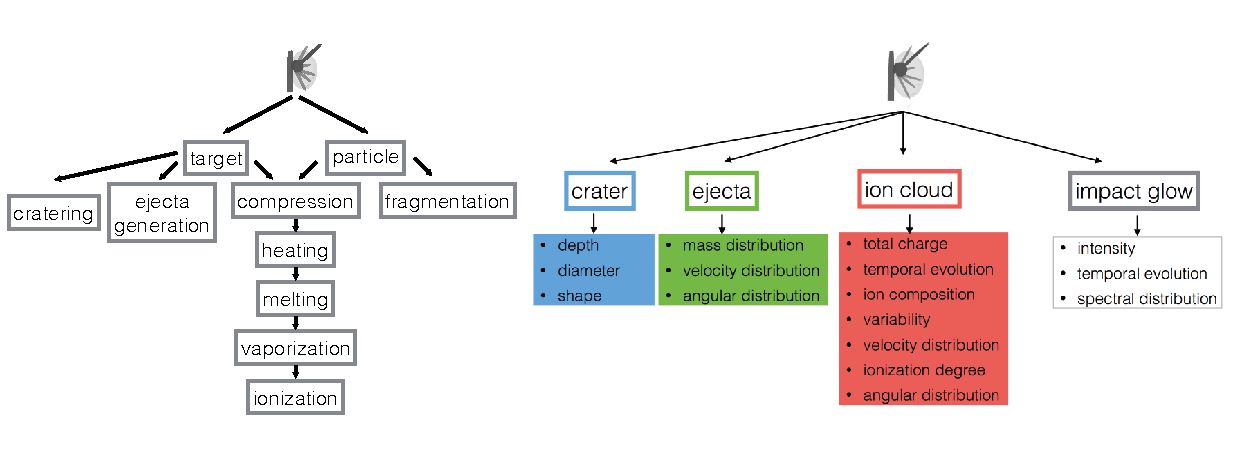
- Surface alteration and cratering,
- generation of ions and neutral gas atoms (impact plasma)
- glow of the impact plasma cloud
- generation of secondary particles (ejecta).
The resulting observables of HVIs (Fig. 1) are a function of projectile and target material, impact velocity, incident angle and the mass and shape of the projectile. This allows to use the quantitative investigation of these phenomena to deduce information about the impacting particles and the impact parameters and to gain a deeper understanding of the impact and its subsequent processes.
An experimental set up to study simultaneously the impact plasma and the generation of secondary particles
We will present a new experimental set up designed and build to allow to measure as many resulting observables as possible simultaneously. Furthermore, it allows for a wide variety of target materials form metal and silicate materials to even ice and ice-silicate mixtures.
The experimental set up is implemented into the beam line of the dust accelerator in an angle of 45 degree and consists of
- a cylindrical vacuum camber allowing attach additional detectors to the chamber in addition to the linear time-of-flight mass spectrometer set up in the chamber. A newly designed and built high-vacuum chamber allows simultaneous measurements of the ion and neutral generation and the simultaneous recording of the surface alteration. Eight flanges are provided for feed-throughs, windows and interface for the particle beam.
- A small cubic vacuum chamber serving as an airlock to insert various target materials in ti the vacuum of the set up.
- A linear feedthrough to move the target from the airlock very precisely into the detector set up as well as providing a cooling channel to allow the use of ices and ice-silicate mixtures as targets.
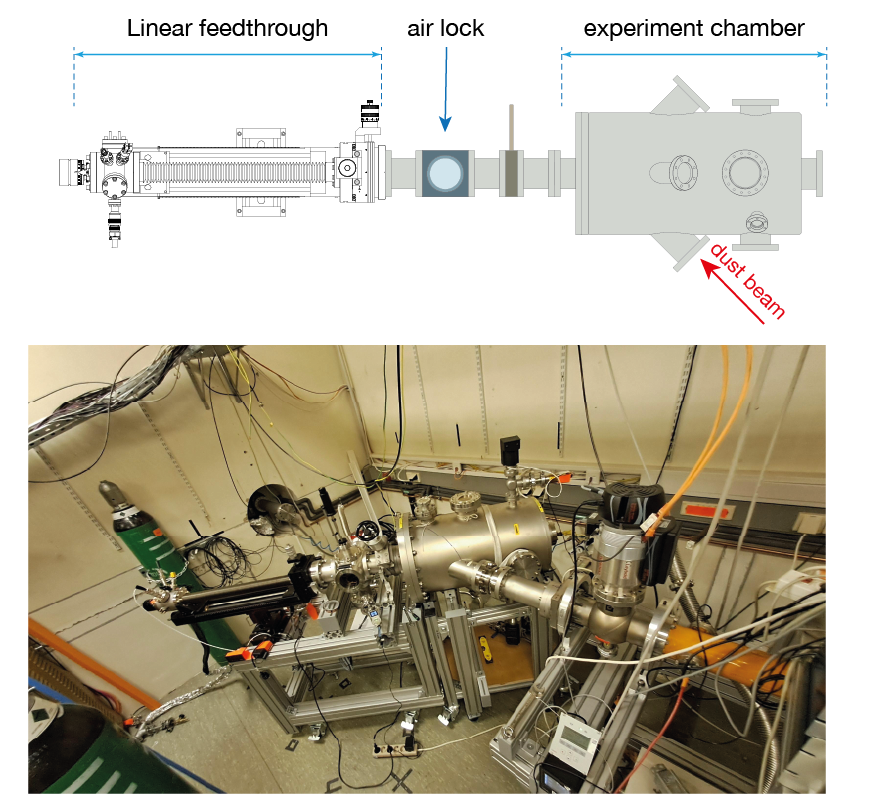
This unique set up allows to
- Characterise of the emerging plasma, with a linear TOF mass spectrometer. This allows to investigate the thermodynamical properties of the impact plasma leading to a deeper understanding of the process of impact ionisation and the behaviour of matter under extreme conditions.
- The generation of secondary particles is characterised by measuring the number of generated particles, their mass and velocity distribution as well as their angular distribution with a delay line detector.
- Additionally a residual gas analyser will be used to measure the neutral component of the impact plasma
Conclusion and outlook
We would like to present:
- A short overview the simulation of HVIs of micrometeorites in the laboratory using a 2MV electrostatic dust accelerator at the University of Stuttgart.
- The overall design of the experimental set up
- A report of the first test of the set up.
- -The status and outlook for the planned experimental programme for the characterisation and description of the HVI onto silicate-ice mixtures due to the generation of ions and their properties
with a linear time-of-flight mass spectrometer, as well a the generation of secondary particles and of neutral gas production.
This experimental work in combination with future theoretical studies of the impact process and the subsequent expansion of the impact generated plasma could also open a new door to investigate the state of hot compressed matter.
How to cite: Mocker, A., Behrens, F., Dillmann, B., Dürrstein, S., Ehrhard, E., Jeyecumar, C., Nestle, D., Li, Y.-W., Ngyuen, B., Schmid, J., Sychold, M., and Srama, R.: A new experimental set up to study the partition of energy upon hypervelocity impacts of micrometeorites onto a variety of solid targets, Europlanet Science Congress 2026, The Hague, The Netherlands, 7–11 Sep 2026, EPSC2026-1148, https://doi.org/10.5194/epsc2026-1148, 2026.


