
 ,,
,,- LATMOS/IPSL, UVSQ Université Paris-Saclay, Sorbonne Université, CNRS, Guyancourt, France
Understanding habitability beyond Earth requires more than locating planets within the classical habitable zone. One crucial factor is the chemical availability of bioessential elements—particularly C, H, N, and O—and the geochemical pathways that convert them into life-accessible forms. Among the many interesting hypotheses of prebiotic chemistry on Earth, organic aerosols formed by photochemical and thermionic processes are predicted to play a significant role [1]. The organic haze in Titan presents a clear example of how organic aerosols can arise from photochemical and electrochemical pathways in the ionosphere of a nitrogen and methane-dominant environment. Several experiments have been conducted to produce organic aerosol analogs (tholins) to understand the chemistry behind their formation. Importantly, hydrolysis of these tholins has been proven to produce nucleic acid bases[2]. In this work, we start from the example of the atmospheres of Titan and the early Earth and then explore beyond the atmospheric composition. Our goal here is to understand how the presence of hydrogen (H2), carbon dioxide (CO2), or water vapour (H2O(g)) can alter the organic aerosol formation in the ionosphere of a nitrogen-dominant planetary environment. Several studies have pointed out that the presence of methane (CH4) is crucial for aerosol formation. Therefore, we kept CH4 in all our experiments and varied the ratios of the target gases to CH4 to determine the variation in chemical compositions of the formed aerosols. Transmission infrared spectroscopy is used to study the CN, CH, NH, and OH bands of the generated organic films. In-situ mass spectrometry and optical emission spectroscopy are also planned to identify the reactive and intermidiate species. The solid organic samples is being analysed by elemental analysis to determine the compositional change depending upon the gas mixture, indicating any variations in nitrogen and oxygen incorporations in the solid phase.
Experimental setup
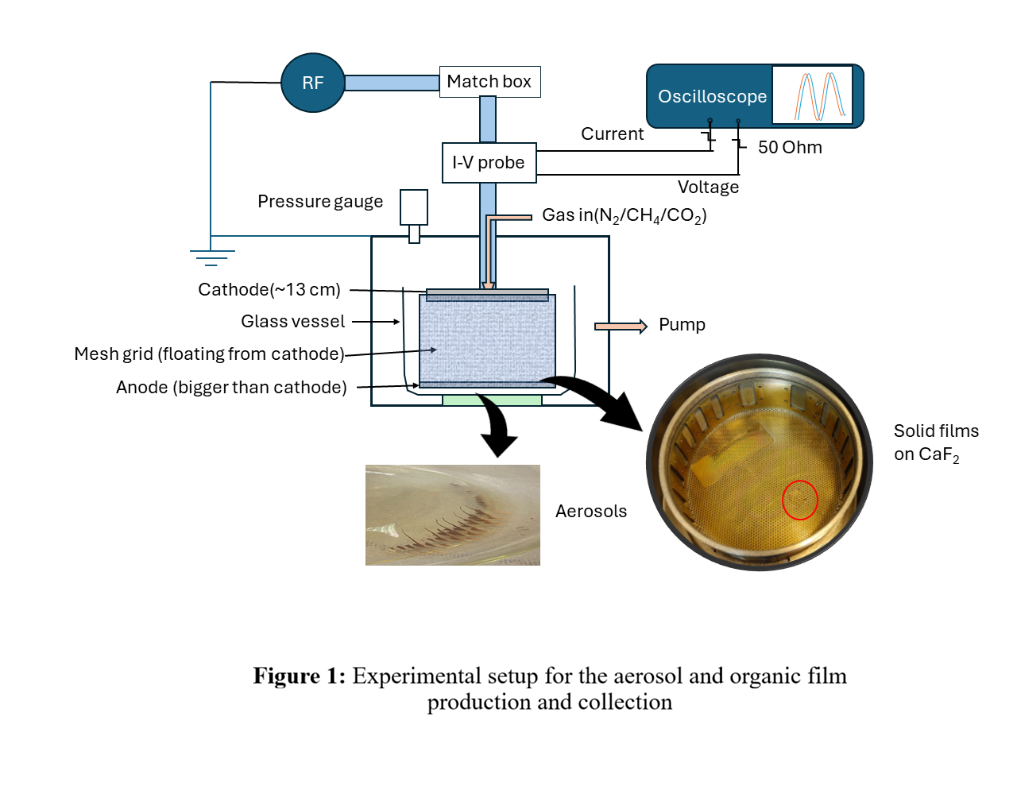
Experiments were performed in the PAMPRE reactor at LATMOS, using a capacitively coupled radiofrequency (RF) plasma at 13.56 MHz, a well-established tool for simulating ionospheric chemistry in planetary atmospheres [3]. The electron temperatures and densities achievable in this discharge are comparable to conditions in the upper atmospheres of Titan or Earth's ionosphere. A constant total gas flow of 55 sccm of N2/CH4/X mixtures (where X = CO2, H2, or H2O) was used, with N2 fixed at 90% by volume. A water bubbler kept at a constant 30 0C thermal bath is used to supply the water vapor into the reactor using a microleak. The CH4: X ratio was systematically varied to explore the dependency of the compositional variation upon the ratio. Organic particles were collected both as aerosols deposited on a quartz vessel outside the active plasma region and as solid films on CaF2 windows positioned above the anode, and exposed longer to the plasma. We wish to reveal the compositional difference of the films and the aerosols to differentiate between clustered monomers that settle down after a few growth and the material that remains several hours in the active electrochemical region.
First resulrs
FTIR Spectroscopy of Organic Films in N2-CH4-CO2
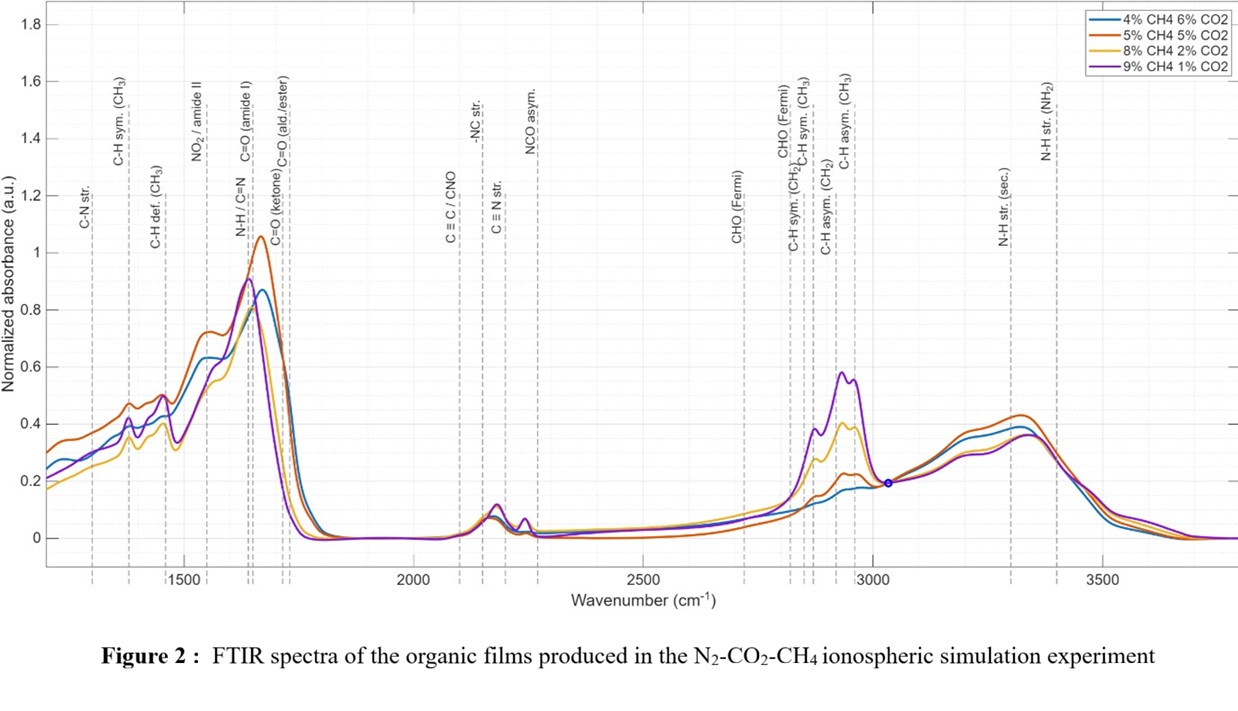
Fourier-transform infrared (FTIR) spectroscopy of the deposited organic films reveals systematic changes in chemical composition as a function of gas mixture. At CH4:CO2 < 1 (CO2-rich regime), the C–H stretching bands (2800-3000 cm-1) weaken, and the β-unsaturated and aryl nitrile band near 2210 cm-1 disappears, signaling a change in the nitrogen-bearing organic network formed. At CH4:CO2 < 1, the CO (1700 cm-1) and NO2(1570 cm-1) bands also become more prominent, suggesting incorporation of oxygenated functional groups. These spectral shifts reflect a fundamental change in chemical pathways between the CH4-rich and CO2-rich regimes, with implications for the optical properties of hazes in diverse planetary atmospheres. A detailed study of relative functional group strength change will be presented.
Ongoing and Planned Measurements
In-situ optical emission spectroscopy and mass spectrometry are being conducted to identify gas-phase reactive radicals (CO, NH, CN, and OH) and track how the addition of CO2, H2, or H2O modifies the ionospheric chemistry, therefore affecting the formation mechanism and chemical structure of the organic molecules. Elemental analysis (C, H, N, O) of solid aerosol samples will confirm bulk compositional shifts between gas mixture regimes. Finally, optical indices (refractive indices n and k) of the produced films will be measured from UV-visible to near infrared range (250-2500 cm-1) [4]. These optical constants are critical inputs for radiative transfer models of hazy exoplanet atmospheres and for interpreting JWST transmission spectra.
[1]Tuck, A. The Role of Atmospheric Aerosols in the Origin Of Life. Surveys in Geophysics 23, 379–409 (2002).https://doi.org/10.1023/A:1020123922767
[2] Kawai, J., Kebukawa, Y., McKay, C. P., & Kobayashi, K. (2019)Life Sciences in Space Research, 20, 20–29. https://doi.org/10.1016/j.lssr.2018.11.002
[3]C. Szopa, G. Cernogora, P. Bourdon, J.-P. Boaire, J.-J. Correia, C. Coll, Planet. Space Sci. 54 (2006) 394–404,
[4] Gavilan, L., Broch, L., Carrasco, N., Fleury, B., & Vettier, L. (2017).The Astrophysical Journal Letters, 848(1), L5., https://doi.org/10.3847/2041-8213/aa8cc4
How to cite: Chatterjee, A., Chatain, A., and Vettier, L.: Experimental study of the effect of CO2, H2, and water vapour in aerosol production at nitrogen-dominant exoplanet ionospheres , Europlanet Science Congress 2026, The Hague, The Netherlands, 7–11 Sep 2026, EPSC2026-115, https://doi.org/10.5194/epsc2026-115, 2026.


