OPS2 | Aerosols and clouds in planetary atmospheres

OPS2

Aerosols and clouds in planetary atmospheres
Co-organized by TP/EXOA
Convener: Panayotis Lavvas | Co-conveners: Anni Määttänen, Audrey Chatain, Ella Sciamma-O'Brien, Sarah M. Hörst, Thomas Drant, Bruno de Batz de Trenquelléon
Orals MON4
| Mon, 07 Sep, 16:30–17:56 (CEST)|Room Jupiter (Jazz 1 & 2)
Posters MON-POS
| Attendance Mon, 07 Sep, 18:00–19:30 (CEST) | Display Mon, 07 Sep, 08:30–19:30|Foyer 3, F3.1–3
Mon, 16:30
Mon, 18:00
Atmospheric aerosols and cloud particles are found in every atmosphere of the solar system, as well as, in exoplanets. Depending on their size, shape, chemical composition, latent heat, and distribution, their effect on the radiation budget varies drastically and is difficult to predict. When organic, aerosols also carry a strong prebiotic interest reinforced by the presence of heavy atoms such as nitrogen, oxygen or sulfur.

The aim of the session is to gather presentations on these complex objects for both terrestrial and giant planet atmospheres, including the special cases of Titan’s, Pluto's and Triton's hazy atmospheres. All research aspects from their production and evolution processes, their observation/detection, to their fate and atmospheric impact are welcomed, including observational & laboratory investigations and theoretical modelling.

Orals: Mon, 7 Sep, 16:30–17:56 | Room Jupiter (Jazz 1 & 2)

16:30–16:32
Earth
16:32–16:44
|
EPSC2026-267
|
ECP
|
Virtual presentation
Luka Ilić, Vincenzo Obiso, María Gonçalves Ageitos, Longlei Li, Natalie M. Mahowald, Ron L. Miller, Paul Ginoux, Quinqian Song, Philip G. Brodrick, David R. Thompson, Roger N. Clark, Bethany L. Ehlmann, Gregory S. Okin, Bo Zhou, Olga Kalashnikova, Robert O. Green, and Carlos Pérez García-Pando
  • Introduction

Mineral dust is a major aerosol constituent in Earth’s atmosphere. Dust plays a role in modulating the radiation budget through scattering and absorption of solar radiation. The direct radiative effect (DRE) of dust remains a source of uncertainty to which dust mineralogy is a contributing factor. The abundance and optical properties of iron-oxide bearing minerals (hematite and goethite), modulates shortwave absorption and their concentrations vary across source regions. Most global models treat dust as compositionally homogeneous with globally fixed optical properties. Here we systematically evaluate how choices in soil mineralogy datasets, mineral complex refractive indices (CRI), and particle mixing assumptions propagate to dust optical properties and radiative effects, using an experimental suite within the MONARCH–RRTMG modeling framework.

  • Methods

We use the MONARCH atmospheric model coupled with the Rapid Radiative Transfer Model for GCMs (RRTMG) to perform 18 global year-long simulations, systematically varying three factors (Figure 1):

  • Soil mineralogy atlases: CQ99 (Claquin et al., 1999), JN14 (Journet et al., 2014), and EMIT, the new global soil mineralogy dataset from the NASA Earth Surface Mineral Dust Source Investigation (Green et al., 2020), which provides spatially resolved estimates of surface mineral composition from orbital spectroscopy.
  • Iron oxide CRI datasets: DB19 (Di Biagio et al., 2019) and SZ15 (Scanza et al., 2015), representing the range of currently available laboratory-derived optical constants for iron-bearing minerals.
  • Particle mineralogy representations: bulk homogeneous dust (BLK), size-resolved but temporally fixed mineralogy (BIN), and a fully dynamic tracer-based representation (MIX) in which each mineral evolves independently through emission, transport, and deposition.

Simulated single scattering albedo (SSA) and DRE at the top of the atmosphere (TOA) and surface are evaluated against AERONET Level 2.0 inversion climatology at dust-dominated stations across six source and downwind regions.

Figure 1 – Experimental Suite

  • Results

The choice of CRI dataset is the dominant control on the absolute magnitude of simulated SSA. SZ15 produces stronger shortwave absorption than DB19 across all regions and seasons. DB19 simulations typically underestimate absorption and SZ15 overestimates it. Soil atlas choice introduces spatially structured SSA differences. CQ99 yields consistently more scattering dust because it represents iron oxides as a single undifferentiated category, while JN14 and EMIT distinguish hematite and goethite as separate minerals with distinct optical properties and size dependencies, leading to enhanced absorption. The EMIT atlas, derived from orbital remote sensing rather than compiled soil surveys, produces source-region patterns that diverge from both CQ99 and JN14 (Figure 2). The mineral mixing representation has a smaller global-mean impact but generates pronounced regional and seasonal differences. MIX experiments show enhanced SSA variability in regions where iron oxide gradients are large enough for dynamic tracer evolution to diverge from fixed-mineralogy assumptions. BIN representation adds little variability beyond BLK at the global scale; in the JN14 atlas, size-dependent mineralogy partially offsets particle size effects on absorption (Figure 3).

Figure 2 – Annual Mean SSA of the EMIT MIX DB19 Experiment

For the DRE, CRI choice again dominates overall magnitude: SZ15 produces weaker net global cooling than DB19 and can locally generate warming at TOA in iron-rich source regions. MIX DRE spreads can exceed BLK–BIN differences. A systematic inversion in atlas-ordering between TOA and surface DRE is also identified, reflecting the competing effects of absorption and scattering on the vertical partitioning of radiative forcing.

Figure 3 – Regional Variability of Annual Mean SSA Values in North West Africa and Sahel

  • Conclusions

The three modeling factors influence dust absorption through distinct pathways: CRI uncertainty dominates DRE magnitude; atlas choice controls spatial distribution; mixing representation governs regional and seasonal variability with limited impact on global means. These findings motivate observational priorities applicable beyond Earth — better characterization of iron oxide speciation and refractive indices across the solar spectrum is the highest-leverage target for reducing radiative forcing uncertainty in dust-laden planetary atmospheres. A computationally efficient representation of dust as three components (hematite, goethite, and a bulk remainder) would capture the dominant SSA variability without the full cost of explicit multi-mineral transport.

  • References

Claquin, T., Schulz, M., and Balkanski, Y. J.: Modeling the mineralogy of atmospheric dust sources, Journal of Geophysical Research: Atmospheres, 104, 22 243–22 256, https://doi.org/https://doi.org/10.1029/1999JD900416, 1999.

Di Biagio, C., Formenti, P., Balkanski, Y., Caponi, L., Cazaunau, M., Pangui, E., Journet, E., Nowak, S., Andreae, M. O., Kandler, K., Saeed, T., Piketh, S., Seibert, D., Williams, E., and Doussin, J.-F.: Complex refractive indices and single-scattering albedo of global dust aerosols in the shortwave spectrum and relationship to size and iron content, Atmospheric Chemistry and Physics, 19, 15 503–15 531, https://doi.org/10.5194/acp-19-15503-2019, 2019.

Green, R. O., Mahowald, N., Ung, C., Thompson, D. R., Bator, L., Bennet, M., Bernas, M., Blackway, N., Bradley, C., Cha, J., Clark, P., Clark, R., Cloud, D., Diaz, E., Ben Dor, E., Duren, R., Eastwood, M., Ehlmann, B. L., Fuentes, L., Ginoux, P., Gross, J., He, Y., Kalashnikova, O., Kert, W., Keymeulen, D., Klimesh, M., Ku, D., Kwong-Fu, H., Liggett, E., Li, L., Lundeen, S., Makowski, M. D., Mazer, A., Miller, R., Mouroulis, P., Oaida, B., Okin, G. S., Ortega, A., Oyake, A., Nguyen, H., Pace, T., Painter, T. H., Pempejian, J., Garcia-Pando, C. P., Pham, T., Phillips, B., Pollock, R., Purcell, R., Realmuto, V., Schoolcraft, J., Sen, A., Shin, S., Shaw, L., Soriano, M., Swayze, G., Thingvold, E., Vaid, A., and Zan, J.: The Earth Surface Mineral Dust Source Investigation: An Earth Science Imaging Spectroscopy Mission, in: 2020 IEEE Aerospace Conference, pp. 1–15, https://doi.org/10.1109/AERO47225.2020.9172731, 2020.

Journet, E., Balkanski, Y., and Harrison, S. P.: A new data set of soil mineralogy for dust-cycle modeling, Atmospheric Chemistry and
Physics, 14, 3801–3816, https://doi.org/10.5194/acp-14-3801-2014, 2014.

Scanza, R. A., Mahowald, N., Ghan, S., Zender, C. S., Kok, J. F., Liu, X., Zhang, Y., and Albani, S.: Modeling dust as component minerals in the Community Atmosphere Model: development of framework and impact on radiative forcing, Atmospheric Chemistry and Physics, 15, 537–561, https://doi.org/10.5194/acp-15-537-2015, 2015.

How to cite: Ilić, L., Obiso, V., Gonçalves Ageitos, M., Li, L., M. Mahowald, N., L. Miller, R., Ginoux, P., Song, Q., G. Brodrick, P., R. Thompson, D., N. Clark, R., L. Ehlmann, B., S. Okin, G., Zhou, B., Kalashnikova, O., O. Green, R., and Pérez García-Pando, C.: Earth's Mineral Dust Radiative Effect: Sensitivity to Mineralogy, Iron Oxide Optical Properties, and Particle Mixing, Europlanet Science Congress 2026, The Hague, The Netherlands, 7–11 Sep 2026, EPSC2026-267, https://doi.org/10.5194/epsc2026-267, 2026.

Titan
16:44–16:56
|
EPSC2026-673
|
On-site presentation
David Dubois, Erika L. Barth, Laura Iraci, Ella Sciamma-O'Brien, Farid Salama, and Sandrine Vinatier

Introduction

Following the northern spring equinox of August 2009, the Cassini Composite Infrared Spectrometer (CIRS) revealed the presence of a benzene (C6H6) ice cloud in Titan's autumn south polar stratosphere. This event increased the mixing ratio of benzene and raised the cloud top near 280 km with an equivalent radius upper limit of ~1.5 μm for pure C6Hice particles [1]. In a previous study, we experimentally measured benzene vapor pressures for Titan-relevant temperatures using the NASA Ames Atmospheric Chemistry Laboratory (ACL)[3,4] and then used these new experimental values in the Community Aerosol and Radiation Model for Atmospheres (CARMA)[2] to model the formation of C6H6 cloud particles and investigate the change in their size and number density as a function of altitude in the south. The critical saturation ratio Scrit of species expected to condense (a temperature-dependent value determined by the ratio between the nucleation partial pressure, i.e., when supersaturation is reached, and the equilibrium vapor pressure) is a key input parameter in microphysics models. Continuing our study of C6H6 ice nucleation, we have carried out experimental Scrit measurements of C6H6 ice deposited under vacuum between 138–157 K, on a bare silicon substrate and on Titan aerosol analogues called tholins. The Scrit measurements of benzene ice condensing onto tholins aim to provide a more realistic simulation of cloud condensation processes in Titan’s atmosphere, where C6H6 ice is expected to nucleate and grow on the aerosol particles. The laboratory Scrit measurements were then incorporated in CARMA simulations in order to derive the benzene mixing ratio and the cloud number density at 87º S latitude, for comparison to CIRS data. Here we present the experimental and modeling results and will discuss how these new temperature-dependent measurements impact our understanding of the microphysics controlling the formation of benzene cloud particles in Titan’s stratosphere.

Methods

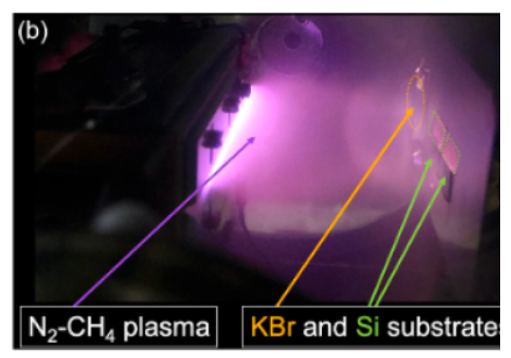
Titan tholins were produced in COSmIC by plasma chemistry in a jet-cooled (150 K) expansion of N2:CH4 (95:5) gas[5] and deposited for 10 hours on a silicon substrate to produce a ~800-nm layer of material. The tholin-coated substrate was manipulated in an inert atmosphere to minimize air exposure, before being placed inside the ACL chamber[6], on a cold finger located in the path of the IR beam of a Fourier transform infrared spectrometer. Under vacuum conditions (P < 6 x 10⁻⁸ Torr), target temperatures were defined and slowly reached (0.5 K min-1). C6H6 vapor was then introduced into the ACL chamber while monitoring the C6H6 vibrational modes and peak area growth rates between 500–7000 cm-1 (1.4–20 μm) with the FTIR until ice deposition began. This entire process was then repeated for different temperatures, enabling Scrit measurements for nucleation of C6H6 on tholins between 138–157 K. Similar measurements were also conducted on a blank silicon substrate, as a reference, to see the impact of the tholins on the benzene ice nucleation.

Figure 1. Photograph of the planar plasma expansion during the deposition of solid samples onto substrates (from [6]).

Results

We found a clear influence of tholins on the C6H6 nucleation, where we measured much lower Scrit values for benzene ice deposited on the tholin sample than on the blank silicon. Our nucleation measurements on both the tholin sample and Si substrates over the 138–157 K temperature range allowed us to derive a temperature dependence of Scrit, which increases with decreasing temperature. The Scrit values obtained on the tholin sample are a factor of ~2-3 lower than those measured on the bare Si substrate, which indicates that a lower degree of supersaturation is necessary for nucleation of C6H6 to proceed on the Titan tholin than on the smooth, chemically inert silicon substrate. Based on these laboratory measurements, we also conducted a new analysis of the south polar cloud microphysics with CARMA. We derived a temperature-dependent nucleation contact parameter of m = 2.6e-4 T + 0.9494, which was used to derive the benzene mixing ratio and the cloud particle number density at 87º S. We demonstrate the influence of the laboratory-derived temperature-dependent contact parameter on predicted cloud top height and describe the expected particle sizes.

Acknowledgements

Funding for this project is provided through NASA CDAP.

References

[1] Vinatier et al. 2018, Icarus, 310, 89-104.

[2] Barth, E. L. 2020, Atmosphere, 11(10), 1064.

[3] Iraci, L. T. et al. 2010, Icarus, 210, 985–991.

[4] Dubois et al. 2021, Planet. Sci. J. 2, 121.

[5] Sciamma-O’Brien, E. et al. 2023, The Planetary Science Journal, 4(7), 121.

[6] Dubois et al. 2025, EPSC-DPS Joint Meeting 2025, Helsinki, Finland, 7–12 Sep 2025, EPSC-DPS2025-1248.

How to cite: Dubois, D., Barth, E. L., Iraci, L., Sciamma-O'Brien, E., Salama, F., and Vinatier, S.: Interdisciplinary Study of Benzene Ice Critical Saturation Ratios on Titan Tholins and Microphysical Modeling of Titan's South Polar Benzene Cloud, Europlanet Science Congress 2026, The Hague, The Netherlands, 7–11 Sep 2026, EPSC2026-673, https://doi.org/10.5194/epsc2026-673, 2026.

16:56–17:08
|
EPSC2026-873
|
On-site presentation
Pascal Rannou and Clement Petetin

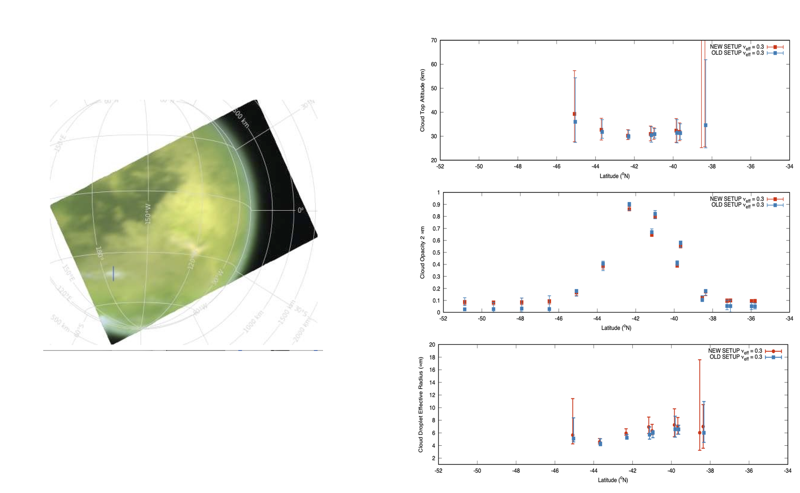
 The photochemical haze layer in the stratosphere and the condensation haze (hereafter, mist) in the lower stratosphere and troposphere completely cover Titan and play a dominant role in its climate. Beneath the haze layer, clouds are formed with a geographic and time pattern that is directly connected to the seasonal meteorological cycle. The instrument VIMS has observed a large amount of clouds of different nature during thirteen years of the Cassini mission.

In this work, we present the procedure and the underlying hypothesis used to characterize the cloud physical properties. Once the surrounding haze is fixed, we are able to retrieve the cloud top altitude, the cloud column opacity and when it is possible, the droplet effective radius. We will display preliminary results and will show comparisons with climate models. We will also discuss the method and its limitation discussed. A typical result obtained with an observation of a cloud at mid latitude is displayed in Figure 1.  

With the upcoming very large telescopes (Extremely Large Telescope, Thirty Meter Telescope,...) with high sensitivity and spectral resolution, this work shows it is important to fully understand past observations and to obtain as much information as possible from them. Finally, fully characterizing Titan’s atmosphere and climate with models to obtain the most accurate analysis and results from them is a major present-day objective to prepare for future missions to Titan such as Dragonfly.


Figure 1 : Left: Clouds observed with VIMS (1481591044_1) during the flyby T88 on 13 Dec 2004 at about 40°S. The blue line shows a latitudinal cut used for the retrieval. Right top: Physical properties of the cloud retrieved as a function of the latitude along the blue latitudinal cut shown at left with VIMS data as publicly available and with VIMS data corrected for the intensity.

How to cite: Rannou, P. and Petetin, C.: Cloud physical properties in Titan's atmosphere as probed with VIMS/Cassini., Europlanet Science Congress 2026, The Hague, The Netherlands, 7–11 Sep 2026, EPSC2026-873, https://doi.org/10.5194/epsc2026-873, 2026.

Pluto
17:08–17:20
|
EPSC2026-258
|
ECP
|
On-site presentation
Bruno de Batz de Trenquelléon, Tanguy Bertrand, Aurélien Falco, Emmanuel Lellouch, Panayotis Lavvas, Ella Sciamma-O’Brien, Ehouarn Millour, and François Forget

The thermal balance and cooling mechanisms of the atmosphere of Pluto have long remained a mystery. Observations of a global haze layer by the New Horizons mission [1,2], together with recent measurements from the James Webb Space Telescope [3], suggest that this haze may play a key role in shaping Pluto’s unusual atmospheric temperature profile. This haze-driven regime establishes Pluto’s atmosphere as a unique case within the Solar System.

Beyond the now well-established role of haze in Pluto’s thermal balance [3,4], its composition and precise radiative impact remain poorly constrained. Several one-dimensional microphysical models, developed based on observations from the New Horizons mission, have attempted to characterize the properties of Pluto’s aerosols. Initially, the haze was interpreted as analogous to that of Titan, dominated by purely photochemical processes [5,6]. However, more recent studies suggest that the aerosols may also include a significant fraction of organic ice [7], formed through direct condensation of major photochemical products in the cold upper atmosphere. Such a condensed component could reduce the efficiency with which haze particles regulate the atmospheric thermal balance. Current microphysical models do not account for a mixed population of both photochemical and icy haze and are not coupled to radiative transfer schemes, preventing a comprehensive assessment of the haze’s impact on Pluto’s atmospheric energy balance. Finally, the seasonal evolution of the haze over a Pluto year, as well as its influence on the annual variability of atmospheric temperature, remains entirely unexplored to date. Constraining the origin, evolution, and composition of Pluto’s haze is therefore essential to quantify its radiative effects and to better understand the planet’s atmospheric behavior and its place among hazy worlds in the Solar System.

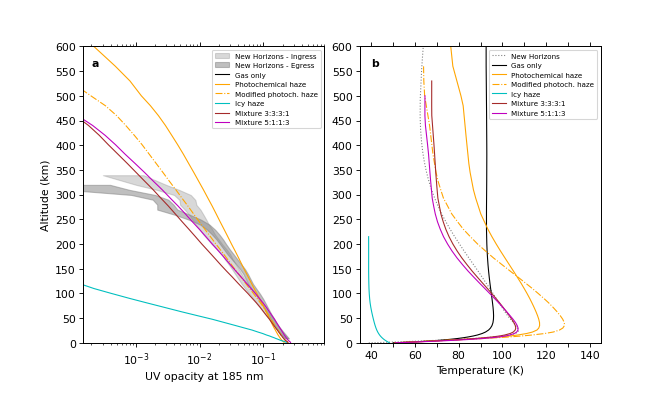
To constrain the origin of Pluto’s haze and assess its impact on the climate, we developed the Pluto Planetary Climate Model (Pluto PCM), a global climate model coupled to a microphysical scheme that describes haze and cloud formation and evolution, along with their impact on thermal balance and atmospheric dynamics (see T. Bertrand’s abstract). Here we show that Pluto’s haze is likely composed of a mixture of photochemical aerosols—analogous to those observed on Titan—and organic ices, reconciling observational constraints from both New Horizons (Fig. 1) and the James Webb Space Telescope. We further demonstrate that this haze governs the global thermal balance and is the primary driver of atmospheric cooling. In addition, we identify a seasonal cycle in the haze, providing a first coherent explanation for the opacity variations inferred from stellar occultation measurements. These findings suggest that the haze is not continuously present throughout the Plutonian year, with direct implications for the planet’s climate evolution. Finally, our results indicate that Pluto’s haze is unique within the Solar System, establishing Pluto as a natural laboratory for studying haze processes in tenuous atmospheres.

Fig. 1 UV opacity and temperature profiles of Pluto’s atmosphere. a Vertical UV opacity profiles at 185 nm derived from New Horizons solar occultations [1] (grey shaded regions), compared with the ones derived from the 1D Pluto PCM reference simulations for 2015. b Vertical temperature profile measured by New Horizons [1] (black dotted line) compared with the 1D Pluto PCM simulations shown in a.

References
[1] Gladstone, G. R. et al. The atmosphere of Pluto as observed by New Horizons. Science 351, aad8866 (2016).
[2] Cheng, A. F. et al. Haze in Pluto’s atmosphere. Icarus 290, 112–133 (2017).
[3] Bertrand, T. et al. Evidence of haze control of Pluto’s atmospheric heat balance from JWST/MIRI thermal light curves. Nature Astronomy 9, 1300–1308 (2025).
[4] Zhang, X., Strobel, D. F. & Imanaka, H. Haze heats Pluto’s atmosphere yet explains its cold temperature. Nature 551, 352–355 (2017).
[5] Gao, P. et al. Constraints on the microphysics of Pluto’s photochemical haze from New Horizons observations. Icarus 287, 116–123 (2017).
[6] Fan, S. et al. A bimodal distribution of haze in Pluto’s atmosphere. Nature Communications 13, 240 (2022).
[7] Lavvas, P. et al. A major ice component in Pluto’s haze. Nature Astronomy 5, 289–297 (2021).

How to cite: de Batz de Trenquelléon, B., Bertrand, T., Falco, A., Lellouch, E., Lavvas, P., Sciamma-O’Brien, E., Millour, E., and Forget, F.:  An icy haze controls Pluto’s atmospheric thermal balance at all seasons, Europlanet Science Congress 2026, The Hague, The Netherlands, 7–11 Sep 2026, EPSC2026-258, https://doi.org/10.5194/epsc2026-258, 2026.

17:20–17:32
|
EPSC2026-1278
|
Virtual presentation
Ella Sciamma-O'Brien, Lora Jovanović, Michel Nuevo, Claire L. Ricketts, Diane H. Wooden, Thomas Drant, Ashton Homyk, Aviraj Destidar, Lauren Scovel, and Farid Salama

I. Introduction

Aerosols formed by photolysis and radiolysis in planetary atmospheres impact the atmospheric chemistry, the formation of clouds, the climate, the surface composition, and affect spectra observed by space telescopes (e.g., the James Webb Space Telescope—JWST, and the Hubble Space Telescope—HST) and missions (e.g., Cassini, New Horizons, Juno). Morphological, spectral, and optical properties, as well as the chemical composition of analogs of planetary haze particles are therefore critical to constrain radiative transfer, photochemical, microphysical, and global circulation models used to analyze and interpret observational data returned by past and current missions (e.g., JWST, HST, Cassini, New Horizons, Juno), as well as to help with the technological advancement of observational capabilities for future missions (e.g., Dragonfly, Habitable Worlds Observatory–HWO). In this work, we produced laboratory analogs of Pluto and Jupiter aerosols (‘tholins’) in the NASA Ames COsmic SImulation Chamber (COSmIC) from N2:CH4:CO (98.95:1:0.05) and Ar:NH3:CH4:H2 (86.4:2.8:0.8:10) gas mixtures, respectively, and characterized their morphological, spectral, and optical properties, as well as their elemental composition. Furthermore, we conducted ultraviolet/extreme ultraviolet (UV/EUV) irradiation experiments at the National Synchrotron Radiation Research Center(NSRRC) in Hsinchu, Taiwan, to investigate the impact of the irradiation on the physical and chemical properties of these tholins.

II. Methods

Production of Aerosol Analogs with the NASA Ames COSmIC facility COSmIC uses a pulsed discharge nozzle (PDN) to expand a gas mixture through a very thin slit (127 µm × 10 cm) hence cooling the gas down to 150 K and reducing the pressure to 30 mbar[1] . Chemistry, induced in the cooled gas by generating a pulsed plasma discharge in the stream of the expansion, results in the formation of larger molecular products and solid particles that can be deposited on various substrates depending on the type of ex situ analysis to be conducted next. Short experiments (1–4 hours) are run to obtain samples with scattered grain deposition, to enable Scanning Electron Microscopy (SEM) analysis of individual particles, statistical size distribution analysis, and morphology characterization[2]. Long experiments (up to 40 hours) are run to produce tholin samples with layers of grains forming films up to 1 µm thick for spectral and elemental composition analyses[2-4] . In this study, Pluto and Jupiter samples were produced for both the SEM and optical constants analyses. Because of the large width of the slit in the COSmIC PDN and the small size samples needed for our ex situ analyses, we could obtain up to 15 samples in one run.

UV/EUV Irradiation at the NSRRC

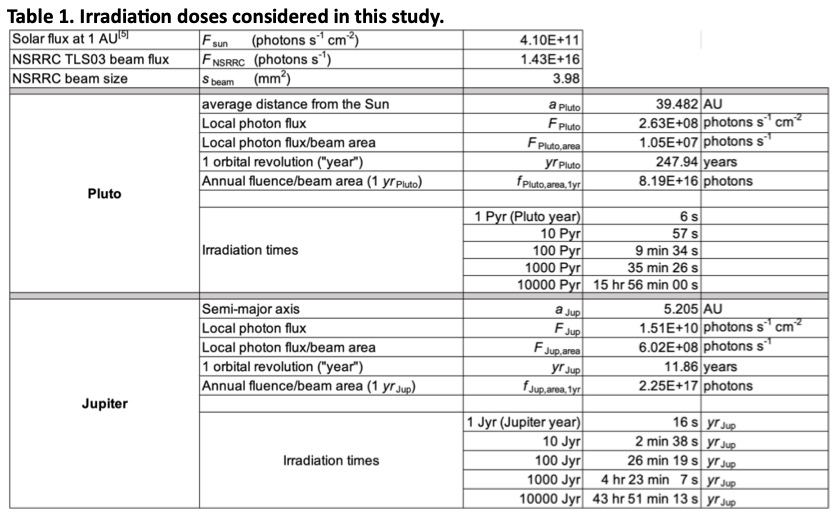
A subset of the Pluto and Jupiter tholins were irradiated with UV/EUV photons on NSRRC’s TLS03B beamline to study the impact of irradiation on their elemental composition and optical constants. Considering the solar flux expected to reach Pluto and Jupiter together with the known TLS03B beam photon flux and beam size, irradiation times were chosen to be equivalent to radiation doses of 1, 10, 100, 1000, and 10000 years on Pluto and Jupiter (see Table 1).

fileStorageProxy.php.jpg


Sample Characterization:

For both the pristine Pluto and Jupiter tholins and the irradiated tholins, we characterized their morphological, spectral, and optical properties using SEM, as well asreflectance and transmission spectroscopy (from 0.4 up to 200 μm) with the NASA Ames Optical Constants Facility (OCF). We also characterized their elemental composition using X-ray absorption spectroscopy at NSRRC’s TLS20A beamline (carbon edge from 275 to 315 eV, nitrogen edge from 400 to 435 eV, and oxygen edge from 520 to 570 eV).

III. Results

Here we present the results of these ex situ analyses, show the impact of the irradiation on the tholins’ physical and chemical properties, and discuss the importance of providing these experimental data via the NanoGrain database (NGdb, nanograin.odr.io) and the Optical Constants database (OCdb, ocdb.smce.nasa.gov) for the science community to use for the analysis and interpretation of observational data.

Acknowledgements: E.S.O., L.J., C.L.R., and F.S. acknowledge funding from NASA SMD CSSO and LADWP ISFMs. M.N. and D.H.W. acknowledge funding from NASA SMD CSSO ISFM. L.S. acknowledges funding from grant No. 80NSSC25M7129. A.H. acknowledges internship funding from the NASA Office of STEM Engagement (OSTEM). The authors thank J. Koehne, J. Varelas, and D. Ruth for helping with SEM, and E. Quigley and M. Jordan for technical support.

References:

[1] Salama, F., et al. Proceedings IAU Symposium 332, 13, 364 (2018)

[2] Sciamma-O’Brien, E., et al. Icarus, 289, 214 (2017)

[3] Nuevo, M., et al. Icarus, 376, 114841 (2022)

[4] Sciamma-O’Brien, E., et al. Planet. Sci. J., 4, 121 (2023)

[5] Gladstone, G. R., et al. Icarus, 246, 279 (2015)

How to cite: Sciamma-O'Brien, E., Jovanović, L., Nuevo, M., Ricketts, C. L., Wooden, D. H., Drant, T., Homyk, A., Destidar, A., Scovel, L., and Salama, F.: Impact of UV Irradiation on the Physicochemical Properties of Pluto and Jupiter Atmospheric Aerosol Analogs, Europlanet Science Congress 2026, The Hague, The Netherlands, 7–11 Sep 2026, EPSC2026-1278, https://doi.org/10.5194/epsc2026-1278, 2026.

Exoplanets
17:32–17:44
|
EPSC2026-115
|
ECP
|
On-site presentation
Abhyuday Chatterjee, Audrey Chatain, and Ludovic Vettier

Understanding habitability beyond Earth requires more than locating planets within the classical habitable zone. One crucial factor is the chemical availability of bioessential elements—particularly C, H, N, and O—and the geochemical pathways that convert them into life-accessible forms. Among the many interesting hypotheses of prebiotic chemistry on Earth, organic aerosols formed by photochemical and thermionic processes are predicted to play a significant role [1]. The organic haze in Titan presents a clear example of how organic aerosols can arise from photochemical and electrochemical pathways in the ionosphere of a nitrogen and methane-dominant environment. Several experiments have been conducted to produce organic aerosol analogs (tholins) to understand the chemistry behind their formation. Importantly, hydrolysis of these tholins has been proven to produce nucleic acid bases[2]. In this work, we start from the example of the atmospheres of Titan and the early Earth and then explore beyond the atmospheric composition. Our goal here is to understand how the presence of hydrogen (H2), carbon dioxide (CO2), or water vapour (H2O(g)) can alter the organic aerosol formation in the ionosphere of a nitrogen-dominant planetary environment. Several studies have pointed out that the presence of methane (CH4) is crucial for aerosol formation. Therefore, we kept CH4 in all our experiments and varied the ratios of the target gases to CH4 to determine the variation in chemical compositions of the formed aerosols. Transmission infrared spectroscopy is used to study the CN, CH, NH, and OH bands of the generated organic films. In-situ mass spectrometry and optical emission spectroscopy are also planned to identify the reactive and intermidiate species. The solid organic samples is being analysed by elemental analysis to determine the compositional change depending upon the gas mixture, indicating any variations in nitrogen and oxygen incorporations in the solid phase.

Experimental setup

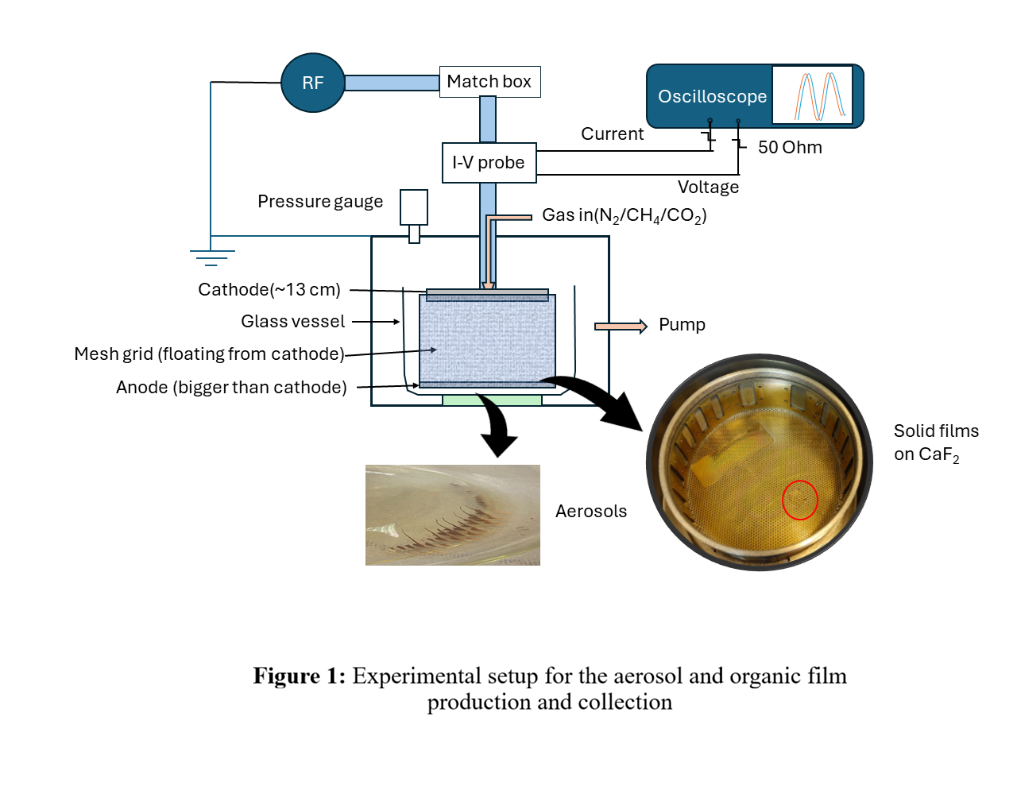
Experiments were performed in the PAMPRE reactor at LATMOS, using a capacitively coupled radiofrequency (RF) plasma at 13.56 MHz, a well-established tool for simulating ionospheric chemistry in planetary atmospheres [3]. The electron temperatures and densities achievable in this discharge are comparable to conditions in the upper atmospheres of Titan or Earth's ionosphere. A constant total gas flow of 55 sccm of N2/CH4/X mixtures (where X = CO2, H2, or H2O) was used, with N2 fixed at 90% by volume. A water bubbler kept at a constant 30 0C thermal bath is used to supply the water vapor into the reactor using a microleak. The CH4: X ratio was systematically varied to explore the dependency of the compositional variation upon the ratio. Organic particles were collected both as aerosols deposited on a quartz vessel outside the active plasma region and as solid films on CaF2 windows positioned above the anode, and exposed longer to the plasma. We wish to reveal the compositional difference of the films and the aerosols to differentiate between clustered monomers that settle down after a few growth and the material that remains several hours in the active electrochemical region.


First resulrs

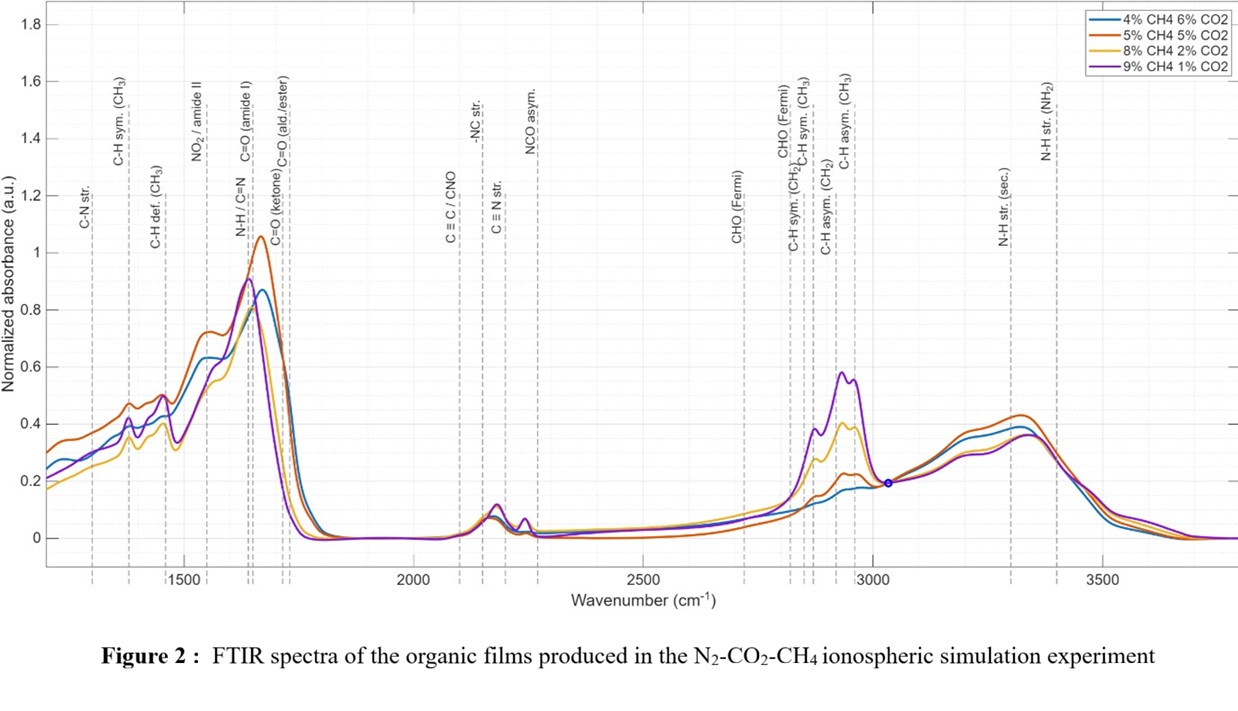
 FTIR Spectroscopy of Organic Films in N2-CH4-CO2

Fourier-transform infrared (FTIR) spectroscopy of the deposited organic films reveals systematic changes in chemical composition as a function of gas mixture. At CH4:CO2 < 1 (CO2-rich regime), the C–H stretching bands (2800-3000 cm-1) weaken, and the β-unsaturated and aryl nitrile band near 2210 cm-1 disappears, signaling a change in the nitrogen-bearing organic network formed. At CH4:CO2 < 1, the CO (1700 cm-1) and NO2(1570 cm-1) bands also become more prominent, suggesting incorporation of oxygenated functional groups. These spectral shifts reflect a fundamental change in chemical pathways between the CH4-rich and CO2-rich regimes, with implications for the optical properties of hazes in diverse planetary atmospheres. A detailed study of relative functional group strength change will be presented.

Ongoing and Planned Measurements

In-situ optical emission spectroscopy and mass spectrometry are being conducted to identify gas-phase reactive radicals (CO, NH, CN, and OH) and track how the addition of CO2, H2, or H2O modifies the ionospheric chemistry, therefore affecting the formation mechanism and chemical structure of the organic molecules. Elemental analysis (C, H, N, O) of solid aerosol samples will confirm bulk compositional shifts between gas mixture regimes. Finally, optical indices (refractive indices n and k) of the produced films will be measured from UV-visible to near infrared range (250-2500 cm-1) [4]. These optical constants are critical inputs for radiative transfer models of hazy exoplanet atmospheres and for interpreting JWST transmission spectra.

[1]Tuck, A. The Role of Atmospheric Aerosols in the Origin Of Life. Surveys in Geophysics 23, 379–409 (2002).https://doi.org/10.1023/A:1020123922767

[2] Kawai, J., Kebukawa, Y., McKay, C. P., & Kobayashi, K. (2019)Life Sciences in Space Research, 20, 20–29. https://doi.org/10.1016/j.lssr.2018.11.002

[3]C. Szopa, G. Cernogora, P. Bourdon, J.-P. Boaire, J.-J. Correia, C. Coll, Planet. Space Sci. 54 (2006) 394–404,

[4] Gavilan, L., Broch, L., Carrasco, N., Fleury, B., & Vettier, L. (2017).The Astrophysical Journal Letters, 848(1), L5., https://doi.org/10.3847/2041-8213/aa8cc4


How to cite: Chatterjee, A., Chatain, A., and Vettier, L.: Experimental study of the effect of CO2, H2, and water vapour  in aerosol production at nitrogen-dominant exoplanet ionospheres , Europlanet Science Congress 2026, The Hague, The Netherlands, 7–11 Sep 2026, EPSC2026-115, https://doi.org/10.5194/epsc2026-115, 2026.

17:44–17:56
|
EPSC2026-589
|
ECP
|
On-site presentation
Sofia Paraskevaidou and Panayotis Lavvas

Temperate exoplanets (Teq between 300 and 500 K) occupy a key but still underexplored atmospheric regime between Solar System planets and hotter exoplanets. Investigating their atmospheres is essential for interpreting future observations from the James Webb Space Telescope (JWST) and the ARIEL (Atmospheric Remote-sensing Infrared Exoplanet Large-survey) mission. Here we study the TOI-270 system, discovered by TESS and located 22.45 pc away [7]. The system consists of an M3 host star and three transiting planets: the super-Earth TOI-270 b, Teq ~ 600 K, and the temperate sub-Neptunes TOI-270 c and TOI-270 d, Teq ~ 489 and 383 K respectively, with TOI-270 d possessing the most constraining transmission spectrum in the system. Assuming retained atmospheres, we explore a range of metallicities, haze fluxes, and cloud-species scenarios. Atmospheric structures are simulated using a 1D, self-consistent forward model coupling stellar energy deposition, disequilibrium chemistry, and haze/cloud microphysics from the deep atmosphere, 10³ bar, to the upper thermosphere, 10-¹⁰ bar [1,2,9]. This system allows us to examine how irradiation and orbital distance may shape atmospheric composition, cloud formation, and possible formation pathways. Studying an exoplanetary system also helps separate effects caused by orbital distance from those caused by composition, making TOI-270 a useful study case for comparative atmospheric characterization and evolutionary processes.

By exploring a range of atmospheric metallicities from 50x to 400x solar, we evaluate haze formation and the vertical distribution of clouds. For TOI-270 d, the light-haze cases produce thermal structures and compositions that result in a deep cloud deck formation, ≥1 bar, composed of KCl, NaCl, and ZnS, providing a good match to most of the JWST transmission spectrum. The favored metallicity depends on the observational dataset, but the spectra generally favor 200–300x solar, in agreement with previous studies [3,5], with the main molecular signatures of H₂O, CH₄, CO₂, COS, and NH₃ (Fig. 1). As noted in previous studies, the loss of NH₃ improves the comparison with observations. Since condensation is unlikely due to the elevated temperature, we tested subsolar nitrogen compositions. Lowering [N/H] was more effective than lowering [N/S] in suppressing NH3, but neither case changed the abundance of CS2 near 4.5 microns. Despite many attempts to enhance the signature of CS₂ [3], such as including photoelectron chemistry [10] and modified stellar UV flux, none appears to produce the required amount around 10-³ bar. Currently, the CS₂ mole fraction is around 10-⁷, meaning that an increase of about 10⁴ would be required for detectability. Such an enhancement is unlikely because CS2 is limited by the available sulfur from H2S. Even at 400x metallicity, H2S reaches only ~ 10-2, and only part of this sulfur budget can form CS2. Therefore, CS₂ cannot realistically exceed this upper limit.

In contrast, atmospheric constraints for TOI-270 b and TOI-270 c remain limited due to the quality and wavelength coverage of current observations, which include JWST dual-transit extractions [4,6] and HST/WFC3 data [11], respectively. For TOI-270 b, both a clear and light hazy atmosphere at ~10x solar metallicity with [C/O] < 0.55 reproduce the observations, though shorter-wavelength observations are required to assess the necessity of hazes. Nonetheless, the light haze’s simulated thermal structure and composition again favor cloud formation, with KCl, NaCl, and ZnS clouds forming near ~10-¹ bar. The detection of H₂O in TOI-270 b is consistent with the interpretation of Coulombe et al. [4], who found that the planet can plausibly host a volatile-rich atmosphere and argued that stellar TLS (Transit Light-Source) contamination is unlikely. We therefore assume that TLS effects do not significantly affect the available spectra. For TOI-270 c, the low signal-to-noise ratio prevents meaningful discrimination between atmospheric scenarios, although the thermal structure permits cloud condensation future observations are needed to test whether hazes or clouds are required.

Concerning a possible formation pathway, the presence of H2O in TOI-270 b and TOI-270 d suggests that water-bearing material may have been incorporated during formation, consistent with accretion near or beyond the H2O ice line followed by inward migration [10,13]. For TOI-270 b, the oxygen-rich composition favored by our simulations may indicate enrichment by water- or oxide-rich solids. In contrast, the molecular inventory of TOI-270 d, including CO2 and CH4 together with the reduced NH3 signature, may point to formation farther out in the disk, where ice-line chemistry and subsequent atmospheric reprocessing under irradiation shaped the present-day composition [12]. Overall, the TOI-270 planets may have been shaped by disk ice-line chemistry and inward migration, while their volatile-rich compositions and the low activity of the host star are more consistent with long-term atmospheric retention than with catastrophic atmospheric loss, since fully stripped planets would be expected to resemble compact rocky cores rather than volatile-bearing sub-Neptunes.

Figure 1: Simulated transmission spectrum of TOI-270 d compared with JWST observations. The upper two panels show the modeled 200x solar metallicity hazy atmosphere and two subsolar-composition variants overplotted with observational datasets. The third panel shows the wavelength-dependent contribution of individual opacity sources, computed as the difference in transit depth relative to the nominal model.

References

[1] A. Arfaux et al. Monthly Notices of the Royal Astronomical Society 515.4 (2022), pp. 4753–4779. doi: 10.1093/mnras/stac1772.

[2] A. Arfaux et al. Monthly Notices of the Royal Astronomical Society 530.1 (2024), pp. 482–500. doi: 10.1093/mnras/stae826.

[3] B. Benneke et al. arXiv e-prints (2024), arXiv:2403.03325. doi: 10.48550/arXiv.2403.03325.

[4] L.-P. Coulombe et al. The Astronomical Journal 170.4 (2025), p. 226. doi: 10.3847/1538-3881/adfc6a.

[5] L. Felix et al. Astronomy & Astrophysics 701 (2025), A296. doi: 10.1051/0004-6361/202555194.

[6] M. Holmberg et al. Astronomy & Astrophysics 683 (2024), L2. doi: 10.1051/0004-6361/202348238.

[7] M. N. Günther et al. Nature Astronomy 3 (2019), pp. 1099–1108. doi: 10.1038/s41550-019-0845-5.

[8] N. Madhusudhan et al. The Astrophysical Journal Letters 791.1 (2014), L9. doi: 10.1088/2041-8205/791/1/L9.

[9] P. Lavvas et al. Monthly Notices of the Royal Astronomical Society 502.4 (2021), pp. 5643–5657. doi: 10.1093/mnras/stab456.

[10] P. Lavvas et al. arXiv e-prints (2026), arXiv:2603.26474. doi: 10.48550/arXiv.2603.26474.

[11] T. Mikal-Evans et al. The Astronomical Journal 165.3 (2023), p. 84. doi: 10.3847/1538-3881/aca90b.

[12] J. I. Moses et al. The Astrophysical Journal 777.1 (2013), p. 34. doi: 10.1088/0004-637X/777/1/34.

[13] K. I. Öberg et al. The Astrophysical Journal Letters 743.1 (2011), L16. doi: 10.1088/2041-8205/743/1/L16.

How to cite: Paraskevaidou, S. and Lavvas, P.: Investigating the atmospheric composition of the TOI-270 system: Haze and cloud formation, Europlanet Science Congress 2026, The Hague, The Netherlands, 7–11 Sep 2026, EPSC2026-589, https://doi.org/10.5194/epsc2026-589, 2026.

Posters: Mon, 7 Sep, 18:00–19:30 | Foyer 3

Display time: Mon, 7 Sep, 08:30–19:30
F3.1
|
EPSC2026-363
|
ECP
|
On-site presentation
Colombe Maurice, Olwen Rering, Audrey Chatain, and Sandrine Vinatier

1. Introduction 

Titan hosts a unique atmosphere in the Solar System, characterized by an extremely complex organic chemistry. Composed primarily of nitrogen (≈ 98% N2 ) and methane (≈1.5% CH4 ) in the stratosphere, it undergoes photochemical processes driven by solar radiation and energetic particles, leading to the formation of a wide range of complex organic species.

These processes result in the production of photochemical aerosols, initially formed in the ionosphere at altitudes between 900 and 1300 km as spherical monomers of less than 10–30 nm in size (Lavvas et al. (2013)). These particles then sediment into the stratosphere, where they aggregate into fractal structures and continue to evolve through additional chemical and physical processes. They ultimately settle onto the surface over timescales of a few years.

The Cassini-Huygens mission provided observational constraints on aerosol composition, revealing variations in infrared spectral signatures with latitude and altitude. However, the physical and chemical processes driving these variations — and their seasonal evolution — remain poorly understood. Laboratory analogues offer a powerful approach to disentangling these effects, yet a direct and systematic comparison with observational data across a broad range of latitudes and seasons has not yet been performed.

2. Methods

The methodology adopted in this work combines both observational and experimental approaches in order to better constrain the nature of Titan’s photochemical aerosols.

The observational approach consists of analyzing the continuum of Cassini/CIRS limb spectra, following the methodology developed by Vinatier et al. (2012). We retrieved the aerosols spectrum over the 7–16 µm (600–1500 cm-1 ) spectral range from high-resolution limb observations collected throughout the Cassini mission, from 2006 to 2015  (Mathé et al. (2020)). This allows us to investigate spatial and seasonal variability across latitudes from 84°S to 88°N and spanning northern winter, equinox, and northern spring.

In parallel, we produced tholins with the PAMPRE experiment (Szopa et al. (2006)), which simulates ion-driven chemistry responsible for aerosol formation on Titan, using different input gas mixtures. Infrared spectroscopy of the samples was performed over the same spectral regions as observed by CIRS, following approaches described in Gautier et al. (2012). Complementary techniques — SEM (scanning electron miscroscopy), elemental analysis, and mass spectrometry — allow for further characterization of their physical and chemical properties.

Previous studies (Hadamcik et al. (2009)) explored the influence of experimental parameters on Titan aerosol analogues, but without direct comparison to the large seasonal and latitudinal variability observed by Cassini. Here, by varying gas composition and plasma exposure time — allowing the chemistry to evolve to different stages — and comparing the resulting spectra with CIRS observations acquired over a wide range of latitudes and seasons, we aim to better constrain the chemical composition of Titan’s aerosols and its evolution with atmospheric conditions.

3. Results and perspectives

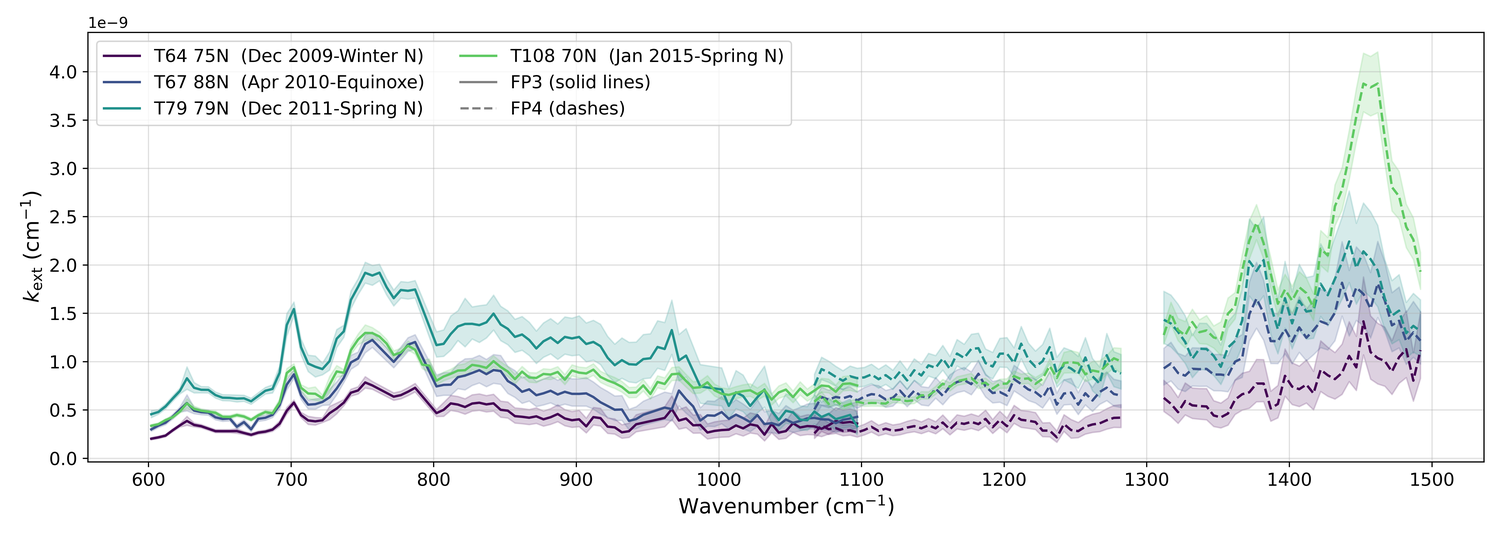
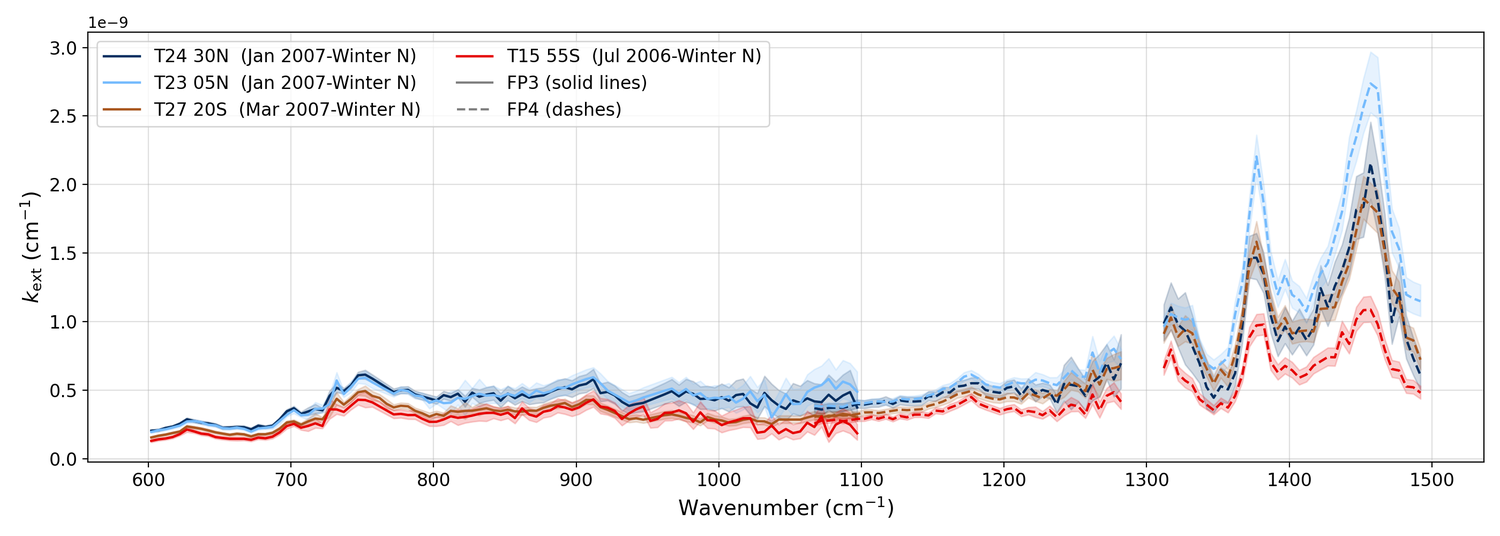
The analysis of the Cassini/CIRS high-resolution limb spectra, with spectral bins of 5 cm-1 wide over the 600–1500 cm-1 spectral range, reveals no latitudinal variations of the haze extinction coefficient kext during Titan’s northern winter (Figure 1), suggesting stable aerosol composition with latitude during this season. In contrast, clear seasonal variations are observed throughout Titan's northern spring (Figure 2), with differences in band intensity near 1380 cm-1 and 1460 cm-1 — associated with C–H vibrational modes — indicating seasonal changes in aerosol composition.

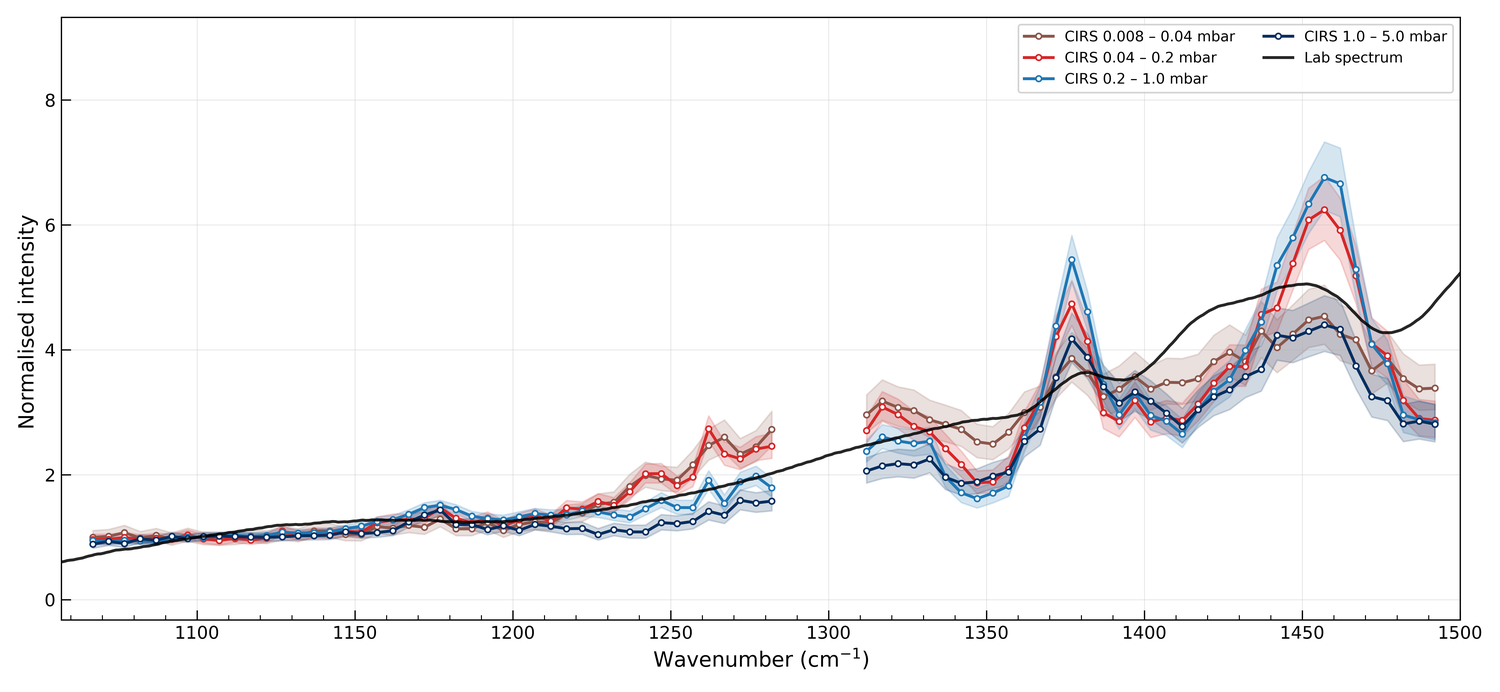
Figure 3 presents a preliminary comparison between a CIRS spectrum near the equator (5°N) at different pressure levels and a tholin spectrum from the PAMPRE experiment using a 5% CH4 mixture at 55 sccm. The partial agreement observed in the 1380–1460 cm-1 region supports the relevance of PAMPRE tholins as aerosols analogues.

The next step of this work is to perform a systematic comparison between the aerosol observed spectra and the full laboratory tholin dataset to constrain, aerosol composition and chemical complexity as a function of altitude, latitude, and season — providing a basis for interpreting future Dragonfly mission measurements at Titan's surface.

Figure 1: Comparison of the haze extinction coefficient kext at four latitudes during Titan’s northern winter, from 600  cm-1 to 1500 cm-1 between 0.2-1 mbar (≈ 175-220 km), observed with the FP3 and FP4 detectors of the Cassini/CIRS instrument.

Figure 2: Comparison of the haze extinction coefficient kext at four latitudes across Titan’s northern spring, from 600 cm-1 to 1500 cm-1 between 0.2-1 mbar (≈ 175-220 km), observed with the FP3 and FP4 detectors of the Cassini/CIRS instrument.

Figure 3: Preliminary comparison in the 1000-1500 cm-1 spectral range between a CIRS spectrum at 05°N during the T23 flyby, retrieved at different pressure levels in Titan’s atmosphere, and a tholin spectrum produced in the PAMPRE experiment using a 5% CH4 mixture at a flow rate of 55 sccm, both normalized at 1100 cm-1 .

References

[1] P. Lavvas et al. “Aerosol growth in Titan’s ionosphere”. In: Proceedings of the National Academy of Sciences 110.8 (2013), pp. 2729–2734. doi: 10.1073/pnas.1217059110.

[2] S. Vinatier et al. “Optical constants of Titan’s stratospheric aerosols in the 70–1500 cm−1 spectral range constrained by Cassini/CIRS observations”. In: Icarus 219.1 (2012), pp. 5–12. doi: 10.1016/j.icarus.2012.02.009.

[3] C. Mathé et al. “Seasonal changes in the middle atmosphere of Titan from Cassini/CIRS observations: Temperature and trace species abundance profiles from 2004 to 2017”. In: Icarus 344 (2020). Cassini Mission Science Results, p. 113547. doi: 10.1016/j.icarus.2019.113547.

[4] C. Szopa et al. “PAMPRE: A dusty plasma experiment for Titan’s tholins production and study”. In: Planetary and Space Science 54.4 (2006), pp. 394–404. doi: 10.1016/j.pss.2005.12.012.

[5] T. Gautier et al. “Mid- and far-infrared absorption spectroscopy of Titan’s aerosols analogues”. In: Icarus 221.1 (2012), pp. 320–327. doi: 10.1016/j.icarus.2012.07.025.

[6] E. Hadamcik et al. “Laboratory light-scattering measurements with Titan’s aerosols analogues produced by a dusty plasma”. In: Planetary and Space Science 57.13 (2009), pp. 1631–1641. doi: 10.1016/j.pss.2009.06.013.

How to cite: Maurice, C., Rering, O., Chatain, A., and Vinatier, S.: Seasonal and Latitudinal Variability of Titan's Stratospheric Aerosols Composition: Cassini/CIRS and Laboratory Constraints, Europlanet Science Congress 2026, The Hague, The Netherlands, 7–11 Sep 2026, EPSC2026-363, https://doi.org/10.5194/epsc2026-363, 2026.

F3.2
|
EPSC2026-461
|
On-site presentation
Tanguy Bertrand, Bruno de Batz de Trenquelléon, Aurélien Falco, Gabin Tabellion, Emmanuel Lellouch, Aymeric Spiga, François Forget, and Ehouarn Millour

As one of the ten atmospheres in the Solar System, Pluto offers a remarkable natural laboratory to test our understanding of atmospheric dynamics and physics, and to investigate the diversity of possible climate regimes.

We present a new version of the 3D Pluto Planetary Climate Model (PCM) in which haze microphysics is fully coupled to radiative transfer, allowing for the first time for a self-consistent representation of the radiative impact of photochemical and icy aerosols in Pluto’s atmosphere [Bertrand et al., 2020, Falco et al., 2024, de Batz de Trenquelléon et al., 2025]. The inclusion of radiatively active haze reduces the atmospheric radiative time constant by approximately an order of magnitude compared to the gas-only configuration [de Batz de Trenquelléon et al., this issue]. This modification leads to profound changes in the simulated climate and circulation.

In the absence of haze, the general circulation in the lower atmosphere is dominated by a retro-rotation. The long radiative timescale results in weak meridional temperature gradients and meridional winds. This is an angular-momentum-dominated general circulation regime, in which heating gradients imposed by insolation are efficiently erased by dynamical mixing [Forget et al., 2017, Bertrand et al., 2020].

In contrast, simulations with radiatively active haze exhibit a markedly different dynamical behavior. The shorter radiative timescale enhances radiative heating gradients and allow weak meridional temperature gradients. This leads to an enhanced baroclinic activity, associated with significantly stronger meridional circulation and mid-latitude prograde jets.

Our results illustrate that radiative feedbacks from the haze can shift Pluto’s atmosphere between fundamentally different dynamical regimes, from a quiescent, angular-momentum-controlled state to a more active, baroclinic circulation. They also place Pluto in a broader comparative context. In particular, a strong analogy can be drawn with Mars, where variations in dust loading similarly modulate the radiative timescale and control the intensity and vertical structure of baroclinic activity. Our results also provide some explanations for several observations of Pluto, in particular the atmospheric meridional heating gradient observed with ALMA [Lellouch et al., 2022] as well as the year-to-year variability in haze opacity derived from stellar occultations [see review in Meza et al., 2018].


References:

de Batz de Trenquelléon, B., Bertrand, T., Falco, A., Lellouch, E., Millour, E., & Forget, F. (2025). Investigating the Radiative Balance of Pluto's Atmosphere (No. EPSC-DPS2025-638). Copernicus Meetings.

Bertrand, T., Forget, F., White, O., Schmitt, B., Stern, S. A., Weaver, H. A., et al. (2020). Pluto's beating heart regulates the atmospheric circulation: Results from high‐resolution and multiyear numerical climate simulations. Journal of Geophysical Research: Planets, 125(2), e2019JE006120.

Falco, A., Bertrand, T., Forget, F., Millour, E., Charnay, B., & de Batz de Trenquelléon, B. (2024, September). After New Horizons, a new Pluto Climate Model for new challenges. In European Planetary Science Congress (pp. EPSC2024-400).

Forget, F., Bertrand, T., Vangvichith, M., Leconte, J., Millour, E., & Lellouch, E. (2017). A post-new horizons global climate model of Pluto including the N2, CH4 and CO cycles. Icarus, 287, 54-71.

Lellouch, E., Butler, B., Moreno, R., Gurwell, M., Lavvas, P., Bertrand, T., et al. (2022). Pluto’s atmosphere observations with ALMA: Spatially-resolved maps of CO and HCN emission and first detection of HNC. Icarus, 372, 114722.

Meza, E., Sicardy, B., Assafin, M., Ortiz, J. L., Bertrand, T., Lellouch, E., et al. (2019). Lower atmosphere and pressure evolution on Pluto from ground-based stellar occultations, 1988–2016. Astronomy & Astrophysics, 625, A42.

How to cite: Bertrand, T., de Batz de Trenquelléon, B., Falco, A., Tabellion, G., Lellouch, E., Spiga, A., Forget, F., and Millour, E.: How Radiative Haze Reshapes Pluto’s Atmospheric Dynamics, Europlanet Science Congress 2026, The Hague, The Netherlands, 7–11 Sep 2026, EPSC2026-461, https://doi.org/10.5194/epsc2026-461, 2026.

F3.3
|
EPSC2026-1240
|
On-site presentation
Leoni Janssen, Yamila Miguel, Michiel Min, Helong Huang, Mantas Zilinskas, and Christian P.A. van Buchem

The  atmosphere of the hot super Earth 55 Cnc e shows strong variability, for which cloud formation above a molten crust could be one possible explanation. If cloud formation takes place in a planetary atmosphere this affects the gas composition, its cooling and heating rates and it can dim or lead to spectral features. We have run cloud formation models for atmospheres of hot super Earths with various oxidation states. Our models combine radiative transfer with equilibrium chemistry of the gaseous and condensed phases, vertical mixing of condensable species, sedimentation, nucleation and coagulation. In this talk I will present the results of this study, focusing on the impact of the oxidation state of rocky planet atmospheres on cloud stability and composition. I will also discuss the main spectroscopic features which we can expect from these clouds in the wavelength range covered by JWST and Ariel.

How to cite: Janssen, L., Miguel, Y., Min, M., Huang, H., Zilinskas, M., and van Buchem, C. P. A.: Exotic clouds on molten super-Earths, Europlanet Science Congress 2026, The Hague, The Netherlands, 7–11 Sep 2026, EPSC2026-1240, https://doi.org/10.5194/epsc2026-1240, 2026.