
 1,1,2,1,1,3,3
- 1Department of Earth Science & Engineering, Imperial College London, London, UK (c.bill23@imperial.ac.uk)
- 2Department of Earth, Atmospheric and Planetary Sciences, Purdue University, West Lafayette, USA
- 3Natural History Museum, London, UK
Large impact basins provide key insights into planetary evolution by excavating and redistributing deep material. The South Pole–Aitken (SPA) Basin on the Moon and the Hellas Basin on Mars are among the largest known impact structures in the Solar System. Observations indicate that both impact events significantly modified crustal structure and exposed deep crustal and potentially mantle material (e.g., [1-4]). Numerical modelling allows these observations to be used to constrain basin formation and improve our broader understanding of basin-scale impact processes across planetary bodies.
3D numerical simulations of the SPA and Hellas basin formation were conducted using iSALE-3D [5-6]. Simulations explored impact velocities of 10–20 km s⁻¹, oblique impact angles of 20–45°, and a range of target thermal gradients representative of early lunar and martian interiors. Targets were modelled as spherical layered bodies and impactors as differentiated spheres, with materials defined by ANEOS-derived equations of state [7-10] and strength models from [11]. Simulations were run up to 5 hours post-impact, until crustal motions stabilised. Simulated crustal thickness, topography, and material distributions were compared with observation-based constraints, including basin morphology and crustal structure datasets [1, 12].
Best-fit scenarios for both SPA and Hellas favour moderately oblique impacts at an angle of 30° to the tangent plane, which produce elongated basin planforms that are consistent with the observed basin shapes (Figure 1a-b). This supports the idea that, for impacts large enough for planetary curvature to influence basin-forming dynamics, moderately oblique impacts produce elliptical basins.
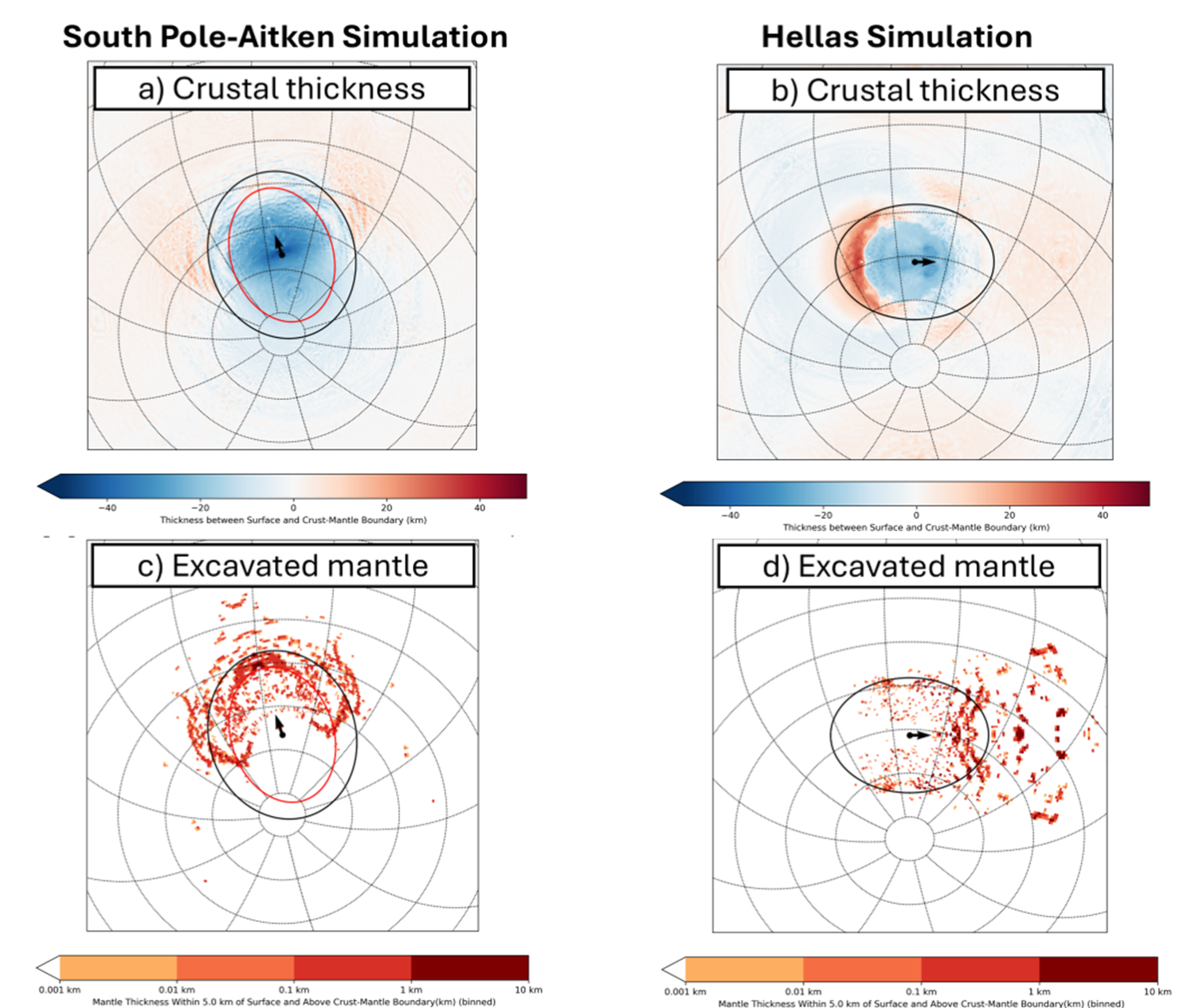
Figure 1: Left: a best-fit SPA basin-forming simulation employing a 200km diameter impactor striking a target with a 30K/km near-surface thermal gradient and 1700K mantle at 11.1km/s and a 30° impact angle. Inner and outer ellipses [13] and the centre of the basin are plotted. A northwards impact trajectory is assumed. Right: a best-fit Hellas basin-forming simulation employing a 480km diameter impactor striking a target with a 30K/km near-surface gradient and 1400K mantle at 10km/s and a 30° impact angle. Here, the crust is still deforming and has not yet reached its final state at 5 hours post-impact. An ellipse shows the approximate outline of the observed basin, and an eastward impact trajectory is assumed. In the top figures, the change in crustal thickness induced by the simulation is shown, with areas of thickened crust in red and thinned crust in blue. In the lower figures, the integrated thickness of mantle above or entrained in the crust and within 5km of the model surface is shown. Each map shows the simulation at 5 hours after impact.
Basin-scale impacts are highly sensitive to target thermal structure and rheology, yet the pre-impact thermal states of both bodies are not yet well constrained. Simulation results show that impacts into warm, thermally weakened crust provide the best-fit for both SPA and Hellas, suggesting early formation times when lower crust and mantle temperatures were close to the solidus. In cases employing a cooler target, a thickened crust surrounds the basin whilst the mantle remains exposed at the basin centre. To produce a thin crust in the basin consistent with present-day observations, these scenarios would require a secondary buoyant crust to be produced from the mantle melt pool.
The preferred warmer scenarios produce extensive material redistribution, including crustal rafting that covers mantle exposed at the basin centre (Figure 2e-h) and asymmetrical, downrange “butterfly” patterns of ejecta (Figure 1c-d). Mantle material is excavated during both the excavation stage and central uplift collapse. However, continued post-impact crustal motion and inward crustal rafting bury or entrain much of this mantle beneath and into the redistributed crust. Thus, a large portion of the excavated mantle becomes mixed within the upper crust rather than remaining exposed at the surface. The precise trajectories and therefore the ultimate distribution of the material excavated by each of these basin-forming impacts remain uncertain.
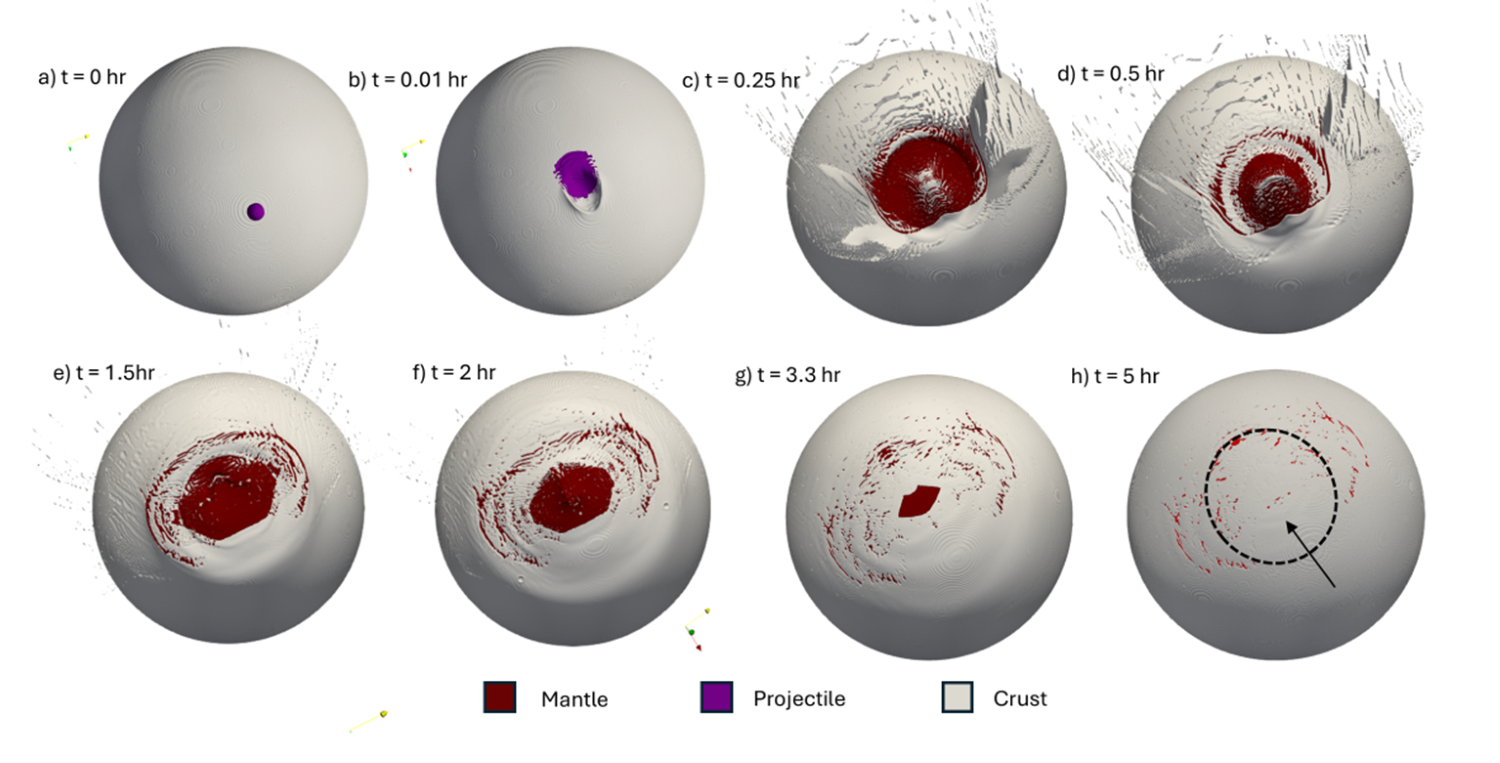
Figure 2: Snapshots from an iSALE-3D simulation at different timesteps for a 200 km diameter impactor striking a 30 K/km Moon-like target with a 1700 K mantle at a 30° impact angle and 11.1 km/s velocity. The impact direction is toward the upper left (arrow) and the approximate outer rim of the basin (dashed outline) is shown in the final snapshot.
Ongoing and future work will investigate the effects of lateral variations in crustal thickness and thermal structure on basin formation and material redistribution. This will help better constrain impact direction and the fate of excavated material, while providing new insights into the role of basin-forming impacts in the early evolution of the Moon and Mars.
Acknowledgments: CB is funded by the Kentfield Scholarship. This work used the DiRAC Data Intensive service at the University of Leicester, managed by the University of Leicester Research Computing Service on behalf of the STFC DiRAC HPC Facility. This DiRAC service was funded by BEIS, UKRI and STFC capital funding and STFC operations grants. DiRAC is part of the UKRI Digital Research Infrastructure.
References : [1] Wieczorek, M.A. et al. (2013) Science 339: 671-675. [2] Melosh, H.J. et al (2017) Geology, 45 (12), 1063-1066. [3] Moriarty, D. et al. (2021) JGR: Planets, 126(1), e2020JE006589 [4] McNeil, J., et al. (2025), PSC–DPS Joint Meeting 2025, Helsinki, Finland, Abstract EPSC-DPS2025-617. [5] Elbenhausen, D. et al. (2009) Icarus, 204:716-731. [6] Elbenhausen, D. & Wünnemann, K. (2011) 11th Hypervelocity Impact Soc. Symposium. [7] Thompson, S. L. & Lauson, H. S. (1972). Sandia National Laboratory Report, SC-RR-710:309p. [8] Benz, W. et al. (1989). Icarus, 81:113–131. [9] Pierazzo, E. et al. (1997). Icarus, 127:408–423. [10] Ivanov, B. A. et al. (2010). Geol. Soc. Spec. Pap. 465:29– 49. [11] Potter, RWK et al. (2012) Icarus, 220, 730–743. [12] Wieczorek, M. et al. (2022), JGR: Planets, 127, e2022JE007298. [13] Garrick-Bethell & Zuber (2009), Icarus, 204(2), 399–408. https://doi.org/10.1016/j.icarus.2009.05.032.
How to cite: Bill, C., Collins, G., Davison, T., Johnson, B., Wakita, S., Sokolowska, A., Coombes, O., Kallenborn, D., Grindrod, P., and McNeil, J.: 3D Numerical Modelling of the South Pole-Aitken and Hellas Basin-Forming Impacts, Europlanet Science Congress 2026, The Hague, The Netherlands, 7–11 Sep 2026, EPSC2026-1156, https://doi.org/10.5194/epsc2026-1156, 2026.


