
 1,1
1,1- 1Edinburgh University, Institute for Astronomy, School of Physics and Astronomy, Edinburgh, United Kingdom of Great Britain – England, Scotland, Wales (james.robinson@ed.ac.uk)
- 2Astrophysics Research Centre, School of Mathematics and Physics, Queen’s University Belfast, Belfast BT7 1NN, UK
The Legacy Survey of Space and Time (LSST) at the Vera C. Rubin Observatory is predicted to discover ~6 million new solar system objects (SSOs) over 10 years of operation. For every visit the solar system processing pipeline (SSP) will automatically associate difference image sources with known SSOs and issue public alert packets containing details of each detection within minutes of exposure. The depth and resolution of the LSST Camera (LSSTCam) means that these SSO alerts will be an excellent resource to search for transient activity of asteroids and comets. Such events could be caused by the onset of cometary activity, outbursts, fragmentation, and collisional or rotational induced activity. Each visit is expected to generate ~10,000 alerts (with ~100s of SSOs) and so the ability to rapidly identify and narrow down events of interest will help to prioritise follow up observations. The analysis of activity across the SSO populations will help inform us of their physical properties and the processes by which they evolve.
The Adler software package is an LSST:UK in-kind contribution of analysis tools to detect and characterise SSO activity in the LSST alert stream. It is an open source package which is intended to allow an automated analysis of alerts served by a broker, or for users to perform their own analysis on the Rubin Science Platform (RSP). Adler will digest both the photometric measurements and cutout images provided in alerts. By using a range of models describing asteroid brightness, through phase angle and rotational effects, Adler will compare the new photometric measurement to the predicted brightness of an SSO and identify outliers which could indicate an activity event. Furthermore, Adler will perform image analysis techniques specific to active SSOs. Wedge photometry measures fluxes in azimuthal bins centred on the target in order to identify the presence and direction of cometary tails. We also apply a noise-based non-parametric detection technique (NoiseChisel; originally designed for detection of low surface brightness galaxies) in order to characterise the extent of faintly active SSOs. Such image analyses could run on the small cutout images supplied with the alert packet and on larger cutouts retrieved via the RSP after the standard 80 hour embargo period.
At the time of writing the Rubin Observatory is in the final stages of preparation prior to commencement of the LSST proper. As such Adler is being developed and tested on the available early science data, namely Data Preview 1 (taken with the Commissioning Camera), intermittent pre-survey LSSTCam alerts, and the database of photometry submitted to the Minor Planet Center as part of SSP validation. We present the capabilities of Adler's photometric and image-based analysis and initial results from this early data.
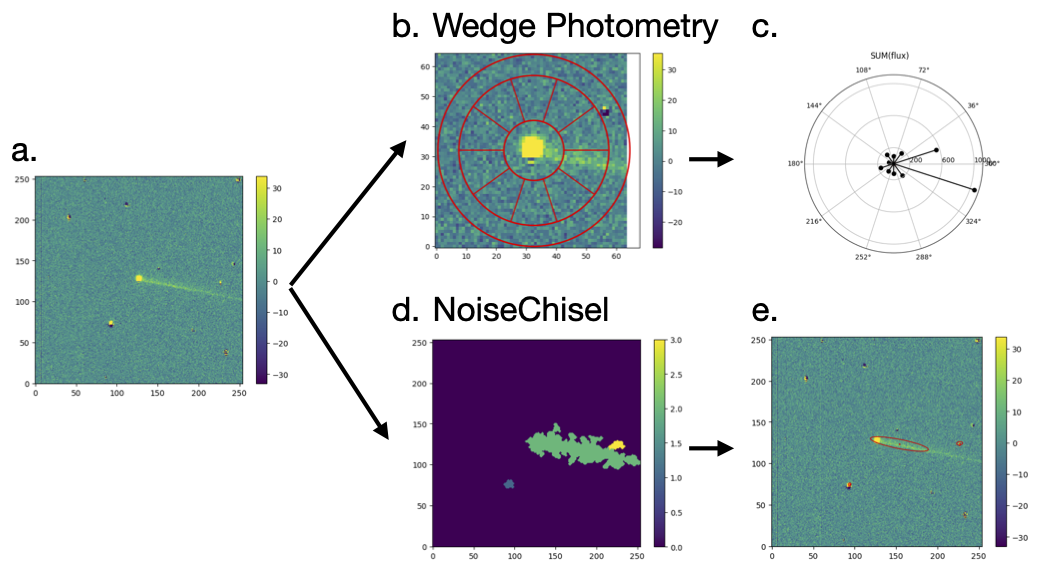
Figure 1. Adler (1) provides a python wrapper for Gnuastro (2) image analysis routines to aid in active solar system object detection and characterisation: wedge photometry (3) and NoiseChisel (4).
a. Input ZTF difference image of the Didymos asteroid system, where the activity was initiated by the DART mission impact on the secondary Dimorphos.
b. Azimuthal bins used in the wedge photometry analysis.
c. Radial plot of the sum of flux in each azimuthal bin, showing a flux excess due to the dust tail.
d. Identification of sources and their extent using NoiseChisel.
e. Image showing some of the source properties from ellipsoidal fits to the pixels identified by NoiseChisel.
References:
1. https://github.com/lsst-uk/lsst-adler
2. GNU Astronomy Utilities 0.24, https://doi.org/10.5281/zenodo.17726900
3. Raúl Infante-Sainz et al 2024 Res. Notes AAS 8 22, https://doi.org/10.3847/2515-5172/ad1ee2
4. Akhlaghi, M.; Ichikawa, T. Noise Based Detection and Segmentation of Nebulous Objects. ApJS 2015, 220 (1), 1. https://doi.org/10.1088/0067-0049/220/1/1
How to cite: Robinson, J. E., Schwamb, M. E., Opitom, C., and Snodgrass, C.: Adler: Detection and Characterisation of Activity in LSST Alerts, Europlanet Science Congress 2026, The Hague, The Netherlands, 7–11 Sep 2026, EPSC2026-1164, https://doi.org/10.5194/epsc2026-1164, 2026.


