
 1
1- 1Aix-Marseille Université, CNRS, CNES, LAM, Marseille, France.
- 2Aix Marseille Université, CNRS, Centrale Marseille, FSCM, Spectropole, Marseille, France
- 3Aix-Marseille Université, CNRS, PIIM, Marseille France.
- 4Institut d’Astrophysique Spatiale (IAS), Université Paris-Saclay, Orsay, France
The detection of molecular chirality in planetary environments is a fundamental objective of planetary exploration, both for its astrobiological implications as a possible biosignature [1], and as a tracer of pre-biotic chemistry shedding light on the distribution of enantiomeric excess across the Solar System and the origins of biological homochirality on Earth. Yet direct chirality measurements remain scarce across Solar System bodies, limited to laboratory analyses of meteorites and returned samples from Bennu and Ryugu.
Among meteorites, notable enantiomeric excesses have been measured in Murchison (L-isovaline ~18% ee, L-glutamic acid ~16–40% ee), Orgueil (L-isovaline ~15% ee), and Tagish Lake (L-aspartic acid, up to ~60% ee) [2,3]. The current state of the art for in-situ chirality detection relies on chiral columns within Gas Chromatography-Mass Spectrometers (GC-MS), as deployed on COSAC for comet 67P/Churyumov-Gerasimenko, MOMA for Mars, and DraMS for Titan. Despite their high sensitivity, these instruments are complex to implement, require a destructive derivatization process, and allow only a limited number of measurements over a mission lifetime.
In terrestrial chemistry, chirality is routinely probed non-destructively through mid-infrared spectropolarimetry via Vibrational Circular Dichroism (VCD) [4]. This well-established optical technique operates on the principle of detecting the differential absorption of left- and right-circularly polarized infrared light [5]. It is sensitive to the exact molecular conformation of chiral compounds [6] and to their local chemical environment (solvent, hydrogen bonding, aggregation, pH), all of which influence the VCD signal. VCD spectroscopy is applicable to samples in solid, liquid, and gas phases but usually requires sample preparation in the lab. Its application to planetary exploration has, however, not yet been demonstrated.
In this work, we investigate the VCD response to Solar System analogue material that is applicable to carbonaceous small bodies and the surface of Mars. We use L- and D-phenylalanine as a plausible chiral organic compound, embedded in a variety of hydrated mineral matrices (gypsum, serpentine, carbonates, and opals) as well as in established Mars and asteroid (CM-E) simulants [7, 8]. Minerals were selected based on surface compositions inferred from the Bennu and Ryugu sample return missions, as well as from ongoing and planned Mars exploration.
Solid-state samples are prepared as KBr pellets and measured in transmission across 2.5–12.0 µm using a Bruker Vertex 70 FTIR spectrometer with a PMA50 VCD accessory. This spectral range was selected to match the capabilities of current and future in-situ planetary spectrometers. We focus on two regions: the MWIR (C-H stretching near 3.4 µm), accessible to current in-situ spectrometers [9], and the LWIR (6–12 µm), which hosts numerous diagnostic bands and is expected to be accessible to future instruments. Measurements are performed at organic:mineral concentrations ranging from 10% to 50% (Figures 1 and 2), with preliminary results indicating detection thresholds below this level, consistent with organic abundances reported from Ryugu sample analyses.
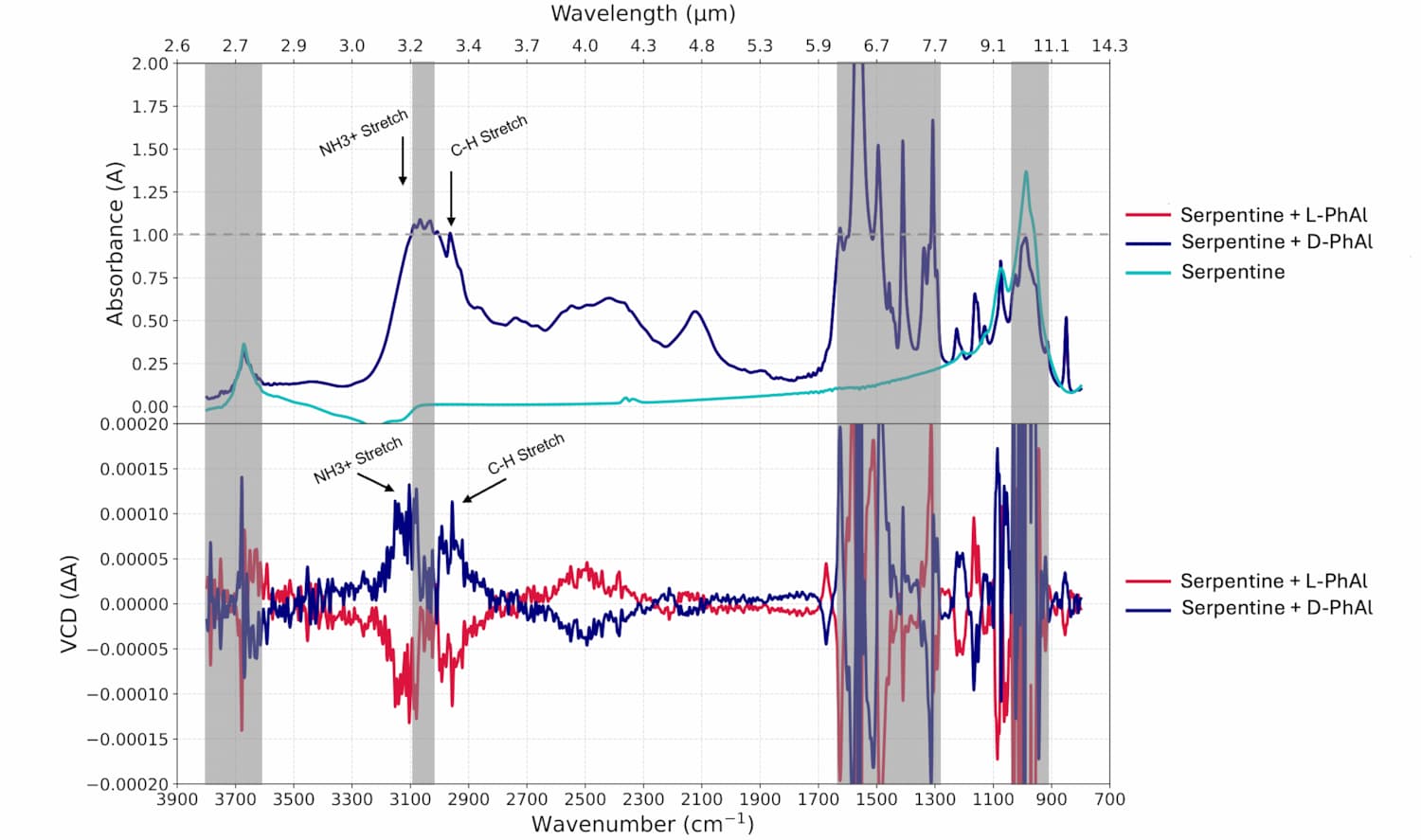
Figure 1: Infrared absorbance and VCD signal in transmission of pure serpentine mixed with the L- and D- form of phenylalanine respectively in a 2:1 ratio. Gray regions indicate spectral ranges excluded due to high mineral absorbance combined with low instrument throughput (A > 1).
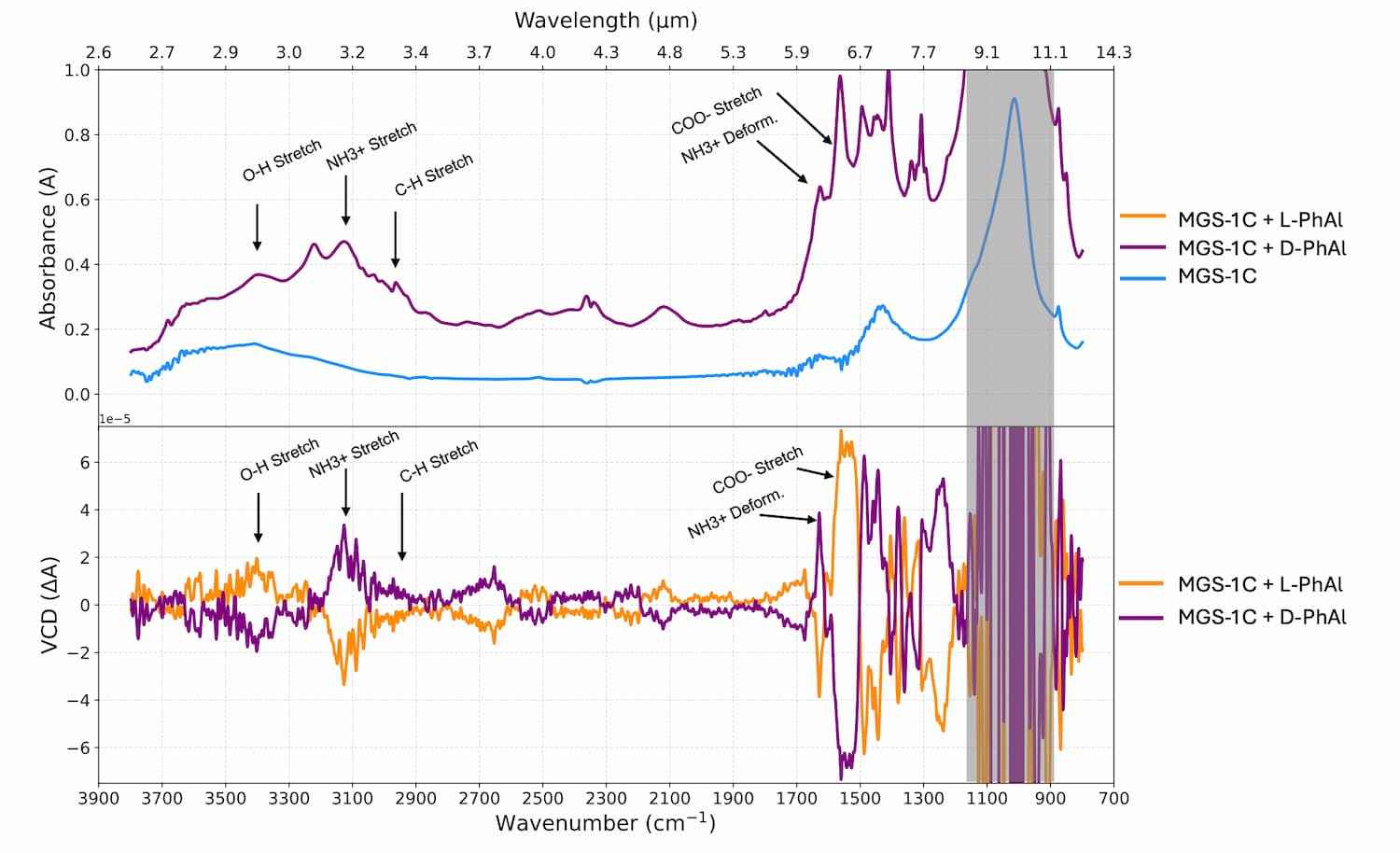
Figure 2: Infrared absorbance and VCD signal in transmission of a clay-rich Mars simulant MGS-1C mixed with the L- and D- form of phenylalanine respectively in a 10:1 ratio. Gray regions indicate spectral ranges excluded due to high mineral absorbance combined with low instrument throughput (A > 1).
Our results (Figures 1 and 2) demonstrate that the chiral VCD signature of both L- and D-phenylalanine remains detectable within these mineral matrices, establishing the feasibility of a chirality diagnostic inherently inaccessible to conventional IR spectroscopy. Signal averaging was optimised for the MWIR to resolve the fainter and broader O-H, NH3+, and C-H stretch signals, at the cost of saturation in the LWIR. Despite this, the NH3+ deformation and COO- stretching features remain identifiable in the LWIR. Both serpentine and the clay-rich Mars simulant MGS-1C exhibit low absorbance across most of the MWIR and LWIR, enabling detection of a VCD signal of 10⁻⁵ at an organic:mineral concentration of 10%. LWIR bands remain comparatively easier to detect, requiring fewer averaged measurements and lower concentrations.
These findings establish VCD spectropolarimetry as a promising approach for the non-destructive characterisation of organic matter in planetary analogue materials, preserving the native solid-state relationship between organics and their host mineral matrix. Future work will broaden the range of chiral organics and mineral matrices studied and refine sample preparation protocols. Together, these laboratory results provide the scientific foundation for the development of a space-qualified VCD instrument capable of probing chirality and organic–mineral interactions directly on the surfaces of asteroids, comets, and other small bodies [10].
References:
[1] Glavin, D., et al. (2019). The Search for Chiral Asymmetry as a Potential Biosignature in our Solar System.. Chemical reviews. https://doi.org/10.1021/acs.chemrev.9b00474.
[2] Glavin, D., et al. (2020). Extraterrestrial amino acids and L‐enantiomeric excesses in the CM2 carbonaceous chondrites Aguas Zarcas and Murchison. Meteoritics & Planetary Science, 56. https://doi.org/10.1111/maps.13451.
[3] Chan, Q., et al (2023). The amino acid and polycyclic aromatic hydrocarbon compositions of the promptly recovered CM2 Winchcombe carbonaceous chondrite. Meteoritics & Planetary Science, 59. https://doi.org/10.1111/maps.13936.
[4] Keiderling, T. (2018). Instrumentation for Vibrational Circular Dichroism Spectroscopy: Method Comparison and Newer Developments. Molecules : A Journal of Synthetic Chemistry and Natural Product Chemistry, 23. https://doi.org/10.3390/molecules23092404.
[5] Nafie, L. (2020). Vibrational optical activity: From discovery and development to future challenges.. Chirality. https://doi.org/10.1002/chir.23191.
[6] He, Y., et al. (2011). Determination of Absolute Configuration of Chiral Molecules Using Vibrational Optical Activity: A Review. Applied Spectroscopy, 65, 699 - 723. https://doi.org/10.1366/11-06321.
[7] Cannon, K. M., et al (2019). Mars global simulant MGS-1: A Rocknest-based open standard for basaltic martian regolith simulants. Icarus, 317, 470-478.
[8] Britt, D. T., et al. (2019). Simulated asteroid materials based on carbonaceous chondrite mineralogies. Meteoritics & Planetary Science, 54(9), 2067-2082.
[9] Bibring, J. P., et al. (2017). The micrOmega investigation onboard ExoMars. Astrobiology, 17(6-7), 621-626.
[10] Krasteva, M., et al. (2024). CHirality Analyzer In-Situ (CHAIS)-A Novel Approach to Planetary Surface Characterisation (No. EPSC2024-881). Copernicus Meetings.
How to cite: Krasteva, M., Carter, J., Naubron, J.-V., Vinogradoff, V., and Groussin, O.: Vibrational Circular Dichroism of Organics in Planetary Analog Minerals: Laboratory Constraints for Chiral Detection in Small Body Environments, Europlanet Science Congress 2026, The Hague, The Netherlands, 7–11 Sep 2026, EPSC2026-1169, https://doi.org/10.5194/epsc2026-1169, 2026.


