SB4 | Advances in Photopolarimetry and Spectropolarimetry of Solar System Small Bodies

SB4

Advances in Photopolarimetry and Spectropolarimetry of Solar System Small Bodies
Convener: Oleksandra Ivanova | Co-conveners: Ludmilla Kolokolova, Irina Belskaya, Olga Munoz, Yuna Kwon, Karri Muinonen, Stefano Bagnulo, Johannes Markkanen, Zuri Gray, Olena Shubina, Antti Penttilä
Orals FRI2
| Fri, 11 Sep, 11:00–12:24 (CEST)|Room Earth (Tango 1)
Posters THU-POS
| Attendance Thu, 10 Sep, 18:00–19:30 (CEST) | Display Thu, 10 Sep, 08:30–19:30|Foyer 3, F3.70–71
Fri, 11:00
Thu, 18:00
The section "Advances in Photopolarimetry and Spectropolarimetry of Solar System Small Bodies" highlights recent progress and breakthroughs in the application of these techniques to study small bodies, including asteroids, comets, moons, trans-Neptunian objects, and interplanetary dust. Photopolarimetry and spectropolarimetry provide critical insights into surface textures, particle sizes, porosities, and compositions, offering constraints on the physical, compositional, and dynamical evolution of these objects. We welcome abstract submissions on advancements in observational, numerical, and laboratory techniques, as well as innovative approaches for extracting and analyzing data, including new methodologies in photometric, polarimetric, and spectropolarimetric observations, advances in modeling, data reduction algorithms, and analysis pipelines, including machine learning, laboratory measurements of optical, polarimetric, and scattering properties, and software or web-based tools for collaborative data sharing and interpretation. This section aims to foster interdisciplinary discussions and encourage novel approaches that enhance our understanding of the physical properties, activity, and evolution of small bodies in the Solar System.

Orals: Fri, 11 Sep, 11:00–12:24 | Room Earth (Tango 1)

Chairpersons: Olena Shubina, Antti Penttilä
11:00–11:12
|
EPSC2026-217
|
On-site presentation
Oleksandra Ivanova, Leonid Shakun, Johannes Markkanen, and Igor Luk’yanyk

Comets are considered to be important remnants of the early Solar System. According to prevailing theories, a substantial fraction of planetesimals was scattered into the Oort cloud during the epoch of giant planet formation. Subsequent gravitational perturbations, including stellar encounters and Galactic tides, can alter their orbits, injecting them into the inner Solar System or, in some cases, placing them on hyperbolic trajectories. Hyperbolic comets and dynamically new Oort cloud objects are of particular interest, especially during their inbound phase, when their surfaces are expected to be minimally processed by solar radiation. Such distant comets represent valuable analogues of pristine material and are considered prime targets for future space missions, including Comet Interceptor. Since these objects are observable only for a limited time and often at large heliocentric distances, it is essential to obtain comprehensive observational datasets already at early stages of activity. In this study, we present spectroscopic, polarimetric, and photometric observations of the hyperbolic comet C/2013 V4 (LINEAR) (hereafter 2013V4). The comet follows a hyperbolic orbit with eccentricity e = 1.0026, perihelion distance q = 5.19 au, and inclination i = 67.85°, providing a valuable opportunity to investigate the physical properties and activity of distant comets that may preserve relatively unprocessed material.

We observed comet 2013V4 on two observing runs, on November 6, 2015, and April 6, 2016, using the 6-m BTA telescope SAO. The comet was located at heliocentric distances of 5.19–5.36 au and geocentric distances of 4.61–5.62 au, with phase angles of 9.4°–10.1°. Photometric imaging was obtained during both runs using g-sdss and r-sdss filters. Long-slit spectroscopic observations were carried out with the VPHG1200@540 grism, covering the spectral range 3600–7070 Å.  Spectroscopy post-monitoring shows no significant gas emissions, allowing a focus on the dust environment. Polarimetric observations were performed on November 6, 2015, using the R filter. The phase angle during the polarimetric measurements was 9.4°. Using our photometric and polarimetric observations of this comet, we attempted to model the physical characteristics of its dust environment. We utilized the state-of-the-art modeling tools such as Fast superposition T-matrix method [1] and Radiative transfer with reciprocal transactions [2], in combination with a dynamical dust model, to characterize dust properties and their evolution in the coma. Morphological analysis of the images showed a compact dust coma with a slight asymmetry and a long tail. No prominent jet-like structures are clearly detected. The average dust activity level Afρ is more than 1000 cm, consistent with other distant comets.

 [1] Markkanen J., Yuffa A. “Fast superposition T-matrix solution for clusters with arbitrarily-shaped constituent particles”, JQSRT 189, pp. 181-188 (2017)

[2] Muinonen et al. “Multiple scattering of light in discrete random media using incoherent interactions”, Opt. Lett. 43, pp.683-686 (2018)

 Acknowledgments

 The research of Leonid Shakun and Oleksandra Ivanova is supported by the Slovak Research and Development Agency under Contract No. APVV-24-0076 and the grant of the Slovak Academy of Sciences (grant Vega No. 2/0067/26); Oleksandra Ivanova and Johannes Markkanen are supported by grants for projects under the Mobility Program DAAD-SAS-2024-02 no. 57752921. The research of Igor Luk’yanyk was supported by the projects of the Ministry of Education and Science of Ukraine No. 0125U002319.


How to cite: Ivanova, O., Shakun, L., Markkanen, J., and Luk’yanyk, I.: Dust Properties of distant comet C/2013 V4 (Catalina) at heliocentric distances beyond 5 au, Europlanet Science Congress 2026, The Hague, The Netherlands, 7–11 Sep 2026, EPSC2026-217, https://doi.org/10.5194/epsc2026-217, 2026.

11:12–11:24
|
EPSC2026-709
|
ECP
|
On-site presentation
Kilho Baek, Sungsoo Kim, Minsup Jeong, and Young-Jun Choi

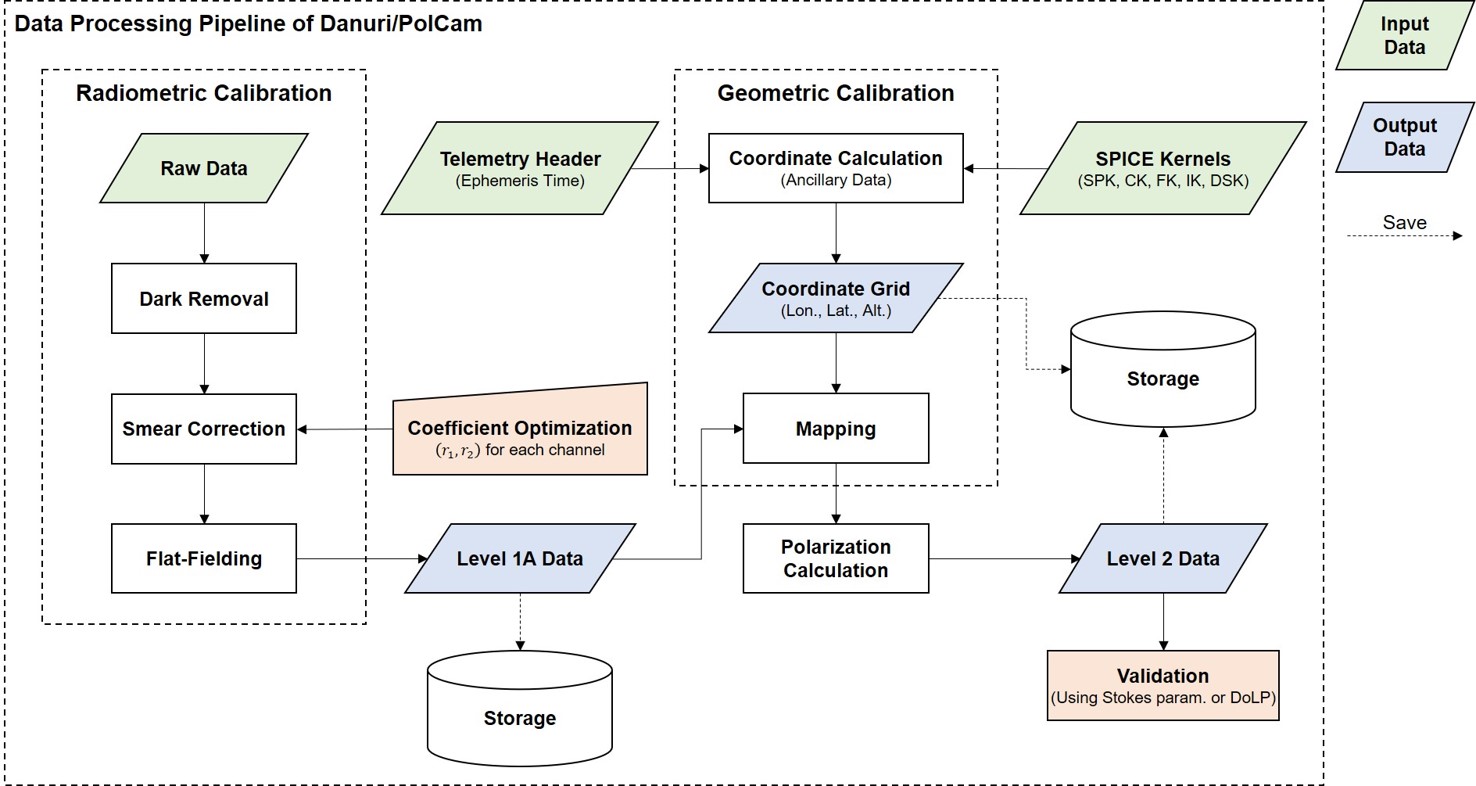
The wide-angle Polarimetric Camera (PolCam) onboard South Korea’s Danuri spacecraft is a pioneering instrument designed to conduct the first global polarimetric survey of the Moon from lunar orbit. However, its highly oblique viewing geometry (~45° tilt) and shutterless frame-transfer CCD introduced significant topographic distortions and severe charge-smearing artifacts. Due to the lack of comprehensive pre-launch characterization, establishing a rigorous on-orbit calibration pipeline was imperative. This pipeline integrates both geometric and radiometric calibrations (Figure 1). In this presentation, we briefly outline this calibration framework and present the resulting first quasi-global lunar polarimetric map, which notably encompasses observations of the lunar farside.

Figure 1. Flowchart for the on-orbit calibration pipeline of PolCam.

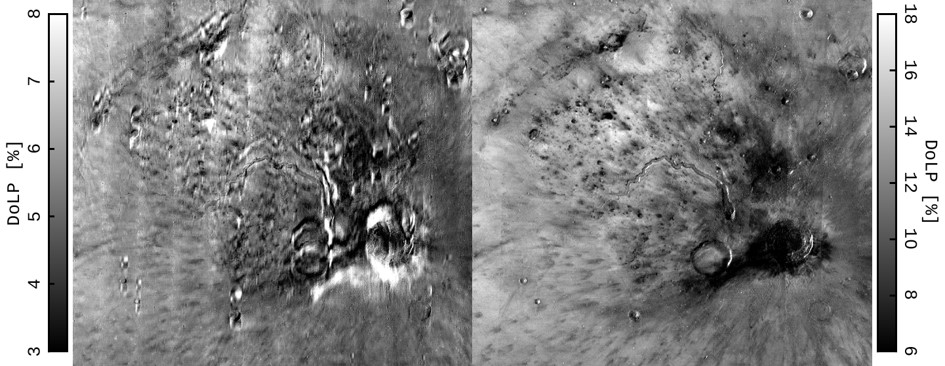
The implementation of this pipeline yielded the high-fidelity data required for polarimetric analysis. Geometric parameter refinement minimized reprojection errors, achieving sub-pixel geolocation accuracy with a cross-track root-mean-square error of ~0.87 pixels. This precision enabled the generation of seamless orthorectified mosaics, even across topographically complex terrains such as cratered basins. Radiometrically, the dynamic de-smearing correction effectively mitigated vertical smear artifacts exacerbated by frame-transfer times exceeding exposure times. By optimizing channel-specific de-smearing coefficients for distinct viewing orientations, these artifacts—particularly prominent in high-contrast regions—were successfully suppressed, thereby restoring the radiometric fidelity essential for deriving the Degree of Linear Polarization (DoLP) (Figure 2).

Figure 2. DoLP maps of the Aristarchus Plateau before (left) and after (right) smear correction.

Utilizing this radiometrically corrected and co-registered dataset, we generated the first quasi-global polarimetric map of the lunar surface, spanning all longitudes across a restricted latitudinal range. The map clearly resolves distinct polarimetric features, successfully differentiating the elevated DoLP of the lunar maria (10–15%) from the lower DoLP of the highlands (4–7%). These measurements validate the inverse relationship between reflectance and polarization (Umov's law) across vast spatial scales. Furthermore, these results provide unprecedented insights into regolith maturity, surface roughness, and localized space weathering phenomena. Ultimately, the successful construction of this extensive regional map demonstrates PolCam's robust capability for high-phase-angle polarimetry and establishes the foundational framework for a comprehensive global polarimetric map of the Moon.

How to cite: Baek, K., Kim, S., Jeong, M., and Choi, Y.-J.: First Quasi-Global Lunar Polarimetric Map from Danuri/PolCam Using a Calibration Pipeline with Smear Correction, Europlanet Science Congress 2026, The Hague, The Netherlands, 7–11 Sep 2026, EPSC2026-709, https://doi.org/10.5194/epsc2026-709, 2026.

11:24–11:36
|
EPSC2026-316
|
On-site presentation
Wouter van Straalen, Niels Ligterink, Pierre Piron, and Jérôme Loicq

The solar system is our home in the universe, and there is still a lot to discover about the planetary bodies within it. One of the main ways to study these bodies is via remote observations, where we measure the light reflected from the planetary body. By combining traditional spectral measurements with polarization observations, we can obtain more information about the microscopic structure and chemical composition of the surface. By investigating the spectro-polarimetric signature, we can determine the grain size, porosity and ice morphology of the surface.

The observed reflected polarization of a planetary body depends heavily on the observation parameters, such as the wavelength and angular configuration of the measurement, and the material properties of the observed surface. This results in a large parameter space that needs to be explored to understand what spectro-polarimetric features can be linked to which material properties. Therefore, the interpretation of these features can be very complex. Fortunately, we can measure the spectro-polarimetric signature of planetary analogue samples to disentangle this problem.

Previous research has been done on measuring the polarization properties of planetary analogue samples. Some instruments of note are PROGA2, GRIT-T Pol and the POLICES instrument. These instruments were created to investigate specific science questions regarding spectro-polarimetry and therefore have a limited wavelength range and sometimes limited polarimetric accuracy, which reduces the parameter space they can explore. Therefore, it will be useful to create an instrument that can explore the available parameter space more thoroughly.

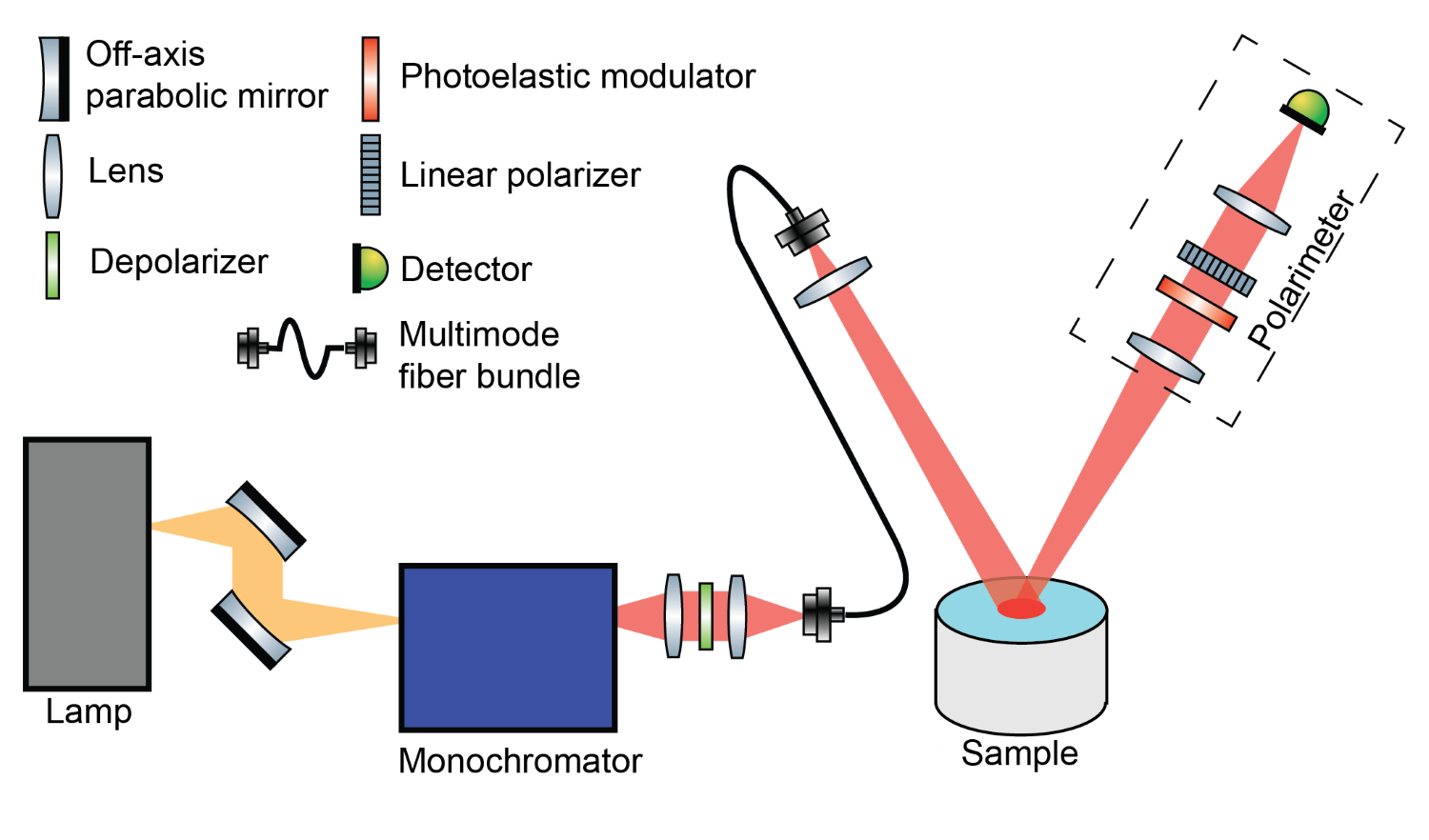
To fill this research gap, the Delft University of Technology is developing the AgSPARROW instrument (A goniometric SpectroPolArimeter for Optical and NIR Wavelengths). The goals of this instrument are to combine broadband wavelength coverage with high polarimetric accuracy and separately rotating instrument arms to provide precise control of the incidence and reflectance angles. The design wavelength range of the instrument is 350-3500 nm. The instrument is designed to measure both linear and circular polarized light reflected from a sample illuminated with unpolarized light. The minimum phase angle targeted by the instrument will be 5 degrees. Furthermore, the instrument will be designed such that it can measure both room temperature samples and cryogenic samples, starting with the implementation of the room-temperature measurements. Figure 1 shows a drawing of the instrument layout.

In this talk I will present the design, construction and calibration of the AgSPARROW instrument. The current goal is to have first light for the instrument in the summer of 2026. I will also present the preliminary results from the first measurements done with the instruments. Finally, I will discuss the future plans for the instrument, with a main focus on using spectro-polarimetry to characterize the surface of Enceladus for future landing missions.

Figure 1: Illustration of the component layout of the AgSPARROW instrument.

How to cite: van Straalen, W., Ligterink, N., Piron, P., and Loicq, J.: Experimental investigation of spectro-polarimetry for solar system exploration, Europlanet Science Congress 2026, The Hague, The Netherlands, 7–11 Sep 2026, EPSC2026-316, https://doi.org/10.5194/epsc2026-316, 2026.

11:36–11:48
|
EPSC2026-1169
|
ECP
|
On-site presentation
Mariya Krasteva, John Carter, Jean-Valère Naubron, Vassilissa Vinogradoff, and Olivier Groussin

The detection of molecular chirality in planetary environments is a fundamental objective of planetary exploration, both for its astrobiological implications as a possible biosignature [1], and as a tracer of pre-biotic chemistry shedding light on the distribution of enantiomeric excess across the Solar System and the origins of biological homochirality on Earth. Yet direct chirality measurements remain scarce across Solar System bodies, limited to laboratory analyses of meteorites and returned samples from Bennu and Ryugu. 

Among meteorites, notable enantiomeric excesses have been measured in Murchison (L-isovaline ~18% ee, L-glutamic acid ~16–40% ee), Orgueil (L-isovaline ~15% ee), and Tagish Lake (L-aspartic acid, up to ~60% ee) [2,3]. The current state of the art for in-situ chirality detection relies on chiral columns within Gas Chromatography-Mass Spectrometers (GC-MS), as deployed on COSAC for comet 67P/Churyumov-Gerasimenko, MOMA for Mars, and DraMS for Titan. Despite their high sensitivity, these instruments are complex to implement, require a destructive derivatization process, and allow only a limited number of measurements over a mission lifetime.

In terrestrial chemistry, chirality is routinely probed non-destructively through mid-infrared spectropolarimetry via Vibrational Circular Dichroism (VCD) [4]. This well-established optical technique operates on the principle of detecting the differential absorption of left- and right-circularly polarized infrared light [5]. It is sensitive to the exact molecular conformation of chiral compounds [6] and to their local chemical environment (solvent, hydrogen bonding, aggregation, pH), all of which influence the VCD signal. VCD spectroscopy is applicable to samples in solid, liquid, and gas phases but usually requires sample preparation in the lab. Its application to planetary exploration has, however, not yet been demonstrated. 

In this work, we investigate the VCD response to Solar System analogue material that is applicable to carbonaceous small bodies and the surface of Mars. We use L- and D-phenylalanine as a plausible chiral organic compound, embedded in a variety of hydrated mineral matrices (gypsum, serpentine, carbonates, and opals) as well as in established Mars and asteroid (CM-E) simulants [7, 8]. Minerals were selected based on surface compositions inferred from the Bennu and Ryugu sample return missions, as well as from ongoing and planned Mars exploration.

Solid-state samples are prepared as KBr pellets and measured in transmission across 2.5–12.0 µm using a Bruker Vertex 70 FTIR spectrometer with a PMA50 VCD accessory. This spectral range was selected to match the capabilities of current and future in-situ planetary spectrometers. We focus on two regions: the MWIR (C-H stretching near 3.4 µm), accessible to current in-situ spectrometers [9], and the LWIR (6–12 µm), which hosts numerous diagnostic bands and is expected to be accessible to future instruments. Measurements are performed at organic:mineral concentrations ranging from 10% to 50% (Figures 1 and 2), with preliminary results indicating detection thresholds below this level, consistent with organic abundances reported from Ryugu sample analyses.
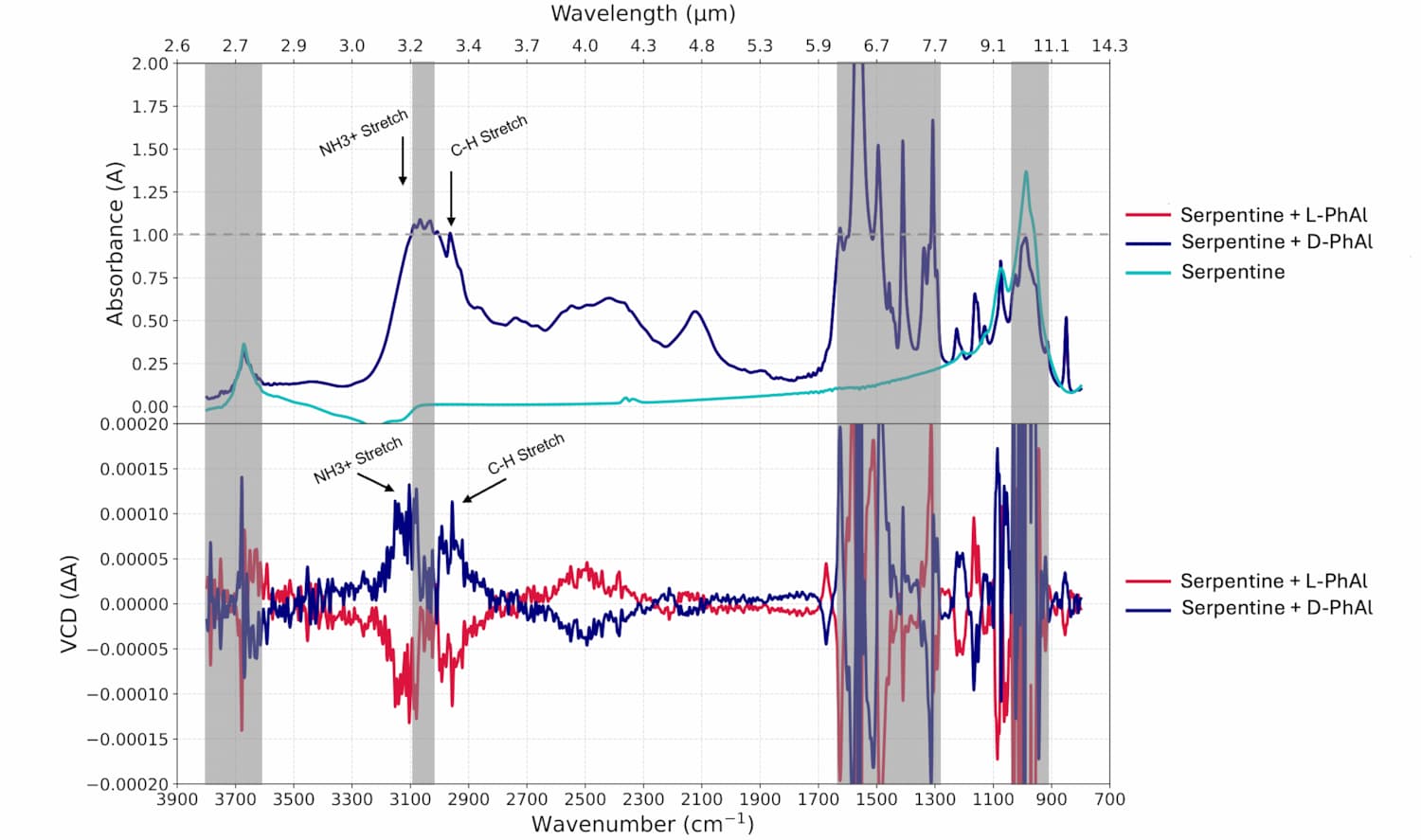
Figure 1: Infrared absorbance and VCD signal in transmission of pure serpentine mixed with the L- and D- form of phenylalanine respectively in a 2:1 ratio. Gray regions indicate spectral ranges excluded due to high mineral absorbance combined with low instrument throughput (A > 1).
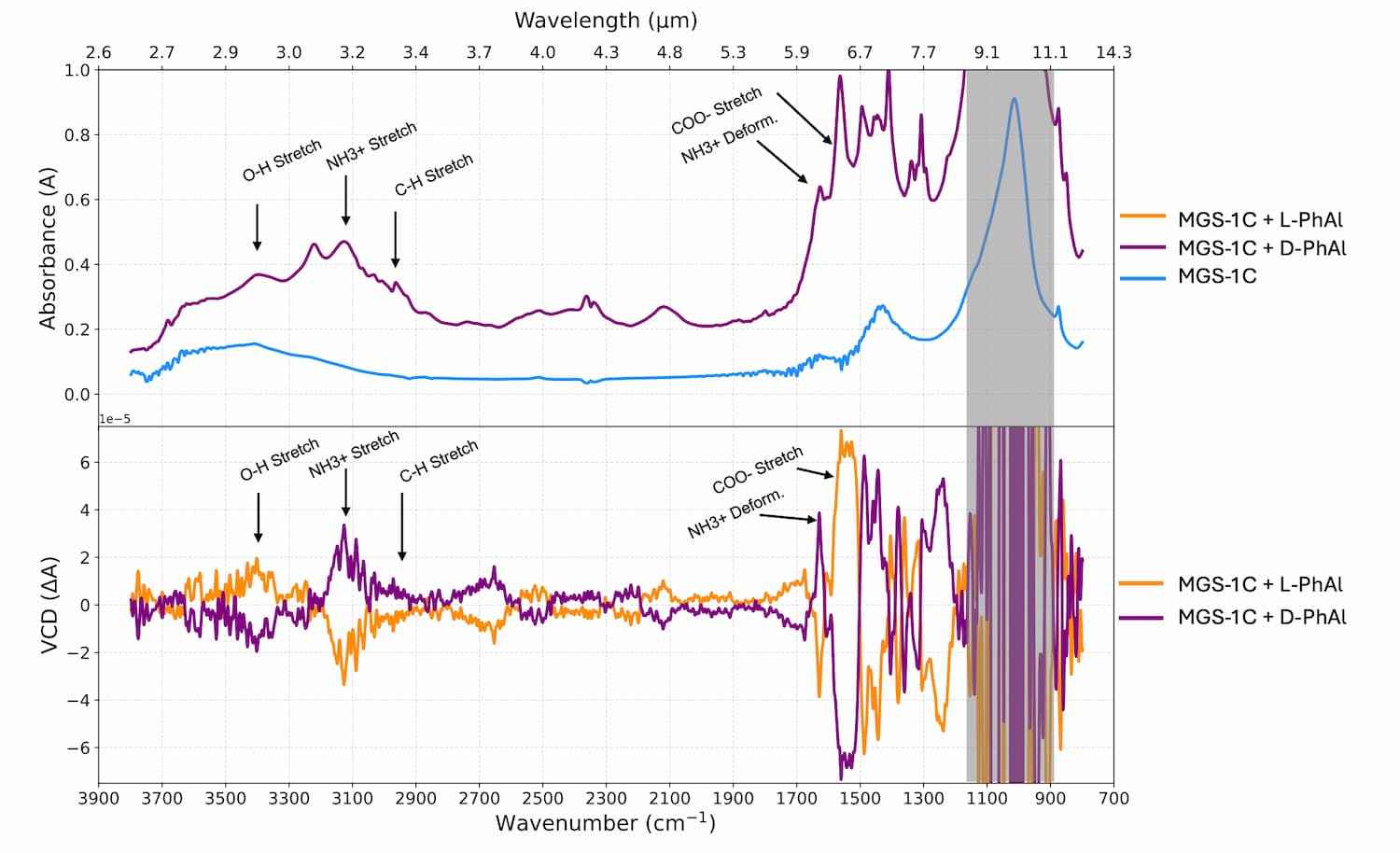
Figure 2: Infrared absorbance and VCD signal in transmission of a clay-rich Mars simulant MGS-1C mixed with the L- and D- form of phenylalanine respectively in a 10:1 ratio. Gray regions indicate spectral ranges excluded due to high mineral absorbance combined with low instrument throughput (A > 1).


Our results (Figures 1 and 2) demonstrate that the chiral VCD signature of both L- and D-phenylalanine remains detectable within these mineral matrices, establishing the feasibility of a chirality diagnostic inherently inaccessible to conventional IR spectroscopy. Signal averaging was optimised for the MWIR to resolve the fainter and broader O-H, NH3+, and C-H stretch signals, at the cost of saturation in the LWIR. Despite this, the NH3+ deformation and COO- stretching features remain identifiable in the LWIR. Both serpentine and the clay-rich Mars simulant MGS-1C exhibit low absorbance across most of the MWIR and LWIR, enabling detection of a VCD signal of 10⁻⁵ at an organic:mineral concentration of 10%. LWIR bands remain comparatively easier to detect, requiring fewer averaged measurements and lower concentrations.

These findings establish VCD spectropolarimetry as a promising approach for the non-destructive characterisation of organic matter in planetary analogue materials, preserving the native solid-state relationship between organics and their host mineral matrix. Future work will broaden the range of chiral organics and mineral matrices studied and refine sample preparation protocols. Together, these laboratory results provide the scientific foundation for the development of a space-qualified VCD instrument capable of probing chirality and organic–mineral interactions directly on the surfaces of asteroids, comets, and other small bodies [10].


References: 

[1] Glavin, D., et al. (2019). The Search for Chiral Asymmetry as a Potential Biosignature in our Solar System.. Chemical reviews. https://doi.org/10.1021/acs.chemrev.9b00474.

[2] Glavin, D., et al. (2020). Extraterrestrial amino acids and L‐enantiomeric excesses in the CM2 carbonaceous chondrites Aguas Zarcas and Murchison. Meteoritics & Planetary Science, 56. https://doi.org/10.1111/maps.13451.

[3] Chan, Q., et al  (2023). The amino acid and polycyclic aromatic hydrocarbon compositions of the promptly recovered CM2 Winchcombe carbonaceous chondrite. Meteoritics & Planetary Science, 59. https://doi.org/10.1111/maps.13936.

[4] Keiderling, T. (2018). Instrumentation for Vibrational Circular Dichroism Spectroscopy: Method Comparison and Newer Developments. Molecules : A Journal of Synthetic Chemistry and Natural Product Chemistry, 23. https://doi.org/10.3390/molecules23092404.

[5] Nafie, L. (2020). Vibrational optical activity: From discovery and development to future challenges.. Chirality. https://doi.org/10.1002/chir.23191.

[6] He, Y., et al. (2011). Determination of Absolute Configuration of Chiral Molecules Using Vibrational Optical Activity: A Review. Applied Spectroscopy, 65, 699 - 723. https://doi.org/10.1366/11-06321.

[7] Cannon, K. M., et al (2019). Mars global simulant MGS-1: A Rocknest-based open standard for basaltic martian regolith simulants. Icarus, 317, 470-478.

[8] Britt, D. T., et al. (2019). Simulated asteroid materials based on carbonaceous chondrite mineralogies. Meteoritics & Planetary Science, 54(9), 2067-2082.

[9] Bibring, J. P., et al. (2017). The micrOmega investigation onboard ExoMars. Astrobiology, 17(6-7), 621-626.

[10] Krasteva, M., et al. (2024). CHirality Analyzer In-Situ (CHAIS)-A Novel Approach to Planetary Surface Characterisation (No. EPSC2024-881). Copernicus Meetings.

How to cite: Krasteva, M., Carter, J., Naubron, J.-V., Vinogradoff, V., and Groussin, O.: Vibrational Circular Dichroism of Organics in Planetary Analog Minerals: Laboratory Constraints for Chiral Detection in Small Body Environments, Europlanet Science Congress 2026, The Hague, The Netherlands, 7–11 Sep 2026, EPSC2026-1169, https://doi.org/10.5194/epsc2026-1169, 2026.

11:48–12:00
|
EPSC2026-331
|
On-site presentation
Maxime Devogele, Juan Luis Cano, Marin Ferrais, Joseph Masiero, Elena Selmi, Galin Borisov, Stefano Bagnulo, Philippe Bendjoya, Jean-Pierre Rivet, Lyu Abe, Alberto Cellino, and Eduardo Peleato

Context and aim. The diameter of a newly discovered near-Earth object (NEO) is usually inferred from its absolute magnitude, but this conversion is dominated by the assumed geometric albedo. For objects discovered shortly before a close approach, the use of a default albedo can therefore leave a wide range of possible sizes and impact consequences. We present a polarimetric approach designed to reduce this uncertainty with a minimal observational investment.

Concept. We present a phase-angle-dependent calibration that links the linear degree of polarization, Pr, to the geometric albedo, pV, for near-Earth objects observed at moderate to high phase angles. Classical polarimetric albedo estimates use the slope of the phase-polarization curve near the inversion angle [1], which requires several observations at low phase angles. Such observations are often not possible for NEOs, whose observing windows are short and whose discovery geometries frequently correspond to large Sun-object-observer angles. Our approach uses the positive polarization branch, typically above about 30 degrees, where the polarization amplitude is strongly anti-correlated with surface reflectivity through the Umow effect [2]. This makes it possible to obtain an albedo estimate from a single high-phase polarimetric measurement.

Observations and calibration. The calibration is built from a dedicated polarimetric survey of NEOs, combined with literature polarimetry and independent albedo estimates from thermal modelling, radar, stellar occultations, and spacecraft measurements. Most of the new observations were obtained with the Torino Polarimeter at the 1-m C2PU West telescope, Calern Observatory [3]. Additional measurements come from the FoReRo2 polarimeter at Rozhen Observatory [4] and from FORS2 in polarimetric mode at the VLT. For each calibration object with sufficient phase-angle coverage, we model the phase-polarization curve using either an exponential-linear function or a trigonometric function [5,6]. The model choice depends on the available phase-angle range and on whether the high-phase turnover is constrained. The phase-curve parameters and the Pr-pV relation at each selected phase angle are inferred with Markov Chain Monte Carlo sampling, allowing uncertainties in the polarization data and in the reference albedos to be propagated to the final calibration.

Application. For a target asteroid observed at a given phase angle, the calibration returns a posterior distribution for pV from the measured Pr and its uncertainty. If several observations are available, the individual posterior distributions can be combined to produce a final albedo estimate. The method is implemented in PANDA, Polarimetric ANalysis for the Determination of the Albedo, a database-backed tool that stores calibration objects, albedo references, selected phase-polarization models, and single- or multi-measurement predictions. Because the calibration depends on an evolving reference database, PANDA is designed to be updated when new polarimetric data or improved independent albedo determinations become available.

Implications. This work provides a practical route to rapid NEO albedo and size estimates from ground-based polarimetry. It is particularly relevant for objects discovered during close approaches, for targets with short visibility windows, and for cases in which thermal-infrared or radar characterization is not immediately available. The method does not replace independent diameter measurements, but it offers a fast complementary constraint that can reduce the uncertainty associated with assumed albedo values in planetary-defense follow-up.

References:


[1] Cellino A., et al. 2015, Monthly Notices of the Royal Astronomical Society, 451, 3473.

[2] Umow v. N., 1905, Phys. Z, 6, 674.

[3] Devogèle M., et al. 2017, Monthly Notices of the Royal Astronomical Society, 465, 4335.

[4] Nikolov Y., et al. 2026, Astronomy & Astrophysics, 708, A30.

[5] Muinonen K., et al. 2002, Memorie della Società Astronomica Italiana, 73, 716.

[6] Goidet-Devel B., et al. 1995, Planetary and Space Science, 43, 779.

How to cite: Devogele, M., Cano, J. L., Ferrais, M., Masiero, J., Selmi, E., Borisov, G., Bagnulo, S., Bendjoya, P., Rivet, J.-P., Abe, L., Cellino, A., and Peleato, E.: Rapid Albedo Estimation of Near-Earth Objects From Single High Phase Angle Polarimetric Observation, Europlanet Science Congress 2026, The Hague, The Netherlands, 7–11 Sep 2026, EPSC2026-331, https://doi.org/10.5194/epsc2026-331, 2026.

12:00–12:12
|
EPSC2026-1097
|
ECP
|
Virtual presentation
Hanna Pentikäinen, Karri Muinonen, Antti Penttilä, Ari Leppälä, Mikko Vuori, Elo Tuominen, Vasilij Shevchenko, and Irina Belskaya

The photometric and polarimetric phase curves of asteroids contain information about their surface properties. Physical modelling of these phase curves has been a major goal for decades. Focusing first on achieving good fits to polarimetric observations ([1] and references therein), we have taken different approaches to understanding light scattering from the surface of C-, S-, and E-class asteroids.


First, for the brighter S- and E-class asteroids, the parametrized [2,3] empirical scattering phase matrix for small (≤ 1 μm) ensemble-averaged olivine particles [4] is combined with a phase matrix describing the scattering of a size distribution of large (compared to the wavelength of light) olivine particles computed with the geometric optics approximation [5]. The combined single-scattering albedo is calculated and used in the multiple-scattering computation performed with the radiative-transfer coherent-backscattering (RT-CB) algorithm developed by Muinonen et al. [6]. The resulting phase curves are strong fits to polarimetric observations, and the resulting geometric albedos match levels representative of the asteroid classes. The high linear polarization maxima of C-class asteroids required us to choose the empirical scattering phase matrix of the iron and carbon containing Allende meteorite to represent the small particles likely present on low-albedo asteroids. Very large externally reflecting olivine particles were combined with the small particles to achieve a high linear polarization maximum. Secondly, we have calculated single-particle scattering matrices with a surface-integral-equation method (SIEM) [7] across different size distributions of randomly orientated Gaussian spheres. We will then repeat the analysis of the first approach by using the theoretical, numerically computed single-particle scattering and absorption properties. An even more realistic approach involves modelling light scattering by a layer of small particles on top of a semi-infinite homogeneous material (see Muinonen et al., Leppälä et al., present conference).


With the aim of finding the photometric phase functions that describe the intrinsic surface properties of individual asteroids, we retrieved opposition effect amplitudes and widths from photometric observations of asteroids (e.g., [8]) that have detailed shape models and spin parameters determined by Vernazza et al [9]. Subsequently, the photometric slopes were optimised by including the shape models, spin parameters, fitted opposition effect values, and Gaia DR3 observations, which contain high-precision photometry at around 10° < 𝛼 < 30°. The resulting slope values categorised by asteroid class agree with classification results by Pentikäinen et al. [10] using photometric slopes obtained from lightcurve inversion by MacLennan et al [11].


References

[1] Gil-Hutton R. 2023, Catalogue of asteroid polarization curves.

[2] Muinonen K., Leppälä A., A&A 2025, 704, A106.

[3] Leppälä A., Muinonen K., Penttilä A., et al. JQSRT 2026, submitted.

[4] Muñoz O., Frattin E., Martikainen J., et al. JQSRT 2025, 331, 109252.

[5] Lindqvist H., Martikainen J., Räbinä J., et al. JQSRT 2018, 217, 329–337.

[6] Muinonen K., Leppälä A., Markkanen J., JQSRT 2025, 330, 109226.

[7] Markkanen J., JQSRT 2025, 341, 109467.

[8] Shevchenko V., Belskaya I., Muinonen K., et al. PSS 2016, 123, 101-116.

[9] Vernazza P., Ferrais M., Jorda L., et al. A&A 2021, 654, A56.

[10] Pentikäinen H., MacLennan E., Penttilä A., et al. A&A 2026, 707, A132.

[11] MacLennan E., Pentikäinen H., Uvarova E., et al. A&A 2026, 707, A131.

How to cite: Pentikäinen, H., Muinonen, K., Penttilä, A., Leppälä, A., Vuori, M., Tuominen, E., Shevchenko, V., and Belskaya, I.: Asteroid Photometric and Polarimetric Phase Curve Modelling, Europlanet Science Congress 2026, The Hague, The Netherlands, 7–11 Sep 2026, EPSC2026-1097, https://doi.org/10.5194/epsc2026-1097, 2026.

12:12–12:24
|
EPSC2026-831
|
Virtual presentation
Karri Muinonen, Ari Leppälä, Anne Virkki, Hanna Pentikäinen, Antti Penttilä, and Gorden Videen

Scattering and absorption of light in macroscopic discrete random media of densely packed particles (e.g., planetary regoliths) constitutes a computational challenge in electromagnetics described by the Maxwell equations. There are differing physics cases that must be tackled separately. Exact solutions are typically available only for systems with maximum sizes of only a few wavelengths. 
  
We consider a radiative-transfer coherent-backscattering (RT-CB) approximation for embedded discrete random media of particles. The first case (Case I) concerns wavelength-scale particles within a half space of optically isotropic and homogeneous material described by a complex refractive index (host medium). In comparison to a semi-infinite discrete random medium in free space, Case I introduces an interface between free space and host medium and particle scattering and absorption properties must be computed in relation to the host medium. In RT-CB, interaction paths always include refractions into and out of the host medium, as well as any internal reflections that take place at the interface. Numerical Monte Carlo computation largely resembles that for semi-infinite random media in free space. In the UV-Vis-NIR part of the spectrum (wavelengths of 0.1-2.5 microns), Case I is relevant for planetary-regolith particles large compared to the wavelength with inhomogeneous internal composition. The internal inhomogeneities can derive from agglomerated minerals or voids. In the microwave part of the spectrum relevant for radars (wavelengths of 1-100 mm), Case I is relevant by the very definition of the radar scattering problem. 
  
Case II concerns a finite layer of wavelength-scale particles in free space on a half space of optically isotropic and homogeneous material (host medium). In comparison to a semi-infinite discrete random medium in free space, Case II thus introduces an interface in the bottom of the finite layer of particles. In RT-CB, interaction paths including a refraction into the host medium do not contribute to the scattering by the medium: refracted radiation is considered to be entirely absorbed. The interaction paths can include reflections from the interface and, from the point of view of RT-CB, the paths fall into different categories. The categories include the following cases: 
(i) the interaction path is a pure reflection process at the interface;
(ii) the interaction path includes particle scattering processes but no reflection processes;
(iii) the interaction path includes reflection processes but, in the RT path, the first and final interactions are particle scattering processes;
(iv) the first interaction is a reflection process and the last interaction is a particle scattering process;
(v) the first interaction is a particle scattering process and the last interaction is a reflection process;
(vi) the first and last interactions are reflection processes.    

We highlight a number of applications in scattering and absorption by airless Solar System objects in the UV-Vis-NIR and microwave spectral ranges (see Leppälä et al. and Pentikäinen et al., present conference). For UV-Vis-NIR, we apply the RT-CB computations to the case of a layer of wavelength-scale amorphous ice particles on the surface of crystalline ice particles large compared to the wavelength. For radar, we carry out a computation for absorbing particles within pure, crystalline water ice.

How to cite: Muinonen, K., Leppälä, A., Virkki, A., Pentikäinen, H., Penttilä, A., and Videen, G.: Coherent backscattering and radiative transfer inembedded particulate planetary media, Europlanet Science Congress 2026, The Hague, The Netherlands, 7–11 Sep 2026, EPSC2026-831, https://doi.org/10.5194/epsc2026-831, 2026.

Posters: Thu, 10 Sep, 18:00–19:30 | Foyer 3

Display time: Thu, 10 Sep, 08:30–19:30
Chairperson: Oleksandra Ivanova
F3.70
|
EPSC2026-51
|
ECP
|
On-site presentation
Leonid Shakun, Oleksandra Ivanova, Johannes Markkanen, and Igor Luk’yanyk

Comets retain relatively unprocessed material from the early Solar System, making their dust component a key probe of primordial conditions and evolutionary processes. In this context, particular interest is associated with comets that approach very small heliocentric distances, such as C/2012 S1 (ISON), since intense solar radiation and thermal processing can significantly modify their dust and gas properties, providing a unique opportunity to study the response of primitive material under extreme conditions. Observations of cometary comae using photometry, spectroscopy, image polarimetry and spectropolarimetry provide complementary constraints on the physical properties, composition, and size distribution of dust particles. The dynamically new comet C/2012 S1 (ISON) entered the inner Solar system on a near-parabolic orbit from the Oort Cloud and was considered a representative of pristine protoplanetary material. As the comet disintegrated during its perihelion passage [1], its pre-perihelion observations are of particular importance, especially given the scarcity of polarimetric and spectropolarimetric data. In this study, we present photometric, imaging polarimetric (both linear and circular), and spectropolarimetric observations obtained with the 6-m BTA telescope at heliocentric distances and phase angle from r = 4.811 and α = 7.3° to 0.76 au and α = 66.78°, respectively. The analysis focuses on dust activity level (Afρ), searching for emission at large heliocentric distances, spatial variations in linear and circular polarization. The long-slit spectroscopy at 4.81 au revealed no detectable gas emission features, indicating a dust-dominated coma at large heliocentric distance. The Afρ parameter decreases from approximately 1000 cm to 300 cm during observations. Using our photometric and polarimetric observations of this comet, we attempted to model the physical characteristics of its dust environment.


Acknowledgements

The research of Leonid Shakun and Oleksandra Ivanova is supported by the Slovak Research and Development Agency under Contract No. APVV-24-0076 and the grant of Slovak Academy of Sciences (grant Vega No. 2/0067/26); Oleksandra Ivanova and Johannes Markkanen are supported by grants for projects under the Mobility Program DAAD-SAS.


References

1. Keane, J. V., Milam, S. N., Coulson, I. M., Kleyna, J. T., Sekanina, Z., Kracht, R., ... & Charnley, S. B. The Astrophysical Journal 2016, 831, 207.

How to cite: Shakun, L., Ivanova, O., Markkanen, J., and Luk’yanyk, I.: Dust properties of сomet C/2012 S1 (ISON) at pre-perihelion, Europlanet Science Congress 2026, The Hague, The Netherlands, 7–11 Sep 2026, EPSC2026-51, https://doi.org/10.5194/epsc2026-51, 2026.

F3.71
|
EPSC2026-902
|
On-site presentation
Gijs Verdoes Kleijn and Stefano Bagnulo

VSTPOL, the new polarimetric mode of the OmegaCAM 1 square degree imager at the VLT Survey Telescope is planned to be commissioned in December 2026 . The polarimetric mode of the VST has a 1 square degree Field of View with a 2.5 meter diameter primary mirror and an expected systematic instrumental polarization controlled to about 0.1%. VSTPOL aims to improve one or more of the limitations of current polarimeters: (i) limited field of view; (ii) small light collecting area; (iii) difficult calibration of (spatially varying) instrumental polarization. 

Near-Earth Asteroids, main-belt asteroids, Jupiter Trojans, Centaurs, Transneptunian objects and comets have shown to have linear polarization levels. These can vary between subpercent to few percent at small phase angles (up to order ten degree) and increase to values of up to 10%-30% at 90 degrees. Decreasing again for larger phase angle. The details of the polarization phase curve (e.g., the value of the phase angle at which the polarization changes sign, and the slopes of the curve) depend on the topology and structure (e.g., craters), size and structure of regolith / dust particles and the refractive index of the polarizing materials. 

The combination of low systematic floor in the calibration and the large collecting area of VSTPOL has the potential to characterize the details of the polarization phase curve even for distant minor bodies (i.e., small range of phase angles) by achieving systematic errors well below the measured signal.  

In case of rocky bodies such as asteroids, one of the quantities that can be determined with polarimetric techniques is the geometrical albedo of the object, which is proportional to the slope of the polarization phase curve. Theoretical modeling and lab experiments indicate that the variation in the physical mineral composition of asteroids leads to average refractive indices in the optical range that vary in the range ∼1.6-4 and can vary as a function of optical wavelength. The wide field of view opens the possibility to get sufficiently large samples of diverse populations to establish statistically the diversity and demography of the types of weathered surfaces on especially asteroids, Near-Earth Objects, Centaurs and Transneptunian objects. 

For comets the detailed features of the polarization phase curves depend on the composition and size of the dust in conglomerates averaged over the inner regions of the comet coma. The wide field of view allows us to follow the evolution of the dust structure in the comet coma and in the comet tail. This could represent a game changer in the field. Specifically, VSTPOL could contribute to help with target identification and with the follow up with ground based observations during the encounter of ESA’s Comet Interceptor mission (to be launched around 2029) when it obtains observations from within the comet coma, using its instrument ENViSS which has polarimetric capabilities.

By combining VST’s optical polarimetric results with optical and thermal infrared photometry plus optical/near-IR spectroscopy, one can lift degeneracies between object size and albedo to provide definitive constraints on surface topology, physical composition and object size. This to increase our understanding of the evolutionary path of the minor body populations since their formation. 

In this talk we describe in more detail these anticipated advances in minor body characterization to be achieved with survey programs with VSTPOL. We also describe the instrument design and the calibration approaches to achieve the subpercent polarization measurements across 1 square degree field of view. 

How to cite: Verdoes Kleijn, G. and Bagnulo, S.: Polarimetric Characterisation of Minor Planets with VSTPOL, Europlanet Science Congress 2026, The Hague, The Netherlands, 7–11 Sep 2026, EPSC2026-902, https://doi.org/10.5194/epsc2026-902, 2026.