
 1,2
1,2- 1Delft University of Technology, Aerospace Engineering, Planetary Exploration, Delft, Netherlands (m.roviranavarro@tudelft.nl)
- 2Dipartimento di Matematica, Università di Pisa, Via Bruno Pontecorvo 5, Pisa, Italy
In recent decades, subsurface oceans have been detected in several moons of the gas giants (1). While multiple observations suggest that subsurface oceans may also exist within some moons of the ice giants (2–5), our understanding of the ice-giant satellite systems remains limited. Owing to their astrobiological potential, the detection and characterization of subsurface habitats in the Uranian moons is a key scientific objective of a future Uranus system mission . To inform mission planning and enable interpretation of future observations, it is essential to understand the conditions that lead to the formation and persistence of such habitats, as well as their potential observational signatures.
The formation and longevity of subsurface oceans depend on moon composition, thermal properties, and orbital evolution. Several studies have investigated the interior evolution of the Uranian moons without accounting for orbital dynamics (2, 3), or conversely have explored their orbital evolution with simplified or absent interior modeling (4, 5). Here, we bridge this gap by studying the interior evolution of the Uranian moons under a range of orbital evolution scenarios. Our objectives are twofold: to identify the conditions that enable the formation and long-term survival of subsurface oceans, and to identify observable properties that may discriminate between different evolutionary pathways.
We use DelfTIDE (Delft Tides Interior and Dynamics Evolution), a Python framework that simulates the coupled thermal, tidal, and orbital evolution of planetary bodies over geological timescales. We first model the evolution of the moons under radiogenic heating alone, and then investigate the effects of prescribed orbital histories consistent with the passage through mean-motion resonances. We explore the influence of initial conditions, composition, and orbital evolution on subsurface ocean formation, longevity, and potential observables relevant to a future Uranian mission.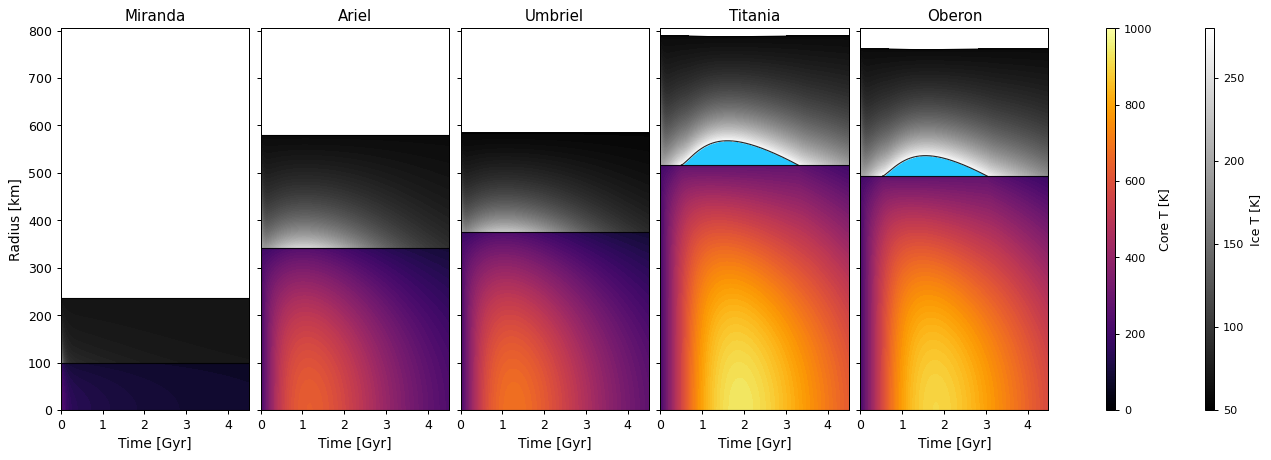
Figure 1 Modeled interior evolution of the Uranian moons under radiogenic heating assuming CI chondrite rock composition. The models start from fully differentiated bodies with a rocky core and a pure H₂O ice envelope.
(1) F. Nimmo, R. T. Pappalardo, J. Geophys. Res. Planets. 121, 1378–1399 (2016).
(2) R. J. Cartwright et al., Astrophys. J. 898, L22 (2020).
(3) C. B. Beddingfield, R. J. Cartwright, E. Leonard, T. Nordheim, F. Scipioni, Planetary Science Journal. 3 (2022), doi:10.3847/PSJ/ac63d1.
(4) C. B. Beddingfield, E. Leonard, R. J. Cartwright, C. Elder, T. A. Nordheim, Planetary Science Journal. 3 (2022), doi:10.3847/PSJ/ac7be5.
(5) C. Strom, T. A. Nordheim, D. A. Patthoff, S. K. Fieber-Beyer, Planet. Sci. J. 5, 226 (2024).
(6) C. J. Bierson, F. Nimmo, Icarus. 373 (2022), doi:10.1016/j.icarus.2021.114776.
(7) J. Castillo-Rogez et al., J. Geophys. Res. Planets. 128 (2023), doi:10.1029/2022JE007432.
(8) M. Ćuk, M. El Moutamid, M. S. Tiscareno, Planetary Science Journal. 1 (2020), doi:10.3847/PSJ/ab9748.
(9) S. F. Dermott, C. D. Murray, Icarus. 76, 295–334 (1988).
How to cite: Rovira-Navarro, M., van Woerkom, Q. B., and Lari, G.: Conditions for the formation and persistence of subsurface oceans in the Uranian moons, Europlanet Science Congress 2026, The Hague, The Netherlands, 7–11 Sep 2026, EPSC2026-117, https://doi.org/10.5194/epsc2026-117, 2026.


