OPS3 | Ice Giant Systems: Science and Exploration

OPS3

Ice Giant Systems: Science and Exploration
Convener: Vincent Hue | Co-conveners: Leigh Fletcher, Thibault Cavalié, Mark Hofstadter, Kurt D. Retherford, Michael T. Roman, Lorenz Roth, Krista Soderlund
Orals THU1
| Thu, 10 Sep, 08:30–10:00 (CEST)|Room Uranus (Swing)
Orals THU2
| Thu, 10 Sep, 11:00–12:30 (CEST)|Room Uranus (Swing)
Posters THU-POS
| Attendance Thu, 10 Sep, 18:00–19:30 (CEST) | Display Thu, 10 Sep, 08:30–19:30|Foyer 3, F3.1–10
Thu, 08:30
Thu, 11:00
Thu, 18:00
This session will cover all aspects of ice giant (IG) systems including (but not limited to) the atmospheric structure and composition, magnetospheres, interiors, satellites, and rings of the IGs. Interdisciplinary, crosscutting themes of ice giant planet exploration, such as the relationship to exoplanetary science and connections with heliophysics will also be considered in the session. The session will consist of a combination of solicited and contributed oral and poster presentations on new, continuing, and future studies of the ice giant systems and the importance of the ice giants to models of the formation and evolution of the giant planets and the Solar System.

We welcome abstracts that:

Address the current understanding of ice giant systems, including atmospheres, interiors, magnetospheres, rings, and satellites including Triton.
Advance our understanding of the ice giant systems in preparation for future exploration, both by remote sensing and in situ.
Discuss what the ice giants can tell us about solar system formation and evolution leading to a better understanding of the current structure of the solar system and its habitable zone as well as extrasolar systems.
Address outstanding science questions requiring future investigations including from spacecraft, remote sensing, theoretical, and laboratory work necessary to improve our knowledge of the ice giants and their relationship to the gas giants and the solar system.
Present concepts of missions, instruments, and investigations relevant to future exploration of the ice giant planetary systems.
Due to the prioritization of the Uranus Orbiter and Probe (UOP) mission theme by the 2023 National Academy of Sciences "Origins, Worlds, and Life" planetary science decadal survey, we encourage the submission of abstracts that discuss broad science goals as they relate to the proposed objectives of the UOP mission. We welcome abstracts discussing measurements that could be made of the planet, satellites, and rings via remote sensing and/or in situ observations.

Orals THU1: Thu, 10 Sep, 08:30–10:00 | Room Uranus (Swing)

Chairpersons: Lorenz Roth, Tom Briand
08:30–08:42
|
EPSC2026-403
|
On-site presentation
Emmanuel Lellouch, Manuel L'opez-Puertas, Ian Wong, Bryan Holler, Silvia Protopapa, Dean Hines, Jonathan Lunine, Stefanie Milam, and Heidi Hammel

Triton was observed by JWST/NIRSpec  in December 2022, covering the 0.97-5.27 μm range at a spectral resolution R ~ 2700, as part of Cycle 1 GTO program  #1272. In addition to the wealth of surface features due to N2, CH4, CO, CO2 ices and some of their isotopes, as well as organics in the 3.4-μm region, the spectra show the unambiguous signature of atmospheric CH(in absorption at 1.66, 2.3 and 3.3 μm) and CO (in fluorescent emission at 4.7 μm). These new data provide contemporary estimates of the abundances of these gases, for which past measurements have been scarce. CH4 appears enhanced by a factor ~4 compared to the Voyager epoch, and CO is estimated at the ~1000 ppm level within a factor of 3.

How to cite: Lellouch, E., L'opez-Puertas, M., Wong, I., Holler, B., Protopapa, S., Hines, D., Lunine, J., Milam, S., and Hammel, H.: CH4 and CO in Triton's atmosphere as seen by JWST, Europlanet Science Congress 2026, The Hague, The Netherlands, 7–11 Sep 2026, EPSC2026-403, https://doi.org/10.5194/epsc2026-403, 2026.

08:42–08:57
|
EPSC2026-773
|
ECP
|
solicited
|
On-site presentation
Alex Akins, Katherine de Kleer, Maria Camarca, Alexander Thelen, Imke de Pater, and Bryan Butler

Ground- and spacecraft-based microwave radiometry investigations of the satellites of Jupiter and Saturn have provided interesting constraints on the properties of their icy regoliths, including degree of ice purity, porosity and, at the longest wavelengths, conductive ice shell thickness. These properties in turn have applications towards understanding the evolutionary history of the moons; as a recent example, Phua and Stevenson (2026) find that the ice purity of Ganymede inferred from Juno MWR observations corresponds to an impactor flux which is less by an order of magnitude than that posited by Barr and Canup (2010) to explain differences in the differentiation outcomes of Ganymede and Callisto during their evolutions.

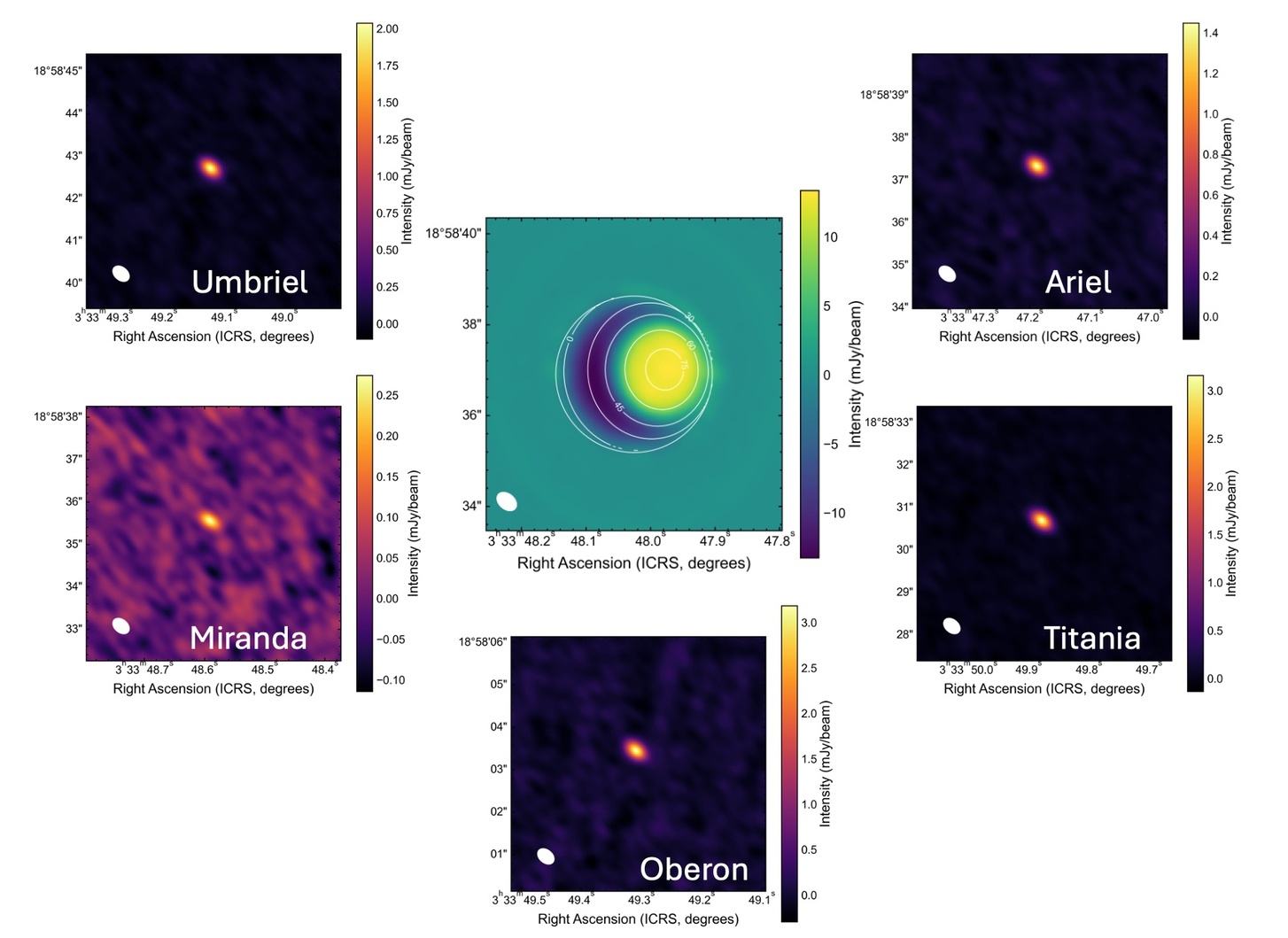
                  While several microwave thermal emission measurements have been obtained for the primaries of Jupiter and Saturn, no such measurements have yet been reported for the Uranian system. We re-reduced VLA and ALMA observations of Uranus between 2015-2025 and have compiled disk-integrated spectra for Miranda, Ariel, Umbriel, Titania, and Oberon from 0.85-30 mm; the previous longest wavelength of detection is 160 micron, by Detre et al. (2020). Over this time, the sub-observer point on the satellites moves closer to their northern poles, resulting in insolation-induced changes in their disk-integrated brightness temperatures The fact that these satellites are co-observed with Uranus enables an improvement in the calibration accuracy over the observatory standard procedures.

 The spectra for Titania and Oberon are generally consistent with Europa, Ganymede, and Callisto: Brighter at millimeter-wavelengths, then decreasing substantially as (presumably) scattering in the low-loss sub-surface regolith begins to become a substantial process. The spectra for Ariel and Umbriel in comparison are remarkably flat (although Umbriel is as expected much brighter than Ariel overall). Our presentation will discuss thermal and radiative transport modeling of these observations which consistently treats the porosity and grain size of the regolith material.

How to cite: Akins, A., de Kleer, K., Camarca, M., Thelen, A., de Pater, I., and Butler, B.: VLA/ALMA Microwave Spectra of Uranus’ Primary Satellites and their Implications for Regolith Structure, Europlanet Science Congress 2026, The Hague, The Netherlands, 7–11 Sep 2026, EPSC2026-773, https://doi.org/10.5194/epsc2026-773, 2026.

08:57–09:09
|
EPSC2026-702
|
On-site presentation
Xianzhe Jia

Uranus’ strongly non-axisymmetric internal magnetic field and extreme obliquity combine to produce a highly dynamic magnetosphere with pronounced diurnal and seasonal variability. The single flyby of Uranus’ magnetosphere by Voyager 2, together with limited remote sensing of the atmosphere and aurora, provides only partial constraints on how this system reconfigures as the planet rotates and evolves through seasonal phases. Here we use the BATSRUS magnetohydrodynamic (MHD) model to simulate Uranus’ magnetosphere and quantify changes in its large-scale structure over a rotation cycle and across seasonal phases. We present results for near-solstice and near-equinox conditions, enabling direct comparison of how the relative geometry of the planetary rotation axis, internal magnetic field, and solar wind alters magnetospheric topology, boundary locations, and current systems. Comparison with Voyager 2 observations shows that the model reproduces the observed large-scale configuration, including the temporal variability of the tail plasma sheet sampled during the flyby. We use the simulations to characterize how periodic rotation-driven reconfiguration differs between solstice and equinox. These results provide context for interpreting auroral observations from Voyager and HST, including how seasonal geometry may modulate auroral morphology and variability.

How to cite: Jia, X.: Diurnal and Seasonal Variability of Uranus’ Magnetosphere from Global MHD Simulations, Europlanet Science Congress 2026, The Hague, The Netherlands, 7–11 Sep 2026, EPSC2026-702, https://doi.org/10.5194/epsc2026-702, 2026.

09:09–09:24
|
EPSC2026-253
|
ECP
|
solicited
|
On-site presentation
Dan Naylor, Licia C. Ray, William R. Dunn, Jamie M. Jasinski, H. Todd Smith, Samuel J. Wharton, Ravindra T. Desai, Carol S. Paty, and Xin Cao

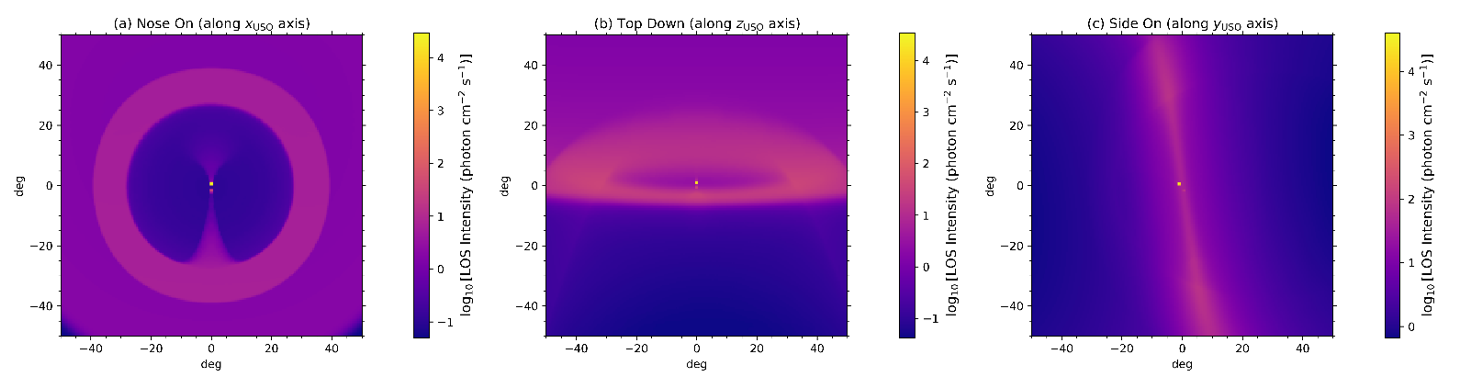
Soft X-ray emission from a planetary magnetosheath and its associated cusps can be generated by charge exchange between highly charged solar wind ions (such as O7+) and system neutrals. Instruments such as the SXI on the ESA/CAS SMILE mission aim to perform global and dynamic imaging of the terrestrial magnetosheath and explore the driving of the magnetosphere by the solar wind. We investigate the viability of this technique at Uranus where neutral particles sputtered from the icy moons are predicted to form extended tori, although densities are unconstrained. The 98 planetary obliquity and 59 tilt of the dipole axis relative to the spin axis mean the magnetosphere and neutrals have a complex interaction with the solar wind where, for example, the cusps can coincide not only with the exosphere but with the moon-sourced neutrals. We present simulation-derived results that considers the Uranian system at equinox and solstice conditions, estimating the emission generated in the magnetosheath and cusps at different stages of a planetary rotation. Example cases show that around the time of the Voyager 2 flyby, line-of-sight integrated intensity could have been up to ~102 photon cm-2 s-1 on average in the magnetosheath, and up to ~104 photon cm-2 s-1 in the cusps near the planet. This suggests imaging of the magnetosheath and cusps within planetary and solar wind timescales may be possible and that soft X-ray imaging is a potentially valuable tool for studying Uranus’s magnetosphere.

Figure 1: intensity maps for an example case of Uranus’s magnetosheath at solstice, with a large instrument field-of-view being used to show the full dayside magnetosheath region. Intensity is shown for an instrument positioned (a) nose-on to the system, (b) top-down, and (c) side-on to the planet.

How to cite: Naylor, D., Ray, L. C., Dunn, W. R., Jasinski, J. M., Smith, H. T., Wharton, S. J., Desai, R. T., Paty, C. S., and Cao, X.: Soft X-Ray Emission from Uranus's Magnetosheath, Europlanet Science Congress 2026, The Hague, The Netherlands, 7–11 Sep 2026, EPSC2026-253, https://doi.org/10.5194/epsc2026-253, 2026.

09:24–09:36
|
EPSC2026-1155
|
On-site presentation
Ola Al-Khuraybi, Karen Aplin, and Alberto Gambaruto

Characterising the electrical environment on Uranus is crucial for the understanding of atmospheric chemical and physical processes such as chemical composition, cloud microphysics, and aerosol charging mechanisms. Due to its complex and highly asymmetric magnetic field, Uranus exhibits strong variations in Galactic Cosmic Ray (GCR) cutoff rigidities. As a result, the GCR-induced ionisation is highly non-uniform across the planet. Previous work modelled the atmospheric conductivity of the Ice Giants by assuming simple 1D ionisation rate averages and used ion-aerosol attachment calculations based on classical theory that fail in the unique thermodynamic conditions of Uranian stratosphere.

This work offers the first 3D model of conductivities of Uranus based on its global GCR ionisation profiles (computed with CORSIKA 8) and a newly developed first-principles solution for the kinetic attachment of ions to aerosols. Unlike the previous classical models, based Fuchs-Hoppel framework, our model accounts for the full Maxwellian distribution of ions' velocities instead of assuming an average ion velocity. The inclusion of Maxwellian distribution leads to the introduction of a new capture surface at the repulsive Coulomb barrier. This approach provides a more rigorous prediction of the electron ‘bite-out’; a region within the stratospheric hazes where aerosol surfaces rapidly scavenge free electrons.

Using the steady-state ion and electron concentrations, we show how the vertical range and altitude of this bite-out depend on the local balance between the GCR ionisation intensity and the static aerosol sink. Moreover, the deeper-atmospheric conductivity profile resulting from GCRs is compared with the upper-atmospheric conductivity profile resulting from solar radiation. This comparison provides a more holistic view of the planet's electrical structure, providing a baseline for future studies of lightning generation, haze stability, and local electrical potentials in the Uranian atmosphere.

How to cite: Al-Khuraybi, O., Aplin, K., and Gambaruto, A.: The Global Electrical Structure of Uranus: 3D Conductivity Mapping via GCR Ionisation in the Haze Layer, Europlanet Science Congress 2026, The Hague, The Netherlands, 7–11 Sep 2026, EPSC2026-1155, https://doi.org/10.5194/epsc2026-1155, 2026.

09:36–09:48
|
EPSC2026-511
|
ECP
|
On-site presentation
Kai Chen and Ingo Mueller-Wodarg

   Knowledge of Uranus’ atmosphere has been limited by the fact that only one spacecraft has to-date performed a close flyby. With the Voyager 2 mission setting much of the landscape of Uranus science since 1986 [1, 2], new remote observations steadily providing new, but mostly height-integrated information [3], numerical modelling is a key tool that allows us to provide further constraints on the ice giant.  

   Solar heating alone is not enough to heat the giant planets to their observed thermospheric temperatures which defines the so-called ‘Giant Planet Energy Crisis’ [4]. What is likely to be supplying the extra energy is the coupling between the magnetosphere and upper atmospheres of these planets. For the Gas Giants, this process has been thoroughly studied, and sufficient energy can be provided from the aurora. Modelling has addressed how this energy can be transported to explain the observed hot thermospheric temperatures of these planets at all latitudes and longitudes in despite of suppression of equatorward transport from Coriolis forces [5, 6].  

   For Uranus, and likely Neptune, the problem is intrinsically different. The relative importance of the coupling terms from solar-wind or rotation-driven magnetosphere interaction, charged particle precipitation and joule heating remains under-constrained. The planet has a strongly tilted magnetic field, potentially generating stronger diurnal and seasonal variability and dynamical energy transport. At Uranus, the observed long-term cooling of the planet also represents an additional phenomenon not seen on the other Gas Giants [7].

   A physics-based, three-dimensional, general circulation model, of Uranus’ upper atmosphere (thermosphere and ionosphere) is under development, based on previously published similar models for Jupiter and Saturn, and we use this to address some of the above questions. Naturally, this development also encourages comparative aeronomy. We discuss preliminary results from UTIM, the Uranus Thermosphere-Ionosphere Model, which self-consistently calculates winds, temperatures and composition in response to external drivers. The model allows us to place local observations into a global context and understand underlying physical processes. Due to the current unconstrained nature of the planet, parameter space can be explored to guide where Uranus may lie. We will present case-studies at different conditions, outline future refinement and feature development of the model.

References

[1] Lindal, Gunnar F., et al. "The atmosphere of Uranus: Results of radio occultation measurements with Voyager 2." Journal of Geophysical Research: Space Physics 92.A13 (1987): 14987-15001.

[2] Herbert, Floyd, et al. "The upper atmosphere of Uranus: EUV occultations observed by Voyager 2." Journal of Geophysical Research: Space Physics 92.A13 (1987): 15093-15109.

[3] Melin, Henrik, et al. "The ionosphere of Uranus as revealed by JWST." Geophysical Research Letters 52.22 (2025): e2025GL118301.

[4] Melin, Henrik. "Towards a solution to the energy crisis." Nature Astronomy 4.9 (2020): 837-838.

[5] Müller‐Wodarg, I. C. F., et al. "Atmospheric waves and their possible effect on the thermal structure of Saturn's thermosphere." Geophysical Research Letters 46.5 (2019): 2372-2380.

[6] Müller-Wodarg, Ingo CF, et al. "Temperatures of Jupiter’s Upper Atmosphere: The Role of the Planetary Magnetic Field." The Astrophysical Journal Letters 990.1 (2025): L22.

[7] Melin, Henrik. "The upper atmospheres of Uranus and Neptune." Philosophical Transactions of the Royal Society A: Mathematical, Physical and Engineering Sciences 378.2187 (2020).

How to cite: Chen, K. and Mueller-Wodarg, I.: Exploring the Uranian upper atmosphere with a general circulation model, Europlanet Science Congress 2026, The Hague, The Netherlands, 7–11 Sep 2026, EPSC2026-511, https://doi.org/10.5194/epsc2026-511, 2026.

09:48–10:00
|
EPSC2026-524
|
ECP
|
On-site presentation
Caleb Keaveney and Juan Lora

Uranus is a peculiar planet with an understudied but compelling climate. Its rotation rate and radius place it, along with Neptune, in an interesting dynamical parameter space between the terrestrial planets and the gas giants. Its high obliquity leads to extreme seasonal forcing, its internal heat flux is weak relative to the other giant planets [1], and the abundance and molecular weight of methane contributes to convective inhibition and influences the global circulation [2]. Observational evidence supports to presence of a single eastward jet in each hemisphere along with weak westward flow around the equator [3]. Temperature retrievals suggest a warm equator and poles with cold mid-latitudes [4,5], and there is an apparent methane enrichment at the equator, with methane depleted towards the poles [5,6]. These features allude to an interesting global circulation that nevertheless remains mysterious. Furthermore, observations themselves are limited in spatial and temporal coverage and have large uncertainties, all of which motivates high fidelity atmospheric modeling ahead of a future satellite mission.

Here we present simulation results from a novel general circulation model (GCM) for Uranus. The GCM is built on the GFDL Finite-Volume Cubed-Sphere (FV3) dynamical core, which has hydrostatic and non-hydrostatic capabilities solving Euler’s equations on the sphere. We incorporate a modular and hierarchical suite of model physics packages that includes two-stream, multiple-scattering, non-gray correlated-k “full” radiative transfer including molecular absorption by CH4, C2H2, and C2H6, collision-induced absorption by H2-H2, H2-He, H2-CH4, He-CH4, and CH4-CH4, and a prescribed aerosol model from Irwin et al. [7]; two-stream gray radiation; Newtonian relaxation to radiative equilibrium with pressure-dependent relaxation timescales; large-scale condensation of methane with virtual effects included in the governing equations; Rayleigh bottom-boundary drag to represent interactions with the interior in solid-body rotation; intrinsic heat flux at 0.078 W/m2 introduced uniformly at the model bottom [1]; and an enthalpy- and moisture-conserving dry convective adjustment which homogenizes potential temperature and specific humidity where the virtual potential temperature profile is unstable.

The simulations we present here use idealized Newtonian relaxation to equinoctial radiative equilibrium, with the equilibrium profile itself and relaxation timescales determined from the “full” radiative transfer scheme. The relaxation timescales are pressure-dependent, which we determined to be a critical element of the forcing in properly representing the contributions of radiation to the global energy balance, and a change from previous studies. The simulations are spun-up for multiple Uranus years with horizontal resolution of 0.5° and the vertical domain spanning 30 bar at model bottom to 0.1 hPa at model top.

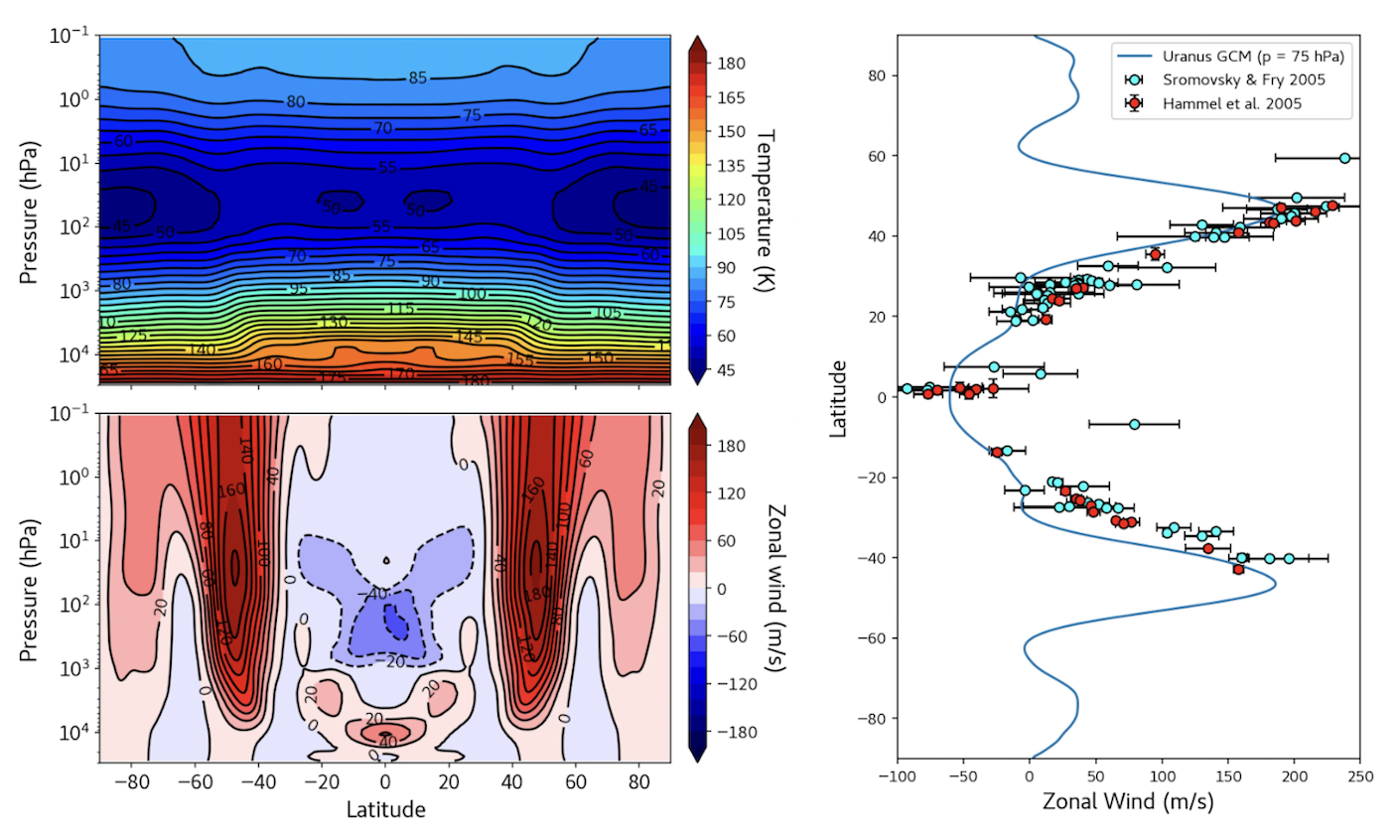
Our results are consistent with and add color to the observations described above (Fig. 1). We observe a single eastward jet in each hemisphere and westward flow around the equator. We also see a local eastward maximum in the polar regions, suggesting the presence of polar cyclones. The positions of the jets and the magnitude of the winds are consistent with observations. The jets are eddy-driven, with baroclinic waves evident in the jet formation regions. The virtual effect of methane is substantial, and we present evidence to suggest that the equatorial flow on Uranus is dynamically linked to the methane distribution. We also observe methane condensation in the upper troposphere and an interesting energy balance in the lower troposphere, where radiation does not produce appreciable heating and instead dynamical transport and convection dominate energy processes. 

These simulations represent an advancement in our understanding of Uranus’s climate, particularly in how the planet’s unique forcing drives an interesting atmospheric circulation, how that circulation transports energy, momentum, and moisture, and how different regions of the planet couple and participate in the energy balance. Ongoing and future work with this Uranus GCM will emphasize methane radiative and dynamical feedbacks, seasonal effects in the stratosphere and troposphere, and the dynamics of mid-latitude and polar vortices present in our simulations.

Figure 1: Temperature and wind results from simulations with Uranus GCM. Top left: Zonal-time mean temperature. Bottom left: Zonal-time mean winds, eastward flow in red and westward flow in blue. Right: Time mean zonal winds at 75 hPa in comparison to observation, with Sromovsky & Fry [8] data in blue and Hammel et al. [9] data in red.

References

[1] Wang et al. (2025). Geophysical Research Letters 52(14)

[2] Leconte et al. (2017). Astronomy & Astrophysics 598

[3] Soyeur et al. (2022). The Astronomy Journal 165(1)

[4] Orton et al. (2015). Icarus 260

[5] Roman et al. (2025). EPSC-DPS Joint Meeting 2025, Helsinki, Finland

[6] Sromovsky et al. (2014). Icarus 238

[7] Irwin et al. (2022). Journal of Geophysical Research: Planets 127(6)

[8] Sromovsky & Fry (2005). Icarus 179(2).

[9] Hammel et al. (2005). Icarus 175(2).

How to cite: Keaveney, C. and Lora, J.: Global circulation and the influence of methane in a novel general circulation model for Uranus, Europlanet Science Congress 2026, The Hague, The Netherlands, 7–11 Sep 2026, EPSC2026-524, https://doi.org/10.5194/epsc2026-524, 2026.

Orals THU2: Thu, 10 Sep, 11:00–12:30 | Room Uranus (Swing)

Chairpersons: Leigh Fletcher, Michael T. Roman
11:00–11:12
|
EPSC2026-643
|
On-site presentation
Yohai Kaspi, Eli Galanti, Keren Duer-Milner, Nimrod Gavriel, and Ilai Guendelman
The giant planets exhibit a fundamental contrast in their equatorial circulation: Jupiter and Saturn are characterized by broad eastward equatorial jets, or superrotation, whereas Uranus and Neptune exhibit strong westward equatorial flow, or subrotation. This dichotomy has often been interpreted as evidence for distinct dynamical regimes on the gas and ice giants. However, here we show that these opposing equatorial states may instead arise from a common dynamical mechanism, with the direction of the equatorial jet determined by the way convection, rotation, and eddy momentum transport interact within the planetary interior and atmosphere.
Here we present a unified perspective on the formation of super- and sub-rotating equatorial jets across the giant planets. In deep rotating convection models, columnar convective motions can organize angular momentum in a way that produces either eastward or westward equatorial flow. The two outcomes emerge as separate equilibrated branches of the same dynamical system, implying that the transition from superrotation to subrotation may be understood as a bifurcation rather than as a change in the underlying forcing. Importantly, both regimes are maintained by comparable wave and eddy processes, suggesting that the gas and ice giants need not require fundamentally different explanations for their equatorial jets.
This picture connects naturally with idealized atmospheric 3D hydrodynamical simulations of the ice giants, which show that Uranus- and Neptune-like subrotation can be sustained when the modeled circulation extends sufficiently deep and allows eddy momentum fluxes to converge angular momentum away from the equator. Taken together, the two approaches suggest a continuous dynamical pathway linking the deep convective interiors of the gas giants with the deep atmospheric circulation of the ice giants. The observed contrast between superrotation and subrotation may therefore reflect different equilibrated states of a shared convective-eddy system, controlled by planetary parameters such as convective forcing, stratification, rotation rate, and effective dynamical depth.
This unified framework provides a basis for interpreting the diversity of zonal winds among the giant planets and offers testable predictions for future observations of Uranus and Neptune, where the depth and maintenance of the equatorial jets remain key open questions.

How to cite: Kaspi, Y., Galanti, E., Duer-Milner, K., Gavriel, N., and Guendelman, I.: A mechanism for super- and sub-rotation on the gas and ice giants, Europlanet Science Congress 2026, The Hague, The Netherlands, 7–11 Sep 2026, EPSC2026-643, https://doi.org/10.5194/epsc2026-643, 2026.

11:12–11:27
|
EPSC2026-1055
|
ECP
|
solicited
|
On-site presentation
Gwenaël Milcareck, Jeremy Leconte, Sandrine Guerlet, Arthur Le Saux, Noé Clément, Thomas Dubos, Franck Montmessin, Aymeric Spiga, Déborah Bardet, Ehouarn Millour, Emmanuel Lellouch, Raphael Moreno, Thibault Cavalié, and Oscar Carrion-Gonzalez

The atmospheric circulation of Uranus and Neptune is particularly intense and shows strong similarities between the two planets. It is characterised by a retrograde jet (westerly winds) at the equator, reaching speeds of up to 400 m/s on Neptune, as well as prograde jets (easterly winds) located at the mid-latitudes of each hemisphere, with speeds of up to 250 m/s on both planets [1,2]. The origin of these jets remains poorly understood.


More recently, observations have revealed a latitudinal gradient in methane within the tropospheres of both planets [3,4]. The molar fraction of methane varies approximately between 1% and 5% on Uranus and between 2% and 6% on Neptune, from the poles to the equator. Due to its high molecular weight relative to that of hydrogen and helium, its variation in mass fraction reaches up to 15–20% between the poles and the equator for both planets. This gradient therefore induces significant variations in the average molecular weight. The wet thermal wind equation therefore predicts significant shear associated with this latitudinal gradient, suggesting that the prograde jets could be in dynamic equilibrium with this methane distribution.


To investigate the effect of the latitudinal methane gradient on the general circulation of ice giants, numerical simulations at a resolution of 2° were carried out between 15 bar and 0.01 mbar using the DYNAMICO dynamical core [5], coupled with a seasonal radiative-convective model previously applied to these planets [6]. To maintain this latitudinal gradient, the methane concentration is relaxed towards the values imposed at pressures above 2.5 bar. Variations in average molecular weight were taken into account in the dynamic solver. Thus, the potential temperature used in the thermodynamic equation was replaced by the potential enthalpy. The effects of molecular mass were also incorporated into the dry and moist convective adjustments. For dry convection, the potential temperature was replaced by a local adiabatic temperature consistent with variations in molecular mass as a criterion for convective instability. In the case of moist convection, the critical mixing ratio controls the inhibition of convection. In both adjustment schemes, the enthalpy conservation equation has been reformulated and condensates have been explicitly accounted for. Finally, the condensation scheme, comprising condensation, re-evaporation and mass redistribution, has also been modified to include effects related to variations in molecular weight.


According to our GCM, an intense prograde jet is simulated in each hemisphere at mid-latitudes for both planets. Their intensity varies between 200 m/s and 300 m/s and the eastward winds extend from the poles to low latitudes, similar to what was observed during the Voyager 2 flyby. These two jets also extend to high altitudes, which is consistent with recent observations. As for the retrograde jet observed at the equator, our simulations produce a jet twice as intense as the one observed on Uranus, and half as intense as the observed one on Neptune. When the methane gradient is excluded, the prograde jets reach only 30 m/s; and when the relaxation towards this gradient is halted during the simulation, the methane gradient does not persist and becomes homogeneous from the poles to the equator. Thus, an unknown mechanism is required to maintain this latitudinal gradient. There is also a discrepancy between the latitudinal position of the maximum of the prograde jet and the region where the latitudinal methane gradient is most pronounced, indicating a a momentum convergence linked to wave dissipation at these latitudes.


The tropospheric thermal structure is also affected by the presence of this gradient, where local maxima and minima develop on either side of the jets. At lower pressures, seasonal thermal variations are greatly attenuated by atmospheric dynamics. With regard to the meridional circulation, the Transformed eulerian formalism has been modified to take into account the variation in molar mass in the calculation of the mass stream function. We will present the main features of the resulting meridional circulation and how it differs from the one suggested from observations


References

[1] Allison et al. (1991), Uranus atmospheric dynamics and circulation. 253–295.

[2] Limaye et al. (1991), Journal of Geophysics Research, 96:18941–18960.

[3] Karkoschka and Tomasko (2009), Icarus, 202(1):287– 309.

[4] Karkoschka and Tomasko (2011), Icarus, 211(1):780– 797.

[5] Dubos et al. (2015), Geoscientific Model Development, 8(10):3131– 3150.

[6] Milcareck et al (2024), Astronomy & Astrophysics, 686:A303.

How to cite: Milcareck, G., Leconte, J., Guerlet, S., Le Saux, A., Clément, N., Dubos, T., Montmessin, F., Spiga, A., Bardet, D., Millour, E., Lellouch, E., Moreno, R., Cavalié, T., and Carrion-Gonzalez, O.: Moist thermal wind balance between zonal jets and the latitudinal methane gradient on Uranus and Neptune, Europlanet Science Congress 2026, The Hague, The Netherlands, 7–11 Sep 2026, EPSC2026-1055, https://doi.org/10.5194/epsc2026-1055, 2026.

11:27–11:42
|
EPSC2026-551
|
ECP
|
solicited
|
On-site presentation
Oliver King, Leigh Fletcher, Tom Stallard, Henrik Melin, Michael Roman, and Simon Toogood

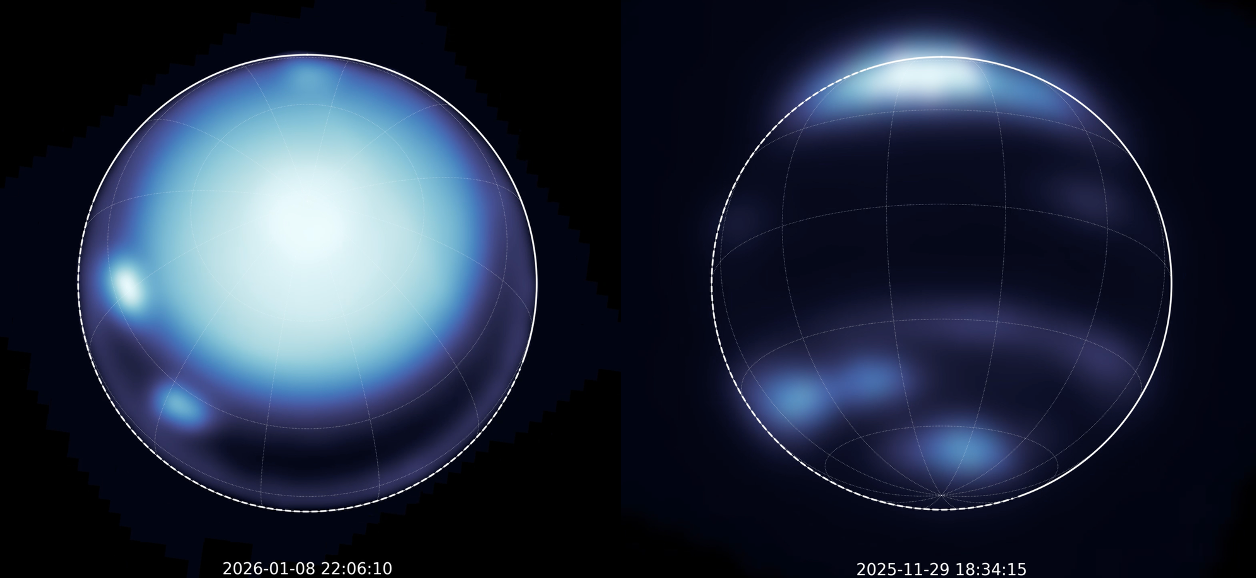
JWST has recently completed an unprecedented campaign, observing the ice giants Uranus and Neptune repeatedly over the course of several months. Over this campaign (GO 7570, PI: Stallard), each planet was observed ~200 times (Neptune in November and December 2025; Uranus in January and February 2026) with the NIRSpec/IFU instrument (Figure 1), providing 2.8-5.2 µm spatially resolved spectroscopy (R=2700, 0.1”/pixel). This has created a comprehensive dataset of the evolution and variation of the atmospheres of these ice giants, over timescales ranging from ~10 minutes to ~1 month. This presentation provides a first look at the dynamic and evolving cloud systems in the neutral atmospheres of Uranus and Neptune, as observed by this JWST campaign.

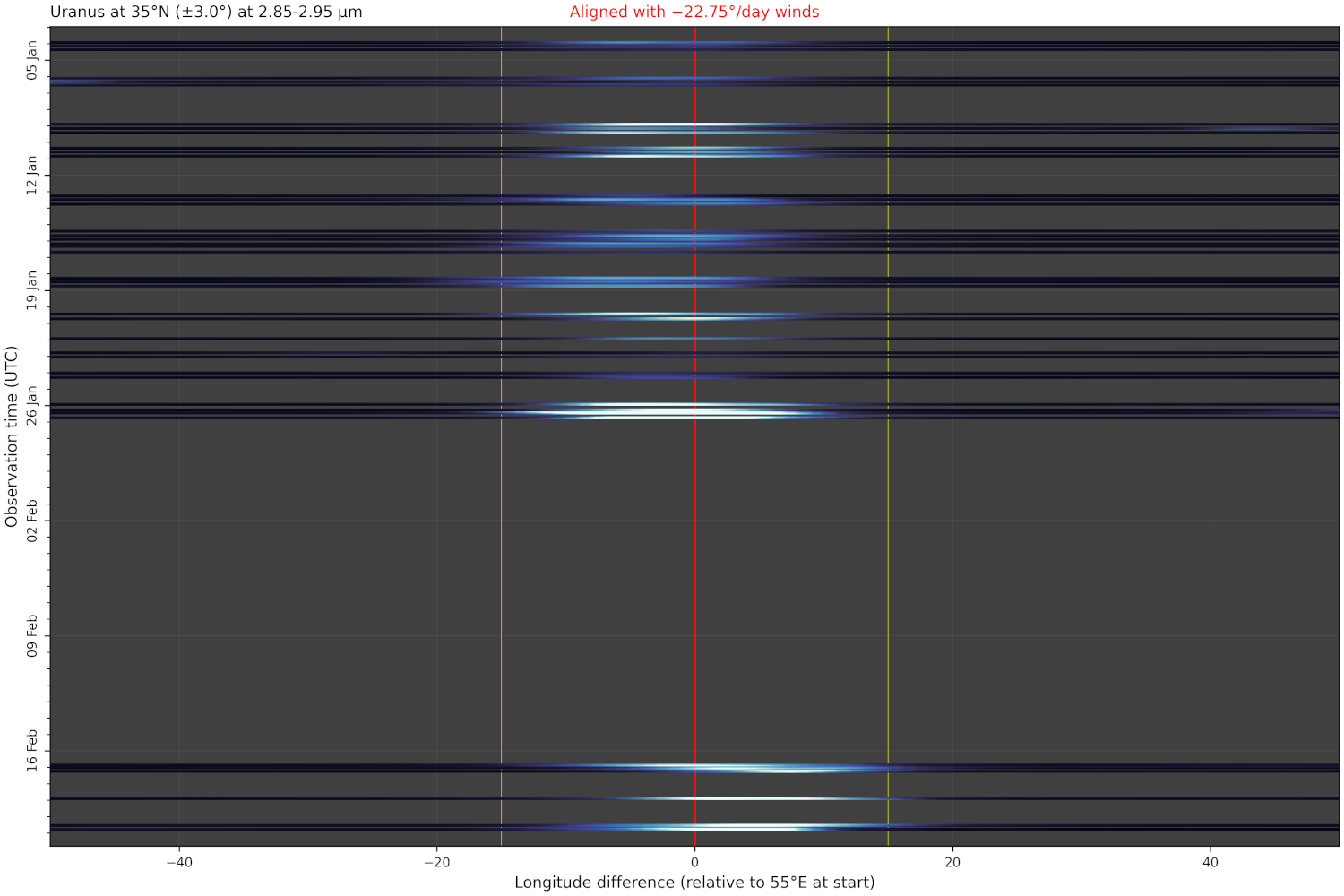
Tracking of cloud drift, morphology and brightness variations: We use the dataset to track the locations and evolution of several clouds over the month-long period of observations of each planet. Fitting the longitudinal drift of each cloud allows us to calculate zonal wind velocities at discrete latitudes, where initial analysis of the Uranus data appears generally consistent with previous studies (e.g., Sromovsky et al., 2005). However, tracking of individual clouds shows significant dynamic evolution of clouds over ~day long timescales – for example, the prominent cloud at 35°N on Uranus (Figure 2) appears to rapidly intensify and fade in brightness multiple times over the dataset. Other clouds show a range of behaviours, with some fading completely, and others seeming to disappear, only to reappear after several days in the same location. We are also able to study the variation in spatial structure and extent of clouds, with some appearing to oscillate slightly in location (around a consistent zonal drift), while others may be changing in size and shape.

Spectral analysis and vertical structure: The power of the JWST/NIRSpec instrument allows us to go beyond tracking the locations and spatial extents of the clouds by also studying their spectral properties. Different wavelengths in the 2.8-5.2 µm spectral range probe different depths in the atmospheres of Uranus and Neptune, allowing us to infer the evolution of 3D structure of ice giant clouds using this dataset. We can isolate the spectrum for each identified cloud feature, compare it to the typical background spectrum for that latitude, and then track how the cloud’s spectrum (and therefore its vertical extent) varies over time. Preliminary results suggest that the clouds may vary more slowly at longer wavelengths, suggesting that they may be longer lived at the lower altitudes that these wavelengths are most sensitive to. Similarly, there are some more subtle and faint cloud features which are only visible at longer wavelengths (> ~4µm), suggesting that some cloud features may only be present at these lower altitudes/higher pressures.

The powerful combination of temporal, spatial and spectral information provided by this JWST dataset enables a detailed study of cloud features in the neutral atmospheres of the ice giants, tracking how clouds dynamically move, evolve and change in all three dimensions.

Figure 1: Images of Uranus (left) and Neptune (right) at 2.9µm, showing examples of cloud features observed in this dataset. Over the whole campaign, ~200 observations were captured of each planet, providing fully spatially resolved 2.8-5.2µm spectra across the discs of Uranus and Neptune.

Figure 2: Example cloud tracking keogram, showing the variation of the 35°N cloud on Uranus. The longitudes for each successive observation have been shifted with a -22.75°/day zonal wind, consistent with the observed drift rate of this cloud. Over the course of the observations, the cloud appears to vary significantly in brightness and potentially oscillate slightly in longitude around the constant drift rate (red line).The yellow lines show the approximate longitudinal extent of the feature.

How to cite: King, O., Fletcher, L., Stallard, T., Melin, H., Roman, M., and Toogood, S.: JWST’s observations of dynamic cloud systems on Uranus & Neptune, Europlanet Science Congress 2026, The Hague, The Netherlands, 7–11 Sep 2026, EPSC2026-551, https://doi.org/10.5194/epsc2026-551, 2026.

11:42–11:54
|
EPSC2026-297
|
On-site presentation
David Dubois, Ana Lucia Ferreira de Barros, Sreeja Raghunandanan, Thibault Nguyen Trung, Cintia Aparecida Pires da Costa, Hermann Rothard, and Alicja Domaracka

The ice giants represent the last two and least explored planets of the solar system. The Uranus Orbiter and Probe (UOP) identified as a top priority flagship mission by the 2023 Planetary Science & Astrobiology Decadal Survey represents an important step towards the future characterization of Uranus and its moons [1]. This offers us an opportunity to draw from decades of science conducted at Jupiter, Saturn, and their moons, to advance research in preparation before the arrival of the UOP at Uranus, whose composition is still largely unknown. Atmospheric composition, formation and evolution of organic haze, and the processes influencing haze formation on Uranus and on the icy surface of its moons have all been highlighted as key topics of interest to address by the UOP [1]. As such, supportive laboratory simulations will be necessary to improve our understanding of Uranus and its icy moons, and the formation and evolution of organic molecules in the planet’s atmosphere.

For laboratory astrophysics applications, we reproduce the radiative conditions induced by cosmic rays found in planetary and astrophysical environments by utilizing heavy ions delivered by the GANIL facility (Grand Accélérateur National d’Ions Lourds, in Caen, France) [2]. Irradiation experiments of low-temperature ices and organic materials have been performed with the IGLIAS setup, part of the CIMAP-GANIL user facility CIRIL, where in situ infrared absorption spectroscopy and QMS mass spectrometry have allowed for the detection and physico-chemical characterization of organic molecules induced by heavy ion irradiation [3]. A unique and versatile multibeam irradiation platform called MIRRPLA, soon to be commissioned, will enable more realistic radiation conditions where the synergistic effect on planetary and astrophysical ices of UV photons, keV electrons, and keV-GeV ions delivered by GANIL will be studied [4]. For the ice giants, key open questions include the radiation-induced synthesis of complex organics from CH4/NH3/H2O-based ices and the spectral signature of irradiation residue products relevant to Uranus’s haze. The upcoming MIRRPLA platform at GANIL will enable for the first time simultaneous UV–electron–ion irradiation, offering a realistic proxy for Uranian stratospheric and magnetospheric chemistry. We will present ongoing work from heavy-ion experiments and outline MIRRPLA’s future role in UOP preparatory science.

Acknowledgements

The authors acknowledge funding support from the French Agence National de Recherche (ANR MIRRPLA - 22-EXOR-0012 and ANR CPJ).  

References

[1] National Academies of Sciences, Engineering, and Medicine, 2023, Origins, Worlds, and Life: A Decadal Strategy for Planetary Science and Astrobiology 2023–2032; National Academies Press: Washington, DC, USA.
[2] Rangama, J., Grygiel, C., Mery, A., Rousseau, P., Rothard, H., 2022, Nucl. Phys. News. 32, No. 2 29-33.
[3] Rothard, H., Domaracka, A., Boduch, P., Palumbo, M.E., Strazzulla, G., da Silveira, E.F., and Dartois, E., 2017, Modification of ices by cosmic rays and solar wind, J. Phys. B: At. Mol. Opt. Phys. 50, 062001.
[4] Domaracka and Danger, 2023, Nuclear Physics News 33(4), 36–37.

How to cite: Dubois, D., Lucia Ferreira de Barros, A., Raghunandanan, S., Nguyen Trung, T., Aparecida Pires da Costa, C., Rothard, H., and Domaracka, A.: Open Questions and Perspectives for Experimental Studies of Uranus’s Atmospheric Chemistry, Europlanet Science Congress 2026, The Hague, The Netherlands, 7–11 Sep 2026, EPSC2026-297, https://doi.org/10.5194/epsc2026-297, 2026.

11:54–12:06
|
EPSC2026-52
|
ECP
|
On-site presentation
Joseph Penn, Patrick Irwin, and Jack Dobinson

The spectral signature of hydrogen sulphide (H2S) above the cloud tops in Uranus’ atmosphere was detected in 2018 [1]. The H2S humidity can be used as a tracer of Uranus’ overturning circulation [2] - peaks and troughs in the latitudinal humidity distribution may correspond to regions of local upwelling and downwelling near the H2S condensation level.


We analysed observations from Gemini-NIFS and VLT-SINFONI, taken between 2009 and 2014, to study the H2S humidity distribution of Uranus. In our previous analysis of H2S on Neptune [3], we found a significant degeneracy between the methane (CH4) and H2S distributions, so we prescribe a latitudinally varying deep methane abundance previously derived from HST-STIS spectra [4]. We deconvolve the observations and extract spectra using the Minnaert limb-darkening approximation, which has been applied in several analyses of Ice Giant observations [3,4,5].


We fit a parameterised aerosol model and the H2S humidity to our extracted spectra with nested sampling using our open-source radiative transfer code, archNEMESIS [6]. Our atmospheric model has a large number of parameters, and to make nested sampling computationally feasible we utilise a trained neural network for early exploration of the parameter space during our retrievals.


Since our observations span several years, we search for temporal changes. We find changes in the aerosol structure and aerosol spectral properties corresponding to the development of Uranus' north polar hood, in agreement with previous work [4,8]. If we assume that the CH4 distribution is stable over time, then our results show no significant changes in the H2S distribution. 


Our results show a general equator-to-pole decrease in the H2S humidity, similar to what has been found in microwave analyses that are sensitive to the deep H2S distribution [7]. Superimposed on this are local increases, which are fairly evenly spaced in latitude. We found a somewhat similar pattern in our analysis of H2S on Neptune [3], and an analysis of Neptune with VLT/MUSE also found peaks in reflectivity with a similar spacing [5]. These results are suggestive of a complex circulation pattern near the deep H2S aerosol layer.


[1] Irwin, P. G. J., et al. (2018). Detection of hydrogen sulfide above the clouds in Uranus's atmosphere. Nature Astronomy, 2(5), 420-427. 

[2] Fletcher, L.N., et al. (2020). Ice Giant Circulation Patterns: Implications for Atmospheric Probes. Space Sci Rev 216, 21

[3] Penn, J., et al. (2026). Reconciling Near-Infrared and Microwave Analyses of Neptune’s Hydrogen Sulphide Distribution. Monthly Notices of the Royal Astronomical Society, 548, 2, 

[4] James, A., et al. (2023). The Temporal Brightening of Uranus' Northern Polar Hood From HST/WFC3 and HST/STIS Observations. Journal of Geophysical Research: Planets, 128(10), e2023JE007904.

[5] Irwin, P. G. J., et al. (2023). Latitudinal Variations in Methane Abundance, Aerosol Opacity and Aerosol Scattering Efficiency in Neptune's atmosphere determined from VLT/MUSE. Journal of Geophysical Research: Planets, 128(11), e2023JE007980.

[6] Alday, J., et al. (2025). archNEMESIS: An Open-Source Python Package for Analysis of Planetary Atmospheric Spectra. Journal of Open Research Software, doi:10.5334/jors.554.

[7] Molter, E. M., et al. (2021). Tropospheric Composition and Circulation of Uranus with ALMA and the VLA. The Planetary Science Journal, 2(1), 3.

[8] Sromovsky, L. A., et al. (2024). The puzzling north polar region of Uranus: Continued zero-shear winds and increasing brightness from 2015 through 2022 according to 7 years of Keck AO imaging. Icarus, 420, 116186.

How to cite: Penn, J., Irwin, P., and Dobinson, J.: The Latitudinal Variation of H2S Humidity on Uranus , Europlanet Science Congress 2026, The Hague, The Netherlands, 7–11 Sep 2026, EPSC2026-52, https://doi.org/10.5194/epsc2026-52, 2026.

12:06–12:18
|
EPSC2026-766
|
On-site presentation
Daniel Toledo, Pascal Rannou, Patrick Irwin, Michael Roman, Bruno de Batz de Trenquelléon, Raul Rodriguez-Veloso, Clara Lorenzo-Corvo, Víctor Apéstigue, Marco Personat, and Ignacio Arruego

Radiative transfer analyses of Uranus and Neptune spectra have revealed a cloud layer at pressures greater than ~2 bar (1,2), with H₂S gas detected above it on both planets (3,4), suggesting H₂S ice as its main constituent. However, the properties of these clouds and their dependence on the deep atmospheric composition remain poorly constrained.

We present an extended version of a one-dimensional cloud microphysics model [5,6] previously applied to simulate CH₄ and H₂S clouds in the Ice Giants (7,8). The model now incorporates NH₄SH chemistry, extending the simulation domain to ~50 bar. Since NH₃ reacts with H₂S to form NH₄SH at depth, the deep N/S ratio controls how much H₂S is available to condense at higher altitudes. We explore how the deep NH₃ and H₂S abundances, together with the vertical mixing profile, determine the properties of the H₂S cloud layer, including its base pressure, total opacity, and particle size distribution.

Preliminary results and the implications of this work for the interpretation of current and future observations of Uranus and Neptune will be discussed.

References: [1] P. G. Irwin, et al., JGR: Planets, 127, e2022JE007189. [2] L. Sromovsky, et al., Icarus,Volume 317, (2019) [3] P. G. Irwin, et al., Nature Astronomy 2, 420 (2018). [4] P. G. Irwin, et al., Icarus 321, 550 (2019). ). [5] P. Rannou, et al., Science 311, 201 (2006). [6] F. Montmessin, et al., JGR: Planets 107, 4 (2002). [7] D. Toledo, et al., A&A, 694, A81 (2025). [8] D. Toledo, et al.,: Microphysical Modeling of Hydrogen Sulfide Clouds in the Atmospheres of the Ice Giants, EPSC-DPS Joint Meeting 2025,  https://doi.org/10.5194/epsc-dps2025-1456, 2025.

How to cite: Toledo, D., Rannou, P., Irwin, P., Roman, M., de Batz de Trenquelléon, B., Rodriguez-Veloso, R., Lorenzo-Corvo, C., Apéstigue, V., Personat, M., and Arruego, I.: H2S Cloud Properties in Uranus and Neptune: Sensitivity to Deep Composition and Vertical Mixing, Europlanet Science Congress 2026, The Hague, The Netherlands, 7–11 Sep 2026, EPSC2026-766, https://doi.org/10.5194/epsc2026-766, 2026.

12:18–12:30
|
EPSC2026-303
|
On-site presentation
Olivier Mousis, Robin Canup, Christopher Glein, Mark Hofstadter, and Jonathan Lunine

Understanding the bulk compositions of Uranus and Neptune remains a major challenge because their interiors cannot be directly sampled and their atmospheric compositions are only weakly constrained by remote sensing. In particular, the relative proportions of rocky, icy, and gaseous material accreted during their formation remain uncertain, limiting our understanding of ice giant formation in the protosolar nebula (PSN). Noble gases provide powerful diagnostics because they are chemically inert and preserve the signature of their formation environment. Among them, argon isotopes are especially promising because they can distinguish primordial material inherited from the PSN from radiogenic components released from rocks in planetary interiors. In particular, 40Ar is produced by the radioactive decay of 40K, a potassium isotope hosted in rocky material. Measuring atmospheric 40Ar in Uranus and Neptune could therefore constrain the amount of rocky material accreted by the ice giants.

A recent study [1] used chondritic potassium abundances and plausible degassing efficiencies to estimate the atmospheric 40Ar/H2​ ratios expected in Uranus and Neptune as a function of their rocky mass fraction. That study showed that radiogenic argon may contribute significantly to the present-day atmospheric argon inventory of the ice giants. Depending on the assumed rocky fraction and degassing efficiency, the predicted 40Ar abundances span several orders of magnitude and could be detectable by future entry probe mass spectrometers. The results further suggested that even moderate-precision measurements of 40Ar would provide meaningful constraints on the amount of rocky material incorporated into the planets.

A major challenge, however, is that atmospheric 40Ar is not expected to be purely radiogenic because a primordial component inherited from the PSN was likely incorporated during planet formation. The goal of the present study is therefore to evaluate the contribution of primordial argon delivered to Uranus and Neptune. This component depends on volatile trapping and transport processes operating in the PSN, including condensation of pure argon ice at very low temperatures (~20 K) and trapping within clathrate hydrates formed from crystalline water ice. We investigate a range of plausible primordial argon enrichments associated with volatile condensation fronts and argon icelines in the PSN, where local enhancements may substantially increase the amount of primordial argon incorporated into the solids accreted by the forming planets.

Specific attention is paid to the evolution of the 40Ar/C abundance ratio in the PSN as a function of time and heliocentric distance within the giant planet formation region. Near argon condensation fronts and icelines, this ratio can exceed the protosolar value by more than an order of magnitude [2, 3]. Combined with the strong carbon enrichment measured in Uranus’ atmosphere (50-100× protosolar), these conditions suggest that substantial amounts of primordial 40Ar may have been incorporated into the planet’s envelope during its formation. However, the presence of this primordial component introduces significant degeneracies when interpreting atmospheric 40Ar measurements. For example, a planet with a relatively small rocky fraction but strong primordial argon enrichment could exhibit atmospheric 40Ar abundances comparable to those of a planet with a larger rocky inventory but weaker primordial enrichment. To quantify these effects, we calculate the evolution of atmospheric 40Ar as a function of the rocky mass fraction under different assumptions for the primordial contribution. The resulting trends demonstrate that the interpretation of future measurements critically depends on disentangling primordial and radiogenic sources of argon.

Fortunately, argon isotopic measurements provide a powerful way to break these degeneracies. Primordial argon preserves the isotopic composition inherited from the PSN, whereas radioactive decay selectively enriches 40Ar. Simultaneous measurements of multiple argon isotopes can therefore disentangle primordial and radiogenic contributions. In particular, isotopic ratios involving 36Ar, 38Ar, and 40Ar provide a direct diagnostic of the radiogenic excess and, consequently, of the rocky component incorporated into the planets. In parallel, the total argon enrichment may constrain the formation location of the planetary building blocks within the PSN, because argon incorporation strongly depends on volatile trapping processes operating near argon icelines and condensation fronts. Together, these measurements would place strong constraints on the interiors, accretion histories, and formation pathways of Uranus and Neptune.

The study highlights the importance of future in situ atmospheric measurements at Uranus and Neptune. Because noble gases lack strong infrared and microwave spectroscopic signatures, their abundances and isotopic ratios cannot be reliably determined by remote sensing. Entry probes equipped with high-resolution mass spectrometers are therefore required to measure argon isotopes with sufficient sensitivity and precision, while also enabling measurements of other noble gases and isotopic systems. Such measurements would provide key constraints on the rocky fractions, accretion histories, migration pathways, and volatile delivery mechanisms of the ice giants, thereby helping reconstruct where and when they formed within the evolving PSN.

More broadly, our study confirms that argon isotopes constitute a promising and largely unexplored diagnostic of the rocky component of ice giants, with implications extending to the interpretation of extrasolar ice giants and sub-Neptune planets, which appear to be common outcomes of planet formation around other stars.

References

[1] Nimmo, F., Lunine, J., Zahnle, K., Stixrude, L. 2024. Probing the Rock Mass Fraction and Transport Efficiency inside Uranus Using 40Ar Measurements. The Planetary Science Journal 5. doi:10.3847/PSJ/ad3b93

[2] Mousis, O. and 8 colleagues 2024. Insights on the Formation Conditions of Uranus and Neptune from Their Deep Elemental Compositions. The Planetary Science Journal 5. doi:10.3847/PSJ/ad58d8

[3] Schneeberger, A., Mousis, O., Aguichine, A., Lunine, J.I. 2023. Evolution of the reservoirs of volatiles in the protosolar nebula. Astronomy and Astrophysics 670. doi:10.1051/0004-6361/202244670


How to cite: Mousis, O., Canup, R., Glein, C., Hofstadter, M., and Lunine, J.: Disentangling Primordial and Radiogenic Argon in Uranus and Neptune, Europlanet Science Congress 2026, The Hague, The Netherlands, 7–11 Sep 2026, EPSC2026-303, https://doi.org/10.5194/epsc2026-303, 2026.

Posters: Thu, 10 Sep, 18:00–19:30 | Foyer 3

Display time: Thu, 10 Sep, 08:30–19:30
F3.1
|
EPSC2026-117
|
On-site presentation
Marc Rovira-Navarro, Quirijn B. van Woerkom, and Giacomo Lari

In recent decades, subsurface oceans have been detected in several moons of the gas giants (1). While multiple observations suggest that subsurface oceans may also exist within some moons of the ice giants (25), our understanding of the ice-giant satellite systems remains limited. Owing to their astrobiological potential, the detection and characterization of subsurface habitats in the Uranian moons is a key scientific objective of a future Uranus system mission . To inform mission planning and enable interpretation of future observations, it is essential to understand the conditions that lead to the formation and persistence of such habitats, as well as their potential observational signatures.

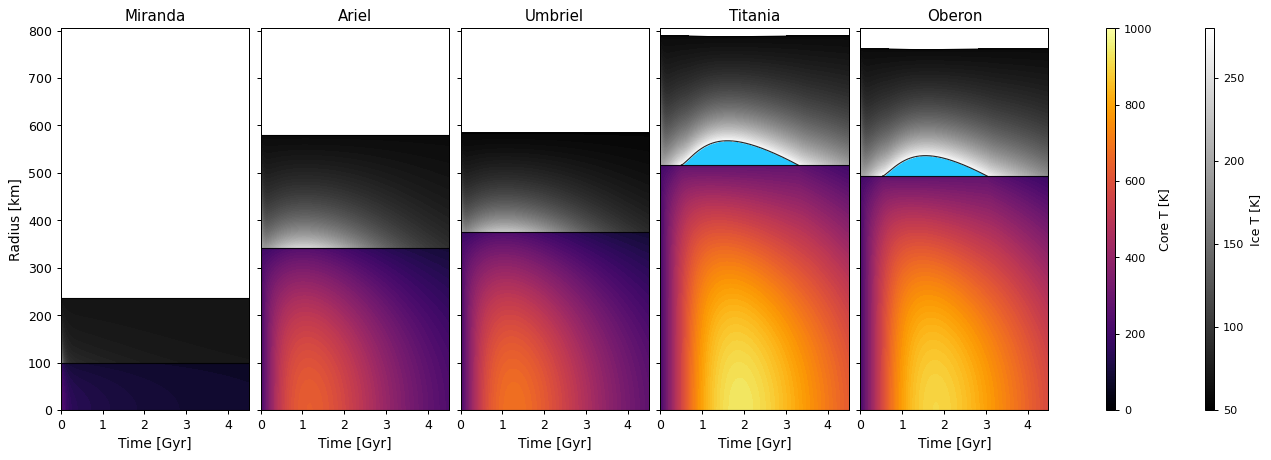
The formation and longevity of subsurface oceans depend on moon composition, thermal properties, and orbital evolution. Several studies have investigated the interior evolution of the Uranian moons without accounting for orbital dynamics (2, 3), or conversely have explored their orbital evolution with simplified or absent interior modeling (4, 5). Here, we bridge this gap by studying the interior evolution of the Uranian moons under a range of orbital evolution scenarios. Our objectives are twofold: to identify the conditions that enable the formation and long-term survival of subsurface oceans, and to identify observable properties that may discriminate between different evolutionary pathways.

We use DelfTIDE (Delft Tides Interior and Dynamics Evolution), a Python framework that simulates the coupled thermal, tidal, and orbital evolution of planetary bodies over geological timescales. We first model the evolution of the moons under radiogenic heating alone, and then investigate the effects of prescribed orbital histories consistent with the passage through mean-motion resonances. We explore the influence of initial conditions, composition, and orbital evolution on subsurface ocean formation, longevity, and potential observables relevant to a future Uranian mission.

Figure 1 Modeled interior evolution of the Uranian moons under radiogenic heating assuming CI chondrite rock composition. The models start from fully differentiated bodies with a rocky core and a pure H₂O ice envelope.

(1) F. Nimmo, R. T. Pappalardo, J. Geophys. Res. Planets. 121, 1378–1399 (2016).
(2) R. J. Cartwright et al., Astrophys. J. 898, L22 (2020).
(3) C. B. Beddingfield, R. J. Cartwright, E. Leonard, T. Nordheim, F. Scipioni, Planetary Science Journal. 3 (2022), doi:10.3847/PSJ/ac63d1.
(4) C. B. Beddingfield, E. Leonard, R. J. Cartwright, C. Elder, T. A. Nordheim, Planetary Science Journal. 3 (2022), doi:10.3847/PSJ/ac7be5.
(5) C. Strom, T. A. Nordheim, D. A. Patthoff, S. K. Fieber-Beyer, Planet. Sci. J. 5, 226 (2024).
(6) C. J. Bierson, F. Nimmo, Icarus. 373 (2022), doi:10.1016/j.icarus.2021.114776.
(7) J. Castillo-Rogez et al., J. Geophys. Res. Planets. 128 (2023), doi:10.1029/2022JE007432.
(8) M. Ćuk, M. El Moutamid, M. S. Tiscareno, Planetary Science Journal. 1 (2020), doi:10.3847/PSJ/ab9748.
(9) S. F. Dermott, C. D. Murray, Icarus. 76, 295–334 (1988).


How to cite: Rovira-Navarro, M., van Woerkom, Q. B., and Lari, G.: Conditions for the formation and persistence of subsurface oceans in the Uranian moons, Europlanet Science Congress 2026, The Hague, The Netherlands, 7–11 Sep 2026, EPSC2026-117, https://doi.org/10.5194/epsc2026-117, 2026.

F3.2
|
EPSC2026-123
|
On-site presentation
Jack Dobinson and Patrick Irwin

Modified CLEAN is a deconvolution technique derived from the classic CLEAN algorithm, adapted for application to extended planetary targets. We have previously demonstrated its effectiveness in enhancing the spatial resolution of recent (2018) ground-based observations of Neptune, revealing additional atmospheric structure beyond that accessible with standard processing techniques.

We are now extending this work to legacy near-infrared integral-field spectroscopy data obtained in 2009 and 2011 with the Near-infrared Integral Field Spectrograph (NIFS). The older datasets are more challenging to work with as they have stronger artefacts from the optical system and calibration procedures in both the science and standard star measurements.

As with all deconvolution methods, modified CLEAN performs optimally in low-noise conditions, where calibration data are smooth and have a high signal-to-noise ratio. This required a series of preprocessing steps. Principal component analysis was applied to both science and calibration observations to suppress noise and remove instrumental systematics. Telescope pointing information, not explicitly recorded for the original NIFS science observations, was reconstructed from ancillary data. Disk fitting and de-rotation were used to align and combine all observations within individual observing blocks. Finally, residual atmospheric refraction present in the standard NIFS pipeline products was identified and corrected.

These processing steps improve the performance of the modified CLEAN algorithm on the legacy NIFS datasets, giving improved spatial resolution and more reliable interpretation of Neptune’s atmospheric structure. This work demonstrates the continued scientific value of archival ground-based observations when combined with modern data analysis and deconvolution techniques.

How to cite: Dobinson, J. and Irwin, P.: Enhancing Ground-Based Neptune Observations Using Modified CLEAN Deconvolution, Europlanet Science Congress 2026, The Hague, The Netherlands, 7–11 Sep 2026, EPSC2026-123, https://doi.org/10.5194/epsc2026-123, 2026.

F3.3
|
EPSC2026-129
|
ECP
|
On-site presentation
Leonor Bernardo, Pedro Machado, Alexandre C. M. Correia, and Sérgio Gomes

The extreme 98º axial tilt of Uranus remains one of the most intriguing puzzles in planetary science, commonly attributed to a series of giant impacts during the late stages of planetary formation. This scenario argues that an impactor of 1–3 Earth masses at a grazing angle could deliver the angular momentum required to reach the current orientation and also generate a debris disk for satellite formation and potentially explain Uranus’ anomalously low internal heat flux [1, 2]. The specific impact parameters required for this hypothesis are tightly constrained and, therefore, while giant impacts remain a plausible contributor, they do not provide a fully self-consistent explanation for Uranus' present configuration.

Recent dynamical studies suggest that secular spin-orbit resonances, driven by the tidal migration of ancient satellites, could offer a compelling alternative explanation [3]. This mechanism has already been successfully invoked to explain the obliquity of Saturn, driven by tidal migration of Titan [4], and the future tilting of Jupiter. In this context, Uranus would represent the final stage of this dynamical progression: a planet that has completed its tilting phase.

Following the work of Saillenfest et al. (2022) [5], it has been demonstrated that the outward tidal migration of a single ancient satellite with a mass higher than 4e-4 Uranus masses could successfully tilt Uranus from a small initial obliquity towards 90º.

This study aims to numerically revisit and extend these findings using the self-consistent open-source N-body code TIDYMESS [6], by simulating the coupled tidal and rotational dynamics of a proto-Uranian system. We explore the tilting scenario of Uranus by analyzing the dynamical evolution of its spin-axis as a function of satellite distance and identifying the spin-orbit resonances capable of driving large-scale obliquity evolution. Our numerical approach accounts for gravitational field to the quadrupole order and integrates the equations of motion for orbital, spin, and deformation dynamics. Building on the scenarios proposed by Saillenfest [5], we investigate and broaden the parameter space of a hypothetical ancient satellite, specifically its mass and migration rate, to determine the conditions under which Uranus can be tilted from a low initial obliquity to its current state. 

Preliminary results focus on identifying the stability limits of such satellites at high obliquities and the potential for chaotic spin-axis evolution. By exploring different satellite configurations and migration timescales, this work aims to refine our understanding of the dynamical history of the ice giants and the role of tidal-migration mechanisms in planetary dynamics.

References

[1] Kegerreis, J. A., et al. (2018). The Astrophysical Journal, 861(1):52.

[2] Reinhardt, C., et al. (2020). Monthly Notices of the Royal Astronomical Society, 492:5336-5353.

[3] Gomes, R. (2026). Icarus, 453:117055.

[4] Saillenfest, M., et al. (2021). Astronomy & Astrophysics, 647:A92.

[5] Saillenfest, M., et al. (2022). Astronomy & Astrophysics, 668:A108.

[6] Boekholt, T. C. N. & Correia, A. C. M. (2023). Monthly Notices of the Royal Astronomical Society, 522(2):2885-2900.

How to cite: Bernardo, L., Machado, P., C. M. Correia, A., and Gomes, S.: Planetary Orbital Mechanics - The Weird Case of Uranus’ Rotation Axis Tilt, Europlanet Science Congress 2026, The Hague, The Netherlands, 7–11 Sep 2026, EPSC2026-129, https://doi.org/10.5194/epsc2026-129, 2026.

F3.4
|
EPSC2026-164
|
On-site presentation
Giacomo Lari and Mattia Rossi

The planet Uranus hosts five regular satellites: Miranda, Ariel, Umbriel, Titania, and Oberon. Unlike the moons of Jupiter and Saturn, these satellites are not involved in any mean motion resonance. However, both current orbital elements and geological features suggest that some of the moons had resonant interactions in the past (Peale 1999). As tidal forces are the main driver of moons' orbital expansion after their formation, the value of the quality factor Q of Uranus dictates the orbital evolution of the satellites and their possible past resonance crossings.

Based on classic tidal models, past works considered values of Uranus' Q larger than 10'000, which set a quite slow migration rate of the moons (e.g. Tittemore and Wisdom 1988, Cuk et al. 2020). With such values, the total variation in semi-major axes for most moons was limited, and consequently only a few low-order resonances were crossed during their orbital migration. In particular, a Q larger than 10'000 allows to avoid the encounter with the 2:1 resonance between Ariel and Umbriel (Tittemore and Wisdom 1990).

However, recent studies and estimations suggest that tidal dissipation within Uranus is much higher than previosuly thought (Nimmo 2023, Jacobson and Park 2025). They proposed a value of Uranus' Q around 1'000, so that the migration rate of the moons would be at least ten times faster than previously assumed. As a consequence, it is almost impossible to avoid the 2:1 resonance between Ariel and Umbriel, and it suffices to go back in time between 200 and 600 Myrs to encounter this resonance, depending on the exact value of Q.

In this context, we investigated the orbital evolution of the Uranus' system through the 2:1 resonance between Ariel and Umbriel, assuming a low value for the Q of the planet (Rossi et al. 2026). Through numerical simulations of the resonance crossing, we found that the two satellites were almost certainly captured into resonance, and their eccentricities were forced to increase. In particular, Ariel's eccentricity could have become as high as 0.02, which is more than ten times its current value. We also showed that eventually the resonance was disrupted through a three-body resonance crossing with Titania (either 4:2:1 or 3:2:1). Though we estimate that the moons left the resonance between 200 and 600 Myrs ago, our research does not allow us to determine when they entered the resonance or for how long they remained locked in.

Nevertheless, the depicted orbital history has a large impact on the geophysical evolution of the moons. The increase in the moons' eccentricities would have enhanced the tidal heating within the satellites, and for some of them the heat flux could have been large enough to induce tectonic activities and even cause partial resurfacing. We estimated the tidal heating within the satellites during the evolution into the 2:1 resonance, and compared it with geophysical estimates obtained from surface data.

The energy dissipation within Ariel due to the eccentric tides during the 2:1 resonance would have amounted to about 200 GWs, which correspond to a heat flux of 50 mW/m2. This value is within the range obtained from the analysis of the surface of the satellite (28-92 mW/m2, Peterson et al. 2015). Therefore, the 2:1 resonance could be responsible for the resurfacing on Ariel. However, a recent study on the Ariel's surface response to tidal stress found that the eccentricity necessary to cause resurfacing should have been at least 0.04 (Strom et al. 2026). In our simulations, we found that with the 2:1 resonance is very difficult for Ariel's eccentricity to reach such a high value.

Although also Umbriel was involved in the resonance, its equilibrium eccentricity was smaller (about 1/4 that of Ariel) and its orbit was farther from the planet. Therefore, the tidal heating within Umbriel resulted to be at least 500 times smaller the one experienced by Ariel. This is coherent with the different geological features observed on the surfaces of the two satellites, as Umbriel does not show signs of significant past tectonic activity.

Finally, even though Miranda was not directly involved in the resonant interaction between the moons, its orbital elements increased significantly during the orbital excitation due to the disruption of the 2:1 resonance. This is due to its small mass compared to the other bodies of the system and its proximity to Ariel. Miranda's eccentricity could have increased up to 0.1, which would have lead to a global tidal heating of tens of GWs, sufficient to explain the formation of the youngest coronae observed on its surface. These geological features are probably younger than 500 Myrs (Beddingfield et al. 2022); such a young age matches the epoch of the disruption of the 2:1 resonance in our scenario.

In the end, a low Q of Uranus changes the classic orbital history that was outlined for the Uranian moons (e.g. Dermott et al. 1988). In particular, the inclusion of the 2:1 resonance between Ariel and Umbriel has a significant impact on the orbital elements of the two moons and provides a natural explanation for the resurfacing of Ariel. Future measurements of the Uranian system, including data from Uranus Orbiter and Probe, will allow to confirm or confute this dynamical scenario.


Acknowledgments:

This research was developed under the ASI/UniBo-CIRI agreement no. 2024-5-HH.0.

 
References:

Beddingfield et al. (2022), Planet. Sci. J., 3, 174.
Cuk et al. (2020), Planet. Sci. J., 1, 22.
Dermott et al. (1988), Icarus, 76, 295-334.
Jacobson and Park (2025), Astron. J. 169, 65.
Nimmo (2023), Planet. Sci. J. 4, 241.
Rossi et al. (2026), Astron. Astrophys. 705, A48.
Peale (1999), Annu. Rev. Astron. Astrophys. 37, 533-602.
Peterson et al. (2015), Icarus, 250, 116-122.
Strom et al. (2026), Icarus 444, 116822.
Tittemore and Wisdom (1988). Icarus 74, 172-230.
Tittemore and Wisdom (1990). Icarus 85, 394-443.

How to cite: Lari, G. and Rossi, M.: Tidal heating of the Uranian moons during the 2:1 resonance between Ariel and Umbriel, Europlanet Science Congress 2026, The Hague, The Netherlands, 7–11 Sep 2026, EPSC2026-164, https://doi.org/10.5194/epsc2026-164, 2026.

F3.5
|
EPSC2026-421
|
On-site presentation
Tom Briand, Vincent Hue, Olivier Mousis, Thibault Cavalié, Antoine Schneeberger, Tom Benest, and Mark Hofstadter
Uranus and Neptune are the most distant and the least explored planets within our solar system. To this day, the formation history of these ice giants remains uncertain. A better understanding of their deep atmospheric composition helps to constrain where and how these planets formed within the protoplanetary disk.  Remote sensing can only retrieve the atmospheric composition down to the few bar level in the millimeter to infrared domain, and an entry probe as part of the Uranus Flagship mission may only measure the atmospheric composition down to ~10-20 bars. Some species are measured in this upper-tropospheric region at abundances several order of magnitude above what is predicted by thermochemical equilibrium. Atmospheric models are thus needed to interpret how the measured abundances of such species reflect the deeper atmospheric composition. 

Using a thermochemical & diffusion model (Cavalie et al., 2024), we aim to take advantage of such disequilibrium species to further constrain Uranus's and Neptune's deep atmospheric compositions. We have updated the model to consider the meridional variability of several parameters in the troposphere, including a formulation for the eddy diffusivity coefficient, Kzz, based on convection under rotation laboratory experiments. We provide a range of plausible deep O/H ratios for both planets, as well as assess the impact of uncertainty propagation in a large chemical network on such ratios. We compute C/O ratios as a function of latitude, and compare them with a protoplanetary disk model results (e.g. Schneeberger et al. 2023) that tracks the time-dependent radial transport of solids through the disk. Our results suggest a different C/O between Uranus and Neptune and thus may support a different formation pathway for the ice giants.

How to cite: Briand, T., Hue, V., Mousis, O., Cavalié, T., Schneeberger, A., Benest, T., and Hofstadter, M.: Evidence for Distinct C/O Ratios in Uranus and Neptune from Disequilibrium Chemistry , Europlanet Science Congress 2026, The Hague, The Netherlands, 7–11 Sep 2026, EPSC2026-421, https://doi.org/10.5194/epsc2026-421, 2026.

F3.6
|
EPSC2026-525
|
On-site presentation
Olivier Mousis, John Andrews, Matthew Beasley, Mark Hofstadter, Christopher Mankovich, Kevin Sacca, and Alejandro Soto

Helium is a key diagnostic of giant planet interiors. As the second most abundant component of hydrogen-rich atmospheres, the He/H2 ratio constrains planetary structure, thermal evolution, and formation history [1]. Departures from the protosolar value provide evidence for helium rain, layered convection, and deep compositional gradients [2], all of which affect luminosity evolution and the interpretation of gravity and magnetic field data. Yet helium abundance remains poorly constrained beyond Jupiter because helium lacks strong infrared or microwave signatures, and ultraviolet techniques probe only upper atmospheric layers. The only high-precision in situ measurement was obtained by the Galileo Probe Helium Abundance Detector (HAD), which revealed helium depletion in Jupiter [3-5]. No equivalent measurements exist for Saturn, Uranus, or Neptune, where models predict very different helium distributions [6-8]. For future Uranus and Saturn probe missions, a precise He/H2 measurement is therefore a high-priority interior diagnostic.

We propose a next-generation Helium Abundance Detector concept for future atmospheric probes. The instrument retains the simplicity of the refractometric principle of the Galileo HAD while leveraging modern optical metrology to simplify the architecture. The main innovation is the removal of the onboard reference gas cell, historically a major source of complexity and calibration risk. In the proposed concept, a diode laser or Vertical-Cavity- Surface-Emitting Laser (VCSEL) propagates through a fused-silica prism exposed to the ambient atmosphere. The location of the laser beam after one internal reflection, which is controlled by the differing indices of refraction of the prism and the ambient atmosphere, is measured with a high-resolution CMOS detector. Using Snell’s law and molecular refractivities, the He/H2 ratio can then be retrieved from the measured angular deviation.

The simplified design contains no moving parts and no reference gas cell, improving robustness under probe entry conditions while reducing mass and power requirements. Current performance estimates, based on analytical calculations and preliminary ray-tracing simulations, indicate a target He/H2 precision of about 0.003 over 1-20 bar and 100-350 K, with a mass below 1 kg and power consumption below 1 W.

Development is structured as a phased risk-reduction program. Phase 1 will optimize the optical design and establish a comprehensive error budget through high-fidelity simulations. Phase 2 will experimentally validate the refractometric retrieval method using surrogate gases under representative temperature–pressure conditions, followed by dedicated He/H2 testing in certified facilities. Phase 3 will evaluate integration within representative Uranus or Saturn probe architectures, including accommodation, thermal control, and operational constraints.

This effort directly addresses a major science objective for future ice giant exploration. In the absence of precise in situ measurements, Uranus’ helium abundance remains poorly constrained, and competing interior models diverge significantly depending on the extent of helium phase separation. Similarly, a more reliable in situ measurement of helium at Saturn would test whether current models of its interior, which include helium rain as an energy source, are correct. A compact, low-mass, low-power HAD would therefore provide a transformative constraint on giant planet evolution while establishing a reusable capability for future outer-planet probe missions.


References


[1] Atreya, S.K. et al. 2020. Space Sci. Rev. 216. doi:10.1007/s11214-020-0640-8

[2] Nettelmann, N. et al. 2024. Space Sci. Rev. 220.  doi:10.1007/s11214-024-01090-1

[3] Guillot, T. 2005. Annu. Rev. Earth Planet. Sci. 33, 493–530. doi:10.1146/annurev.earth.32.101802.120325

[4] von Zahn, U., Hunten, D.M., Lehmacher, G. 1998. J. Geophys. Res. 103, 22815–22830. doi:10.1029/98JE00695

[5] von Zahn, U., Hunten, D.M. 1996. Science 272, 849–851. doi:10.1126/science.272.5263.849

[6] von Zahn, U., Hunten, D.M. 1992. Space Sci. Rev. 60, 263–281. doi:10.1007/BF00216857

[7] Howard, S., Müller, S., Helled, R. 2024. Astron. Astrophys. 689. doi:10.1051/0004-6361/202450629

[8] Morf, L., Helled, R. 2025. A&A 704, A183 doi.org/10.1051/0004-6361/202556911


How to cite: Mousis, O., Andrews, J., Beasley, M., Hofstadter, M., Mankovich, C., Sacca, K., and Soto, A.: A Compact High-Precision Helium Abundance Detector for Giant Planet Entry Probes, Europlanet Science Congress 2026, The Hague, The Netherlands, 7–11 Sep 2026, EPSC2026-525, https://doi.org/10.5194/epsc2026-525, 2026.

F3.7
|
EPSC2026-168
|
ECP
|
On-site presentation
Alessandro Arcangeli, Lorenzo Fois, and Daniele Durante

The Uranus Orbiter and Probe (UOP) mission, prioritized by the 2023-2032 Decadal Survey, represents a critical step in understanding ice giant interiors, a class of planets left unexplored since the Voyager 2 flyby. This work investigates the potential for a dedicated gravity science experiment to resolve Uranus's hidden internal structure by measuring its gravitational field.

Through a comprehensive multi-arc covariance analysis conducted using the MONTE software, we evaluate the performance of three different candidate orbital families depending on pericenter altitude and latitude, as well as inclination and period. These families are designed to balance the high gravitational sensitivity of low-altitude periapsis passes with the operational safety constraints imposed by Uranus’s ring system. We specifically assess the recovery accuracy of zonal harmonics (J_l) and degree-2 tidal Love number (k_22) the latter being a pivotal indicator of whether the Uranian interior is fluid or partially solid.

Furthermore, following recent discoveries of seismic effects at Jupiter and Saturn, we incorporate a model of planetary normal modes (f-modes and p-modes) into the spacecraft dynamical model. We explore the detectability threshold of these acoustic oscillations and their potential to bias static gravity field estimations. By simulating various excitation scenarios and frequency envelopes, we identify orbital inclinations and periods that optimize the decorrelation between static, tidal, and dynamic gravitational signals. Our results demonstrate that a strategic selection of orbital parameters, specifically targeting polar inclinations and non-resonant periods, can advance our understanding of Uranus, potentially confirming the existence of a stratified or frozen core.


This work has been supported in part by the Italian Space Agency under contract n. 2024-5-HH.0.

How to cite: Arcangeli, A., Fois, L., and Durante, D.: Assessing the accuracy in the determination of Uranus gravity field with the UOP mission, Europlanet Science Congress 2026, The Hague, The Netherlands, 7–11 Sep 2026, EPSC2026-168, https://doi.org/10.5194/epsc2026-168, 2026.

F3.8
|
EPSC2026-454
|
ECP
|
On-site presentation
Carolin Meyer and Johannes Wicht

The ice giants Uranus and Neptune are the only planets in the solar system with an unusual magnetic field morphology that deviates significantly from a dipole-dominated field observed on all other planets in the solar system. Their magnetic fields were measured only once directly during the Voyager II flybys in 1986 and 1989. The flybys provided only brief, distant observations, capturing limited spatial and temporal coverage of each planet’s magnetic environment. As a result, the magnetic field structures of Uranus and Neptune remain poorly constrained and their temporal variations are entirely unknown.

We analyse to which extent these measurements enable accurate determination of the magnetic fields. In particular we assess how well a classical regularized least-square inversion constrains individual Gauss coefficients and other global field properties. To this end, we simulate a variety of multipolar-dominated magnetic fields using MagIC, an open-access pseudo-spectral magnetohydrodynamic code. We then evaluate how effectively the measurements along the Voyager II trajectories allow us to determine the simulated magnetic fields using a statistical analysis to account for the high time dependency of the simulations. Finally, we quantify the similarity to Uranus and Neptune’s field models by comparing the well-constrained Gauss ceofficients.

Additionally, we investigate whether different physically motivated interior structures can reproduce the observed magnetic field morphology of Uranus and Neptune. We implement two representative interior models based on recent literature.

The first model is based on compositionally stratified interiors that include a stably stratified layer above the dynamo region due to a phase separation process (H-H2O immiscibility) [1]. In this scenario, convection and dynamo action are confined to a relatively thick shell beneath the stable layer above a deeper, highly viscous, electrically superionic layer. The stable stratification suppresses radial motions and promotes more laterally varying flow patterns, which can lead to complex, non-axisymmetric magnetic field structures.

The second model follows a thin-shell dynamo configuration, where the magnetic field is generated in a comparatively shallow convective region located below the envelope and above a superionic layer [2]. In contrast to the stratified model, this setup lacks a strong overlying stable layer and instead confines dynamo action geometrically to a thin shell. This configuration tends to favor shorter convective length scales and enhances the influence of boundary conditions on the flow and magnetic field generation. We explore a broad range of control parameters, including the degree of stratification, the electrical conductivity profile, and the density stratification. This allows us to assess the robustness of the resulting magnetic field morphologies across different dynamical regimes.

The two different setups produce distinct magnetic field morphologies and temporal behaviors, both being capable of generating multipolar fields.
Our results show that the presence and strength of stably stratified layers strongly control the magnetic morphology, enabling transitions between multipolar and more dipole-dominated states. 

To assess the relevance of our models for Uranus and Neptune, we introduce a working criterion for “ice-giant-like” magnetic behavior. Rather than relying on instantaneous agreement with observed spectra, we define ice-giant-like fields as those that (i) are not dominated by the dipole component, (ii) show significant non-axisymmetric and hemispherically asymmetric contributions at low spherical harmonic degrees (l ≤ 3), and (iii) remain consistent with the range of Gauss coefficients that can be robustly recovered under Voyager-like sampling conditions.

We find that apparent agreement with observed ice-giant spectra can depend sensitively on temporal sampling and inversion limitations. Models may transiently reproduce Uranus- or Neptune-like spectra, while their long-term behavior differs significantly. This highlights the importance of considering temporal variability and observational filtering when interpreting spacecraft data.

These results demonstrate that different interior structures can produce qualitatively similar magnetic field morphologies under limited observational constraints, but arise from fundamentally different dynamical regimes. They highlight both the diagnostic power and the inherent limitations of single-flyby magnetic field measurements and provide new insights into how interior structure may shape the dynamo processes of Uranus and Neptune.

[1] Cano Amoros, M., et al. (2024), Astronomy & Astrophysics, 692, A152
[2] Militzer, B. (2024), Proceedings of the National  Academy of Sciences, 121, e2403981121

How to cite: Meyer, C. and Wicht, J.: Modelling the magnetic fields of Uranus and Neptune, Europlanet Science Congress 2026, The Hague, The Netherlands, 7–11 Sep 2026, EPSC2026-454, https://doi.org/10.5194/epsc2026-454, 2026.

F3.9
|
EPSC2026-1050
|
On-site presentation
Michael Roman, Leigh Fletcher, Oliver King, Simon Toogood, Heidi Hammel, Patrick Irwin, Joseph Penn, Imke de Pater, Henrik Melin, and Stefanie Miliam

JWST-NIRSpec observations are providing our first detailed view of the Ice Giants in the 5-micron spectral window [1]. Observations of Jupiter and Saturn (see Figure) at 5 microns have historically revealed important insights into their tropospheric composition, along with striking images of clouds silhouetted against the glowing thermal emission from deeper atmospheric layers [2]. Comparable observations of the colder Ice Giants, however, have long remained beyond observational reach—until now.

In this talk, we present JWST-NIRSpec 5-micron observations of the Ice Giants and discuss their implications. We examine what these observations reveal about the tropospheric temperatures, clouds, and composition of Uranus and Neptune, as well as what they may imply for current radiative transfer models at these wavelengths.

In particular, we find that the JWST data may suggest sub-adiabatic temperature gradients near the cloud layers, resulting in colder temperatures in the deeper atmosphere. However, these conclusions depend sensitively on the scattering properties of Ice Giant clouds and on accurate modelling of the gaseous opacity, both of which, we argue, remain uncertain under these conditions.

Figure: Saturn at 5 microns (left, in red) from Cassini, with hazes shown in green (Image credits: NASA/JPL-Caltech/University of Arizona), compared to Uranus at 5 microns from JWST-NIRSpec [1].

[1] Roman, M.T., et al., The Infrared Spectrum of Uranus Revealed with JWST (submitted)

[2] Wong, M.H., Bjoraker, G.L., Goullaud, C., Stephens, A.W., Luszcz-Cook, S.H.,1047
Atreya, S.K., Pater, I., Brown, S.T.: Deep clouds on jupiter. Remote Sensing1048
15(3), 702 (2023)


How to cite: Roman, M., Fletcher, L., King, O., Toogood, S., Hammel, H., Irwin, P., Penn, J., de Pater, I., Melin, H., and Miliam, S.: Cold Temperatures, Dark Clouds, or Missing Absorption: What Does the 5-Micron Window Tell Us about the Ice Giants?, Europlanet Science Congress 2026, The Hague, The Netherlands, 7–11 Sep 2026, EPSC2026-1050, https://doi.org/10.5194/epsc2026-1050, 2026.

F3.10
|
EPSC2026-767
|
On-site presentation
Thibault Cavalié, Raphael Moreno, Camille Lefour, Statia Luszcz-Cook, Thierry Fouchet, Emmanuel Lellouch, Oscar Carrion-Gonzalez, Bilal Benmahi, Sandrine Guerlet, Gwenaël Milcareck, Noé Clément, Michel Dobrijevic, Imke de Pater, Arielle Moullet, Julianne Moses, Jérémy Leconte, Aymeric Spiga, Michael Roman, and Leigh Fletcher

The upper atmospheric composition of giant planets can be altered by material originating from external sources. Icy rings and satellites, large comet impacts and interplanetary dust particles are known sources of oxygen species. For example, oxygen species in the stratosphere of Jupiter result from the impacts of the comet Shoemaker-Levy 9 fragments in 1994 (Lellouch et al. 1995, 2002, Cavalié et al. 2014) and from interplanetary dust particles (Moses & Poppe 2017). In Saturn and Neptune, CO was likely provided by an ancient comet impact (Cavalié et al. 2010, Lellouch et al. 2005, Luszcz-Cook et al. 2013). On the other hand, H2O is supplied to Saturn by Enceladus (Hartogh et al. 2011, Cavalié et al. 2019) and its rings (Waite et al. 2018), and by interplanetary dust particles in Uranus and Neptune (Moses & Poppe 2017, Teanby et al. 2022). Because those sources results in different spatio-temporal distributions of species, 3D mapping and temporal monitoring are powerful tools to determine their nature for each planet.


In addition, these sources can also deliver nitrogen and sulfur species, as in Jupiter and Neptune (Lellouch et al. 1995, Marten et al. 1995, Moreno et al. 2017). We can then use the abundance ratios between oxygen, nitrogen and sulfur species as a complementary diagnostic to determine the sources of exogenic material in a given atmosphere.


In this paper, we will present spectral mapping observations of Uranus, obtained with the Atacama Large Millimeter/submillimeter Array (ALMA) in 2022 and 2024 as part of projects 2021.1.01034.S and 2022.1.00558.S (PI: S. Luszcz-Cook). These observations were set to map the emission of the CO (J=3-2) and HCN (J=4-3) lines. We will report the first detection of HCN in the stratosphere of Uranus. We will present the retrieved abundances for HCN and CO and compare them with previous estimates. We will also discuss the horizontal and vertical distributions of CO, as derived from the observations, and their implications on the source of CO of Uranus. Finally, we will discuss candidate sources of HCN.


References:
Cavalié et al. 2010. A&A 510, A88
Cavalié et al. 2013. A&A 553, A21
Hartogh et al. 2011. A&A 532, L2
Lellouch et al. 1995. Nature 373, 592
Lellouch et al. 2002. Icarus 159, 112
Lellouch et al. 2005. A&A 430, L37
Luszcz-Cook et al. 2013. Icarus 222, 379
Marten et al. 1995. GRL 22, 1589
Moreno et al. 2017. A&A 608, L5
Moses & Poppe 2017. Icarus 297, 33
Teanby et al 2022. PSJ 3, 96

How to cite: Cavalié, T., Moreno, R., Lefour, C., Luszcz-Cook, S., Fouchet, T., Lellouch, E., Carrion-Gonzalez, O., Benmahi, B., Guerlet, S., Milcareck, G., Clément, N., Dobrijevic, M., de Pater, I., Moullet, A., Moses, J., Leconte, J., Spiga, A., Roman, M., and Fletcher, L.: ALMA spectral mapping of Uranus: first detection of HCN and the determination of the external source of CO, Europlanet Science Congress 2026, The Hague, The Netherlands, 7–11 Sep 2026, EPSC2026-767, https://doi.org/10.5194/epsc2026-767, 2026.