
 ,,
,,- Institute of Earth and Environmental Sciences, Albert-Ludwigs-Universität Freiburg, Freiburg, Germany (rajit.das@email.unifreiburg.de)
Introduction
The three space missions by ESA and NASA (Veritas, DAVINCI and EnVision) underscore the growing scientific interest to understand our closest neighbour, Venus. It has a young (McKinnon et al., 1997) but poorly constrained (~350-1 Ga) and seemingly uniform surface age determined by the random distribution of ~950 impact craters (Herrick & Phillips, 1994) (Fig 1). The apparent random distribution of impact craters on the surface suggests an equilibrium resurfacing model of the crust (Phillips et al., 1992). Previous studies (e.g., Ivanov & Head, 2011) have determined relative ages of geological units based on superposition principles. The spatial distribution of craters and the geological units defined by Ivanov & Head (2011) have not been combined previously.
This study aims at investigating the spatial distribution, timing and statistical significance of impact craters and the stratigraphy mapped by Ivanov & Head (2011). Based on the database by Herrick & Phillips (1994), we added parameters, where each impact crater was characterised based on the time of formation, target unit, and an improved degradation classification.
We are testing different statistical methods, such as Kolmogorov–Smirnov (KS) test, to find correlation between the classification parameters and the geological units.
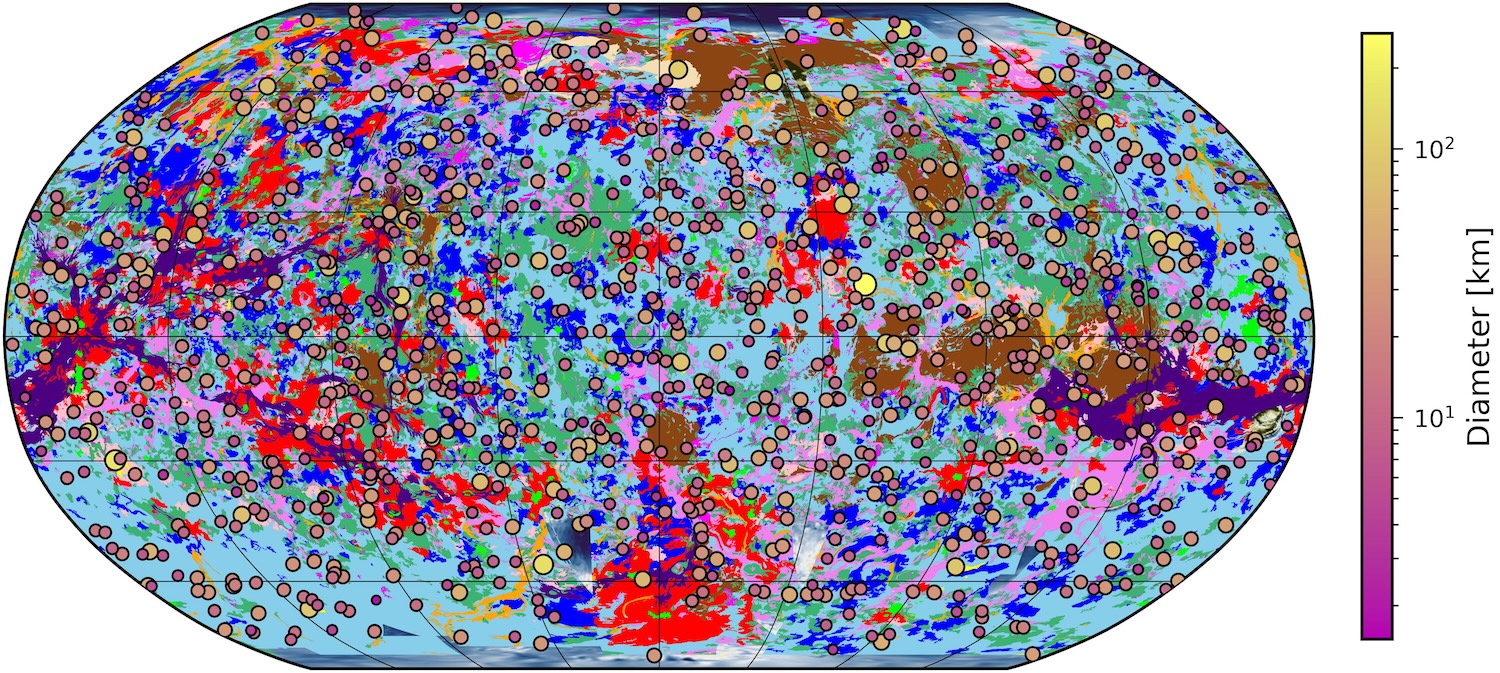
Fig 1. Geological map of Venus in Robinson projection based on Ivanov & Head (2011) with the spatial distribution of impact craters and their diameters. Colour bar shows the variation in diameter in log scale.
Results
The improved weathering index was obtained by:
Wi = (central structure diameter) / (total diameter) * (degradation state) / (rim completeness)
Where the degradation state assumes values 1 for pristine craters with ejecta, 2 for craters with partially preserved ejecta and 3 for heavily degraded craters without ejecta blanket (Herrick & Phillips, 1994).
The spatial distribution of the weathering index was then plotted on the topography (Fig 2a). The degradation state that was previously mapped by Herrick & Phillips (1994) shows a strong correlation with altitude (Fig 2b).
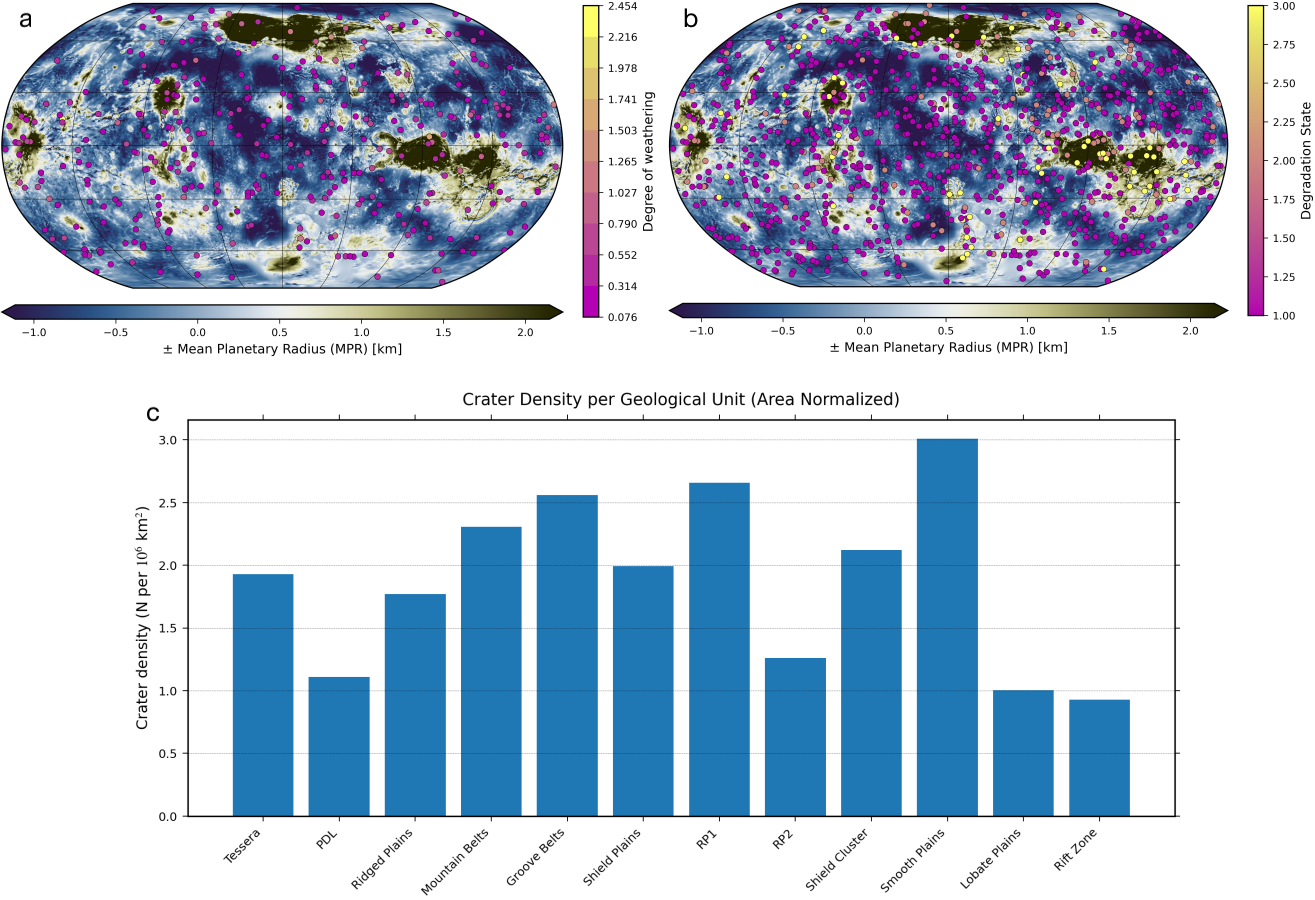
Fig 2. Spatial distribution of the degree of weathering with topography by us (a) and by Herrick & Phillips (1994) (b). c. crater density on different stratigraphical units
The p-value in the KS clustering analysis shows a range from 0.0168 to 0.6707 between the crater size frequency distribution in the different stratigraphic units.
References
Herrick, R. R., & Phillips, R. J. (1994). Implications of a Global Survey of Venusian Impact Craters. Icarus, 111(2), 387–416. https://doi.org/10.1006/ICAR.1994.1152
Ivanov, M. A., & Head, J. W. (2011). Global geological map of Venus. Planetary and Space Science, 59(13), 1559–1600. https://doi.org/10.1016/J.PSS.2011.07.008
McKinnon, W. B., Zahnle, K. J., Ivanov, B. A., & Melosh, H. J. (1997). Cratering on Venus: Models and Observations. Veii, 969. https://ui.adsabs.harvard.edu/abs/1997veii.conf..969M/abstract
Phillips, R. J., Raubertas, R. F., Arvidson, R. E., Sarkar, I. C., Herrick, R. R., Izenberg, N., & Grimm, R. E. (1992). Impact craters and Venus resurfacing history. Journal of Geophysical Research, 97(E10), 15923–15948. https://doi.org/10.1029/92JE01696;JOURNAL:JOURNAL:21562202E;WGROUP:STRING:PUBLICATION
How to cite: Das, R., Kenkmann, T., Karagoz, O., and Hergarten, S.: The impact cratering inventory on Venus: time resolved size-frequency distributions, Europlanet Science Congress 2026, The Hague, The Netherlands, 7–11 Sep 2026, EPSC2026-1174, https://doi.org/10.5194/epsc2026-1174, 2026.


