
 1,2,3,1,3,2,
- 1Instituto de Astrofísica e Ciências do Espaço and Departamento de Física, Faculdade de Ciências, Universidade de Lisboa, Edifício C8, Campo Grande, 1749-016 Lisbon, Portugal (dfquirino@fc.ul.pt)
- 2IDL - Instituto Dom Luiz e Departamento de Ciências da Terra e Energia, Faculdade de Ciências, Universidade de Lisboa, 1749-016 Lisbon, Portugal
- 3School of Ocean Sciences, Bangor University, Menai Bridge, LL59 5AB, United Kingdom
One of the biggest open questions about Venus is the degree and extent of present-day volcanism [1]. Despite having a similar size and density to Earth, Venus underwent distinct geodynamic evolution with no plate tectonics. The planet hosts a wide diversity of tectonic and volcanic landforms, as revealed by NASA/Magellan global imagery (1990 – 1994) [2].
One prominent feature is the extensive, widespread rifts on Venus (e.g., [3]), covering about 8% of the planetary surface [4]. These are extensional structures [5], among the youngest geological features on the planet according to stratigraphic interpretation [6]. Evidence of recent rift volcanism has been suggested for Olapa Chasma [7 – 9] and Ganis Chasma [10 – 11]. However, the mechanisms of rift formation, age, and relationships with other structural features remain poorly understood, yet crucial for supporting modelling studies [12].
In this study, we analyse the tectonovolcanic activity of major rifts on Venus using microwave emissivity as a proxy to constrain the weathering degree, relative age, and composition [11, 13 – 14], assuming the presence of ferroelectric minerals [13, 15 – 16]. We use Synthetic Aperture Radar (SAR), microwave emissivity, and elevation datasets collected from NASA/Magellan (see Figure 1). Site selection, radar emissivity, and elevation extraction are performed in ArcGIS Pro to examine emissivity excursion with altitude. Complementary analyses based on stratigraphic relationships with structural features, such as lava flows, rift structures, and lineaments, provide relative chrono-stratigraphy and conceptual interpretation of tectonovolcanic activation processes. For example, we observe a very recently active region within Rona Chasma, where we can detect multiple and distinct emissivity excursions by isolating specific lava flows (see Figure 2). One of these lava flows shows a very limited excursion despite being above the chemical weathering threshold. Combined with radar imagery, we confirm that the lava flow is fresh and study its cross-cutting relations with the neighbouring rift - which support a pattern of rift activation, followed by lava emplacement and later rift cutting over the lava flow. We expand this analysis to all major rifts on Venus, focusing on regions where lava flows are evident. Thus, the objective is to provide a conceptual model for global-scale tectonovolcanic rift activation by combining microwave emissivity excursions, stratigraphic relationships, and stress patterns. These results are relevant to upcoming accepted and potential missions to Venus in the coming decade, which will yield extensive new data. The objective is to identify and select possible rift zones with recent tectonovolcanic activity to support the selection of regions of interest on Venus (e.g., ESA/EnVision).
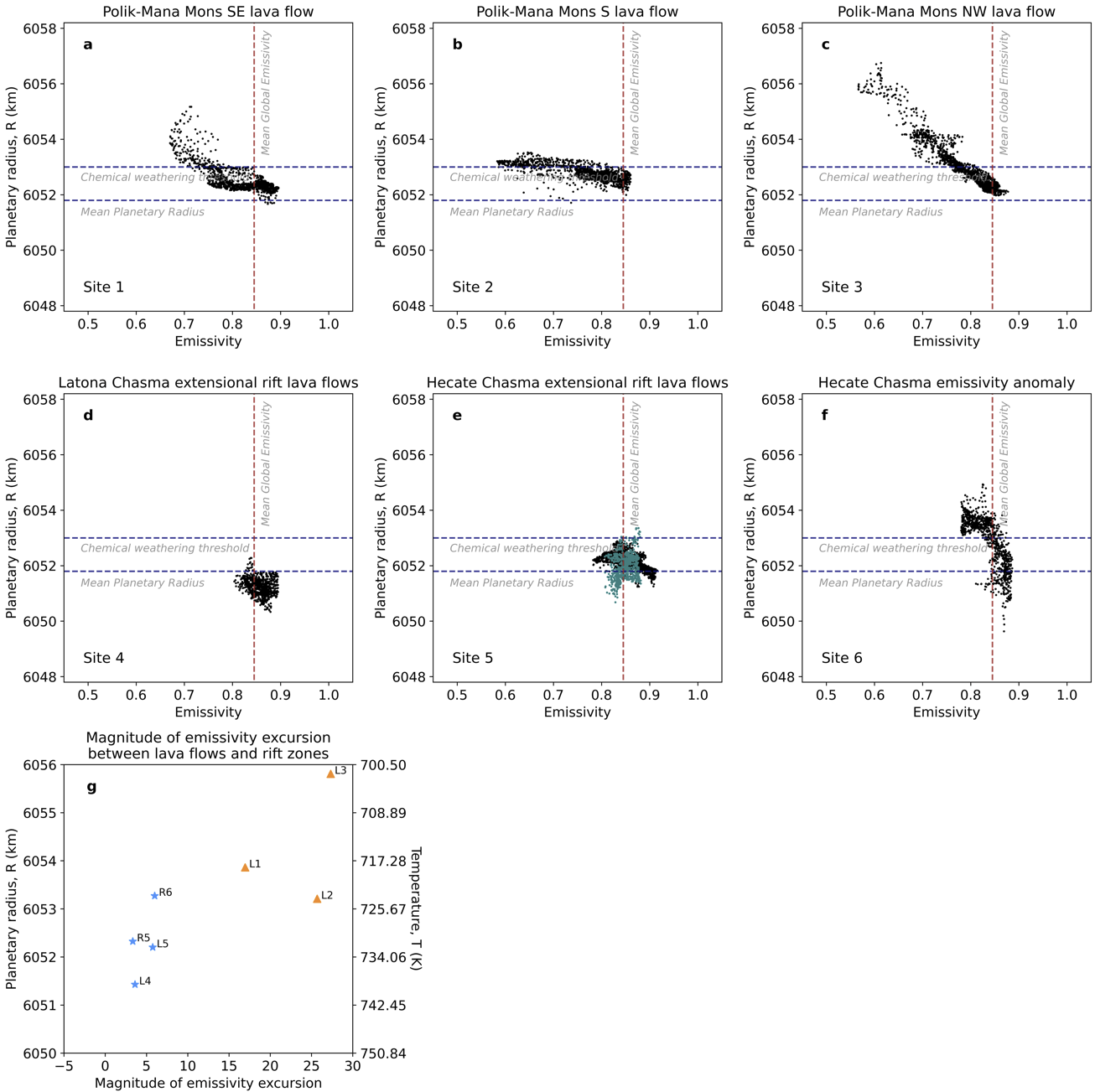
Figure 1. (a - f) Elevation versus emissivity plots for the selected rift region in the vicinity of Polik-Mana Mons (24.5ºN; 264ºE) in Venus. The green data points in (e) indicate rift terrain and are used to separate its contribution from the lava flows (in black) which occupy a smooth terrain with less variations in topography; (g) magnitude of emissivity excursions as a function of elevation and temperature for the different sites in analysis (orange triangles represent lava flows; blue stars represent rift walls with lava flows (L) or rift terrain (R)).
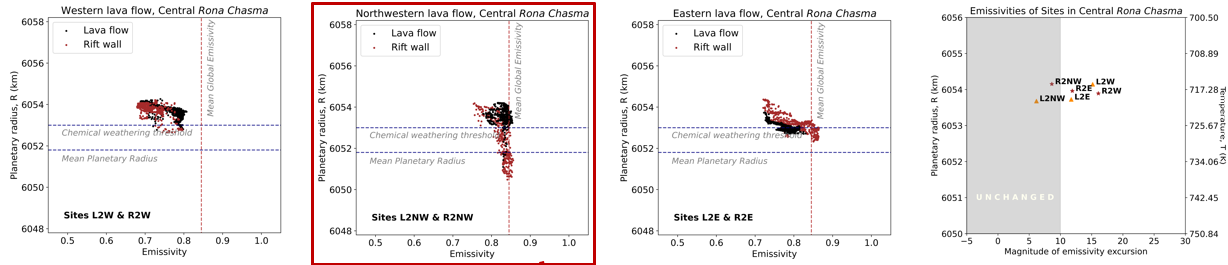
Figure 2. Same as above, but for a recent active region in Rona Chasma (2.5ºN; -72ºE).
References: [1] Filiberto, J., et al., 2025. Geochemistry, 85; [2] Saunders, R. S., & Pettengill, G. H., 1991. Science, 252, 247; [3] Masursky, H., et al., 1980, J. Geophys. Res., 85, A13; [4] Price, M., & Suppe, J., 1995. EM&P, 71, 99; [5] Magee, K. P., & Head, J. W., 1995. J. Geophys. Res., 103, B1; [6] Ivanov, M. A., & Head, J. W., 2011. P&SS, 59, 1559; [7] D’Incecco, P., et al., 2020. EPSL, 546, 116410; [8] D’Incecco, P., et al., 2021. PSJ, 2, 5; [9] López, I., et al., 2022. J. Volcanol. Geotherm. Res., 421, 107428; [10] Shalygin, E. V., et al., 2015. GRL, 42, 12; [11] Brossier, J., et al., 2022. GRL, 49, e2022GL099765; [12] Regorda, A., et al., 2023. JGR: Planets. 128, e2022JE007588; [13] Brossier, J. F., et al. 2020. Icarus. 343. 113693; [14] Brossier, J., et al., 2021. JGR: Planets. 126, e2020JE006722; [15] Shepard, M. K., et al., 1994. GRL, 21, 6; [16] Treiman, A. H., et al., 2016. Icarus, 280, 172.
Funding: DQ acknowledges this work to be supported by FCT - Fundação para a Ciência e Tecnologia, I.P. by project reference and DOI identifier 10.54499/2023.05220.BD.
How to cite: Quirino, D., Duarte, J. C., Machado, P. M., Green, J. M., Rosas, F. M., and Dias, J.: Exploring Rift Tectonovolcanism on Venus: a global perspective, Europlanet Science Congress 2026, The Hague, The Netherlands, 7–11 Sep 2026, EPSC2026-1176, https://doi.org/10.5194/epsc2026-1176, 2026.


