
 1,
1,- 1Montsec Observatory OdM-IEEC, Institute of Space Studies of Catalonia, Castelldefels, Spain (domenech@ieec.cat)
- 2Institute of Cosmos Sciences of the University of Barcelona UB-IEEC, Barcelona, Spain
Before sunset on 12 August 2026, Catalonia beared witness to a total solar eclipse, a once-in-a-lifetime astronomical event not seen in the region for over 121 years, briefly turning day into night, the sky and landscape darkening, and stars suddenly becoming visible. A spectacular and rare phenomenon on a date already significant to popular astronomy due to the Perseids meteor shower. It offered a unique scientific, educational, and social opportunity for the country, as the southern third of Catalonia crossed the path of totality, approximately 200 km wide. Locations like Tarragona and Lleida where able to experience the full phenomenon, lasting up to 1 minute and 30 seconds in some observation points, with the whole of the territory and major cities like Barcelona crossing at least parciality.
Catalonia's Interdepartmental Eclipse Commission
To efficiently manage everything related to this unique phenomenon, the Government of Catalonia (Generalitat) approved early on the creation of the Interdepartmental Eclipe Commission in May 2025 [1], with the activation of a comprehensive plan for the total solar eclipse on 12 Augut 2026, to guarantee coordinated, safe management with high social impact actions. Led by the Department of Research and Universities, it comprised 15 government departments into a nation-wide project, with the scientific and technical support of the Institute of Space Studies of Catalonia (IEEC). The comission also held coordination meetings with the wider National Eclipse Commision, with the goal of aligning territorial strategies with state guidelines and ensuring efficient event management.
An institutional kick-off event for the Year of the Total Eclipse of 2026 was heald in Barcelona under the name "Catalonia looks to the sky" [2] with the participation of experts, communicators and international institutions such as UNESCO and the European Space Agency. In preparation for the event, a series of observation points throughout the region where the total eclipse was visible were selected based on the criteria of safety, accessibility and quality of visibility. Outreach, educational, cultural and cientific activities were promoted throughout the territory leading up to the date.
IEEC's scientific and technical support and participation
As a center that promotes the development of activities related to space in Catalonia in the areas of training, research, and innovation, the Institute of Space Studies of Catalonia (IEEC) constituted a transversal Working Group to coordinate communication, educational and scientific actions across the country. This Working Group was able to advise and support the Catalan administration at different levels to ensure the correct deployment of security measures and guarantee the dissemination of rigorous information for a safe observation of the eclipse, as well as in coordination meetings with other relevant institutions and astronomical associations.
As part of dissemination and promotion activities before the event, the IEEC undertook several projects, such as collaborating on creating the scientific content for the website eclipsicatalunya.cat, the Generalitat's oficcial repository for information on the 2026 eclipse [3], the coordination and preparation of materials for workshops held in schools and educational centers across the territory, and providing safe observing methods readily available for the population (ISO 12312-2 solar filter glasses, pinhole and solarscope projectors).
An already existing and globally referenced app, Eclipse Calculator, developed by IEEC member Eduard Masana [4], was also made available for iOS, considerably increasing the number of potential users, also including information on the 2026 total eclipse. The technical teams also produced an interactive visibility map (a “shadow map”) identifying areas of the territory where observation conditions were optimal, without obstructions to the view of the Sun at the critical moment (Fig. 1a). This resource was made available as a reference tool for institutions, organisations, and the general public.
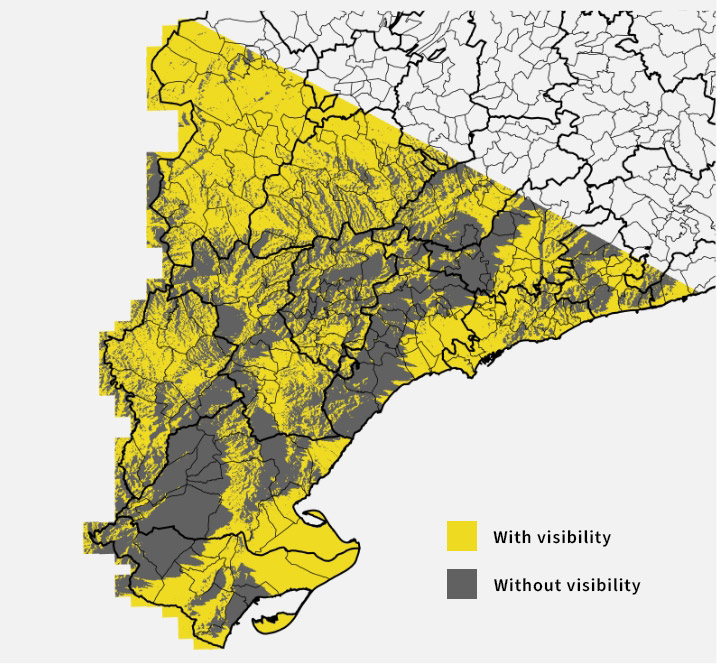
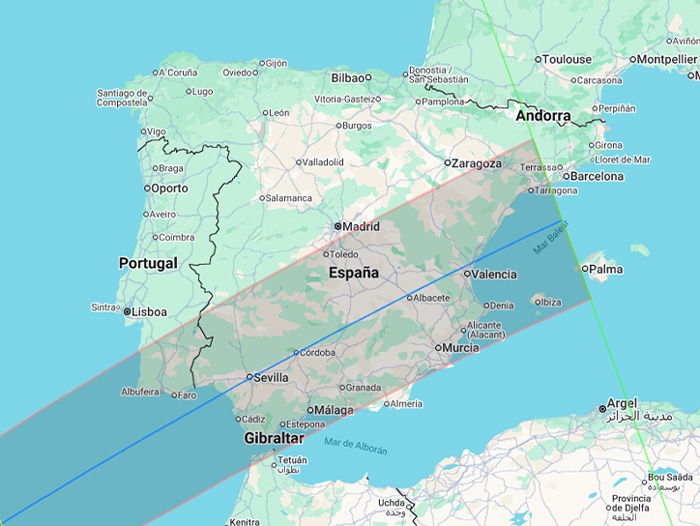
Figure 1. (a) Map of eclipse shadows in Catalonia for 12 August 2026 (Cr. IEEC). (b) Map of the 26 January 2028 annular solar eclipse (Cr. Xavier Jubier).
Social and scientific impact during and after the eclipse
It is expected that such an impressive astronomical event will be of special relevance with great scientific and social impact, especially with the information and educational campaigns in place for schools and from institutional channels. From a scientific standpoint, the Ebre Observatory, the Institute of Cosmos Sciences of the University of Barcelona (ICCUB-IEEC), and the Institute of Space Sciences (ICE-CSIC) will play a prominent role during the day [5]. The event has the potential to act as a catalyst for regional development through astrotourism and the launch of new educational and community-based projects, also looking ahead at the upcoming annular eclipse of 26 January 2028 (Figure 1b), also visible from the southwest and central parts of the territory.
At the time of writing, Catalonia is preparing to welcome the eclipse with a national outlook — grounded in science and education, but also in responsibility, sustainability, and social cohesion. On 12 August 2026, the sky will darken for a few moments. And the entire territory will be ready to look up.
References
[1] Government of Catalonia (2025) Agreement GOV/134/2025 of 20 May regarding the creation of the Interdepartmental Commission for the Coordination and Management of Actions Related to the 2026 Total Solar Eclipse. Diari Oficial de la Generalitat de Catalunya (DOGC), no. 9418. Available at: https://dogc.gencat.cat/ca/document-del-dogc/?documentId=1014586
[2] Government of Catalonia. Department of Research and Universities (2025) Catalonia looks to the sky. Press release / Video summary, 13 November. Available at: https://hdl.handle.net/20.500.14344/605
[3] Institute of Space Studies of Catalonia and Government of Catalonia (2025) Catalonia 2026 Eclipse Website. Available at: https://eclipsicatalunya.cat/
[4] Eduard Masana (2017) Eclipse Calculator 2.0. Mobile application. Available at: https://play.google.com/store/apps/details?id=calcEclipsi2.src&hl=en
[5] Government of Catalonia. Department of Research and Universities (2025) RECERCAT. Research Bulletin of Catalonia, No. 208 (May 2025): Special issue Maria Assumpció Català i Poch. ISSN 1886-676X. Available at: https://hdl.handle.net/20.500.14344/574
How to cite: Domènech Rams, G., Herrero, K., and Masana, E.: Once in a century: the scientific and collective experience of the Total Solar Eclipse 2026 in Catalonia, Europlanet Science Congress 2026, The Hague, The Netherlands, 7–11 Sep 2026, EPSC2026-1178, https://doi.org/10.5194/epsc2026-1178, 2026.


