
 1,1,1,2,3,3,3,3,
- 1IAS, Université Paris-Saclay, CNRS, 91400 Orsay, France (apolline.leclef@universite-paris-saclay.fr)
- 2INAF –Osservatorio Astronomico di Padova, Padova, Italy
- 3INAF– Istituto di Astrofisica e Planetologia Spaziali, I-00133, Roma, Italy
Introduction: Radar observations of Mercury’s poles revealed bright features within its Permanently Shadowed Regions (PSRs), interpreted as water ice [1]. Subsequent neutron measurements by MESSENGER supported this hypothesis, indicating water-equivalent hydrogen-saturated soil and potential water ice layers a few meters thick [2]. The origin of this ice remains uncertain, with scenarios including endogenic (e.g., volcanism) or exogenic sources via hydrated asteroids/comets (containing ~50% H₂O in comets, up to 10-20% in asteroids [3]) or solar wind implantation [4]. Impacts could also deliver other volatiles, notably CO₂ [3,5], suggesting CO₂ ice may coexist with H₂O in Mercury’s PSRs [6,7]. Temperature maps and sublimation rates [6,8] even indicate that some northern PSRs have conditions conducive to CO₂ cold traps.
Building on previous spectral simulations of H₂O/CO₂ mixtures [9], our work incorporates complementary laboratory experimental approach to also investigate possible interactions at molecular level between H₂O and CO₂.
The SIMBIO-SYS instrument [10] aboard BepiColombo, and particularly its VIHI channel [11], will soon observe these regions. We thus further account for PSR illumination conditions and Signal-to-Noise Ratio (SNR) instrumental constraints to calculate Band Detection Limits (BDL) for selected diagnostic features, to evaluate the detectability of CO₂ ice in H₂O mixtures on Mercury’s surface.
Method and results: VIHI/SIMBIO-SYS [10,11] is a Vis-NIR spectrometer (0.4–2.0 µm, 6.25 nm sampling, 125 m spatial resolution at 400 km altitude), partially covering CO₂ ice absorption features at 1.4 µm and 2.0 µm. We deposited H₂O/CO₂ ice mixtures using INGMAR [12,13], under conditions relevant to Mercury’s PSR, to measure the spectral reflectance in the 1 µm – 5 µm range. Thick ice layers were produced at 50 K under a chamber pressure of ~5 × 10⁻⁷ mbar. The substrate was an InfraGold surface coated with a residual organic film formed by irradiation of a CH₃OH:NH₃ mixture, with an estimated thickness below 1 µm. Spectra were acquired in bidirectional reflectance, with illumination, emergence, and phase angles of 20°, 15°, and 15°, respectively. Measurements were performed at a spectral resolution of 2 cm⁻¹, using 256 scans or 512 scans. Pure CO2 and amorphous H2O were produced as references, alongside 3 different mixtures : 20%, 33% and 50% of CO2. These proportions are set by the relative partial pressures of the injected gases in the chamber for each mixture.
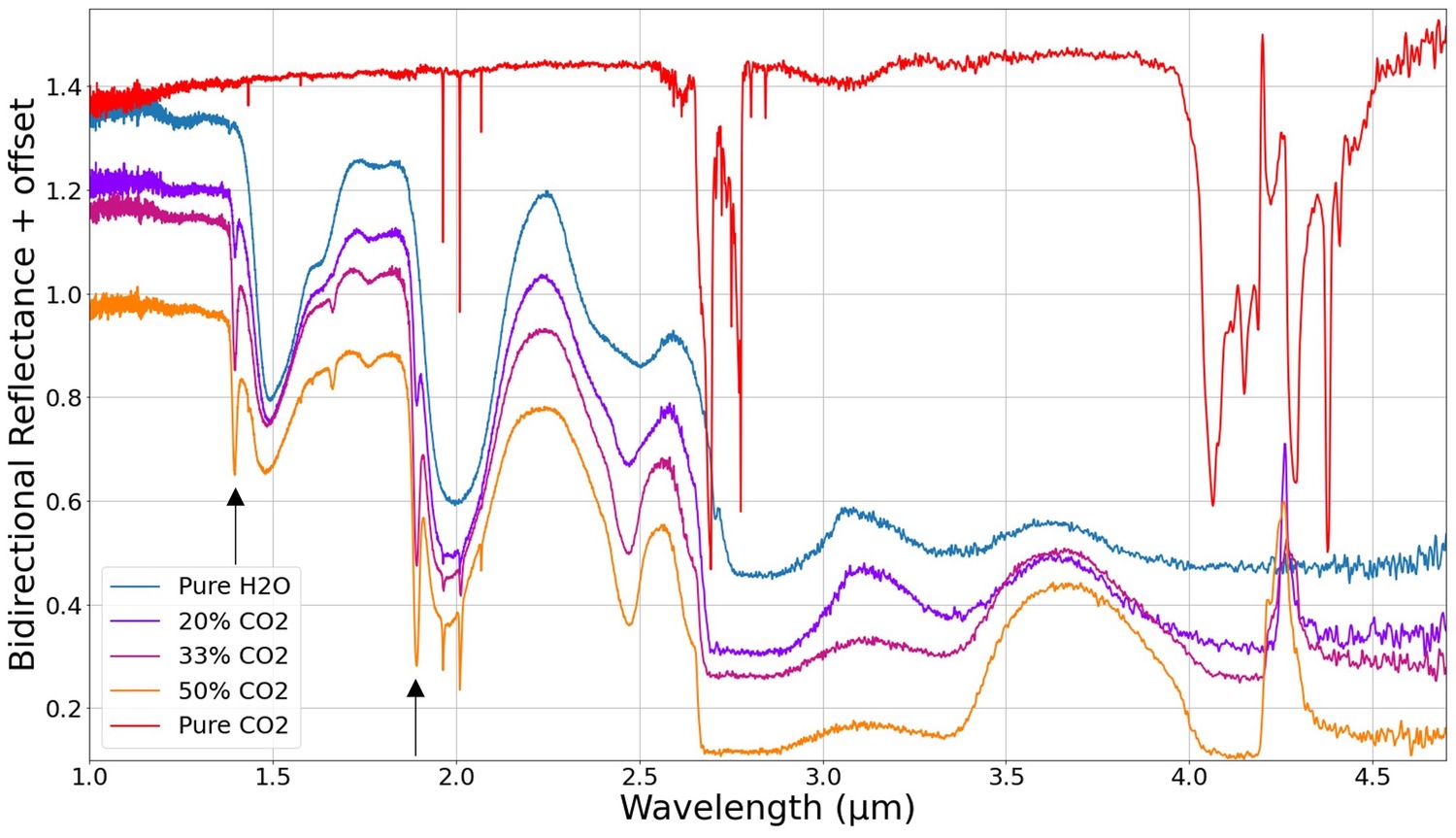 Figure 1: High Resolution experimental data of intimate mixtures between H2O/CO2 ices. Experimental deposition of H2O/CO2 ice mixtures for various CO2 ratio (0 to 100 %), for layers of ~100 µm thick (and ~20 µm for pure CO2). Black arrows show the position of the OH-dangling combinations bands of H2O ice at 1.39 and 1.89 µm.
Fig. 1 shows experimental spectra for mixtures of H2O/CO2, with diverse CO2 ratio, at 50K. These spectra exhibit the behaviour of spectral features for various CO2 ratio in the mix (0 to 100%). Here, the intensity of CO2 features increase with the CO2 ratio in the mix. This trend is primarily evident in the 1.0–2.2 µm range, particularly for bands at 1.43 µm and 1.96 µm, which are of direct relevance for VIHI observations. The 2.01 μm band, slightly outside the spectral range of VIHI, is following the same behaviour. The 1.43 µm band is barely detected, while those at 1.96 µm and 2.01 µm offer stronger band depth. Beyond 2.2 µm, absorption features of CO2 become saturated due to the thickness of the deposited ice layers. In this spectral interval, strong OH-dangling overtone combinations bands are also detected at 1.39 µm and 1.89 µm (also seen in [14, 15] but weaker), varying alongside the CO2 ratio in the mix as well, as also seen in previous studies [14]. Their intensity varies consistently with CO2 content, as also seen in [16] for the fundamental OH-dangling, and they are both broader and stronger than nearby CO2 features. These bands are absent in pure H2O, indicating that their presence is directly associated with the incorporation of CO2 within the ice matrix.
These spectral signatures were then modelled under realistic illumination conditions representative of Hermean PSRs, focusing on Kandinsky crater in the Northern Hemisphere, following the methodology described in [17]. The results indicate that OH dangling features remain detectable under expected environmental conditions, whereas CO2 absorption bands are significantly less robust.
Conclusions: Our experimental simulations revealed the emergence of OH-dangling combination bands at 1.39 µm and 1.89 µm, which are directly linked to the presence of CO2 in the ice matrix. These bands are systematically deeper and broader than CO2 absorption features and increase in intensity with higher CO2 ratios in the mixture. While CO2 band may be challenging to detect under PSR conditions, the OH-dangling bands may offer a more reliable, even if indirect, indicator of CO2 presence in H2O ice, particularly with the detection limits anticipated for VIHI/SIMBIO-SYS instrument.
Acknowledgments: The leading authors would like to thank all the people on SIDONIE who helped us during the experimentations, and the CNES for funding.
References: [1] Harmon J. K. et al. (2011) Icarus, 211, 37–50. [2] Lawrence D. J. et al. (2013) Science, 339, 292–296. [3] Altwegg et al. (2019), Annu. Rev. Astron. Astrophys. 57:113–55. [4] Tucker O. J. et al. (2019) Journal of Geophysical Research: Planets, 124, 278-293. . [5] Neumann G. A. (2013), Science, 339, 296–300. [6] Ahrens et al. (2022) Geosciences, 12, 51. [7] Schorghofer N. et al. (2021) Geophysical Research Letters, 48, e2021GL095533. [8] Paige D. A. et al. (2013) Science, 339, 300–303. [9] Leclef, A. et al. (2024). European Planetary Science Congress, EPSC2024-411. [10] Cremonese G. et al. (2020), Space Sci Rev, 216, 75. [11] Capaccioni F. et al. (2005), AAS/Division for Planetary Sciences Meeting Abstracts, Vol. 37, #37, 57.02. [12] Lantz C. et al. (2017), Icarus, 285, 43. [13] Hénault E. et al. (2025), Astronomy & Astrophysics, 694, A126. [14] Bernstein, M. et al. (2005), Icarus, 179(2), 527–534. [15] Fulvio, D. et al. (2010), Astronomy and Astrophysics, 511, A62. [16] Öberg, K. et al. (2007), Astronomy and Astrophysics, 462(3), 1187–1198. [17] Filacchione, G. et al. (2020), Monthly Notices of the Royal Astronomical Society, 498, 1308.
How to cite: Leclef, A., Vincendon, M., Lantz, C., Brunetto, R., Cambianica, P., Filacchione, G., Raponi, A., Ciarniello, M., Capaccioni, F., and Cremonese, G.: Hunting CO₂ in Mercury’s PSRs with VIHI/SIMBIO-SYS: how OH-dangling bands can help its detection., Europlanet Science Congress 2026, The Hague, The Netherlands, 6–11 Sep 2026, EPSC2026-118, https://doi.org/10.5194/epsc2026-118, 2026.


