
 1,2,1
1,2,1- 1Mullard Space Science Laboratory, University College London, Dorking, United Kingdom
- 2Western University, London, Canada
- 3University of Westminster, London, United Kingdom
Introduction: Rover-based geological investigations rely on multispectral imaging to distinguish lithological and mineralogical variability, helping to reconstruct palaeoenvironmental conditions on Mars [1-5]. However, the interpretation of geological targets from rover imagery is constrained by the discrete spectral sampling of multispectral imaging systems, potentially limiting discrimination of subtle spectral variations within compositionally heterogeneous materials. Evaluating how effectively rover multispectral observations preserve diagnostic mineralogical information is therefore essential for reliable geological interpretation and informed scientific target selection during planetary surface exploration.
The Panoramic Camera (PanCam) is a context imaging instrument onboard the ExoMars Rosalind Franklin rover [6-7]. The optical bench consists of a High-Resolution Camera (HRC) and two multispectral Wide Angle Cameras (WACs), enabling stereo imaging and visible to near-infrared observations across the 440-1000 nm wavelength range [7-9]. PanCam is designed to support geological characterisation and drill target prioritisation within the phyllosilicate-rich terrain of Oxia Planum [10], using a geology filter set optimised for the detection of ferric mineral signatures and broad mineralogical variability [9].
Here, we evaluate the mineralogical discrimination capabilities of PanCam using imagery acquired with the PanCam Training Model (TM), a functional replica of the flight instrument configured with the Right WAC (RWAC) and a filter wheel containing 11 of the 12 geology filters (excluding the 500 nm filter). Using diverse Mars analogue materials, we assess how effectively PanCam multispectral observations preserve diagnostic mineralogical information, while additionally exploring the potential of PanCam imagery to support the astrobiological objectives of the Rosalind Franklin mission.
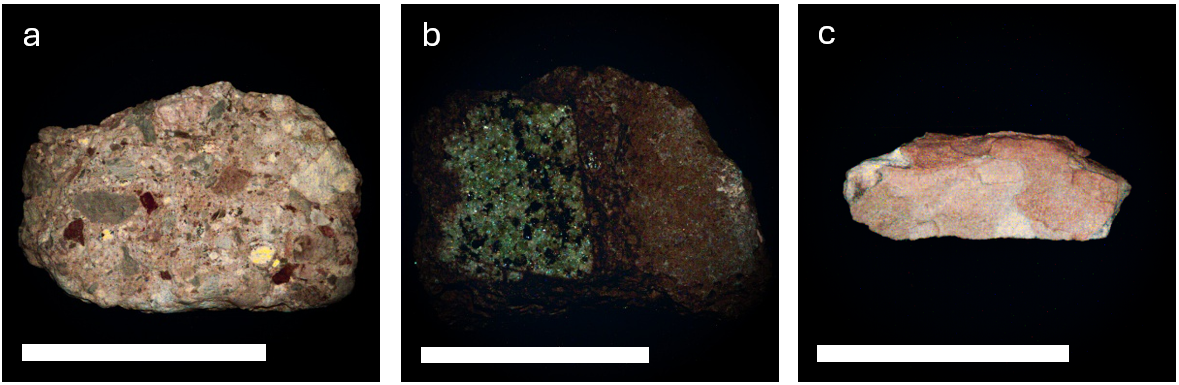
Figure 1. PanCam TM HRC images of a) a polymict lithic impact breccia from the Ries crater, Germany; b) a peridotite mantle xenolith from Arizona, USA; and c) cryptoendolith horizons within Antarctic Dry Valley sandstones [12]. Scale bars each represent 10 cm.
Dataset and methods: Multispectral image datasets were collected under controlled laboratory conditions for ten Mars analogue samples selected to represent a range of mineralogical compositions, lithologies, and formation environments. The sample suite includes a clay-rich polymict lithic impact breccia collected during fieldwork at the Ries impact structure, Germany (Figure 1a), and an ultramafic mantle xenolith sourced from the San Carlos volcanic field, Arizona, USA (Figure 1b). Radiometric calibration was performed using the PanCam Operations Toolkit (PCOT) [11], supporting derivation of reflectance spectra, image enhancement products, and spectral parameter maps. Hyperspectral VIS-NIR measurements were also collected using a high spectral-resolution ASD RxSpec 700Z contact probe spectrometer (350–2500 nm) within the same regions of interest for comparative analysis.
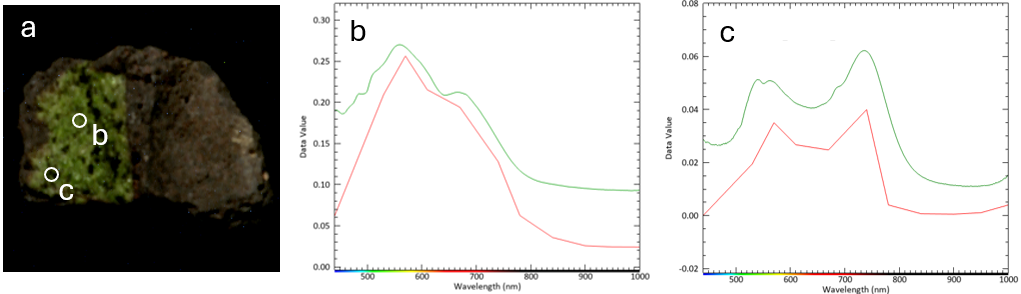
Figure 2. a) Cropped PanCam TM RWAC image of a mantle xenolith sample (RGB: 670, 530, 440 nm) showing ROIs corresponding to b) olivine-rich and c) enstatite-rich regions. Panels b–c compare PanCam TM image-derived spectra (red) with corresponding ASD contact probe spectra (green).
Results: Spectra derived from RWAC images (Figure 2a) capture diagnostic features across diverse mineralogies, including olivine (Figure 2b), enstatite (Figure 2c), and materials not originally prioritised during filter selection, such as illite-bearing assemblages. Comparisons with ASD measurements, that were also resampled to the 11 bands of the TM, show strong agreement in spectral trends across the PanCam wavelength range, indicating minimal loss of diagnostic spectral information despite the reduced spectral resolution of multispectral imaging.
PanCam multispectral observations additionally resolve spectral variations associated with microbial colonisation (Figure 1c), with distinct endolithic horizons detectable at distances of 2 m. Extracted spectra exhibit features consistent with biologically associated pigments, including chlorophyll, melanin, and phycocyanin. Several analogue samples containing endolithic growth and photosynthetic pigments display spectral characteristics consistent with a diagnostic red edge feature within the PanCam wavelength range, suggesting that biologically derived spectral signatures may be distinguishable alongside mineralogical variability within PanCam imagery.
Summary: This work contributes to the development of a PanCam image-based spectral library of analogue materials and demonstrates the value of multispectral imaging for interpreting geologically heterogeneous targets on Mars. These results additionally highlight the potential of PanCam multispectral observations to investigate biologically derived spectral signatures within Mars analogue environments relevant to the astrobiological objectives of the Rosalind Franklin mission.
[1] Bell et al., 2004, Science [2] Bell et al., 2022, Science [3] Farrand et al., 2007, JGR: Planets [4] Royer et al., 2024, Nature [5] Harris et al., 2015, Icarus [6] Vago et al., 2017, Astrobiology [7] Coates et al., 2017, Astrobiology [8] Cousins et al., 2010, Astrobiology [9] Cousins et al., 2012, Planetary and Space Science [10] Quantin-Nataf et al., 2021, Astrobiology [11] Finnis et al., 2024, Geoscience Data Journal [12] Preston et al., 2015, Applied Spectroscopy.
How to cite: Warrilow, R., Preston, L. J., Tornabene, L. L., Dartnell, L., Osinski, G. R., Ballard, C., Hunt, T., and Coates, A.: Multispectral Analysis and Geological Characterisation Using the PanCam Training Model, Europlanet Science Congress 2026, The Hague, The Netherlands, 7–11 Sep 2026, EPSC2026-1180, https://doi.org/10.5194/epsc2026-1180, 2026.


