
 ,,,
,,,- Università degli Studi Roma Tre, Roma Tre, Maths and Physiscs, VITERBO, Italy (gabriele.turchetti@uniroma3.it)
The JUICE and Europa Clipper missions, both directed toward the Jovian system, carry among their instrument suites two radar sounders, RIME [1] and REASON [2], respectively, designed to probe the subsurface structure of Jovian icy moons.
Europa, Ganymede and Callisto ice shells shallow portion are composed by water ice, predominantly in the form of polycrystalline Ih. It is expected that such ice is contaminated by different chemical species [3][4][5] that might or might not affect the penetration of the signal emitted by a radar sounder. Pure water ice Ih, is highly transparent to radio waves especially at the cold temperatures of these moons. The parameter controlling the wave/ice interaction is the complex dielectric permittivity, which is both temperature and frequency dependent and follows a typical Debye-like behaviour up to several hundreds of MHz.
At the microscopic scale, ice dielectric properties are related to the motion of the protonic point defects which generate both polarization and conduction phenomena, although a unified understanding of the physical mechanisms underlying such properties is not available yet [6][7][8]. Measuring such properties in pure water ice is not trivial and it is difficult to reproduce, because sample preparation and laboratory procedure have a strong impact on the results. Conflicting or incompatible experimental data arise from microscopic and macroscopic differences in the ice samples, such as: specific crystal orientations, dislocations, cracks and fractures, gas bubbles and inclusions, chemical impurities, vacancies and other lattice imperfections [9][10][11]. In this work we discuss the results obtained in different conditions by various authors [12][13][14] and we present some results obtained in our laboratory using different procedures and temperature gradients.
Our laboratory setup comprises various instruments (ultra-freezer and climatic chamber) dedicated to controlling the temperature and temperature gradient at which ice is grown, as well as instruments for measuring the dielectric properties (LCR meter and Vector Network Analyzer). As an example, we present the evolution of the real part of the permittivity of two ice samples grown at different temperature rates, measured with an LCR meter at the frequency of 1 MHz (Fig. 1 and Fig. 2) . Our results are compared, in both cases, with those reported in [15]. The cooling rate is seen to have a significant effect on the measured real part of dielectric permittivity. Understanding the factors that influence the dielectric properties of ice is of great importance for the correct interpretation of future radar data.
Bibliografia
[1] Bruzzone L. et al. (2013) In: IEEE international geoscience and remote sensing symposium-IGARSS.
[2] Blankenship D. et al. (2018) In: 42nd cospar scientific assembly 42: B5-3
[3] SK Sharma et al. Standoff Raman spectroscopy for future Europa Lander missions. 2020.
[4] Trumbo, S. K. Science advances 5.6 (2019): eaaw7123.
[5] Pettinelli E., Cosciotti B., Di Paolo F., Lauro S.E., Mattei E., Orosei R., Vannaroni G., Dielectric properties of Jovian satellite ice analogs for subsurface radar exploration: A review, Reviews of Geophysics, 53, 593-641 (2015).
[6] Bjerrum N., Structure and properties of ice, Science, 115, 385-390 (1952)
[7] Petrenko V.F., Whitworth R. W., Physics of Ice, Oxford University Press (2002).
[8] Eigen M., De Maeyer L., Self-dissociation and protonic charge transport in water and ice, Proc. Roy. Soc. Lond., A 247, 505-533 (1958).
[9] Carte A. E., Air Bubbles in Ice, Proc. Phys. Soc., 77, 757-768 (1961).
[10] Murdza A., Schulson E., Renshaw C., Polojärvi A. Rapid Healing of Thermal Cracks in Ice, Geophysical Research Letters, 49, 10.1029/2022GL099771 (2022).
[11] Sasaki K., Kita R., Shinyashiki N., and Yagihara S., Dielectric Relaxation Time of Ice-Ih with Different Preparation, The Journal of Physical Chemistry B, 120, 16, 3950-3953 (2016).
[12] Kawada S., Dielectric Anisotropy in Ice Ih, Journal of The Physical Society of Japan, 44, 6,1881-1886 (1978).
[13] Auty R. P., Cole R. H., Dielectric Properties of Ice and Solid D2O, J. Chem. Phys., 20, 1309-1314 (1952).
[14] Johari G.P., Whalley E., The Orientation Polarization in Hexagonal Ice Parallel and Perpendicular to the c-axis, J. Chem. Phys, 75, 1333 (1981).
[15] Gough S.R., A Low Temperature Dielectric Cell and the Permittivity of Hexag- onal Ice to 2 K, Canadian Journal of Chemistry, 50, 3046-3051 (1972).
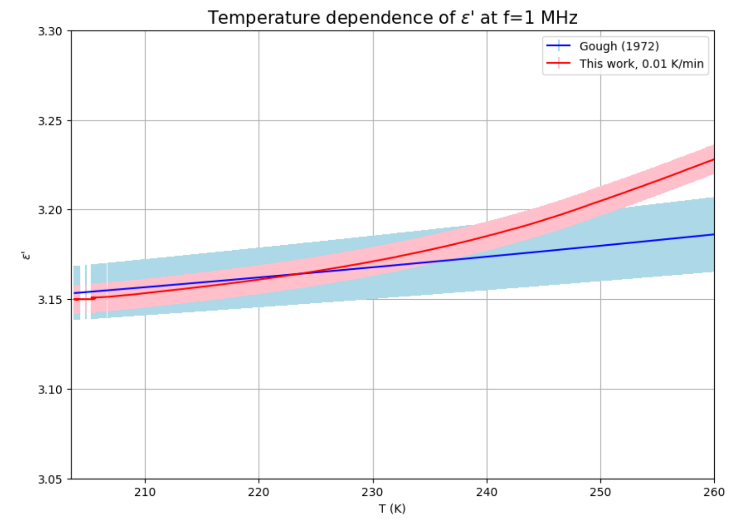
Figure 1 Real part of dielectric permittivity ε’ as a function of the temperature. The red data correspond to a sample grown at a cooling rate of 0.01 K/min, blue data have been obtained by [15].
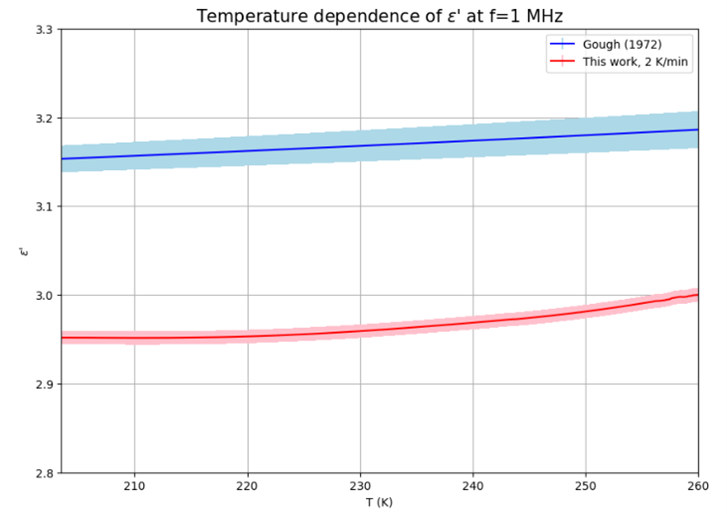
Figure 2 Real part of dielectric permittivity ε’ as a function of the temperature. The red data correspond to a sample grown at a cooling rate of 2 K/min, blue data have been obtained by [15].
How to cite: Turchetti, G., Cimbolli Spagnesi, F., Pettinelli, E., Lauro, S., Cosciotti, B., and Mattei, E.: Re-visiting the dielectric properties of pure water ice in the framework of the SWIM project to assess radio waves penetration in the Galilean icy moons, Europlanet Science Congress 2026, The Hague, The Netherlands, 7–11 Sep 2026, EPSC2026-1181, https://doi.org/10.5194/epsc2026-1181, 2026.


