
- 1Institute for Space Research, German Aerospace Center (DLR), Berlin, Germany
- 2Department of Geosciences, University of Arizona, Tucson, AZ 85721, USA
Motivation
The amount and distribution of water within the Moon and the related accessibility of water or hydrogen at or near the lunar surface are of central interest for future lunar missions as well as our understanding of the Moon’s formation and evolution. Yet, the water budget of the Moon, its evolution over time and the distribution of water among different compositional reservoirs in the lunar mantle and crust are still poorly understood.
Models
We simulate the evolution of the lunar water budget, combining models of lunar magma ocean (LMO) solidification, water (H2 and H2O) solubility, degassing and water partitioning and assess the relative importance of key parameters including magma ocean depth, initial water content, oxygen fugacity, water degassing efficiency and water partitioning between the magma ocean liquid and crystallizing minerals. A plausible parameter space can be identified by comparing modeled mineral water contents with observed water contents in lunar materials, in particular pristine ferroan anothosites (FANs), which might constitute primary products of the lunar magma ocean. Using FAN plagioclase water contents as primary constraint, we find that the current experimental uncertainties in the plagioclase water partition coefficient constitute a key source of uncertainty for estimates of the initial lunar water content and the distribution of water in the lunar interior, e.g. in the source regions of lunar mare basalts and basaltic glasses.
Experiments
To address this uncertainty, we conducted a series of high-pressure, high-temperature experiments using a piston-cylinder apparatus to study water partitioning into plagioclase and clinopyroxene at lunar magma ocean conditions (i.e. reducing conditions, elevated melt FeO contents and low water contents of 14 ppm – 2 wt%). At these conditions we observe non-Henrian behavior for the water partition coefficients (kd) of both plagioclase and clinopyroxene, with water partition coefficients increasing with decreasing melt water contents, ranging from ~0.001 – 0.3 at water contents of 14 ppm – 2 wt% for plagioclase and from ~0.01 – 0.3 at water contents of 44 ppm – 2 wt% for clinopyroxene (figure 1).
Implications for the lunar water budget
Using these new partition coefficients, observed FAN plagioclase water contents can be reproduced assuming an initial LMO bulk water content of 0.5 - 5 ppm, considering a wide parameter space, including LMO depths of 600 – 1350 km, 0-10% liquid trapped in the cumulate during LMO solidification and water partition coefficients in other cumulate minerals covering the range of values reported in earlier studies. Considering an uncertainty of the partition coefficient within 1 stedv, the range of possible initial lunar water contents expands to ~0.3 – 20 ppm, which illustrates the importance of precise water partition coefficients.
Discussion
The observed non-Henrian behavior of the water partition coefficient for plagioclase and clinopyroxene in combination with the modeled low initial bulk LMO water contents strongly suggests that further studies on the water dependence of the water partition coefficients in other major cumulate minerals are essential for correct estimates of the water distribution in the lunar interior. This includes the source regions of mare basalts and volcanic glasses, which reach surprisingly high water contents similar to some terrestrial magmas ([1,2]). Understanding to which degree this water enrichment is the result of magmatic processes forming the mare basalts and volcanic glasses ([2]) or was inherited from earlier processes during LMO solidification (i.e. water partitioning or trapping of water-enriched liquids in the cumulate) will provide further insights into the mobilization of water during lunar magmatism, the resulting distribution of water within the lunar crust and upper mantle and the contribution of such sources to any water-bearing reservoirs at or close to the lunar surface.
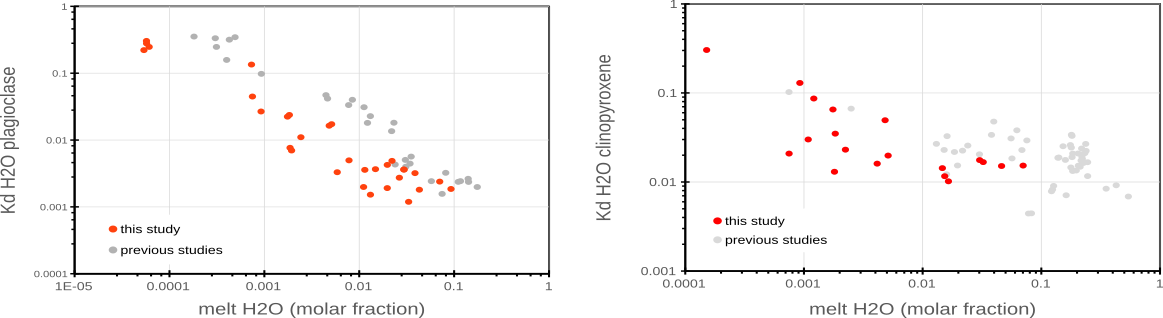
Figure 1: Water partition coefficients for plagioclase (left) and clinopyroxene (right) as a function of melt water content. The data show pronounced non-Henrian behavior of the partition coefficients, i.e. they are increasing with decreasing melt water content. Red points are data from this study, grey points are data from previous studies on plagioclase ([3], [4], [5]) and clinopyroxene ([6], [7], [8], [9], [10], [11], [12], [13]).
References:
[1] Hauri, E. H., Weinreich, T., Saal, A. E., Rutherford, M. C., & Van Orman, J. A. (2011). Science, 333(6039), 213-215.
[2] Ji, D., Dasgupta, R., & Lee, C. T. (2026). Geochimica et Cosmochimica Acta.
[3] Xu, Y., Lin, Y., Zheng, H., & van Westrenen, W. (2024). Chemical Geology, 661, 122153.
[4] Lin, Y. H., Hui, H., Li, Y., Xu, Y., & Van Westrenen, W. (2019). Geochemical Perspectives Letters, 10, 14-19.
[5] Hamada, M., Ushioda, M., Fujii, T., & Takahashi, E. (2013). Earth and Planetary Science Letters, 365, 253-262.
[6] Aubaud, C., Hirschmann, M. M., Withers, A. C., & Hervig, R. L. (2008). Contributions to Mineralogy and Petrology, 156(5), 607-625.
[7] Aubaud, C., Hauri, E. H., & Hirschmann, M. M. (2004). Geophysical Research Letters, 31(20).
[8] Sarafian, A. R., Nielsen, S. G., Marschall, H. R., Gaetani, G. A., Righter, K., & Berger, E. L. (2019). Geochimica et Cosmochimica Acta, 266, 568-581.
[9] O'Leary, J. A., Gaetani, G. A., & Hauri, E. H. (2010). Earth and Planetary Science Letters, 297(1-2), 111-120.
[10] Hauri, E. H., Shaw, A. M., Wang, J., Dixon, J. E., King, P. L., & Mandeville, C. (2006). Chemical Geology, 235(3-4), 352-365. [11] Tenner, T. J., Hirschmann, M. M., Withers, A. C., & Hervig, R. L. (2009). Chemical Geology, 262(1-2), 42-56. [12] Rosenthal, A., Hauri, E. H., & Hirschmann, M. M. (2015). Earth and Planetary Science Letters, 412, 77-87. [13] Potts, N. J., Bromiley, G. D., & Brooker, R. A. (2021). Geochimica et Cosmochimica Acta, 294, 232-254.
How to cite: Schwinger, S., Roy, A., Mallik, A., and Moitra, P.: How wet is the Moon? Insights from lunar evolution models and new water partitioning data , Europlanet Science Congress 2026, The Hague, The Netherlands, 7–11 Sep 2026, EPSC2026-1190, https://doi.org/10.5194/epsc2026-1190, 2026.


