
 1,2,1
1,2,1- 1Mullard Space Science Laboratory, University College London, United Kingdom
- 2Western University, London, Canada
Analysing the surface expressions of Mars’ aqueous history is essential for reconstructing the environmental evolution of early Mars [1–3]. Oxia Planum, the landing site for ESA’s Rosalind Franklin rover [4,5], preserves extensive geomorphological and mineralogical evidence of sustained aqueous activity, including valley networks, sedimentary deposits, and widespread clay-bearing terrains indicative of prolonged water–rock interaction and environmental conditions potentially favourable for past habitability [4,6,7]. While the Oxia Planum landing ellipse has been extensively characterised, the surrounding catchment region remains comparatively underexplored at the regional scale, despite likely acting as a major sediment source and hydrological conduit delivering detrital and aqueously altered materials into the basin [6,8]. In this work, we investigate the mineralogical variability of the catchment using integrated CRISM, CaSSIS, and HiRISE datasets.
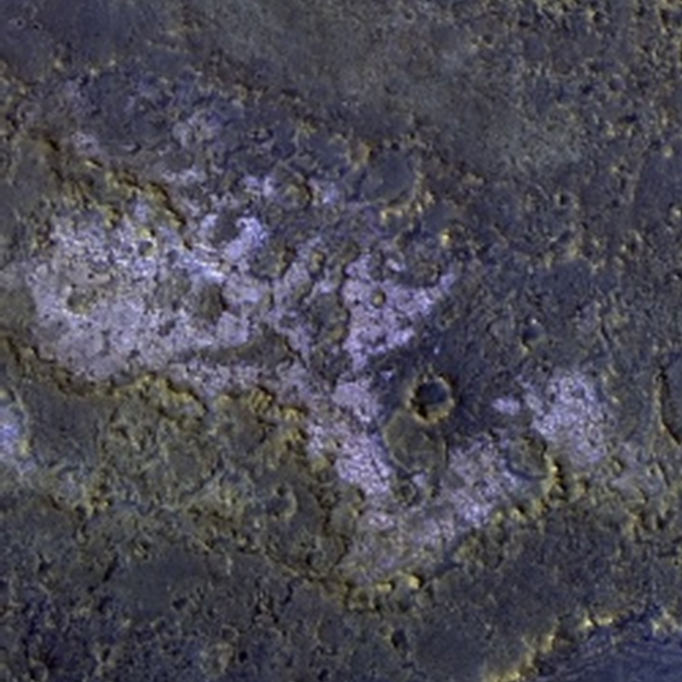
Figure 1. Targeted HiRISE observation (ESP_092719_1970) for this study showing an IRB colour composite of a potential chloride-bearing locality within the Oxia Planum catchment region.
CRISM observations reveal widespread low-calcium pyroxene-bearing terrains throughout the Coogoon Valles catchment, suggesting preservation of an LCP-rich mafic substrate across much of the regional crust, while more localised HCP-bearing materials indicate lithological variability within the crust. Distinct clay-bearing assemblages are additionally identified within altered sedimentary and channel-associated terrains from ratioed spectra, including extensive Fe/Mg-smectite-bearing units extending into the eastern catchment, and possible kaolinite-bearing signatures associated with crater rim terrains, potentially indicating localised alteration environments. These assemblages suggest spatially variable alteration of a predominantly mafic crustal substrate throughout the catchment system.
Targeted CaSSIS observations acquired for this investigation examine several bright-toned channel-associated deposits potentially consistent with chloride-bearing terrains [9] that exhibit distinct colour variability in false-colour NPB composites, colour band ratio composites, and decorrelation stretched imagery. Targeted HiRISE observations further reveal surface textures consistent with altered or evaporitic materials, alongside IRB colour characteristics comparable to previously identified chloride signatures (Figure 1) [10].
These observations provide new constraints on the mineralogical and hydrological evolution of the Oxia Planum catchment system and highlight the importance of regional-scale orbital investigations for reconstructing aqueous and sedimentary processes beyond the landing ellipse, providing broader geological context for assessing the habitability potential of the wider Oxia Planum system.
[1] Bibring et al., 2006, Science [2] Carr and Head, 2010, Earth and Planetary Science Letters [3] Carter et al., 2015, Icarus [4] Quantin-Nataf et al., 2021, Astrobiology [5] Vago et al., 2017, Astrobiology [6] Mandon et al., 2021, Icarus [7] Brossier et al., 2024, Journal of Geophysical Research: Planets [8] Fawdon et al., 2022, Journal of Geophysical Research: Planets [9] Osterloo et al., 2008, Science [10] Bickel et al., 2024, Scientific Data.
How to cite: Warrilow, R., Tornabene, L. L., Preston, L. J., and Coates, A.: Spectral characterisation of the Oxia Planum basin catchment area with CRISM, CaSSIS, and HiRISE., Europlanet Science Congress 2026, The Hague, The Netherlands, 7–11 Sep 2026, EPSC2026-1193, https://doi.org/10.5194/epsc2026-1193, 2026.


