
 ,
,- University of Hamburg, Department of Earth System Sciences, Hamburg, Germany (louisa.bahr@uni-hamburg.de)
Introduction: The Chicxulub hypervelocity meteorite impact crater, located on the Yucatán Peninsula in Mexico, is the remnant of one of the most significant short-term deformation processes in the younger history of our planet [1, 2]. The IODP-ICDP Expedition 364 drill core from the Chicxulub crater (Fig. 1) was instrumental in acquiring fundamental knowledge on the formation of this class of complex impact craters. The drill core is characterized by the pervasive presence of cataclasite zones in shocked target rocks underlying the peak ring of the crater [3] (Fig. 1b, 2a). Cataclasites are a category of shearing-induced fault rocks that develop in the brittle realm, leading to the formation of mostly angular grains within a fine-grained matrix (Fig. 2d). The formation of these zones during cratering is attributed to the transition from acoustic fluidization to localized shear faulting [3]. Hence, the question arises to what extent cataclasis is the result of acoustic pressure fluctuations, possibly leading to pure crushing of target rock, and comminution of rock caused by zone-parallel shearing. Pure crushing is expected to produce random orientations of fragments with diverse shapes. If cataclasite zones primarily formed through this mechanism, it would indicate that the acoustic fluidization persisted considerably longer than previously assumed. Conversely, shearing would entail cataclasis accompanied by cohesion regain, manifesting as a pronounced shape-preferred orientation of elongated fragments. The observation of a significant shape-preferred orientation within cataclasites could be interpreted as evidence for the cessation of acoustic fluidization prior to the consolidation of cataclasite zones. The quantification of the fragment orientation in cataclasite zones is, therefore, paramount to providing geological evidence for the formation mechanism of these fault rocks, which is crucial for our understanding of the progressive cratering and deformation mechanisms.
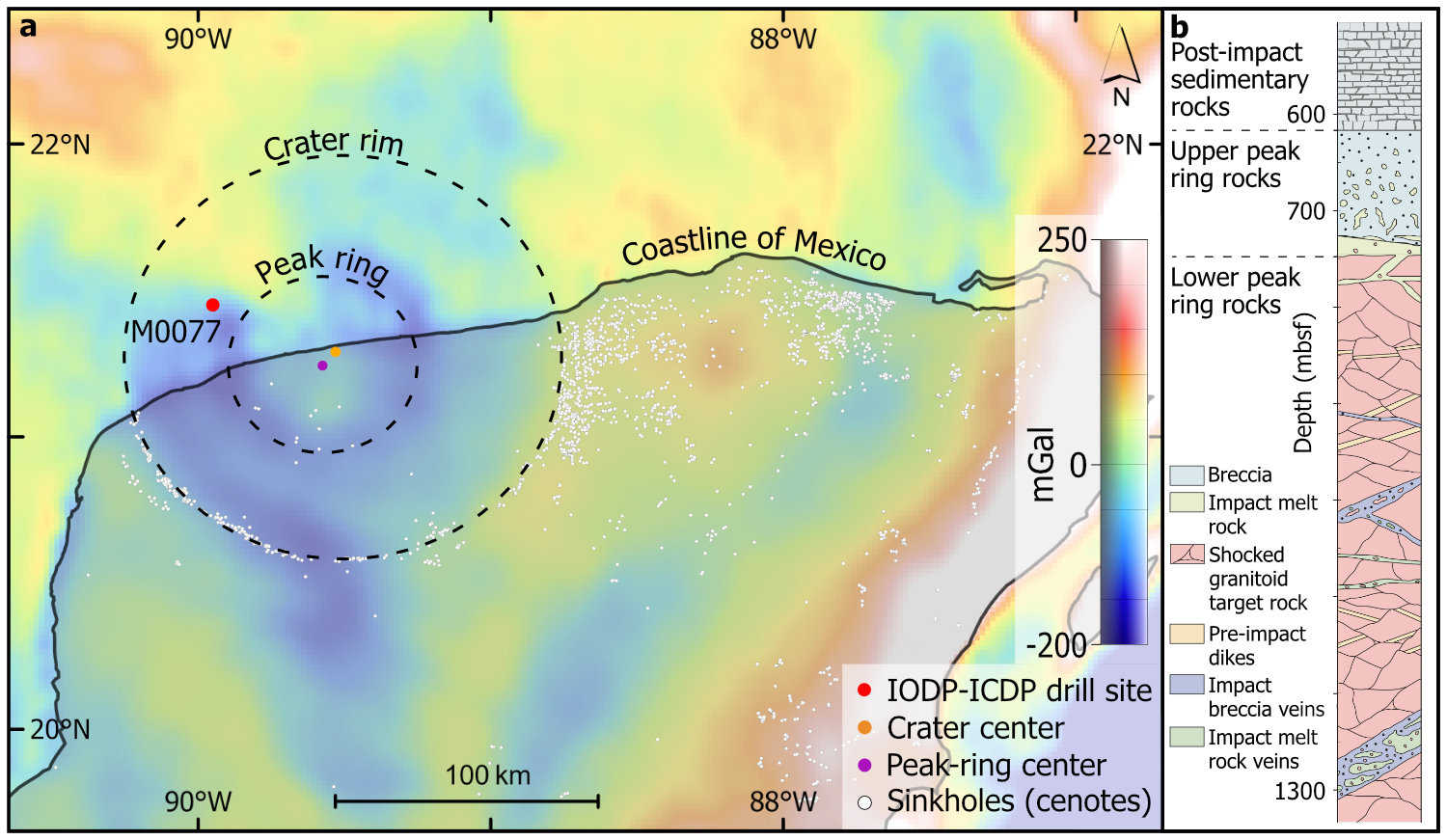
Figure 1. Drill site and lithological column of IODP-ICDP Expedition 364 drill core M0077. (a) Location of the drill site and the crater on the Yucatán peninsula, Mexico. Background colors show a Sandwell gravity anomaly map [4]. (b) Schematic stratigraphy of the recovered lithologies (modified from [5]). Depth is specified in meters below seafloor (mbsf). The lower peak ring rocks exhibit pervasive presence of cataclasite zones.
Methods: In order to characterize shapes and orientations of fragments in cataclasite zones, thin sections of cataclasite zones from drill core samples (Fig. 2) were analyzed with a revised semi-automated 2D image analysis workflow. Firstly, thin section RGB microphotographs were obtained at 5x magnification, in certain polarization configurations and with a lambda plate (Fig. 2d). Subsequently, we conducted the image analysis in the open-source Geographic Information System software SAGA [6], automatically identifying grain boundaries. The analysis ultimately generates polygon shapes from the identified fragments within the section (Fig. 2e). A variety of geometric parameters of these shapes were derived and utilized to quantify the fragments’ shape-preferred orientation (Fig. 2f), fragment sphericity (Fig. 2g) and the D-value, a measure for the degree of fragmentation, derived from the fragment-size distribution (Fig. 2h). The quantitative results from the analysis of numerous cataclasite zones spanning along the shocked target rocks of the drill core were analyzed and compared.
Results and Discussion: Comparing several thin section photographs from within one cataclasite zone indicated that the degree of fragment ellipticity can vary significantly within a cataclasite zone, while a distinct preferred orientation of elliptical fragments (Fig. 2f) remains predominantly consistent. Furthermore, cataclasite zones from different depths of the core appear to mostly exhibit shape-preferred orientations (Fig. 2f). These observations suggest that shearing may have played a significant role in cataclasite formation. This implies that zone-parallel shearing may have indeed triggered a reorientation of elliptical fragments formed by initial crushing. Therefore, acoustic fluidization may have ceased at an earlier stage than previously thought [3, 7].
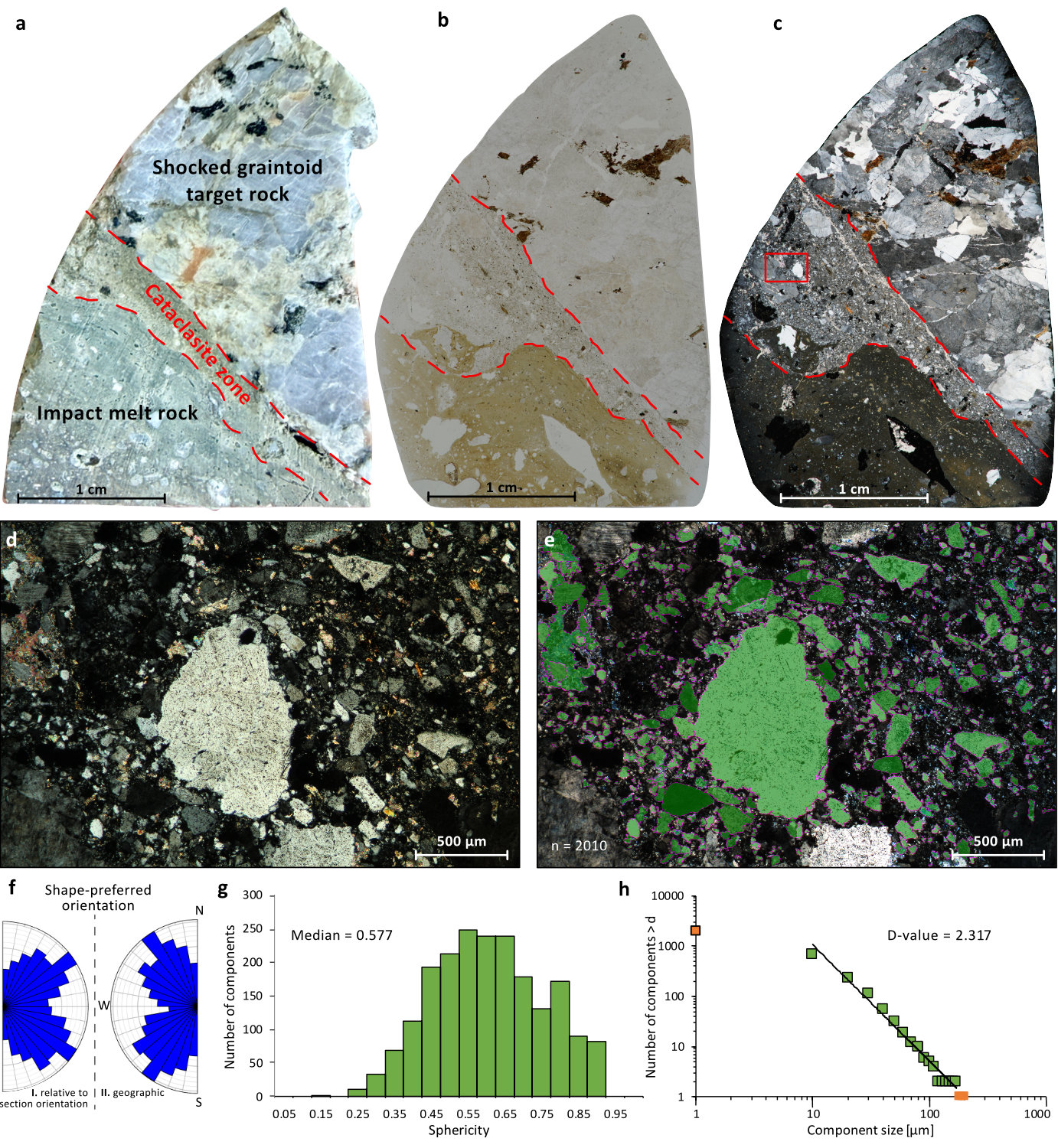
Figure 2. Example of the quantitative image analysis of a cataclasite zone at 754.72 mbsf. (a) Drill core sample of shocked granitoid target rock, impact melt rock and a cataclasite zone in between (b) Bright light photograph of the sample. (c) Cross-polarized photograph of the sample with a red rectangular specifying the section in d and e. (d) Cross-polarized microphotograph at 5x magnification. (e) Cross-polarized microphotograph at 5x magnification depicting the image-analysis-derived polygon shapes of the fragments. n = number of fragments. (f) Rose diagrams depicting a shape-preferred orientation of fragments. I. = Shape-preferred orientation relative to the orientation of the microphotograph. II. = Shape-preferred orientation corrected for geographic directions. (g) Sphericity of the fragments. (h) Fragment-size distribution and respective D-value.
References:
[1] Melosh H. J. (1989) Impact cratering Oxford University Press.
[2] Gulick S. et al. (2013) Reviews of Geophysics 51:31–52.
[3] Riller U. et al. (2018) Nature 562:511–515.
[4] Sandwell D. T. et al. (2014) Science 346:65–67.
[5] Morgan J. V. et al. (2016) Science 354:878–882.
[6] Conrad O. et al. (2015) Geosci. Model Dev. 8:1991–2007.
[7] Collins G. S. et al. (2002) Icarus 157:24-33.
How to cite: Bahr, L., Grolms, N., and Riller, U.: Cataclasite formation in the Chicxulub impact crater gleaned from 2D image analysis of the IODP-ICDP Expedition 364 drill core, Europlanet Science Congress 2026, The Hague, The Netherlands, 7–11 Sep 2026, EPSC2026-120, https://doi.org/10.5194/epsc2026-120, 2026.


