
 1
1- 1INAF Istituto Nazionale di Astrofisica, IRA Istituto di Radioastronomia, Bologna, Italy
- 2Centre for Astrophysics, University of Southern Queenland, Australia
- 33LPG-CNRS, Nantes Universite, France
- 4LPL, University of Arizona, USA
The Martian poles are covered by Amazonian Polar Layered Deposits (PLD), consisting of water ice and 5–15% dust [1][2][3][4]. While characterized by plan-parallel stratigraphy [5][6], these deposits contain unconformities—erosional surfaces likely caused by obliquity-driven warming [7][8]. Notably, the Southern Polar Layered Deposits (SPLD) exhibit glacial-tectonic structures and englacial folding not found in the north [9][10][11] (X1 for locations). As on the Earth [e.g., 12], these structures suggest ice sheet movement caused by weight distribution and interaction with basal topography.
The presence of unconformities and englacial structures points to a complex Late Amazonian geo-climatic history recorded by the polar deposits. This history is yet to be fully revealed, but it is likely that it would be relevant to understand also the origin of putative liquid brines discovered by the radar sounder MARSIS at the base of the SPLD in Ultimi Scopuli [13][14] (X2 for approximate location).
Here we report the preliminary results of our morphological studies of SPLD margins—specifically Ultima, Australe, and Promethei Lingula— (Fig. 1) identifying ridges resembling eskers. These ridges are remnants of subglacial meltwater drainage systems that emplace sediment before ice retreat. While similar features exist in the Argyre Planitia and Dorsa Argentea Formation (early Hesperian) [15][16][17][18], this is the first study to analyze them in direct relation to the SPLD. All this calls for new investigations and insights aimed to revitalize the discussion around the dynamics and potential for subglacial melting of the Southern polar cap glacial body of Mars.
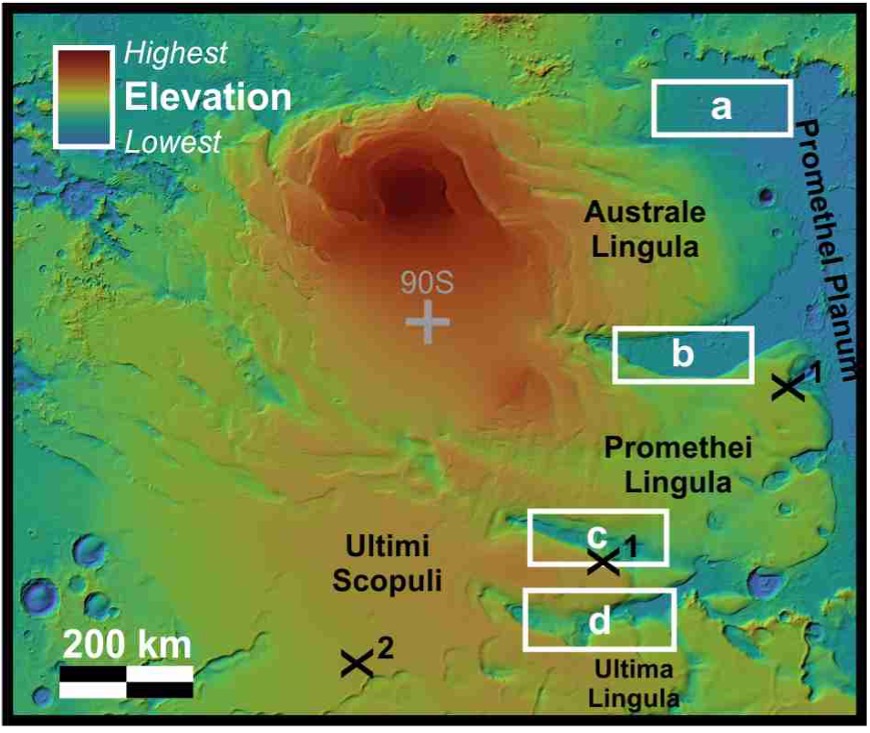
Fig. 1. MOLA context map of the SPLD. White rectangles mark the study areas where the ridges are located. These are shown in detail in Fig. 2.
Dataset: The region has been analyzed using high-resolution visible image (MRO CTX, 6.0 m/pixel; [19]) and THEMIS IR mosaics [20]. Topographic basemaps is from MGS MOLA (512 pixel/degree; 112 m/pixel; [21]); (Fig. 2).
Results: The ridges (Fig. 2a-f) are particularly evident on the floor of Ultimum (UC) and Promethei Chasmata (PC) and Chasmata Australe (CA) (Figs. 2b-d) and are deposited on the bedrock exposed between distinct SPLD lingulae. Here the ridges cross the chasmata floors from side to side. In plan-view, these ridges, some tens of km long, appear linear or sinuous and/or branching into Y-shaped junctions. Other two cases (Fig. 2a) are observed in the basal margins of Australe Lingula, extending towards the Promethei Planum (PP) region. This is the best developed system: here the ridges are 100-1000s m wide, up to 10s of m high (Fig. 2e), with both symmetric and asymmetric profiles, more than 100 km long, and presenting multiple order branching. Ubiquitous ice on top of the ridges partially masks or alters the morphometry of the ridges (Fig. 2f). Nevertheless, in the first instance, the crests appear sharp/round or flat and in some cases possibly split in two (or more) parts by troughs (i.e., multi-crested; black arrow in Fig. 2e). Ridges are also locally eroded and cratered.
Fig. 2. White rectangles mark the study areas where the ridges are located. The inboxes magnifications (red circles and black squares) are to highlight example ridges (data from MOLA + THEMIS IR and HRSC). (a-d) MOLA+shaded reliefs of the ridges in PP (a), CA (b), PC and UC (c-d). (e) Example cross-section profile of a ridge. The arrow points to a split crest, possibly evidence of residual ice on top of the ridge or of its pristine morphology. (f) Appearance of the ridges in Promethei Planum in CTX images, likely covered by residual ice.
Discussion and Conclusions: Analysis of the ridges suggests they are eroded remnants of eskers, supported by their morphology and emergence from the Southern Polar Layered Deposits (SPLD). These features are consistent with terrestrial eskers (Fig. 3; e.g. [21], [22]) and those found in the Martian Dorsa Argentea region. Eskers form when sediment is transported through subglacial drainage systems toward an ice margin; upon retreat, this sediment remains as a ridge. Consequently, their orientation provides a record of past glacial flow and geometry, confirming the necessity of basal melt for their formation. While post-exhumation processes like impact cratering and ice mantling make distinguishing different generations difficult, the presence of fluvio-glacial morphologies would prove that: 1) There was at least one major period of retreat of the Southern ice-sheet; 2) SPLD were significantly more extensive in the past; 3) Alongside englacial folding, that the south polar cap was more dynamic than previously thought, driven by possible melting processes. This opens the door to basal thermal anomalies present through time in this region.
Fig. 3. Example esker in Finland (LiDAR topography; data from National Land Survey of Finland).
References: [1] Herkenhoff K. and Murray B. (1990), doi: 10.1029/JB095iB09p14511; [2] Koutnik M. et al. (2002), doi: 10.1029/2001JE001805; [3] Byrne S. (2009), doi: 10.1146/annurev.earth.031208.100101; [4] Lauro et al. (2022), doi: 10.1038/s41467-022-33389-4; [5] Tanaka K.L. and Kolb E.J. (2001), doi: 10.1006/icar.2001.6675; [6] Kolb E.J. and Tanaka K.L. (2001), doi: 10.1006/icar.2001.6676; [7] Milkovich S.M. and Plaut J.J. (2008), doi: 10.1029/2007JE002987; [8] Guallini L. et al. (2018), doi: 10.1016/j.icarus.2017.08.030; [9] Smith et al., 2024, doi: 10.1016/j.icarus.2024.116125;[10] Guallini et al. (2012), doi: 10.1016/j.icarus.2012.06.023; [11] Guallini et al. (2025), Abs. 1874, 56th LPSC; [12] Bell et al. (2014), doi: 10.1038/NGEO2179; [13] Orosei et al. (2018), doi: 10.1126/science.aar72; [14] Lauro et al. (2021), doi: doi.org/10.1038/s41550-020-1200-6; [15] Head J.W. (2000), Abs. 1116, 31st LPSC; [16] Head J.W. (2000), Abs. 1117, 31st LPSC; [17] Banks M.E. et al. (2009), doi.org/10.1029/2008JE003244; [18] Tanaka K.L. et al. (2014), Map 3292 USGS; [19] Malin et al. (2007), doi: 10.1029/ 20 06JE0 02808; [20] Christensen et al. (2001), doi: 10.1029/2000JE001370 ; [21] Smith et al. (2001), doi: 10.1029/20 0 0JE0 01364; [22] Shreve R.L. (1985), doi:10.1130/0016-7606(1985)96<639:ECITOG>2.0.CO;2; [23] Huddart D. et al. (1999), doi.org/10.1111/j.1502-3885.1999.tb00219.x.
Acknowledgements: This research was supported by the Next Generation EU program, Mission 4, Component 1, through project “Combining mAchine Learning and optImization for Planetary remote Sensing missiOns” (CALIPSO), Unique Project Code C53D23010010001.
How to cite: Guallini, L., Caprarelli, G., Grau Galofre, A., Nerozzi, S., and Orosei, R.: Esker-Like Ridges In The South Polar Ice-Cap On Mars: Possible Evidence Of Ice Melting, Europlanet Science Congress 2026, The Hague, The Netherlands, 7–11 Sep 2026, EPSC2026-1204, https://doi.org/10.5194/epsc2026-1204, 2026.


