

- University of Virginia, Laboratory for Astrophysics and Surface Physics, Materials Science and Engineering, Charlottesville, United States of America (cdukes@virginia.edu)
Without continuous diffusion from the Hermean subsurface to the planetary epiregolith, Mercury’s Na exosphere cannot be sustained [Sprague 1990; Killen and Morgan 1993; Leblanc & Johnson 2010; Gamborino et al. 2019; Verkercke et al. 2024]. Meteoritic impacts and solar wind sputtering excavate Na from regolith minerals into the exosphere where a fraction of the ejected atoms will resettle on the planetary surface. These excavated, adsorbed Na atoms may be subsequently re-ejected into the exosphere either in the same manner or by lower energy (< 10 eV) release processes such as thermal desorption and photodesorption. However, this “surface reservoir” appears unsustainable, with theoretical sublimation fluxes via thermal desorption surpassing the expected available atomic concentrations on Mercury’s sunlit hemisphere [Gamborino et al. 2019; Killen et al. 2007; Leblanc and Johnson 2003]. If not for Na diffusion from the subsurface, exospheric Na would be depleted, inconsistent with current observation [e.g., Millano et al. 2021; Schmidt et al. 2020]. Therefore, sustained diffusion of Na from the subsurface.
We have measured the rate of Na and K diffusion through a porous regolith analog using X-ray photoelectron spectroscopy (XPS). For each measurement, alkali vapor was deposited onto the underside of a puck-shaped quartz glass frit using an alkali metal evaporator, and the atomic concentration was measured. After this, the frit was flipped to monitor the Na/K concentration on the top surface while the bottom of the frit was held at a constant temperature between 300 and 700 K. The high-purity quartz frits used in these experiments are commercial porous filters composed of sintered quartz-glass beads, with puck thickness ranging from 2 to 3 mm and pore sizes ranging from 16 to 40 microns (porosity ~ 53%). (Fig. 1). For initial Na and K surface concentrations of 3.1 at-% and 19 at-%, respectively, on the underside of the frit, we found the rate of diffusion through the frit at 600 K to follow an exponential curve: y = 1.16 – 1.06*exp [-t/163] at-% for Na and y = 0.4909 - 0.5277*exp [-t/30.30] at-% for K. It is notable that diffusion appears to start immediately with heat exposure – before the initial measurement can be acquired (~ 25 min) for Na – leading to a positive y-intercept for both species. Additionally, the time constant – a measure of the rate to reach an equilibrium surface concentration via diffusion – is 5.4x larger for Na than K in this preliminary data set; this implies that the Na concentration at the surface will continue increasing to its equilibrium value for a longer period than K, suggesting a slower diffusion rate. This rather surprising result will be investigated at additional temperatures to confirm.
Acknowledgements: This research was supported by the International Space Science Institute (ISSI) in Bern, through ISSI International Team project 'Multi-scale Understanding of Surface-Exosphere Connections (MUSEC)'.
References:
Gamborino et al. 2019, Ann. Geophys., 37, 455–470.
Killen and Morgan 1993, J. Geophys. Res., 98, E12, 23589–23601.
Killen et al. 2007, Space Sci Rev 132, 433–509.
Leblanc and Johnson 2003, Icarus, 164, 261-281.
Leblanc & Johnson 2010, Icarus, 209, 2, 280-300.
Millano et al. 2021, Icarus, 355, 114179.
Schmidt et al. 2020, Planet. Sci. Journal, 1, 14.
Sprague 1990, Icarus, 84, 1, 93-105.
Verkercke et al. 2024, Geophys. Res. Lett., 51, e2024GL109393.
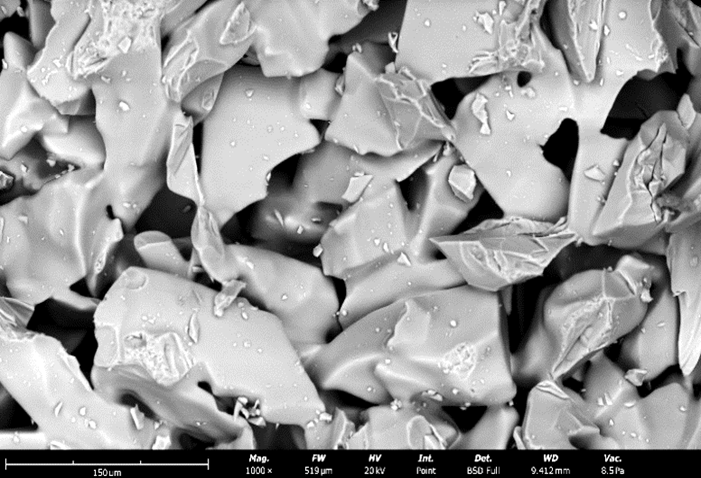
Fig 1. Front face of a quartz disc-shaped frit, where sintered glass particles form irregular channels of 16-40 microns. The image horizontal field width is 519 microns. Alkali atoms are deposited at room temperature on the bottom face of the frit (radius: 5 mm; depth: 2.5 mm), diffusing isothermally through the channels to reach the front face. We monitor the frit front face Na concentration as a function of time, at constant temperature.


Fig. 2. [Left] Elemental concentrations are shown for K vs. time at 600K on the top surface of a porous quartz frit (16-40 um pore dia.) after vapor deposition onto the opposite (bottom) surface. K appears to grow asymptotically on the top surface of the frit over time. [Right] Na increases monotonically at 600K through a similarly specified quartz frit. Both curves are fit with a function of the form y = y0 + A exp ( -t/τ ) utilizing parameters provided in each figure and discussed in the text.
How to cite: Dukes, C. A. and Woodson, A. K.: Measurement of Na and K Diffusion through Hermean Regolith Analogs, Europlanet Science Congress 2026, The Hague, The Netherlands, 7–11 Sep 2026, EPSC2026-1208, https://doi.org/10.5194/epsc2026-1208, 2026.


