TP6 | From Surface to Exosphere: Multi-Scale Processes on Airless Worlds

TP6

From Surface to Exosphere: Multi-Scale Processes on Airless Worlds
Conveners: Alexander Peschel, Rozenn Robidel, Sébastien Verkercke, Liam Morrissey, Menelaos Sarantos
Orals THU4
| Thu, 10 Sep, 16:00–17:30 (CEST)|Room Jupiter (Jazz 1 & 2)
Posters THU-POS
| Attendance Thu, 10 Sep, 18:00–19:30 (CEST) | Display Thu, 10 Sep, 08:30–19:30|Foyer 2, F2.22–25
Thu, 16:00
Thu, 18:00
Understanding surface–exosphere coupling is essential for interpreting observations of airless planets and planning future missions. This session focuses on the physical processes linking surface‑bounded exospheres to their parent surfaces, from atomistic interactions to global dynamics. We welcome contributions from data analysis, laboratory experiments, theoretical work, and numerical modelling that advance our understanding of these systems.

Topics include surface–volatile and plasma interactions, micrometeoroid bombardment, irradiation, space weathering, and volatile implantation. We particularly encourage studies that connect multiple processes or spatial and temporal scales, highlighting the two‑way coupling where surface properties influence exospheric behaviour and exospheric processes contribute to surface evolution.

Comparative studies across planetary bodies, including the Moon, Mercury, asteroids, and icy moons, are also welcome to help refine the physical framework governing surface–exosphere interactions. Contributions linking surface–exosphere processes to exoplanets with tenuous or escaping atmospheres are welcome. This session aims to build a coherent, multi‑scale perspective on the mechanisms shaping these environments and their evolution.

We particularly encourage early‑career scientists to submit abstracts for oral presentations.

Orals: Thu, 10 Sep, 16:00–17:30 | Room Jupiter (Jazz 1 & 2)

16:00–16:01
16:01–16:13
|
EPSC2026-227
|
ECP
|
On-site presentation
Noah Jäggi, Adam K. Woodson, Paul S. Szabo, Johannes Brötzner, Friedrich Aumayr, and Catherine A. Dukes

Angular distributions of sputtered ejecta are critical inputs for simulating regolith sputtering on airless bodies, where surface topography and porosity determine if particles escape or redeposit. We present new analysis and simulations demonstrating that, although current binary collision approximation (BCA) frameworks can reliably predict either total sputter yields or angular distributions for minerals, they cannot reproduce both simultaneously. This is a limitation with direct implications for exosphere and surface-evolution models that require realistic, three-dimensional ejecta plumes. Using SDTrimSP[1] for flat targets, SPRAY[2] for AFM-resolved rough surfaces, and SDTrimSP-3D[3] for porous regolith analogs, we quantify how morphology and binding energies control plume tilt and shape via a dedicated three-dimensional lobe-fitting approach designed for full-plume implementation in modeling tools. This framework addresses the need to move beyond simplified cosine laws and to incorporate azimuthal structure when propagating sputtered particles in regolith and exosphere simulations.

Across surface morphologies, rough and porous targets deflect ejecta toward the surface normal, reducing the strongly forward-facing plumes typical of flat surfaces and introducing geometry-mediated effects such as shadowing and redeposition that reshape both yield and energy distributions. In this regime, we find a robust tradeoff between reproducing sputter yield and plume tilt: the “compound/hybrid” binding-energy model[4] capable of matching experimental mineral yields[5] fails to reproduce the experimentally observed forward tilt at oblique incidence on flat and, more significantly, on rough surfaces (Fig. 1). Conversely, adopting increased surface-binding energies (SBEs) informed by recent molecular dynamics work[6]  strengthens the forward tilt and better matches rough-surface angular data but underestimates absolute mass yields by factors of 3–4.

Figure 1: Model–data comparison of sputter yields and angular distributions for MgSiO3 under 4 keV He irradiation. Left: SDTrimSP model yields that result from the Jäggi et al. (2023) hybrid binding energy model (HB-C, blue dashed) with the increased surface-binding case (SB-C) based on Morrissey et al. (2024) surface binding energies, compared to the Biber et al. (2022) laboratory measurements (black, with 2 SD errors). Center: Normalized mass yield polar distributions from a flat surface at an incidence angle αin = 60° for said simulations. Right: Analogous to the center figure, but for a rough pellet surface.


Methodologically, we map flat-surface SDTrimSP ejecta to measured roughness via ray tracing in SPRAY and construct porous regolith stacks in SDTrimSP-3D, then fit the resulting plumes with a single- or tri-lobe model that captures central and side “winglet” components associated with single-collision recoils (Fig. 2). This procedure allows for consistent comparison to laboratory angular data and direct use of fitted plumes in forward models. For rough surfaces, the simulations confirm a forward tilt relative to the sample surface normal but with magnitudes that depend sensitively on the binding-energy scheme.  Only the higher-SBE case reproduces the observed forward-tilted distributions. For porous targets, preliminary comparisons and prior 3D simulations indicate stronger backscattering, further emphasizing the need for morphology-aware angular inputs in regolith sputtering models.

Figure 2: Comparison of O sputter ejecta distributions sputtered from a rough surface (SPRAY) by 4 keV He at an incidence angle of αin = 75° from the surface normal (black arrow) resulting from (left) the Jäggi et al. (2023) hybrid binding energy (HB) model and from (right) a surface binding energy (SB) model with increased binding energies from Morrissey et al. (2024), fitted by a central plume (blue) and two forward-facing “winglet” plumes (red).


These findings have two key implications. First, exosphere and regolith models should incorporate full 3D angular distributions rather than rely on simple cosine laws, especially for rough and porous substrates where plume tilt and azimuthal structure are non-negligible. Second, the inability to match yield and angle concurrently suggests missing physics in BCA implementations—most notably, yield-enhancing processes such as molecule and cluster sputtering that are not represented in single-atom BCA ejecta—and cautions against parameter tuning. In practice, our results recommend using binding-energy models that best reproduce angular distributions when plume directionality controls transport and redeposition, while acknowledging that total yields must then be corrected for non-BCA processes if absolute source strengths are required.

In summary, angular distribution data are indispensable for realistic regolith sputtering simulations, yet existing BCA parameterizations cannot simultaneously reproduce experimental mass yields and angular distributions across flat, rough, and porous mineral surfaces. This demonstrates a fundamental limitation of current BCA-based models for planetary surfaces and motivates hybrid or extended frameworks that incorporate missing yield mechanisms while retaining accurate, morphology-dependent plume geometry.

References

[1] Mutzke, A., Toussaint, U. v, Eckstein, W., Dohmen, R. & Schmid, K. (2024). SDTrimSP Version 7.00. Technical Report

[2] Cupak, C. et al. Appl. Surf. Sci. 570, 151204 (2021).

[3] von Toussaint, U., Mutzke, A. & Manhard, A. Phys. Scr. T170, 014056 (2017).

[4] Jäggi, N. et al. Planet. Sci. J. 4, 86 (2023).

[5] Biber, H. et al. Planet. Sci. J. 3, 271 (2022).

[6] Morrissey, L.S. et al. Planet. Sci. J. 5, 272 (2024).

How to cite: Jäggi, N., Woodson, A. K., Szabo, P. S., Brötzner, J., Aumayr, F., and Dukes, C. A.: Modeling Limits of BCA for Sputtering Regolith, Europlanet Science Congress 2026, The Hague, The Netherlands, 7–11 Sep 2026, EPSC2026-227, https://doi.org/10.5194/epsc2026-227, 2026.

16:13–16:25
|
EPSC2026-1115
|
On-site presentation
Adam K. Woodson, Noah Jaeggi, and Catherine A. Dukes

Regolith roughness is expected to modulate the sputter flux of surface atoms into the exospheres of airless bodies such as Mercury, and studies have shown that roughness from the nanometer scale upward promotes redeposition and diminishes total sputtering yields. Experiments involving irradiation of olivine, plagioclase, and single-element powders demonstrate yield reductions from 15% to 67% as compared to smooth targets, but the grain size dependence of this effect has not been adequately parameterized. Understanding this mechanism is therefore of critical importance for quantifying desorption and sputter ejection and for predicting the relative contributions of release processes from regolith surfaces.

We measured the sputter depletion of adsorbed Na from polished natural olivine and from synthetic granular forsterite targets with narrow grain size distributions from 45 μm up to 520 μm. Na vapor was deposited onto each target in an ultrahigh vacuum system and then irradiated at either 15° or 60° incidence (from global surface normal) to prescribed fluence steps using 4 keV He+ ions. All experimental steps were carried out at room temperature (~300 K). After each fluence step an X-ray photoelectron spectrum was acquired and used to quantify the remaining Na surface concentration. Depletion rates and cross sections were then extracted from the concentration vs. fluence data for each target.

For the polished targets, Na concentrations exhibited single-exponential decay with increasing fluence, and depletion at 60° incidence outpaced that at 15° due to increased energy deposition near the surface as expected from theory. Conversely, for all granular samples the Na concentrations exhibited at least double-exponential decay, suggesting a bimodal removal process, and depletion from the granular targets occurred more quickly at 15° than at °60, implying enhanced access to grain facets at near normal incidence. We propose that this reflects faster removal of Na that is directly exposed to the incident ion flux, convolved with slower removal of shadowed Na by reflected incident ions. We found that the shadowed sodium was sputtered away 10–100 times more slowly than the exposed Na, with a transition from single-exponential to double-exponential decay at some threshold between nanoscale roughness (polished targets) and microscale roughness (<45 um). These results may help to explain, for example, why current models underestimate the persistence of Na density enhancements in Mercury’s dayside exosphere, as observed by the MESSENGER spacecraft’s UltraViolet and Visible Spectrometer.

Additionally, we present a novel ray-tracing model that incorporates SDTrimSP simulated sputter distributions and high-resolution, triangulated surface reconstructions of the experimental sputter targets, obtained via digital optical microscopy. The model tracks the fluence of primary and reflected incident ions onto each facet of the triangulated surface, along with the transfer of adsorbate atoms from facet to facet and from each facet into space (i.e. loss). By tuning this model to reproduce our laboratory observations, we investigate the redistribution of adsorbate atoms with increasing fluence and the associated surface shape parameters that modulate the transition from fast, single-exponential sputter depletion to slow, double-exponential sputter depletion.

How to cite: Woodson, A. K., Jaeggi, N., and Dukes, C. A.: Bimodal sputter depletion of adsorbates from granular, regolith-like targets: laboratory measurements and comparative simulations, Europlanet Science Congress 2026, The Hague, The Netherlands, 7–11 Sep 2026, EPSC2026-1115, https://doi.org/10.5194/epsc2026-1115, 2026.

16:25–16:37
|
EPSC2026-640
|
ECP
|
On-site presentation
Amanda Ricketts, Jason McLain, Li Hsia Yeo, Menelaos Sarantos, Sébastien Verkercke, and Liam Morrissey

Introduction: The surfaces of airless, planetary bodies like the Moon and Mercury are constantly exposed to several processes that eject atoms into the exosphere1,2. While the composition and densities of these exospheres are partially known based on observational data from exploratory missions3, the source of each component is not well understood. This uncertainty necessitates better constraints for accurately interpreting the observed exospheric data, which requires both experimentally constrained measurement and atomistic-level physical insight.

Laboratory studies provide valuable measurements of adsorption and desorption behavior, while molecular dynamics (MD) simulations enable direct investigation of the atomic-scale interactions that cannot be resolved experimentally. By combining these approaches, it becomes possible to better constrain the physical mechanisms controlling surface-exosphere interactions on bodies such as Mercury and the Moon.

In this work, MD simulations of Na and K adsorption on silica surfaces are combined with thermal stimulated desorption (TSD) experiments of Na and K adsorbed onto silica. The study focuses on understanding how surface coverage and environmental hydroxylation influence adsorption energetics and desorption behavior4. The combined computational and experimental approach not only provides validation between methods, but also demonstrates how MD simulations can explain experimentally observed trends and identify surface processes relevant to planetary environments.


Methodology: MD simulations were performed to investigate Na and K adsorption on silica surfaces under varying surface coverages and surface chemistries. Surface binding energies (SBEs) were calculated for adsorbed Na and K atoms to quantify the strength of adsorbate-surface interactions and to identify how adsorption behavior evolves from isolated adsorbates to high-coverage surfaces5. Additional simulations examined H covered silica surfaces to evaluate the effect of hydroxylation on adsorbed Na SBEs.

TSD experiments were conducted by collaborators using Na- and K-dosed Apollo samples6. Following adsorbate deposition, samples were heated to approximately 1000K while monitoring desorption behavior to derive activation energies associated with adsorbate release from the surface. The experimental desorption energetics were compared directly with the MD-derived SBEs to investigate the physical origins of the experimentally observed desorption behavior.


Results:  The combined MD and experimental results demonstrate strong agreement between stimulated adsorption energetics and experimentally observed desorption behavior. Figure 1 displays the SBE distributions of adsorbed Na on a bare silica surface, Na covered surface, and hydroxylated surface.

MD simulations show that isolated Na atoms adsorbed directly onto bare silica surfaces form strongly bound adsorption states with SBEs exceeding 5 eV. These energies are larger than the effective experimental detection range of the TSD studies, which are insensitive to adsorption energies above approximately 3.5 eV at the maximum experimental temperature of 1000K. Consequently, strongly bound adsorbates detected in the MD results are unlikely to desorb during experimental heating cycles.

This provides important insight into the physical experiments, suggesting that residual adsorbates likely remain on the silica surface between experimental runs despite minimal dosing conditions. Over time, this accumulated coverage may produce increasingly significant Na-Na or K-K interactions and lower-energy adsorption states, consistent with the experimentally observed desorption energies. In this way, the MD simulations provide a physical explanation for experimental behavior that cannot be directly measured.

Further MD simulations demonstrate that hydroxylated silica surface significantly reduce adsorbate SBEs relative to bare silica (by ~2.9 eV). This suggests that exposure of experimental samples to ambient atmospheric water or H during sample transfer may hydroxylate undercoordinated surface oxygens, producing weaker adsorption states and lower desorption temperatures in the TSD measurements. Similar hydroxylation processes are also expected on Mercury and the Moon due to solar wind hydrogen implantation, likely resulting in spatially variable adsorption energetics across the planetary surface.

Together, these results demonstrate how combining MD simulations with laboratory experiments enables a more reliable interpretation of both datasets while providing improved insight into the surface processes governing volatile behavior on airless planetary bodies.


Conclusion: This study demonstrates the strength of integrating MD simulations with laboratory thermal desorption experiments to investigate surface processes on airless planetary bodies. While experiments provide direct measurements of adsorbate desorption behavior, MD simulations reveal the underlying atomic-scale interactions responsible for the observed trends. The combined approach identifies the important roles of surface coverage and hydroxylation in controlling adsorption energetics and explains how experimentally inaccessible strongly bound adsorption states may influence measured desorption behavior.

By coupling computational and experimental methods, this work provides a more physically complete understanding of adsorbate-surface interactions and highlights the importance of considering realistic surface environments when interpreting laboratory measurements and modelling planetary surface-exosphere systems.


References:

1. Killen, R.M., et al. (1999)

2. Wurz, P., et al. (2022)

3. McClintock, et al. (2018)

4. Yeo, L.H., et al. (2024)

5. Morrissey, L., et al. (2025)

6. McLain, J.L., et al. (2024)

How to cite: Ricketts, A., McLain, J., Yeo, L. H., Sarantos, M., Verkercke, S., and Morrissey, L.: A Combined Computational and Experimental Approach to Investigating Volatile-Surface Interactions on Airless Planetary Bodies, Europlanet Science Congress 2026, The Hague, The Netherlands, 7–11 Sep 2026, EPSC2026-640, https://doi.org/10.5194/epsc2026-640, 2026.

16:37–16:49
|
EPSC2026-849
|
ECP
|
On-site presentation
Marc Amorós-Trepat, Noria Brecher, Alexander Peschel, and Philipp Reiss

Introduction:  

Water migration in the lunar regolith is controlled by surface temperatures, sorption kinetics, and surface properties. Previous modeling studies have shown that, under a sustained influx of water molecules at the lunar surface, the diurnal thermal cycle can drive a downward migration of water [1, 2]. This process, often described as thermal pumping, occurs because molecules desorb more efficiently from warmer near-surface grains and can re-adsorb at greater depths, where lower temperatures increase their residence time. In a recent study [3], we showed how this process is mainly influenced by the desorption energy. Both that work and the present study are carried out within the VOLARIS project [4], which aims to advance the understanding of the Moon’s water cycle by combining simulations and experimental studies. 

Previous modeling efforts, including our own [3], used a single desorption energy for all available binding sites on grain surfaces. However, previous temperature-programmed desorption experiments [5] indicated that lunar regolith grains contain a heterogeneous population of adsorption sites with a broad distribution of binding energies. Surface diffusion dictates how efficiently water molecules can hop between these binding sites. A recent study assumed this process to be either infinitely efficient, where an adsorbed molecule instantaneously finds the deepest available binding site, or nonexistent [6]. In reality, the behavior of surface diffusion likely lies between these two extreme cases. Laboratory and theoretical studies suggest that adsorbed water molecules may hop between neighboring binding sites on the same grain if they overcome a surface diffusion barrier (Ediff), often parameterized as a fraction of the desorption energy (Ed), Ediff= α · Ed​, with typical values of α ranging from 0.2 to 0.7 [7, 8]. 

Methodology: 

Our goal is to determine the physical conditions under which thermal pumping remains effective when adsorbed molecules can be redistributed among binding sites. To do this, we developed a one-dimensional model that couples three processes: heat transfer in the regolith, grain surface diffusion between binding sites, and inter-grain diffusion through the porous subsurface. The adsorption model represents the grain surface as a discretized distribution of binding energies, divided into 50 equal-width energy bins. Molecules can move between these bins via thermally activated hopping rates, following the formulation derived by He et al. [6].  

To model inter-grain diffusion, we use the formulation introduced by Schörghofer [5], in which diffusion is driven by gradients in the desorption rates between adjacent grains. This approach accounts for the micro-roughness and high surface area of lunar grains by including the probability that a desorbed molecule re-adsorbs onto the same grain before escaping into the pore space and migrating to another grain. 

Preliminary results: 

We performed numerical experiments with a constant supply rate at the surface of 10-15 kg/(m2 s) over 10 lunations. Simulations initialized with completely dry regolith show that most incoming water remains near the surface, gradually filling the deepest available binding sites. Once molecules occupy these high-energy sites, they are effectively trapped under typical lunar surface temperatures and do not participate in downward migration. To study the role of surface diffusion after the deepest binding sites are partly occupied, we initialized the substrate with a surface coverage of 0.0001%. In these simulations, water can migrate downward by repeatedly adsorbing to and desorbing from weaker binding sites. 

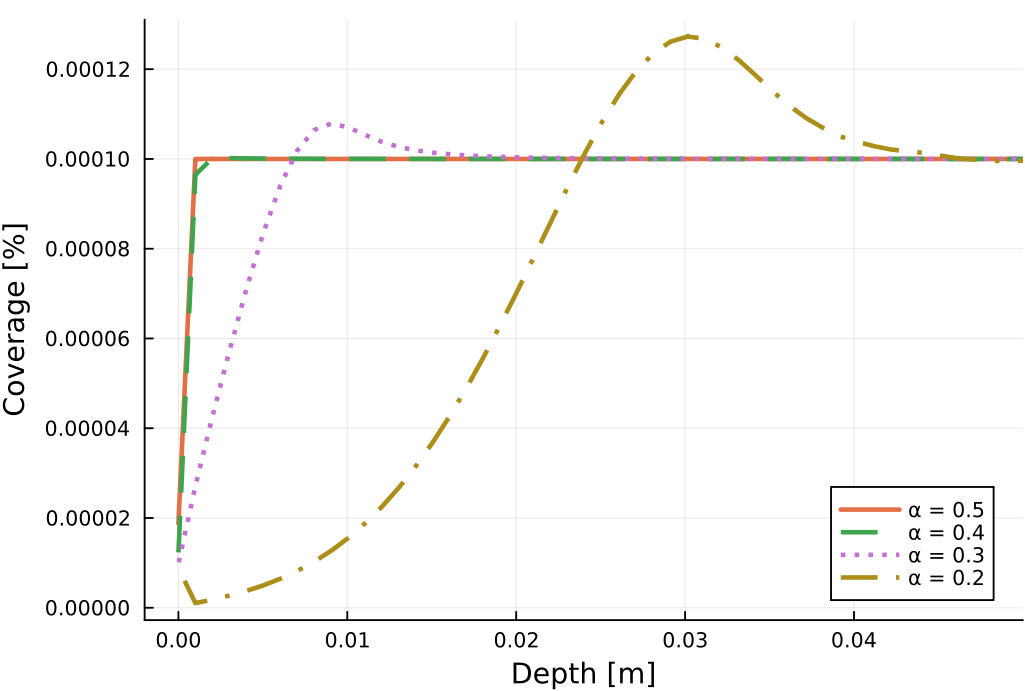
One can see in Fig. 1 how the modeled water abundance is sensitive to the diffusion barrier ratio α. A lower diffusion barrier allows more efficient redistribution among binding sites, making it more likely that lower-energy sites are occupied and enhancing overall migration during one lunation. 


Figure 1: Coverage profile over depth after 10 lunations at the equator, at 0h LT, with different surface diffusion conditions. 

Conclusions: 

These results show how surface diffusion is a key uncertainty factor in predicting the depth distribution and residence time of lunar water. Therefore, further constraining the surface diffusion barrier and the distribution of desorption energies is essential for evaluating in which regions thermal pumping transports water into the lunar subsurface.  

Acknowledgments:  

This work is funded by the European Union (ERC, VOLARIS, 101164002). Views and opinions expressed are however those of the author(s) only and do not necessarily reflect those of the European Union or the European Research Council. Neither the European Union nor the granting authority can be held responsible for them. 

References: 

[1] Reiss, P., Warren, T., Sefton‐Nash, E., & Trautner, R. (2021). Dynamics of subsurface migration of water on the Moon. Journal of Geophysical Research: Planets, 126(5), e2020JE006742. 

[2] Schörghofer, N., & Aharonson, O. (2014). The lunar thermal ice pump. The Astrophysical Journal, 788(2), 169. 

[3] Amorós-Trepat, M., Brecher J. N., and Peschel, A., and Reiss, P. (2026). The Sensitivity of lunar water migration to physical soil parameters, Lunar and Planetary Science conference 57th, Abstract #1634. 

[4] Reiss, P., Amorós-Trepat, M., Brecher J. N., and Peschel, A. (2025). Insights into the lunar water cycle, The Project Repository Journal, vol. 24, pp.86–89. 

[5] Jones, B. M., Aleksandrov, A., Dyar, M. D., Hibbitts, C. A., & Orlando, T. M. (2020). Investigation of water interactions with Apollo lunar regolith grains. Journal of Geophysical Research: Planets, 125(6), e2019JE006147. 

[6] Schörghofer, N. (2025). Diffusion-adsorption of Water Vapor in Chemically Activated Lunar Soil. The Planetary Science Journal, 6(7), 164. 

[7] He, J., & Vidali, G. (2014). Application of a diffusion–desorption rate equation model in astrochemistry. Faraday Discussions, 168, 517-532. 

[8] Sarantos, M., & Tsavachidis, S. (2021). Lags in desorption of lunar volatiles. The Astrophysical Journal Letters, 919(2), L14. 

How to cite: Amorós-Trepat, M., Brecher, N., Peschel, A., and Reiss, P.: Studying the Influence of Surface Diffusion on Lunar Subsurface Water Migration, Europlanet Science Congress 2026, The Hague, The Netherlands, 7–11 Sep 2026, EPSC2026-849, https://doi.org/10.5194/epsc2026-849, 2026.

16:49–17:01
|
EPSC2026-424
|
On-site presentation
Kei Masunaga, Shoichiro Yokota, Yuki Harada, Kunihiro Keika, Naoki Terada, Shotaro Sakai, Ayako Matsuoka, Hiromu Nakagawa, Yudai Arai, Yoshifumi Saito, Masaki Nishino, Makiko Ohtake, Kazushi Asamura, Hisayoshi Shimizu, Futoshi Takahashi, and Masaki Matsushima

Water on the Moon is crucial for understanding its origin and evolution and is also of interest for future human exploration. Recent observations show that water ice and hydroxyl are mainly concentrated in permanently shadowed regions near the lunar poles, and these species have also been detected in the lunar exosphere. However, how exospheric water is distributed and how it is coupled to the surface remain poorly constrained.

Using the Ion Mass Analyzer onboard the Kaguya spacecraft, we report the detection of water ions originating from the lunar exosphere. We identify statistically significant low-energy water ions and characterize their latitudinal distribution, showing that their flux is enhanced in the polar regions compared with lower latitudes, consistent with previous remote-sensing observations of lunar water. From the observed flux, we estimate near-surface exospheric water density, comparable to previous in-situ measurements.

These results demonstrate that the spatial distribution of surface water is reflected in the exospheric ion population, indicating a dynamically coupled surface–exosphere system. Ion measurements therefore provide a powerful tool for investigating the release, transport, and loss of water on airless bodies.

How to cite: Masunaga, K., Yokota, S., Harada, Y., Keika, K., Terada, N., Sakai, S., Matsuoka, A., Nakagawa, H., Arai, Y., Saito, Y., Nishino, M., Ohtake, M., Asamura, K., Shimizu, H., Takahashi, F., and Matsushima, M.: Polar enhancement of lunar water ions observed by Kaguya: Implications for surface-exosphere coupling, Europlanet Science Congress 2026, The Hague, The Netherlands, 7–11 Sep 2026, EPSC2026-424, https://doi.org/10.5194/epsc2026-424, 2026.

17:01–17:13
|
EPSC2026-946
|
On-site presentation
Leander Schlarmann, Audrey Vorburger, Tim Mosimann, Brian Magee, Alizée Amsler Moulanier, Shahab Fatemi, Nicolas Thomas, and Peter Wurz

A range of physical and chemical processes characterises the tenuous atmospheres of the Galilean moons. Io, the innermost Galilean moon, is subject to extreme tidal forces that drive intense volcanic activity, ultimately responsible for Io's SO2-dominated atmosphere. Next to SO2, where the sublimation of surface frost is expected to be the main source [1], dissociation products (e.g., SO, S, O), along with compounds connected with volcanic eruptions (e.g., S2, NaCl, KCl) have been detected in Io’s atmosphere. On the contrary, the main atmospheric species of the icy Galilean moons are expected to be water-related products, such as H2O, O2, and H2. Moreover, dissociation products (O, H) and non-water-related species, such as CO2, have been detected.

In this study, we use the Direct Simulation Monte Carlo (DSMC) model ultraSPARTS (ultrafast Statistical PARTicle Simulation package) [2, 3] to compare the atmospheres of the Galilean satellites. For this purpose, we investigate the influence of various processes, including sublimation, radiolysis, and outgassing from (cryo-)volcanic plumes. To model the sublimation of SO2 and H2O, we apply an adapted version of the thermal model THERMPROJRS [4] to constrain the surface frost temperature on the satellites, which governs the vapour pressure and, therefore, determines whether sublimation or condensation occurs.  Furthermore, we investigate the influence of different collision cross-sections and particle collisions on the macroscopic atmospheric properties.

In the 2030s, the atmospheres of the icy Galilean moons will be studied extensively by the JUICE and Europa Clipper missions using high-resolution mass spectrometry, providing an unprecedented opportunity to compare and verify our results with in-situ data.

Acknowledgements:

This work has been carried out within the framework of the National Centre of Competence in Research PlanetS supported by the Swiss National Science Foundation under grant 51NF40_205606. The authors acknowledge the use of ultraSPARTS from Plasma T.I., Taiwan.

References:

[1] Giles, R. S., et al. (2024). Icarus, 418, 11615.
[2] http://www.plasmati.com.tw/
[3] Klaiber, L. M. (2024). Three-dimensional DSMC modelling of the dynamics of Io’s atmosphere. PhD thesis, University of Bern.
[4] Spencer, J. R. (1989). Icarus 78, 337-354.

How to cite: Schlarmann, L., Vorburger, A., Mosimann, T., Magee, B., Amsler Moulanier, A., Fatemi, S., Thomas, N., and Wurz, P.: Comparing the Galilean moon atmospheres using the DSMC method, Europlanet Science Congress 2026, The Hague, The Netherlands, 7–11 Sep 2026, EPSC2026-946, https://doi.org/10.5194/epsc2026-946, 2026.

17:13–17:28
|
EPSC2026-737
|
ECP
|
On-site presentation
Henry Eshbaugh and Neil Bowles

The discovery of widespread hydration across the lunar surface [1,2,3] is one of the most surprising results of the last twenty years in the field of planetary science. Further considerations have extended to exospheric migration of water on other airless bodies, such as Mercury and Ceres [4]; other works have considered the coupling of multiple volatile species within the lunar volatile inventory [5,6], or have considered the icy moons of the outer Solar System [7], with the seasonal migration of CO2 on the Uranian moon Ariel [8,13] being one such example.

A difficulty in modelling volatile transport is the interplay between various physical and chemical processes, including adsorption kinetics, photochemistry, and transport kinematics. Hence, Monte Carlo modelling has remained the dominant mode of investigation, producing qualitative outputs surveying emergent phenomena. The development of a comprehensive and quantitative forward-modelling approach has remained an outstanding problem.

To produce such a model, we turn to Markov processes [9]. The governing equations of these processes generate, via Kramers-Moyal expansion [10], such familiar results as the Fokker-Planck, continuity, and diffusion equations.

We derive a Markov master equation for a global volatile ensemble from mass-balance. With straightforward probability theory, we model adsorption kinetics at a molecular level, and ballistic transport on a global scale, providing an integrated analytic approach to global volatile dynamics.

Going further, we use tensor products between Markov processes [11,12] to model the interplay between volatile species, allowing for capture of kinetic schemes driven by surficial and photochemical reactions.

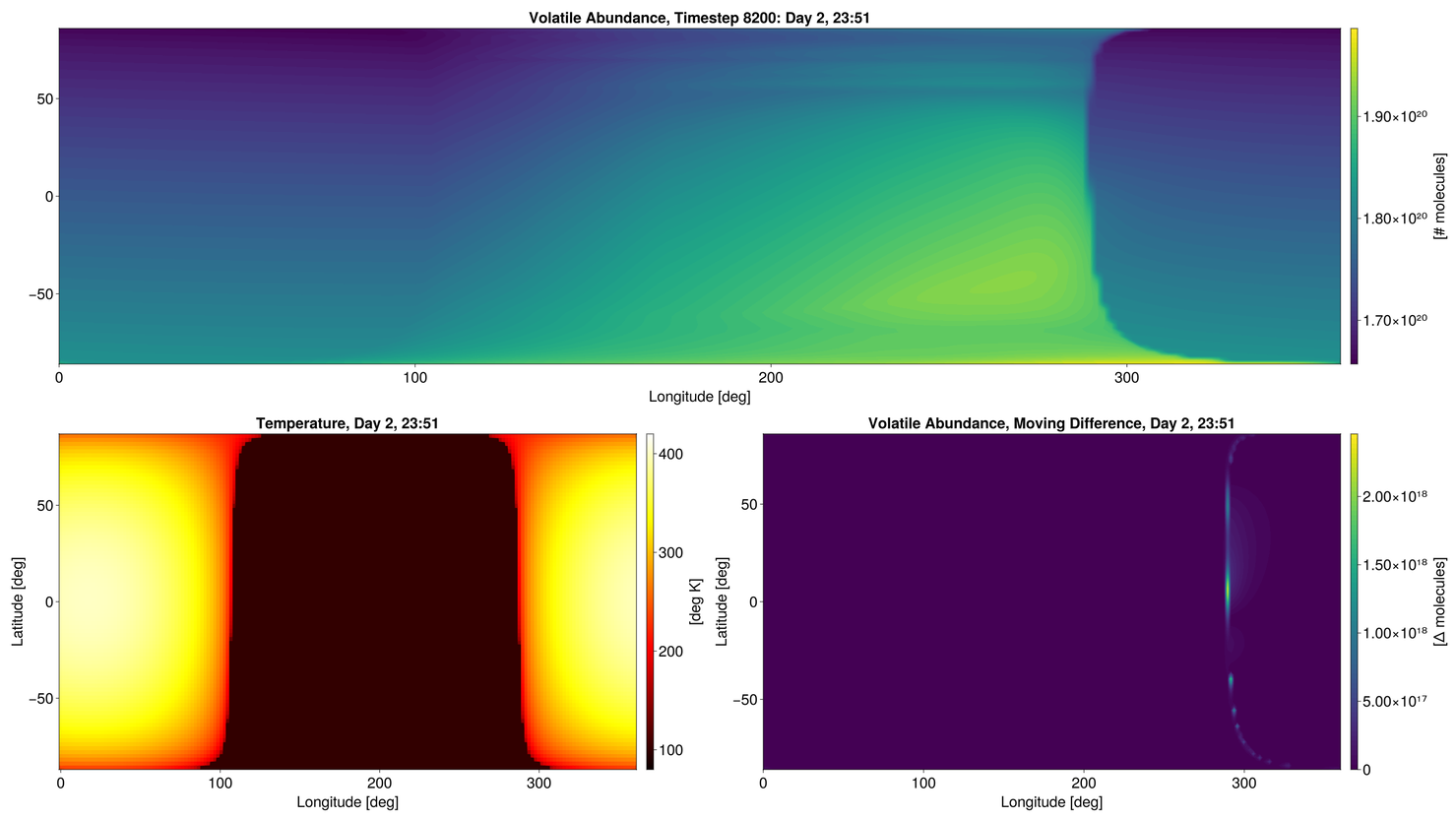
We implement a simplified, straightforward model. The global ensemble was taken to be 10^30 water molecules. 4200 timesteps per lunation are calculated for 100,000 timesteps - approximately 607 seconds per timestep. We neglect implantation and loss mechanisms as well as topography. We use an analytic model of lunar surface temperatures [14]. Desorption probabilities are calculated from the Eyring-Polanyi equation [15,16], with an activation energy of 0.7 eV. The Armand distribution [17,18] drives ballistic-hop transport.

Figure 1: Lunar surficial water abundance; simplified model run, timestep 8200.

Timestep 8200 is shown in Figure 1. Volatile concentration is heightened in the southern winter. The initial volatile distribution was random; onset of equilibrium conditions is rapid. A dusk-dawn asymmetry is present, reproducing the results of Schörghofer [19]. Latitudinal stratification is visible, with the band of minimal concentration dependent on solar declination.


We conclude by presenting paths forward in volatile modelling efforts enabled by this approach.


[1] Pieters, C.M., Goswami, J.N., Clark, R.N., Annadurai, M., Boardman, J., Buratti, B., Combe, J.P., Dyar, M.D., Green, R., Head, J.W. and Hibbitts, C., 2009. Character and spatial distribution of OH/H2O on the surface of the Moon seen by M3 on Chandrayaan-1. science, 326(5952), pp.568-572.

[2] Sunshine, J.M., Farnham, T.L., Feaga, L.M., Groussin, O., Merlin, F., Milliken, R.E. and A’Hearn, M.F., 2009. Temporal and spatial variability of lunar hydration as observed by the Deep Impact spacecraft. Science, 326(5952), pp.565-568.

[3] Clark, R.N., 2009. Detection of adsorbed water and hydroxyl on the Moon. Science, 326(5952), pp.562-564.

[4] Schörghofer, N., Benna, M., Berezhnoy, A.A., Greenhagen, B., Jones, B.M., Li, S., Orlando, T.M., Prem, P., Tucker, O.J. and Wöhler, C., 2021. Water group exospheres and surface interactions on the Moon, Mercury, and Ceres. Space Science Reviews, 217(6), p.74.

[5] Huebner, W.F. and Mukherjee, J., 2015. Photoionization and photodissociation rates in solar and blackbody radiation fields. Planetary and Space Science, 106, pp.11-45.

[6] Smolka, A., Nikolić, D., Gscheidle, C. and Reiss, P., 2023. Coupled H, H2, OH, and H2O lunar exosphere simulation framework and impacts of conversion reactions. Icarus, 397.

[7] Steckloff, J.K., Goldstein, D., Trafton, L., Varghese, P. and Prem, P., 2022. Exosphere-mediated migration of volatile species on airless bodies across the solar system. Icarus, 384, p.115092.

[8] Cartwright, R.J., Nordheim, T.A., DeColibus, R.A., Grundy, W.M., Holler, B.J., Beddingfield, C.B., Sori, M.M., Lucas, M.P., Elder, C.M., Regoli, L.H. and Cruikshank, D.P., 2022. A CO2 Cycle on Ariel? Radiolytic production and migration to low-latitude cold traps. The Planetary Science Journal, 3(1), p.8.

[9] Livi, R. and Politi, P., 2025. Nonequilibrium Statistical Physics: a Modern Perspective. 2nd edition. Cambridge University Press.

[10] Kramers, H.A., 1940. Brownian motion in a field of force and the diffusion model of chemical reactions. physica, 7(4), pp.284-304.

[11] Dayar, T., 2012. Analyzing Markov chains using Kronecker products: theory and applications. Springer Science & Business Media.

[12] Giry, M., 2006, October. A categorical approach to probability theory. In Categorical Aspects of Topology and Analysis: Proceedings of an International Conference Held at Carleton University, Ottawa, August 11–15, 1981 (pp. 68-85). Berlin, Heidelberg: Springer Berlin Heidelberg.

[13] Grundy, W.M., Young, L.A., Spencer, J.R., Johnson, R.E., Young, E.F. and Buie, M.W., 2006. Distributions of H2O and CO2 ices on Ariel, Umbriel, Titania, and Oberon from IRTF/SpeX observations. Icarus, 184(2), pp.543-555.

[14] Crider, D.H. and Vondrak, R.R., 2000. The solar wind as a possible source of lunar polar hydrogen deposits. Journal of Geophysical Research: Planets, 105(E11), pp.26773-26782.

[15] Eyring, H., 1935. The activated complex in chemical reactions. The Journal of chemical physics, 3(2), pp.107-115.

[16] Evans, M.G. and Polanyi, M., 1935. Some applications of the transition state method to the calculation of reaction velocities, especially in solution. Transactions of the Faraday Society, 31, pp.875-894.

[17] Armand, G., 1977. Classical theory of desorption rate velocity distribution of desorbed atoms; possibility of a compensation effect. Surface Science, 66(1), pp.321-345.

[18] Schörghofer, N., 2022. Statistical thermodynamics of surface-bounded exospheres. Earth, Moon, and Planets, 126(2), p.5.

[19] Schorghofer, N., 2014. Migration calculations for water in the exosphere of the Moon: Dusk‐dawn asymmetry, heterogeneous trapping, and D/H fractionation. Geophysical Research Letters, 41(14), pp.4888-4893.

How to cite: Eshbaugh, H. and Bowles, N.: Stochastic Modelling of Volatile Transport in Surface-Bound Exospheres, Europlanet Science Congress 2026, The Hague, The Netherlands, 7–11 Sep 2026, EPSC2026-737, https://doi.org/10.5194/epsc2026-737, 2026.

17:28–17:30

Posters: Thu, 10 Sep, 18:00–19:30 | Foyer 2

Display time: Thu, 10 Sep, 08:30–19:30
F2.22
|
EPSC2026-662
|
ECP
|
On-site presentation
Alexander Peschel, Jurij Simčič, and Philipp Reiss

Solar-wind protons implanted into the upper nanometers of lunar regolith are an important source of hydrogen-bearing species on the Moon. These particles may diffuse through mineral grains, bind to oxygen sites, form OH, recombine to H₂, or contribute to H₂O production and release. Which pathway dominates depends on temperature, binding energies, surface coverage, and the availability of reactive sites (Jones et al., 2021, 2024). These microscopic processes control how much implanted hydrogen is retained in the regolith and how much is released into the surface-bounded exosphere. However, global lunar exosphere models usually cannot directly resolve this subsurface chemistry. We address this scale gap with a particle-resolved time-stepping Monte Carlo model that links solar-wind proton implantation, regolith chemistry, and volatile release.

The model tracks individual H-bearing particles diffusing in a one-dimensional depth grid representing the near-surface (400nm) region of a regolith grain (Nagai et al., 2020; Hansen et al., 2013). Solar-wind proton implantation is implemented using a SRIM/TRIM-informed Gaussian depth distribution centered at 20–25 nm (Farrell et al., 2015). Diffusion and release are controlled by temperature- and coverage-dependent activation energies. Previous versions of the activation energy model assumed infinite diffusion efficiency (Schörghofer, 2023, 2025), leading particles to always choose the deepest available binding site. We extended the model by adding a finite-diffusion efficiency term that allows implanted particles to sample binding sites across a broader local activation-energy distribution, rather than imposing a sharp transition between filled and empty sites.

Using this framework, we are performing a parameter study of the activation energies. We vary the OH binding-energy distribution, recombinative desorption barriers, the probability of H2 formation, and additional physical parameters. Preliminary results show that the parameters of the OH energy distribution have the strongest influence on the partitioning between retained OH, released H2, and recombined H2O. They show distinct dayside desorption patterns controlled by the imposed diurnal temperature and solar-wind flux profiles. These results indicate that the hydrogen release ratios are sensitive to the assumed activation-energy distribution and must be constrained before they can be used as robust source terms in global exosphere simulations.

An example output of the release rates is shown in the Figure, displaying how much of the implanted solar wind protons (SWP) is released at each surface location over one lunation. These rates represent only outgassing from previously implanted protons; they do not include deposition or re-implantation of particles returning from the exosphere. The resulting pattern shows a strong temperature dependence in the outgassing, with enhanced release in warmer regions near the subsolar point.

To couple the micro-scale model with global-scale investigations, the H₂ release is used as a source term in a lunar exosphere simulation and tested against reported densities from LAMP and CHACE measurements (Stern et al., 2013; Cook et al., 2013; Hurley et al., 2017; Thampi et al., 2015). Preliminary comparisons indicate that 40–60% of the implanted solar-wind proton flux must be released as H2 to reproduce the observed exospheric densities. This constraint provides an initial benchmark for the activation-energy parameter study: parameter combinations that retain too much hydrogen as OH, or release too little H2, are unlikely to reproduce the observed lunar H₂ exosphere.

The model results will be constrained by ongoing laboratory work at the Jozef Stefan Institute (Simčič et al., 2025), where Nuclear Reaction Analysis (NRA) is used to measure implanted-particle depth profiles and retention behavior. These experiments will provide independent constraints on diffusion and desorption parameters. Together, the particle-tracking model, the H₂ exosphere comparison, and the laboratory measurements will provide a consistent framework for linking solar-wind implantation, regolith-scale physical chemistry, and volatile release from the lunar surface.


References

Cook et al. (2013), Icarus225(1), 681–687. 10.1016/j.icarus.2013.04.010

Farrell et al. (2015), Icarus255, 116–126. 10.1016/j.icarus.2014.09.014

Hansen and McDonald (2013), Theory of Simple Liquids. 10.1016/b978-0-12-387032-2.00007-6

Hurley et al. (2017), Icarus283, 31–37. 10.1016/j.icarus.2016.04.019

Jones et al. (2021), Earth and Planetary Science Letters571, 117107. 10.1016/j.epsl.2021.117107

Jones et al. (2024), The Planetary Science Journal5(8), 171. 10.3847/PSJ/ad5542

Nagai et al. (2020), Journal of Chemical Theory and Computation16(12), 7239–7254. 10.1021/acs.jctc.0c00448

Schörghofer (2023), The Planetary Science Journal4(9), 164. 10.3847/PSJ/acf19b

Schörghofer (2025), The Planetary Science Journal6(7), 164. 10.3847/psj/ade5b2

Simčič et al. (2025), European Lunar Symposium. 10.5281/ZENODO.15470820

Stern et al. (2013), Icarus226(2), 1210–1213. 10.1016/j.icarus.2013.07.011

Thampi et al. (2015), Planetary and Space Science106, 142–147. 10.1016/j.pss.2014.12.018

How to cite: Peschel, A., Simčič, J., and Reiss, P.: Particle-Resolved Kinetic Modeling of Solar-Wind Hydrogen Release from Lunar Regolith, Europlanet Science Congress 2026, The Hague, The Netherlands, 7–11 Sep 2026, EPSC2026-662, https://doi.org/10.5194/epsc2026-662, 2026.

F2.23
|
EPSC2026-707
|
ECP
|
On-site presentation
Paul S. Szabo, Shane R. Carberry Mogan, Andrew R. Poppe, Shahab Fatemi, Weijie Sun, and Jiutong Zhao

Solar wind ions that reach the surface of Mercury cause surface erosion via sputtering. Among several other processes, sputtering can then contribute to the planet’s exosphere [1]. For the refractory elements Ca and Mg, NASA’s MESSENGER spacecraft provided extensive observations of their occurrence [2, 3]. However, the dawn-centered characteristics and yearly periodicity of the exospheric emission have been attributed to micrometeoroid impact vaporization (MIV) with no significant contribution from sputtering under regular SW conditions [4-6].

Here we present a simulation study that predicts a significant change in dominant sources of Ca and Mg emission during strong interplanetary coronal mass ejections (ICMEs). We use the AMITIS hybrid plasma code to calculate surface precipitation of solar wind H+ and He++ ions during such strong solar storms [7]. We specifically focus on disappearing dayside magnetosphere (DDM) events [8], where the planet’s magnetic field cannot stand off the solar wind pressure and exposure of Mercury’s surface increases significantly. Based on the ion impact results from Amitis, we calculate the sputter emission using regolith sputter yields simulated with SDTrimSP-3D and model the formation of the sputtered Ca and Mg exosphere in the Harrah’s direct simulation Monte Carlo code (DSMC) [9,10].

Considering the ranges of ICME intensities that have been observed by MESSENGER at Mercury [11], our simulations clearly show that strong ICMEs allow full access of the solar wind to Mercury’s surface and increase both the surface precipitation and the sputtering by more than two orders of magnitude. Above a dynamic pressure of around 100 nPa, our calculated sputter rates exceed the surface emission that was reported from MESSENGER and attributed to MIV.

Our DSMC simulations further show that the increased surface erosion rates are also expected to significantly affect the distribution of refractories in the exosphere. Contrary to the dawn-centered MIV emission, the sputtering adds an additional noon-centered emission feature that overwhelms the otherwise preferential dawn emission. The Ca and Mg exospheres show differences in their detailed response to the ICME impact due to the highly efficient photoionization of Ca, which limits the transport of the atoms across the exosphere.

ICME-induced exosphere enhancements as modeled here are expected to be temporary and to last a few hours, due to the highest solar wind pressures typically occurring in the short shock phases of an ICME and the exospheric lifetime of Ca and Mg of similar duration. Such features have not been reported so far, but should be observable similar to exospheric enhancements following meteoroid impacts reported by MESSENGER [12]. Future measurements of such events with BepiColombo and further analysis of the MESSENGER exosphere observations will help understand the response of Mercury’s system to ICME impacts and the role of solar wind sputtering in the exosphere formation.


References

[1]          P. Wurz, et al., Space Science Reviews 218.3 (2022), 10.

[2]          M.H. Burger, et al. Icarus 238 (2014), 51.

[3]          A.W. Merkel, et al., Icarus 281 (2017), 46.

[4]          P. Pokorný et al., The Astrophysical Journal 863.1 (2018), 31.

[5]          J.-Y. Chaufray, et al., Icarus 384 (2022), 115081.

[6]          P.S. Szabo, et al., Journal of Geophysical Research: Planets 130 (2025), e2025JE009058.

[7]          S. Fatemi, et al., Journal of Physics: Conference Series 837.1 (2017).

[8]          J.A. Slavin, et al., Journal of Geophysical Research: Space Physics 124 (2019), 6613.

[9]          U. Von Toussaint, et al., Physica Scripta,  2017.T170 (2017), 014056.

[10]       S.R. Carberry Mogan, et al., Journal of Geophysical Research: Planets 127 (2022), e2022JE007294.

[11]       R. Winslow, et al., The Astrophysical Journal 889 (2020), 184.

[12]       T.A. Cassidy, et al., The Planetary Science Journal 2 (2021), 175.              

How to cite: Szabo, P. S., Carberry Mogan, S. R., Poppe, A. R., Fatemi, S., Sun, W., and Zhao, J.: Mercury's Refractory Exosphere Becomes Sputter-Dominated during Strong Interplanetary Coronal Mass Ejections, Europlanet Science Congress 2026, The Hague, The Netherlands, 7–11 Sep 2026, EPSC2026-707, https://doi.org/10.5194/epsc2026-707, 2026.

F2.24
|
EPSC2026-792
|
On-site presentation
Philipp Reiss, François Leblanc, Peter Llewellyn, Alexander Peschel, and Menelaos Sarantos

The modelling of planetary volatiles is inherently interdisciplinary, encompassing a wide range of physical processes that operate across vastly different spatial and temporal scales. Despite the increasing importance of volatiles for understanding planetary evolution, surface–exosphere interactions, and resource potential, the existing literature remains highly specialised and fragmented. This presents a significant barrier to entry for researchers and early-career scientists seeking to engage in this field. In response to this challenge, we present a new book project that provides a comprehensive, accessible, and integrative overview of modelling approaches used in planetary volatile studies. The book is currently being prepared for publication with Elsevier in 2028.

At the most fundamental level, volatile-surface interaction is governed by atomic- and molecular-scale processes. These include adsorption, desorption, diffusion, and chemical reactions, which are typically investigated using techniques such as Density Functional Theory and Molecular Dynamics. Modelling on this atomic scale provides insights into binding mechanisms, reaction pathways, and kinetic processes that determine volatile stability and mobility. At the grain scale, particle–surface interactions, as well as heat and mass transfer processes, dominate volatile behaviour. Modelling approaches account for the heterogeneous nature of regolith grains, including surface chemistry, morphology, size distribution, and porosity. Heat and mass transport models are essential to capture the exchange of volatiles between the subsurface and the surface, especially under diurnal temperature variations characteristic of airless bodies. At the macro scale, the composition of exospheres and the migration of volatiles are commonly modelled using Monte Carlo methods to track particles originating from release processes via surface interactions, while accounting for surface temperature distributions and topography.

The presented book provides a structured introduction to commonly used computational and theoretical methods, highlighting their assumptions, limitations, and domains of applicability. In addition to theoretical foundations, the book follows a handbook approach, with practical guides, methodological comparisons, illustrative use cases and exercises. By synthesising methodologies from different fields of research into a unified resource, it aims to lower the barrier to entry for new researchers while also serving as a reference for experienced practitioners. Ultimately, this book aims to provide a foundation for future advances in the study of volatiles and their role in shaping planetary surfaces and environments.

How to cite: Reiss, P., Leblanc, F., Llewellyn, P., Peschel, A., and Sarantos, M.: A practical resource for common modelling approaches in simulating planetary volatiles, Europlanet Science Congress 2026, The Hague, The Netherlands, 7–11 Sep 2026, EPSC2026-792, https://doi.org/10.5194/epsc2026-792, 2026.

F2.25
|
EPSC2026-1208
|
On-site presentation
Catherine A. Dukes and Adam K. Woodson

Without continuous diffusion from the Hermean subsurface to the planetary epiregolith, Mercury’s Na exosphere cannot be sustained [Sprague 1990; Killen and Morgan 1993; Leblanc & Johnson 2010; Gamborino et al. 2019; Verkercke et al. 2024]. Meteoritic impacts and solar wind sputtering excavate Na from regolith minerals into the exosphere where a fraction of the ejected atoms will resettle on the planetary surface. These excavated, adsorbed Na atoms may be subsequently re-ejected into the exosphere either in the same manner or by lower energy (< 10 eV) release processes such as thermal desorption and photodesorption. However, this “surface reservoir” appears unsustainable, with theoretical sublimation fluxes via thermal desorption surpassing the expected available atomic concentrations on Mercury’s sunlit hemisphere [Gamborino et al. 2019; Killen et al. 2007; Leblanc and Johnson 2003]. If not for Na diffusion from the subsurface, exospheric Na would be depleted, inconsistent with current observation [e.g., Millano et al. 2021; Schmidt et al. 2020]. Therefore, sustained diffusion of Na from the subsurface. 

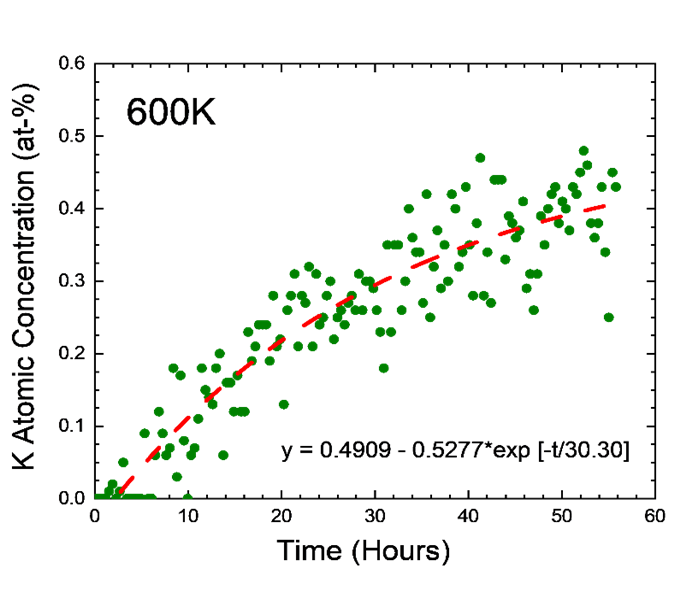
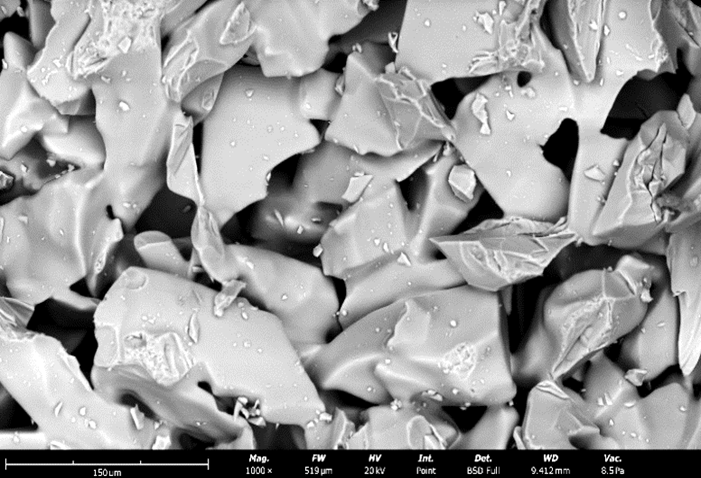
We have measured the rate of Na and K diffusion through a porous regolith analog using X-ray photoelectron spectroscopy (XPS). For each measurement, alkali vapor was deposited onto the underside of a puck-shaped quartz glass frit using an alkali metal evaporator, and the atomic concentration was measured. After this, the frit was flipped to monitor the Na/K concentration on the top surface while the bottom of the frit was held at a constant temperature between 300 and 700 K. The high-purity quartz frits used in these experiments are commercial porous filters composed of sintered quartz-glass beads, with puck thickness ranging from 2 to 3 mm and pore sizes ranging from 16 to 40 microns (porosity ~ 53%). (Fig. 1). For initial Na and K surface concentrations of 3.1 at-% and 19 at-%, respectively, on the underside of the frit, we found the rate of diffusion through the frit at 600 K to follow an exponential curve: y = 1.16 – 1.06*exp [-t/163] at-% for Na and y = 0.4909 - 0.5277*exp [-t/30.30] at-% for K. It is notable that diffusion appears to start immediately with heat exposure – before the initial measurement can be acquired (~ 25 min) for Na – leading to a positive y-intercept for both species. Additionally, the time constant – a measure of the rate to reach an equilibrium surface concentration via diffusion – is 5.4x larger for Na than K in this preliminary data set; this implies that the Na concentration at the surface will continue increasing to its equilibrium value for a longer period than K, suggesting a slower diffusion rate. This rather surprising result will be investigated at additional temperatures to confirm.  


Acknowledgements: This research was supported by the International Space Science Institute (ISSI) in Bern, through ISSI International Team project 'Multi-scale Understanding of Surface-Exosphere Connections (MUSEC)' 

References: 

Gamborino et al. 2019, Ann. Geophys., 37, 455–470. 

Killen and Morgan 1993, J. Geophys. Res., 98, E12, 23589–23601. 

Killen et al. 2007, Space Sci Rev 132, 433–509. 

Leblanc and Johnson 2003, Icarus, 164, 261-281. 

Leblanc & Johnson 2010, Icarus, 209, 2, 280-300. 

Millano et al. 2021, Icarus, 355, 114179.    

Schmidt et al. 2020, Planet. Sci. Journal, 1, 14. 

Sprague 1990, Icarus, 84, 1, 93-105. 

Verkercke et al. 2024, Geophys. Res. Lett., 51, e2024GL109393. 

Fig 1. Front face of a quartz disc-shaped frit, where sintered glass particles form irregular channels of 16-40 microns. The image horizontal field width is 519 microns. Alkali atoms are deposited at room temperature on the bottom face of the frit (radius: 5 mm; depth: 2.5 mm), diffusing isothermally through the channels to reach the front face. We monitor the frit front face Na concentration as a function of time, at constant temperature.

Fig. 2. [Left] Elemental concentrations are shown for K vs. time at 600K on the top surface of a porous quartz frit (16-40 um pore dia.) after vapor deposition onto the opposite (bottom) surface. K appears to grow asymptotically on the top surface of the frit over time. [Right] Na increases monotonically at 600K through a similarly specified quartz frit. Both curves are fit with a function of the form y = y0 + A exp ( -t/τ ) utilizing parameters provided in each figure and discussed in the text. 

How to cite: Dukes, C. A. and Woodson, A. K.: Measurement of Na and K Diffusion through Hermean Regolith Analogs, Europlanet Science Congress 2026, The Hague, The Netherlands, 7–11 Sep 2026, EPSC2026-1208, https://doi.org/10.5194/epsc2026-1208, 2026.