
 1,2,3,3
- 1National Institute for Astrophysics, Italy, Osservatorio Astronomico di Trieste, Trieste, Italy (stavro.ivanovski@inaf.it)
- 2National Institute for Astrophysics, Italy, Osservatorio Astronomico di Padova, Padova, Italy
- 3Museum fur Naturkunde – Leibniz Institute for Evolution and Biodiversity Science, Berlin, Germany
Introduction. This work is carried out within the framework of the LUMIO (Lunar Meteoroid Impact Observer) mission, an ESA 12U CubeSat aimed at detecting and characterizing meteoroid impacts on the lunar far side [1,2]. From a quasi-halo orbit around the Earth–Moon L2 point, LUMIO uses the LUMIO-Cam instrument to observe impact flashes in the visible and near-infrared, enabling estimation of radiated and kinetic energy through luminous efficiency and providing constraints on the meteoroid flux.
To interpret these observations, it is essential to model the evolution of ejecta clouds generated by hypervelocity impacts and to assess the influence of material properties and vaporization processes.
Methods. We conduct numerical simulations using the LIMARDE code to study the dynamical evolution of ejecta clouds generated by impacts. The simulated regolith properties are defined consistently with numerical impact studies, where the lunar surface is represented as a porous regolith layer with properties varying depending on mechanical conditions. Impact conditions are not prescribed analytically, but are derived from the outputs of iSALE shock physics simulations, which provide physically consistent ejecta velocity distributions and material responses following hypervelocity impacts. In addition, thermodynamic processes are incorporated by modeling partial vaporization of the regolith, which generates a transient gas plume characterized by velocities of several hundred m/s and short characteristic timescales.
Simulations are conducted for different materials and configurations, including cases with and without vaporization. Dust grains are modeled as non-spherical axially symmetric particles with characteristic sizes of ~50 μm and ~100 μm, and densities of 2700 kg/m³ for plagioclase and 3450 kg/m³ for pyroxene [3,4].
Results. We performed simulations of the initial ejecta distribution produced by an impact crater of approximately 30 m in radius, considering two dust particle cases corresponding to pyroxene and plagioclase. The particle sizes are constrained by observed lunar regolith morphology, spanning typical grain distributions from equatorial to polar regions.
The simulations provide the spatial distribution of deposited particles on the lunar surface as a function of distance from the crater, as well as the influence of vaporization processes.
Figure 1 shows the number of particles deposited as a histogram of radial distance from the crater center, considering a vaporization phase lasting approximately 1 s after the impact (which can be considered as an upper limit). We simulate the vaporization process as resulting from the melting of lunar surface material, using the following meteoroid impact scenario: a 30 cm meteoroid with a density of 2900 kg/m³ impacting at a velocity of 21 km/s.
The results indicate that a significant fraction of the ejecta is deposited relatively close to the impact site, with about 40% of the particles settling within 8 km. Over the full simulation duration of 10 minutes, less than 10% of the particles remain in motion, and no particles reach or exceed the lunar escape velocity.
Figure 2 illustrates the variation in particle velocities after the vaporization phase has ended. Both accelerated and decelerated particles are observed, reflecting the interaction with the transient gas plume. However, deceleration affects approximately 30% of particles in the plagioclase case and about 40% in the pyroxene case.
These results show that vaporization influences the redistribution of ejecta and that variations in material properties contribute to constraining the thickness of the deposition layer as a function of the impactor characteristics and the resulting crater size.
Future Work. We would like to investigate the deposition of lunar dust in polar regions and to study ejecta timescales. In addition, future work will focus on constraining the most plausible composition of the particles involved in the thermodynamical processes responsible for generating lunar impact flashes.
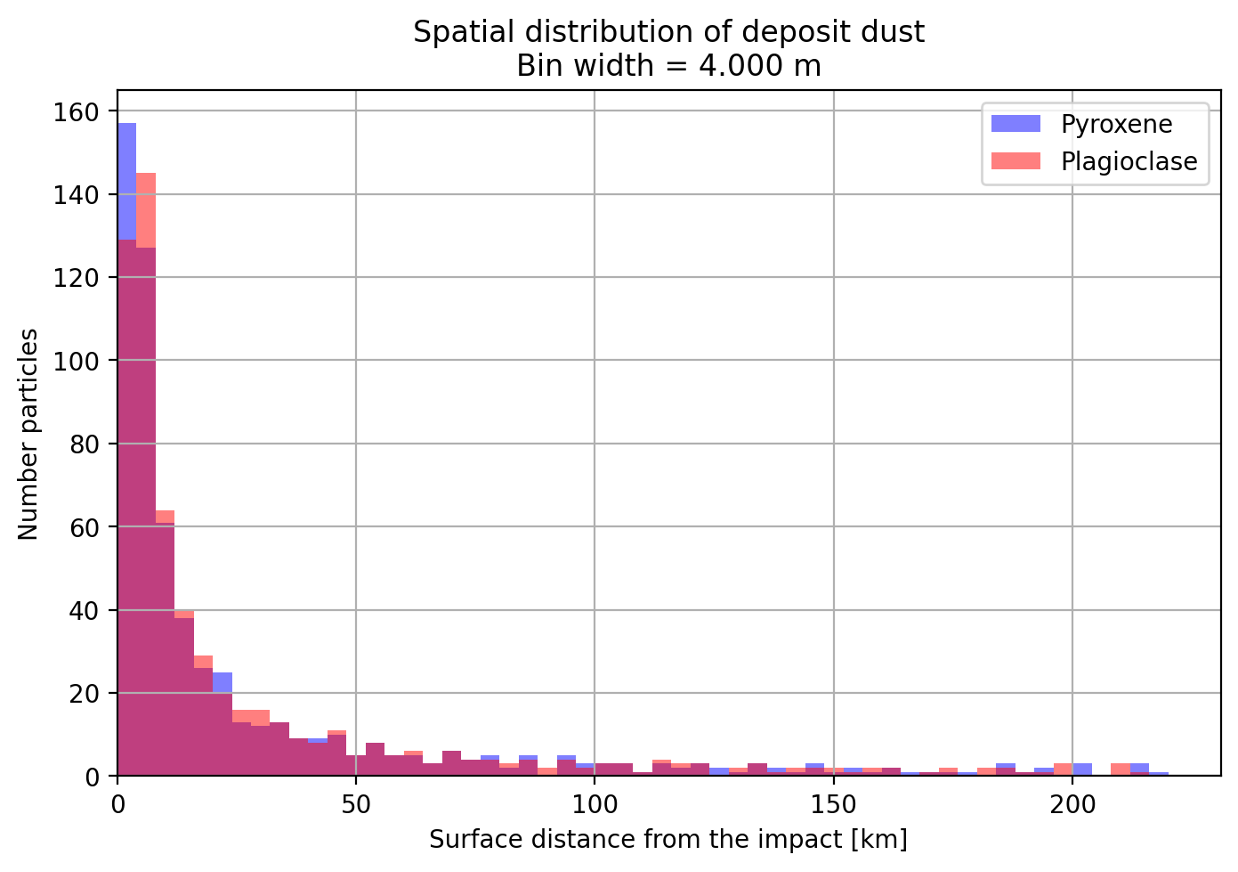
Fig. 1. Deposited particle distribution of pyroxene and plagioclase in the lunar ejecta LIMARDE simulations. The vaporization phase lasts approximately 1 s, while the total simulation duration is 10 minutes.
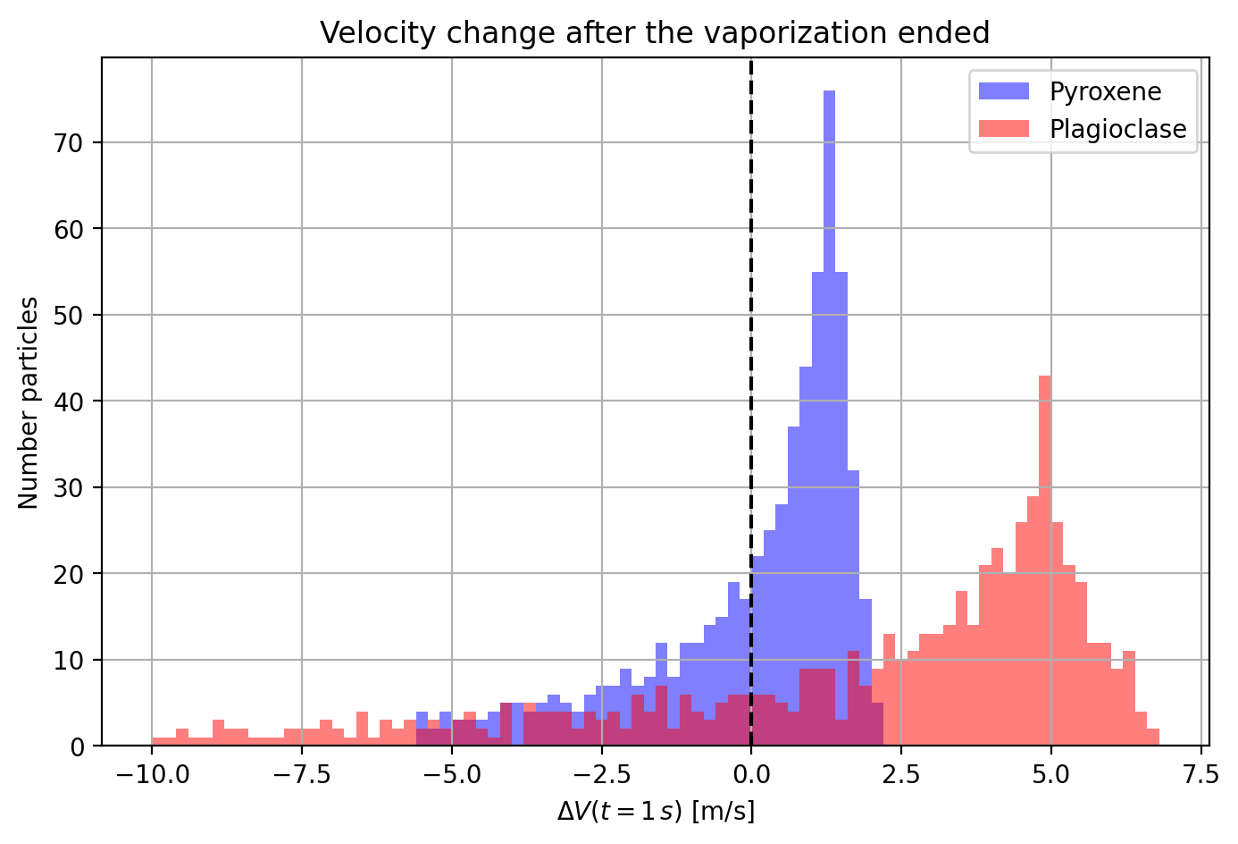
Fig. 2. Acceleration and deceleration of the two types of particles (pyroxene and plagioclase) resulting from the vaporization process following the impact.
[1] Cipriano, A., et al. (2018). LUMIO: Lunar Meteoroid Impacts Observer. Frontiers in Astronomy and Space Sciences.
[2] Topputo, F., et al. (2023). LUMIO mission design and operations. Icarus.
[3] Qin, L., Yue, Z., Gou, S., Zhang, Y., Wei, G., Shi, K., Zhang, X., & Yang, B. (2025). Structure and Formation Mechanism of Lunar Regolith. Space Science & Technology, Article 0219.
[4] Yu, S., Yu, M., Xiao, X., Huang, J., & Xiao, L. (2025). Thermophysical Properties of Lunar Regolith Revealed by Thermal-Infrared Observations of the LRO Diviner Radiometer. The Astrophysical Journal.
Acknowledgements. This work was supported by the Italian Space Agency (ASI) within the LUMIO project (ASI-PoliMi agreement n. 2024-6-HH.0).
How to cite: Ivanovski, S. L., Calderone, L., Martellato, E., Rice, P., and Luther, R.: Modeling Lunar Impact Ejecta with Vaporization under Hypervelocity Meteoroid Impacts, Europlanet Science Congress 2026, The Hague, The Netherlands, 7–11 Sep 2026, EPSC2026-1230, https://doi.org/10.5194/epsc2026-1230, 2026.


