
 1,2,1,
- 1National Institute for Astrophysics (INAF), Trieste Astronomical Observatory, Trieste, Italy (paolo.simonetti@inaf.it)
- 2National Institute for Astrophysics (INAF), Turin Astrophysical Observatory, Turin, Italy
- 3National Institute for Astrophysics (INAF), Institute for Astrophysics and Space Planetology, Rome, Italy
- 4Italian Space Agency (ASI), Rome, Italy
INTRODUCTION:
Elemental abundances are central in characterizing the formation and evolution history of giant exoplanets [1,2,3]. Among them, O and C are the most easily accessible due to being carried largely by relatively abundant and very infrared-opaque carriers such as H2O, CO and CH4 [e.g. 4]. However O, being a very reactive element, is expected to be partially sequestered in species difficult to observe and/or in condensates [5]. Chemical modeling is required to correct for this unseen component, called oxygen deficit [6].
Chemical kinetics models capable of including vertical and/or horizontal dynamics, condensation, sedimentation and photochemistry are the best positioned to further our knowledge of exoplanetary atmospheres [7,8]. While most of the work is focused on building detailed and reliable CHON networks [9], research is underway to include the most abundant refractory elements (Mg, Si and Fe) within a disequilibrium framework [10,11].
MODEL:
Here, we present a new chemical network network to study the main Mg, Si and Fe carriers in the atmospheres of gas giants in the [700, 1600] K range of equilibrium temperatures. It is built upon the SNCHO network of the widely used Vulcan code [12] and it includes a simplified treatment of the formation and destruction of the two main silicates, enstatite and forsterite.
RESULTS:
We applied our new network to study the partition of oxygen in a vertically mixed, Solar-composition atmosphere. Figure 1 shows that vertically mixed (Kzz=10^8 cm2 s-1, solid lines) atmospheres are expected to free oxygen from enstatite and forsterite, here reported collectively as MgSiOx, at a substantially lower equilibrium temperature with respect to atmospheres in chemical equilibrium (dotted lines). This means that the oxygen deficit expected at chemical equilibrium is substantially higher in the [900,1300] K equilibrium temperature interval. Si, which in a mixed atmosphere is not entirely tied in condensed form, can then form SiH4, enhancing its volume mixing ratio to ≳ 10^-7 in the upper atmosphere for planets at the warm/hot class interface (Teq=1000 K), as shown in Figure 2. In the same equilibrium temperature range, SiH4 can be also used as a sensitive tracer of the vertical mixing intensity, that can then be used to refine the VMR estimates of other chemical species. The network has also been applied to the case of the young wide-orbit giant planet YSES-1c [13], showing that the atmosphere is likely very well-mixed in the vertical direction.
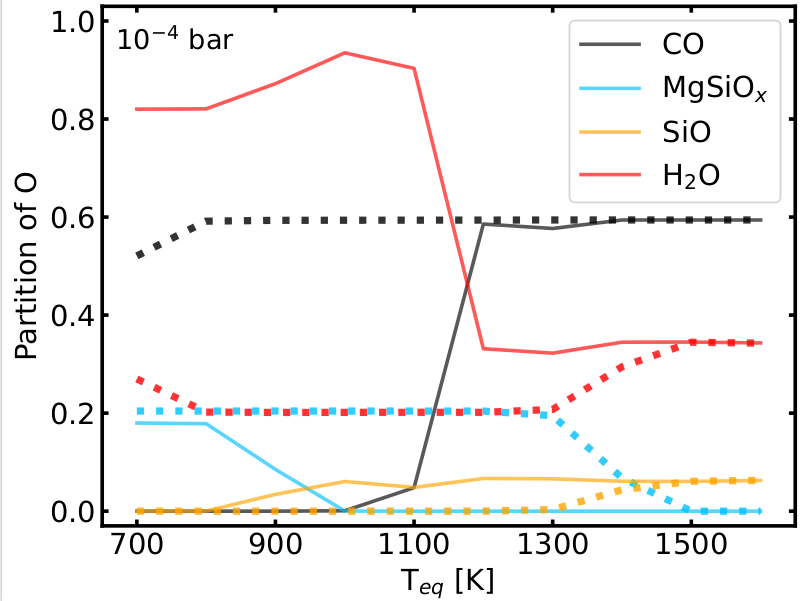
Figure 1: oxygen partition among its main carriers at the 0.1 mbar level of a Solar-composition atmosphere. Solid: mixed atmosphere. Dotted: equilibrium atmosphere.
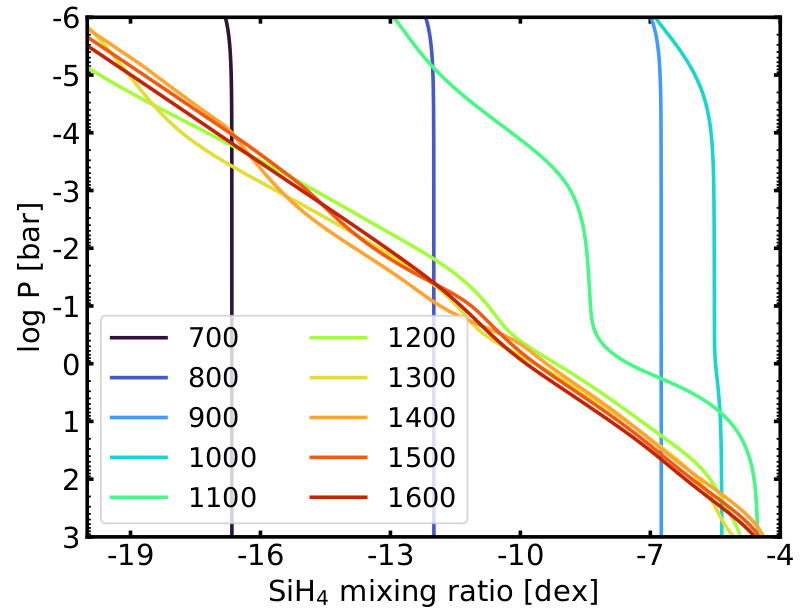
Figure 2: vertical volume mixing ratio profile of SiH4 in a mixed, Solar-composition atmosphere.
BIBLIOGRAPHY:
[1] Oberg et al. (2011), ApJ, 743, 16.
[2] Turrini et al. (2021), ApJ, 909, 40.
[3] Pacetti et al. (2022), ApJ, 937, 36.
[4] https://research.iac.es/proyecto/exoatmospheres/index.php
[5] Fegley & Schaefer (2010) in Principles and Perspectives in Cosmochemistry
[6] Fonte et al. (2023), MNRAS, 520, 4683.
[7] Venot et al. (2012), A&A, 546, 43.
[8] Mukherjee et al. (2024), ApJ, 963, 73.
[9] Veillet et al. (2024), A&A, 682, 52.
[10] Kiefer et al. (2024), A&A, 682, 150.
[11] Agundez (2025), A&A, 699, 306.
[12] Tsai et al. (2021), ApJ, 923, 264.
[13] Hoch et al. (2025), Nature, 643, 938.
How to cite: Simonetti, P., Turrini, D., Ivanovski, S., Schisano, E., Fonte, S., Molinari, S., Pacetti, E., Politi, R., Polychroni, D., Zusi, M., and Cottini, V.: A VULCAN-ready chemical kinetics network for gas giants including magnesium, silicon and iron, Europlanet Science Congress 2026, The Hague, The Netherlands, 7–11 Sep 2026, EPSC2026-1231, https://doi.org/10.5194/epsc2026-1231, 2026.


