
 1,1,1,2,1
- 1Istituto Nazionale di Astrofisica (INAF) - Osservatorio Astronomico di Padova (OAPd), Italy
- 2INAF-IAPS, Institute for Space Astrophysics and Planetology, Rome, Italy
Introduction: On Mars, various geomorphological and geological processes leave behind distinct morphological evidence on the surface, providing insights into Mars's history (Carr and Head, 2010). However, the understanding of the origin of such features is often perplexing and challenging, especially when different geological processes are interlinked, reinforced, or modified through interactions over time. Various hypotheses and studies exist connecting lava/magma interactions with water and subsurface ice to the origins of volcanic features in general, such as Volcanic Rootless Cones (VRCs) (Edwards et al., 2012; Hamilton et al., 2011; Marcucci et al., 2017; Pieterek and Jones, 2026). Though connecting lava cum impact crater ejecta materials with surface ice melting for the formation of sinuous discontinuous morphological features remains unexplored and not characterised properly on the surface of Mars. This study identifies such features to the south of Daedalia Planum and involves 1) the geomorphic mapping, 2) regional geomorphic characterisation of the landforms, 3) the chronology of geomorphic units and age dating of rampart craters, 4) Mineralogical analysis of CRISM tiles, and 5) Interconnecting inferences of the morphological features with various geomorphic processes observed.
Data and Methods: In this study, the global high-resolution MRO-CTX mosaic (V01 release) images (Dickson et al., 2024), HiRISE (McEwen et al., 2007), ExoMars TGO-CaSSIS color cubes (Thomas et al., 2017), and MO-THEMIS Day/Night images (Christensen et al., 2004) were used for morphological analysis. The MRO-CRISM Hyperspectral TRDRs tiles (Murchie et al., 2007) were utilized for mineralogical analysis, while the MGS-MOLA (Smith et al., 2001), MEX-HRSC (Jaumann et al., 2007), and CaSSIS DTMs (Thomas et al., 2017) were used for topographical analysis.
Results and discussions: Daedalia Planum, predominantly known for its lava flows (Giacomini et al., 2012), also preserves well-documented glacial deposits (Schon and Head, 2012). We observed the presence of layer ejecta or Rampart craters, and the glacial evidence, such as Lineated Valley Fills (LVFs), Ring Mold craters (RMCs), Pitted terrain patterns, ice-sublimation scarps within them, provides substantial evidence for subsurface ice presence in the region, along with other surface processes (Mangold, 2011). Interestingly, such sinuous features are more often found in the proximity of layered ejecta craters and short-lived wide fluvial channels within the region of interest encompassing three volcanic Mons and episodes of lava flows. Among those features within the same volcanic ice interactions mapped unit, we observe the presence of possible Volcanic Rootless Cones (Pieterek and Jones, 2026) in the southern extent of the study area, emphasizing more the role of lava and subsurface ice interactions. A localised presence of an inverted fluvial channel gives more clues on the past water activity (Liu et al., 2021), and the role of differential erosion processes of the indurated channel material owing to the lava-filled induration mechanism (Burr et al., 2010), provided its proximity to the Mons. The Chronology of volcanic ice interaction units indicates a Late Noachian to Early Hesperian period, possibly linking either to ancient (sub)surface ice most likely to have been present at high altitudes during high obliquity cycles (Wordsworth et al., 2013), and age dating of rampart craters reveals 3.4 Gya, further supporting the evidence of potential buried ice layers (Boyce and Mouginis-Mark, 2025). In addition to these, the CRISM (Compact Reconnaissance Imaging Spectrometer for Mars) mineralogical analysis of the rampart crater wall shows an active H20 ice spectral signature as per spectral parameters of (Viviano et al., 2014; Harish et al., 2020), emphasizing the ice/frost activity in the region. Further extended CRISM mineralogical analysis in the intra-crater deposits reveals the presence of phyllosilicates, precisely the hydrous mineral Mg-smectite spectral signature, which substantiates strong aqueous activity.
Conclusion: The morphological record of these interactions preserved in various morphological processes, glacio-volcanic landforms, lava-filled plains, and intra-crater deposits offers a critical understanding of Early Mars to the present. Thus, delivering new insights on interactions of Ice, lava, or impact ejecta-driven surface morphology on Mars.
Acknowledgement: This work has been developed under the ASI-INAF agreement n. 2024-40-HH.0
References:
Boyce, J. M. and Mouginis-Mark, P. J.: Icarus, 425, 116336, doi:10.1016/j.icarus.2024.116336, 2025.
Carr, M. H. and Head, J. W.: Earth Planet. Sc. Lett., 294, 185–203, doi:10.1016/j.epsl.2009.06.042, 2010.
Christensen, P. R., et al.: Space Sci. Rev., 110, 85–130, doi:10.1023/B:SPAC.0000021008.16309.94, 2004.
Dickson, J. L., et al.: Earth Space Sci., 11, e2024EA003555, doi:10.1029/2024EA003555, 2024.
Edwards, B., et al.: J. Geophys. Res., 117, 2011JB008985, doi:10.1029/2011JB008985, 2012.
Giacomini, L., et al.: Icarus, 220, 679–693, doi:10.1016/j.icarus.2012.06.010, 2012.
Hamilton, C. W., et al.: J. Geophys. Res., 116, E03004, doi:10.1029/2010JE003657, 2011.
Jaumann, R., et al.: Planet. Space Sci., 55, 928–952, doi:10.1016/j.pss.2006.12.003, 2007.
Liu, Z., et al.: Earth Planet. Sc. Lett., 562, 116854, doi:10.1016/j.epsl.2021.116854, 2021.
Mangold, N.: Geomorphology, 126, 1–17, doi:10.1016/j.geomorph.2010.11.009, 2011.
Marcucci, E. C., et al.: Bull. Volcanol., 79, 89, doi:10.1007/s00445-017-1176-y, 2017.
McEwen, A. S., et al.: J. Geophys. Res., 112, E05S02, doi:10.1029/2005JE002605, 2007.
Mouginis‐Mark, P. J. and Baloga, S. M.: Meteorit. Planet. Sci., 41, 1469–1482, doi:10.1111/j.1945-5100.2006.tb00430.x, 2006.
Murchie, S., et al.: J. Geophys. Res., 112, E05S03, doi:10.1029/2006JE002682, 2007. [1]
Pieterek, B. and Jones, T. J.: npj Space Explor., 2, 15, doi:10.1038/s44453-026-00031-2, 2026.
Schon, S. C. and Head, J. W.: Earth Planet. Sc. Lett., 317–318, 68–75, doi:10.1016/j.epsl.2011.09.005, 2012.
Smith, D. E., et al.: J. Geophys. Res., 106, 23689–23722, doi:10.1029/2000JE001464, 2001.
Thomas, N., et al.: Space Sci. Rev., 212, 1897–1944, doi:10.1007/s11214-017-0421-1, 2017.
Viviano, C. E., et al.: J. Geophys. Res.-Planets, 119, 1403–1431, doi:10.1002/2014JE004627, 2014.
Weiss, D. K. and Head, J. W.: Icarus, 233, 131–146, doi:10.1016/j.icarus.2014.01.038, 2014.
Wordsworth, R., et al.: Icarus, 222, 1–19, doi:10.1016/j.icarus.2012.09.036, 2013.
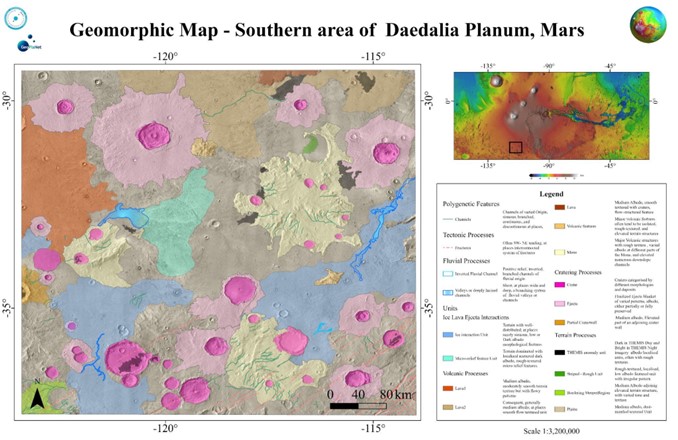
Fig 1: The Geomorphic Map of the study area, Daedalia Planum, Mars.
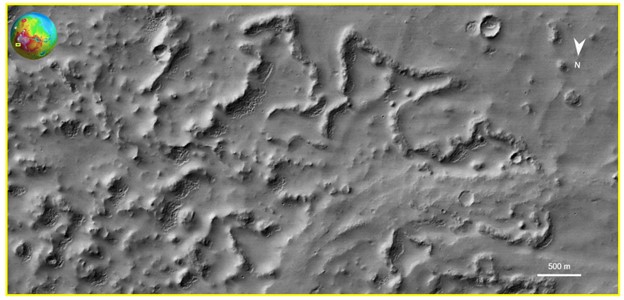
Fig 2: The possible morphological evidence of Ice, lava, and impact ejecta interactions
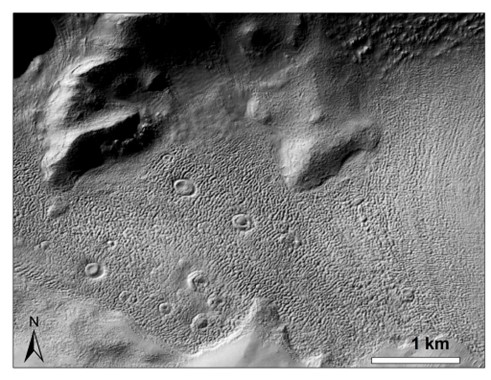
Fig 3: Some of the glacial evidence observed: Ring Mold Craters (RMCs) on Lineated Valley Fill (LVF) within a crater in the study area.
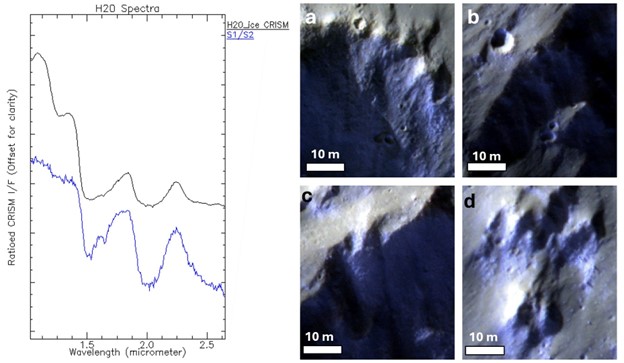
Fig 4: H2O ice spectra observed on a rampart crater ejecta
How to cite: Umar Baig, T., Bertoli, S., Re, C., Tullo, A., Cremonese, G., Baschetti, B., and Costa, N.: New insights on interactions with Ice, lava, and impact ejecta in Daedalia Planum, Mars, Europlanet Science Congress 2026, The Hague, The Netherlands, 7–11 Sep 2026, EPSC2026-1236, https://doi.org/10.5194/epsc2026-1236, 2026.


