
 1,2,2,3,
- 1Department of Physics and Geology, University of Perugia, I-06100 Perugia, Italy
- 2Univ. Grenoble Alpes, CNRS, IPAG, 38000 Grenoble, France
- 3Dipartimento di Scienze Fisiche, della Terra e dell’Ambiente (DSTA), University of Siena, Via Laterina, 8, 53100 Siena, Italy
Introduction:
The most common type of rock present ont he surface of terrestrial planets in the Solar System are volcanic-magmatic rocks, which are constituted by lava flows and fragmented pyroclasts whose texture presents both glassy and crystalline silicate phases.
Planet Mars is, besides the Earth, the most diverse terrestrial planet in the Solar System, presenting magmatic rocks with compositions ranging from ultramafic/basaltic to alkaline/trachy-andesitic [1].
Understanding the influence that chemical composition and different phases (both crystalline and amorphous) have on the spectral response of volcanic rocks is pivotal to interpret remotely sensed spectra that are commonly used to interpret the geology of terrestrial planets. Thus, we synthesized Martian simulants with two putative Martian compositions, on which we performed cooling experiments together with a rheological, mineralogical and spectral characterization in order to provide reference to interpret the geological processes that have occurred on Mars.
Methods:
Samples were created by mixing powdered oxides to mimic the composition (Table 1) of volcanic products from Gusev and Gale craters, as they were hypothesized from data belonging to different missions [1].
Table 1: Composition of the starting materials accounted
|
|
Gusev |
Gale |
|
SiO2 |
47.33 |
52.04 |
|
TiO2 |
0.57 |
0.66 |
|
Al2O3 |
11.19 |
15.83 |
|
FeO |
19.12 |
10.89 |
|
MnO |
0.42 |
0.18 |
|
MgO |
10.29 |
4.44 |
|
CaO |
8.17 |
6.76 |
|
Na2O |
2.76 |
7.06 |
|
K2O |
0.14 |
2.14 |
The powders were molten at 1450°C to form a silicate melt, which were then quickly cooled to produce glasses. Then, for each of the produced glasses three cooling experiments were conducted in a Gero HTRV 70-250/18, equipped with Anton Paar rheometer [see 2 for reference]. Powdered glass was brought to superliqidus temperature and, after having reached the equilibrium, it was cooled down at a 100°C/h rate to crystallize. Crystallization was monitored through the measurement of viscosity during cooling, so that thre phases were individuated and samples: the point at which crystals start nucleating, the point at which crystal were grown and a final point of advanced crystallization where viscosity was not measurable anymore due to extreme rigidity of the samples (see arrows in Fig. 1).
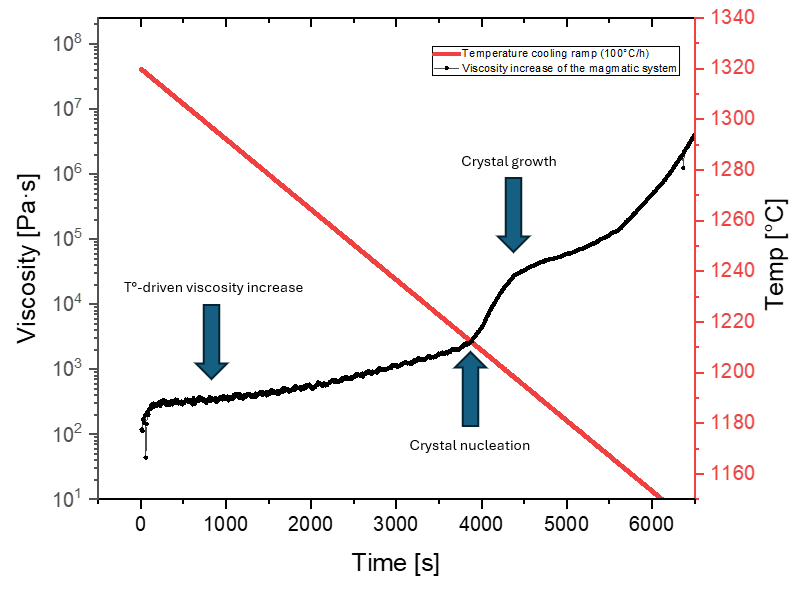
Figure 1: Example of Viscosity path duting cooling for Gale simulant. Arrows indicate stages at which experiments were stopped.
The synthesized samples were analyzed using X-ray powder diffraction (XRPD), and quantitative phase analysis (QPA) was performed using the Rietveld profile fitting method with internal standards to determine amorphous content.
Spectral analyses:
Reflectance spectra were collected at the Cold Surface Spectroscopy (CSS) facility (https://cold-spectro.sshade.eu) located at the Institut de Pla-nétologie et d'Astrophysique (IPAG), Grenoble, France. The instrument used was the SHINE Spec-tro-Gonio Radiometer. The instrument is equipped with a cryogenic simulation chamber, CarboN-IR, to control the temperature of the samples. Spectra were collected in the 1-4.2 μm spectral range at different low temperatures between 105 and 290 K. The sample is cooled to a given temperature and then held for about 5–10 min to wait for thermal equilibrium and then during the measurement time, about 65–80 min depending on some acquisition parameters. We kept each sample for 70–90 min at a given temperature before starting our measurements.
Future perspectives:
Spectral characterization at low temperature is currently ungoing and will shed light on the influence of temperature on the detection of silicate phases. Preliminary spectral investigations suggest us that for samples with identical bulk chemical composition but different mineralogical assemblage, the spectral response within Visible and Near InfraRed (VNIR) and mid-infrared (MIR) is deeply different. VNIR spectra are influenced by the nucleation of iron-related phases whereas MIR spectra are dependant on Si-bearing phases. The mechanism influencing the shape of spectra results in fact from a complex interaction of the spectral response of different mineral/amorphous phases. In this way, the shape is easily misinterpreted as the features of the different phases which are often no longer recognizable. A thorough analysis helped us to understand which are the features that can be accounted for the interpretation of this kind of igneous materials, but a more comprehensive study on different compositions is needed for a complete assessment of this approach.
References:
[1] McSween Jr, H. Y. (2015). Petrology on mars. American Mineralogist, 100(11-12), 2380-2395.
[2] Vetere, F., Petrelli, M., Perugini, D., Haselbach, S., Morgavi, D., Pisello, A., ... & Holtz, F. (2021). Rheological evolution of eruptible Basaltic-Andesite Magmas under dynamic conditions: The importance of plagioclase growth rates. Journal of Volcanology and Geothermal Research, 420, 107411.
Additional Information: This work was carried on thanks to ASI-UniPG agreement 2019-2-HH.0 and in the framework of Trans-National Access research project selected and funded by Europlanet-2024 RI (European Union’s Horizon 2020 RI under grant agreement No. 871149). We also acknowledge the support from MUR in the framework of SUPER-C, ‘Dipartimento di Eccellenza 2023-2027’.
How to cite: Pisello, A., Maximiliano, F., Bernard, S., Pierre, B., Olivier, P., Francesco, V., Paola, C., and Diego, P.: Martian Simulants for Gusev and Gale craters igneous products: rheological, mineralogical and spectral characterization. , Europlanet Science Congress 2026, The Hague, The Netherlands, 7–11 Sep 2026, EPSC2026-1266, https://doi.org/10.5194/epsc2026-1266, 2026.


