
 ,,
,,- International Research School of Planetary Sciences. Università degli studi "G. d'Annunzio", Pescara, Italy
Introduction
High-resolution Digital Terrain Models (DTMs) derived from HiRISE stereo observations are fundamental for the geomorphological analysis of the Martian surface, enabling meter-scale investigation of slopes, sedimentary bodies, aeolian landforms, impact-related features and candidate exploration terrains [1]. Open-source workflows based on ISIS and the NASA Ames Stereo Pipeline (ASP) have made HiRISE DTM generation broadly accessible to the planetary science community [2,3]. Since 2023, however, the intermittent failure of the RED4 CCD has produced a central data gap in many recent HiRISE observations. Because RED4 lies near the center of the focal plane (Figure 1), its loss disrupts CCD mosaicking, tone balancing and stereo processing more severely than edge-CCD losses, often causing standard pipelines to fail at the mosaicking or stereo-preparation stage. The HiRISE team has recently introduced a mitigation strategy [4] in which the overlapping IR10 CCD is radiometrically matched to the surrounding RED data and inserted in place of the missing RED4 as a synthetic component, named SYN4. Previous HiRISE stereo work has shown that these DTMs support ultrahigh-resolution topographic mapping and analyses of active Martian surface processes [5,6], while the September 2024 HiRISE/PDS release explicitly notes both the RED4 failure and the planned use of IR10 data to fill the gap for selected products [7]. While effective, this approach has so far been implemented within selected internal HiRISE pipelines and is not yet integrated into the openly available ASP/ISIS chain on which most external users rely.
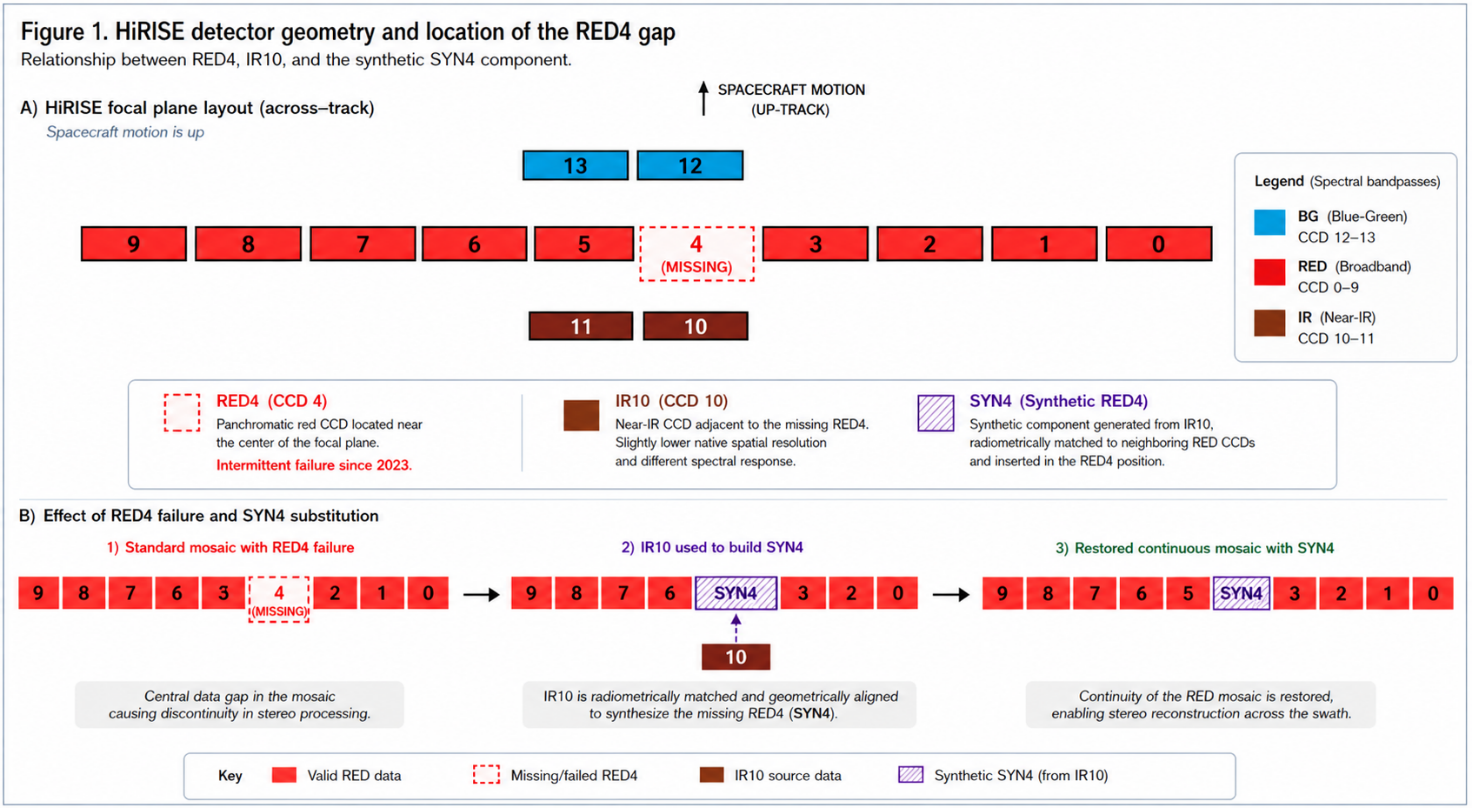
Figure 1: HiRISE focal plane detector geometry and location of the RED4 gap. Relationship between RED4, IR10 and synthetic SYN4 component.
A RED4-aware ASP workflow
We present an adaptive HiRISE stereo processing workflow that integrates the SYN4/IR10 concept into a fully open-source ASP/ISIS chain. The workflow follows the standard sequence of image preparation, bundle adjustment, stereo correlation, point-cloud generation, DEM extraction and co-registration to reference topography, but introduces an automatic preprocessing step that checks the availability of RED4 for each input observation. When RED4 is missing, the workflow activates an IR10-based fallback prior to CCD mosaicking: IR10 is radiometrically matched to the adjacent RED CCDs and ingested as a SYN4 substitute, restoring the continuity of the RED mosaic before stereo reconstruction proceeds. This preserves the usability of stereo pairs that would otherwise fail at the mosaicking stage and keeps the rest of the chain unchanged, ensuring full reproducibility.
Test cases and validation
The workflow was tested on two HiRISE stereo pairs acquired in 2025 in Arabia Terra: ESP_088933_2200 / ESP_089012_2200 (convergence angle 28.0°) and ESP_089500_2200 / ESP_089645_2200 (convergence angle 12.4°). The two pairs were selected to evaluate the workflow under contrasting stereo geometries, an ideal high-convergence case and a marginal low-convergence case below the nominal HiRISE threshold. Both pairs were processed through the full pipeline, producing continuous DTMs across the RED4 gap with no visible seams or correlation drop-outs along the SYN4 strips (Figure 2, left). Vertical consistency was assessed against an independent HRSC reference DTM, chosen because its different instruments, mission and processing chain provide a fully external benchmark. A topographic profile crossing the SYN4 strip shows close agreement between the HiRISE and HRSC datasets along the entire ~9 km transect, with no detectable offset or discontinuity at the SYN4 boundaries (Figure 2, right). The agreement holds for both pairs, indicating that the IR10-based reconstruction does not introduce systematic vertical artefacts within the gap region, even in the marginal convergence-angle case.
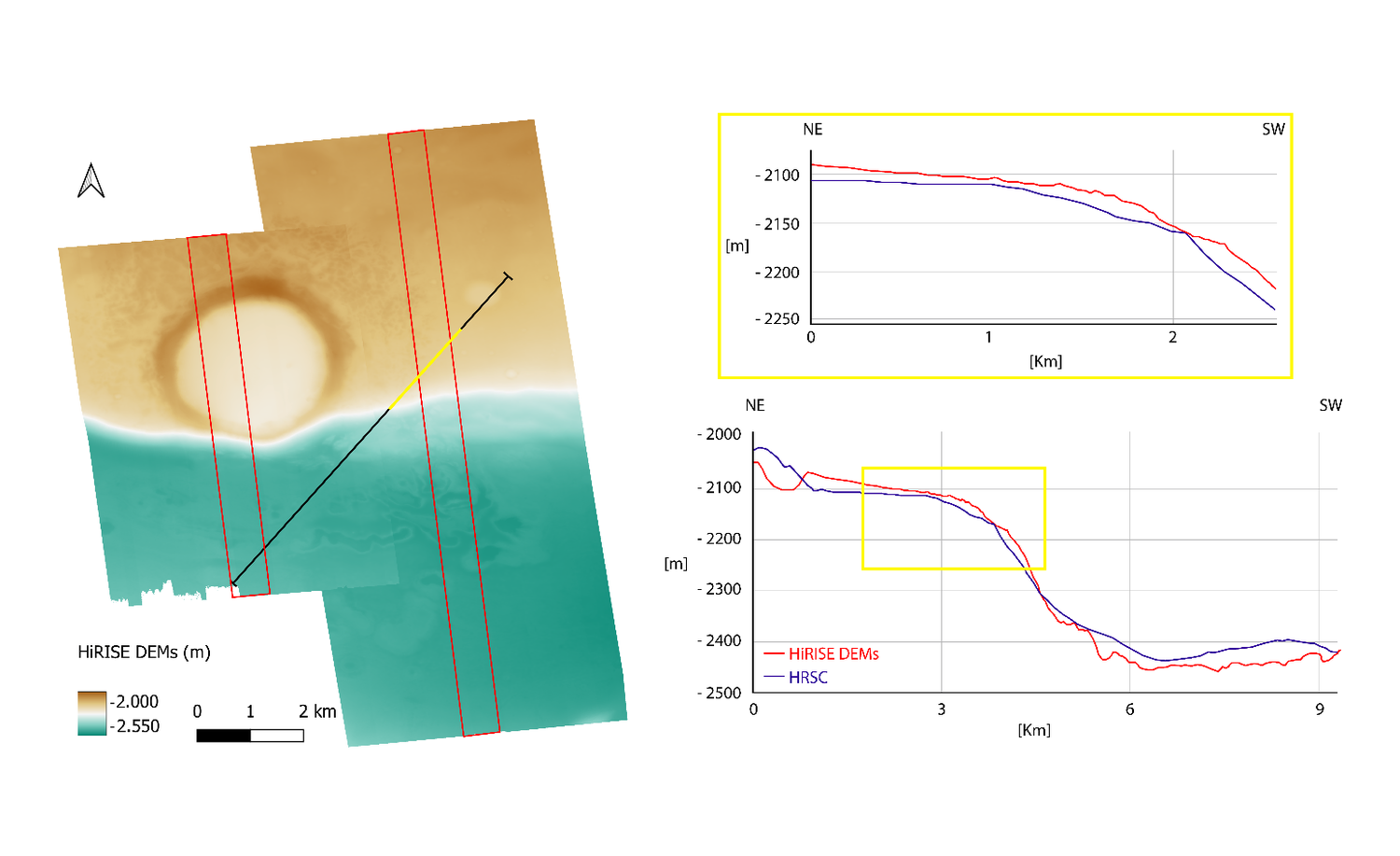
Figure 2: Validation of the RED4-aware HiRISE workflow in Arabia Terra (~39.9°N, 26.5°E). Left: HiRISE DTMs generated from the two test stereo pairs (ESP_089500_2200/ESP_089645_2200 and ESP_088933_2200/ESP_089012_2200); red rectangles outline the RED4 gap, reconstructed through the IR10/SYN4 substitution. The black line indicates the NE–SW topographic transect. Right: ~9 km topographic profile across the SYN4 strip, comparing the HiRISE DTM (red) with the independent HRSC reference DTM (blue). The yellow box marks the most critical portion of the transect across the reconstructed gap; this sector is shown in detail in the upper inset, highlighting the continuity of the HiRISE topography and its agreement with the HRSC reference across the SYN4 boundaries.
Conclusion
By integrating the SYN4/IR10 concept into an open-source ASP-based workflow, this work provides a practical and reproducible solution for recovering scientific value from RED4-affected HiRISE stereo observations. The independent HRSC validation confirms that the reconstructed topography is consistent with external reference data across the gap region.
References: [1] McEwen, A.S., et al., 2007. Journal of Geophysical Research: Planets, 112, E05S02. doi:10.1029/2005JE002605. [2] Hepburn, A.J., Holt, T., Hubbard, B. and Ng, F., 2019. Geoscientific Instrumentation, Methods and Data Systems, 8, 293–313. doi:10.5194/gi-8-293-2019. [3] Kirk, R.L., et al., 2008. Journal of Geophysical Research: Planets, 113, E00A24. doi:10.1029/2007JE003000. [4] Beyer, R.A., Alexandrov, O. and McMichael, S., 2018. Earth and Space Science, 5, 537–548. doi:10.1029/2018EA000409. [5] Sutton, S.S., et al., 2022. Remote Sensing, 14, 2403. doi:10.3390/rs14102403. [6] Sutton, S.S., et al., 2025. 56th Lunar and Planetary Science Conference, Abstract #2463. [7] HiRISE Operations Center, 2024. PDS Release: September 2024 Images. University of Arizona HiRISE.
How to cite: Mancini, F., Pondrelli, M., Pacifici, A., Aboudan, A., Salese, F., and Ori, G. G.: Mitigating the HiRISE RED4 CCD data gap in stereo DTM production: an adaptive workflow for high-resolution Martian DTM generation, Europlanet Science Congress 2026, The Hague, The Netherlands, 7–11 Sep 2026, EPSC2026-1270, https://doi.org/10.5194/epsc2026-1270, 2026.


