
 1,1,6,1
- 1NASA Ames Research Center, Moffett Field, CA, USA
- 2Bay Area Environmental Research Institute, Moffett Field, CA, USA
- 3ETH, Zurich, Switzerland
- 4University of California Berkeley, Berkeley, CA, USA
- 5Perdue University, West Lafayette, IN, USA
- 6School of Chemistry, University of Glasgow, Glasgow, UK
I. Introduction
Aerosols formed by photolysis and radiolysis in planetary atmospheres impact the atmospheric chemistry, the formation of clouds, the climate, the surface composition, and affect spectra observed by space telescopes (e.g., the James Webb Space Telescope—JWST, and the Hubble Space Telescope—HST) and missions (e.g., Cassini, New Horizons, Juno). Morphological, spectral, and optical properties, as well as the chemical composition of analogs of planetary haze particles are therefore critical to constrain radiative transfer, photochemical, microphysical, and global circulation models used to analyze and interpret observational data returned by past and current missions (e.g., JWST, HST, Cassini, New Horizons, Juno), as well as to help with the technological advancement of observational capabilities for future missions (e.g., Dragonfly, Habitable Worlds Observatory–HWO). In this work, we produced laboratory analogs of Pluto and Jupiter aerosols (‘tholins’) in the NASA Ames COsmic SImulation Chamber (COSmIC) from N2:CH4:CO (98.95:1:0.05) and Ar:NH3:CH4:H2 (86.4:2.8:0.8:10) gas mixtures, respectively, and characterized their morphological, spectral, and optical properties, as well as their elemental composition. Furthermore, we conducted ultraviolet/extreme ultraviolet (UV/EUV) irradiation experiments at the National Synchrotron Radiation Research Center(NSRRC) in Hsinchu, Taiwan, to investigate the impact of the irradiation on the physical and chemical properties of these tholins.
II. Methods
Production of Aerosol Analogs with the NASA Ames COSmIC facility COSmIC uses a pulsed discharge nozzle (PDN) to expand a gas mixture through a very thin slit (127 µm × 10 cm) hence cooling the gas down to 150 K and reducing the pressure to 30 mbar[1] . Chemistry, induced in the cooled gas by generating a pulsed plasma discharge in the stream of the expansion, results in the formation of larger molecular products and solid particles that can be deposited on various substrates depending on the type of ex situ analysis to be conducted next. Short experiments (1–4 hours) are run to obtain samples with scattered grain deposition, to enable Scanning Electron Microscopy (SEM) analysis of individual particles, statistical size distribution analysis, and morphology characterization[2]. Long experiments (up to 40 hours) are run to produce tholin samples with layers of grains forming films up to 1 µm thick for spectral and elemental composition analyses[2-4] . In this study, Pluto and Jupiter samples were produced for both the SEM and optical constants analyses. Because of the large width of the slit in the COSmIC PDN and the small size samples needed for our ex situ analyses, we could obtain up to 15 samples in one run.
UV/EUV Irradiation at the NSRRC
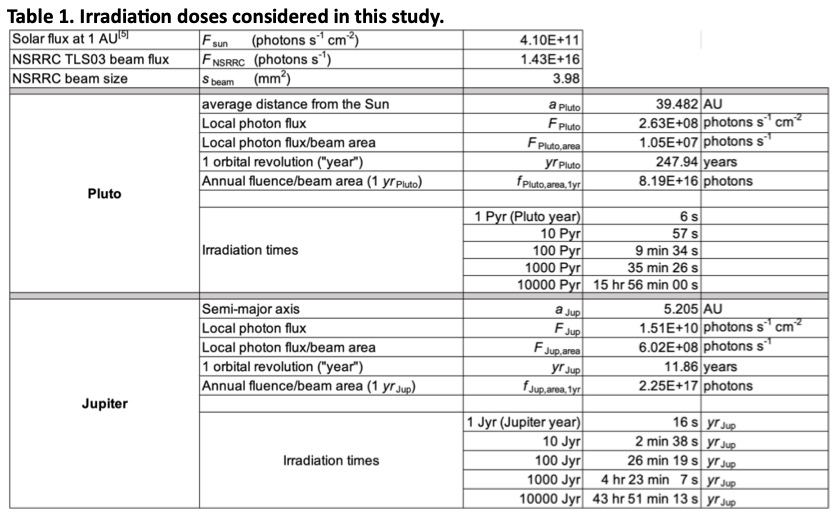
A subset of the Pluto and Jupiter tholins were irradiated with UV/EUV photons on NSRRC’s TLS03B beamline to study the impact of irradiation on their elemental composition and optical constants. Considering the solar flux expected to reach Pluto and Jupiter together with the known TLS03B beam photon flux and beam size, irradiation times were chosen to be equivalent to radiation doses of 1, 10, 100, 1000, and 10000 years on Pluto and Jupiter (see Table 1).
Sample Characterization:
For both the pristine Pluto and Jupiter tholins and the irradiated tholins, we characterized their morphological, spectral, and optical properties using SEM, as well asreflectance and transmission spectroscopy (from 0.4 up to 200 μm) with the NASA Ames Optical Constants Facility (OCF). We also characterized their elemental composition using X-ray absorption spectroscopy at NSRRC’s TLS20A beamline (carbon edge from 275 to 315 eV, nitrogen edge from 400 to 435 eV, and oxygen edge from 520 to 570 eV).
III. Results
Here we present the results of these ex situ analyses, show the impact of the irradiation on the tholins’ physical and chemical properties, and discuss the importance of providing these experimental data via the NanoGrain database (NGdb, nanograin.odr.io) and the Optical Constants database (OCdb, ocdb.smce.nasa.gov) for the science community to use for the analysis and interpretation of observational data.
Acknowledgements: E.S.O., L.J., C.L.R., and F.S. acknowledge funding from NASA SMD CSSO and LADWP ISFMs. M.N. and D.H.W. acknowledge funding from NASA SMD CSSO ISFM. L.S. acknowledges funding from grant No. 80NSSC25M7129. A.H. acknowledges internship funding from the NASA Office of STEM Engagement (OSTEM). The authors thank J. Koehne, J. Varelas, and D. Ruth for helping with SEM, and E. Quigley and M. Jordan for technical support.
References:
[1] Salama, F., et al. Proceedings IAU Symposium 332, 13, 364 (2018)
[2] Sciamma-O’Brien, E., et al. Icarus, 289, 214 (2017)
[3] Nuevo, M., et al. Icarus, 376, 114841 (2022)
[4] Sciamma-O’Brien, E., et al. Planet. Sci. J., 4, 121 (2023)
[5] Gladstone, G. R., et al. Icarus, 246, 279 (2015)
How to cite: Sciamma-O'Brien, E., Jovanović, L., Nuevo, M., Ricketts, C. L., Wooden, D. H., Drant, T., Homyk, A., Destidar, A., Scovel, L., and Salama, F.: Impact of UV Irradiation on the Physicochemical Properties of Pluto and Jupiter Atmospheric Aerosol Analogs, Europlanet Science Congress 2026, The Hague, The Netherlands, 7–11 Sep 2026, EPSC2026-1278, https://doi.org/10.5194/epsc2026-1278, 2026.


