
 1,2,3,1,3,4,3,3,6,3
- 1Institute of Geophysics of the Czech Academy of Sciences, Prague, Czech Republic (kryza@ig.cas.cz)
- 2Department of Geophysics, Faculty of Mathematics and Physics, Charles University, Prague, Czech Republic
- 3School of Physical Science, STEM, The Open University, Milton Keynes, UK
- 4Institute of Chemical Process Fundamentals of the Czech Academy of Sciences, Prague, Czech Republic
- 5Department of Chemistry, Faculty of Science, Jan Evangelista Purkyně University in Ústí nad Labem, Ústí nad Labem, Czech Republic
- 6Space Science and Technology Department, STFC Rutherford Appleton Laboratory, Oxford, UK
Mars's present-day surface lies at an average atmospheric pressure of ~6 mbar, close to the triple point of water — a regime in which any exposed liquid water rapidly boils, evaporatively cools, and may freeze [1-4]. Similar metastable conditions may also have occurred episodically on ancient Mars, even if atmospheric pressures were locally or temporarily higher than today. These coupled phase transitions fundamentally alter water's ability to entrain and transport sediment relative to terrestrial conditions, yet they remain poorly constrained as a function of both pressure and grain size. Reconstructing Mars's surface evolution requires closing this gap, because early Mars likely sustained higher atmospheric pressures under which water could persist in a metastable, boilable state for substantially longer, with correspondingly different transport efficiencies.
Here, we present laboratory experiments that quantify how water instability modulates sediment transport across the relevant Martian pressure range, with a focus on phase-transition effects on millimetre-sized grains. Water is released onto a shallow inclined metal plate within a low-pressure chamber, producing a thin sheet-flow regime that mimics downslope transport by transient liquid films — a process invoked for a range of Martian slope features. Calcite grains (2–4 mm) serve as the test sediment, and runs span terrestrial reference conditions (1024 mbar), the liquid–vapor phase transition near 25 mbar (T ≈ 21 °C), and two reduced pressures (25 and 4.5 mbar) under which water is unstable. Selected pressures were chosen to account for the uncertainty of atmospheric conditions during the Amazonian period. In addition, the tests focused on pressures near the threshold where water shows significant signs of instability. Transport efficiency was quantified using grain runout distance, transport area, bulk velocity data, and grain-density distributions derived from image analysis of repeated experimental runs performed under identical boundary conditions.
We find that transport efficiency for these larger grains is reduced at both low-pressure conditions relative to the terrestrial reference, but the two regimes are physically distinct (Fig. 1, 2) and the response with decreasing pressure is non-monotonic. Near the phase-transition pressure (~25 mbar), transport reaches its lowest efficiency: vigorous bubble nucleation and growth within the sheet disrupt the flow, and grain dispersal becomes asymmetric and chaotic, with strong run-to-run variability. The experiments show that boiling-induced flow destabilisation dominates sediment transport under these intermediate pressures. At the lowest tested pressure (~5 mbar), the behaviour shifts qualitatively. Rapid evaporation cools the water and partially stabilises it — slowing the flow but suppressing the violent bubbling characteristic of the 25 mbar regime — so that grain transport partially recovers and proceeds in a more coherent, reproducible manner, though still well below terrestrial efficiency. The dominant control thus migrates from boiling-driven flow disruption near the phase transition to evaporation-driven cooling and partial flow stabilisation at lower pressures (Fig. 2).
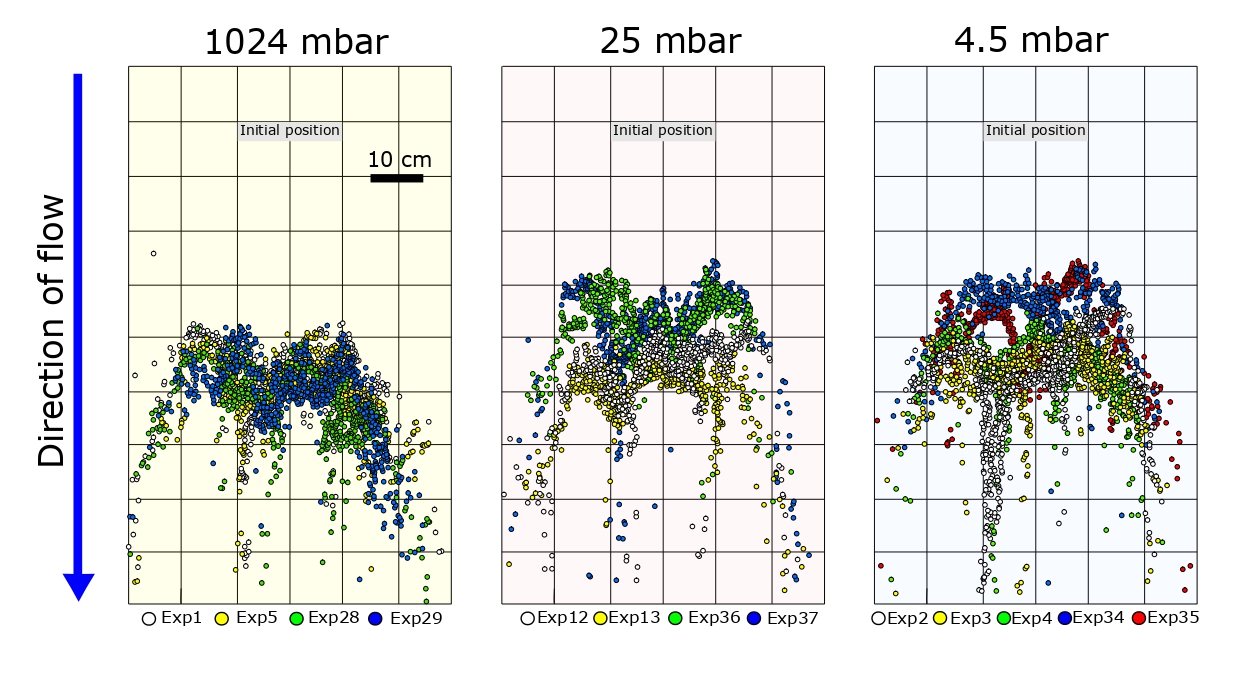
Figure 1: Results of experimentalruns conducted at pressures of 1024 mbar (4 experiments), 25 mbar (4 experiments), and 4.5 mbar (5 experiments). Each point represents the final position of a calcite grain, with the initial grain accumulation indicated by the shaded rectangle. Different colors of points correspond to individual experiments, allowing comparison between runs.
Critically, this pattern for 2–4 mm grains is opposite to the behaviour reported in previous experiments on sub-millimetre particles, where boiling-enhanced ejection can locally enhance transport [5]. Together, these results imply a grain-size threshold across which the net effect of water instability on transport reverses sign — a finding with direct consequences for how grain populations are sorted, redistributed, and ultimately deposited on Martian slopes.
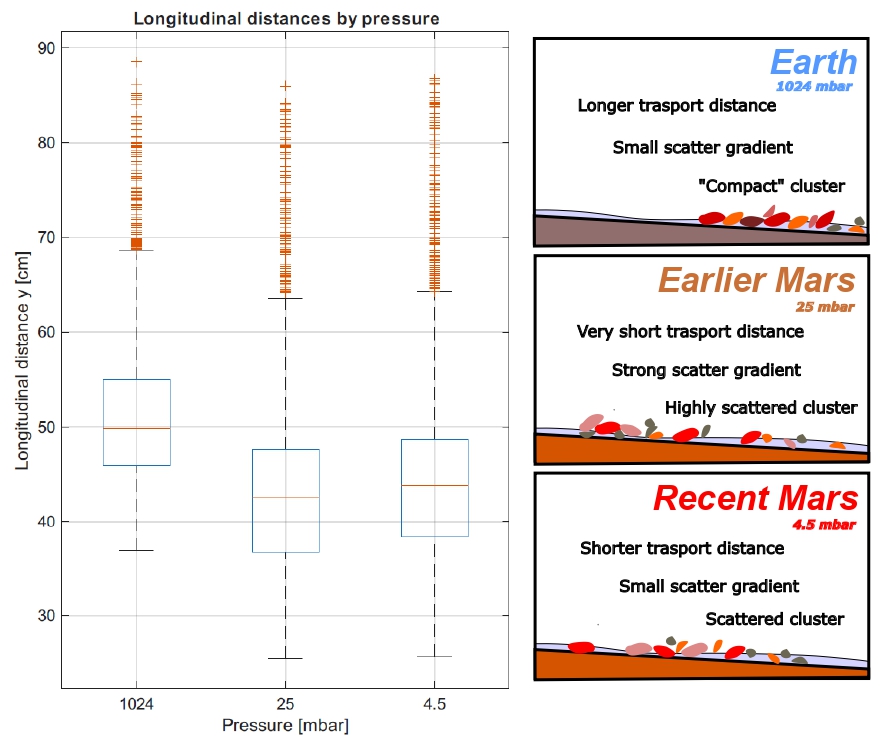
Figure 2: Box-plot diagrams (left panel) showing the longitudinal transport distances reached by individual grains as a function of driving pressure. A minimum transport distance is recorded at 25 mbar, with a slight recovery at 4.5 mbar reflecting partial restoration of transport efficiency. The grain deposit geometry is interpreted in terms of transport regime (right panel), spanning conditions from stable (1024 mbar) to highly unstable (25 mbar) water flow.
Our results provide quantitative constraints on sheet-flow sediment transport under both past and present Martian atmospheric pressures, advancing understanding of sediment dynamics in low-pressure, low-gravity environments. They also underline a broader caution: terrestrial analog studies cannot be straightforwardly extrapolated to Mars, because the coupling between water-phase behaviour and grain size produces transport regimes with no direct Earth equivalent. Interpreting morphological evidence for past liquid-water activity on Mars therefore requires explicit accounting for the metastable-water regime in which any such activity must have unfolded.
References
[1] Hecht et al. (2002), Icarus, 156, 373–386 [2] Bargery et al. (2010), Icarus, 210, 488–506
[3] Brož et al., 2025, EPSL, [4] Patočka et al., 2026, EPSL. [5] Conway et al., 2011, Icarus, 211(1), 443-457
How to cite: Krýza, O., Brož, P., Pěnkavová, V., Havlica, J., Zedníková, M., Emerland, Z., Patel, M., and Sylvest, M.: Effect of Unstable Water Flow on Grain Transport: Insights from Laboratory Experiments under Reduced Atmospheric Pressure, Europlanet Science Congress 2026, The Hague, The Netherlands, 7–11 Sep 2026, EPSC2026-128, https://doi.org/10.5194/epsc2026-128, 2026.


