EPSC Abstracts
Vol. 19, EPSC2026-1368, 2026, updated on 02 Jul 2026
https://doi.org/10.5194/epsc2026-1368
Europlanet Science Congress 2026
© Author(s) 2026. This work is distributed under the Creative Commons Attribution 4.0 License.

Celestial Ink: An Oriental Aesthetic Interpretation of Modern Astrophysics
 1,2
1,2- 1Space and Planetology Division, University of Bern
- 2Department of Astronomy, University of Geneva
Our telescopes reveal the universe with increasing precision, yet perhaps art is what allows us to emotionally recognise it. Inspired by traditional Chinese and Japanese watercolour painting, I explore a different visual language for astronomy and astrophysics — one that departs from the realistic or photorealistic styles commonly associated with astronomical imagery and instead embraces abstraction, negative space, and the wave-like rhythms characteristic of Oriental ink painting.
My paintings emerged informally and personally. I paint occasionally as birthday gifts for colleagues, but the works also serve as subtle invitations to conversation. By asking my friends to explain their latest projects and discoveries, the artistic process transformed into a dialogue between science and visual interpretation. The series includes paintings inspired by the Earth–Moon system, EULAR observations of young planets, direct imaging of hot Jupiters around brown dwarfs, mushroom-shaped ultra-hot Jupiters, potentially tidally locked ocean worlds around Proxima Centauri, the TRAPPIST-1 system, and conceptual diagrams of planet formation. In several pieces, planets dissolve into mist-like textures, while stellar light becomes empty space rather than illumination.
By introducing East Asian watercolour traditions into astrophysical imagery, this work explores how cultural artistic perspectives may expand the visual language of modern astronomy beyond conventional photorealistic representation. Rather than simply illustrating astronomy, these paintings reinterpret contemporary astrophysics through traditional Oriental visual aesthetics.
My paintings emerged informally and personally. I paint occasionally as birthday gifts for colleagues, but the works also serve as subtle invitations to conversation. By asking my friends to explain their latest projects and discoveries, the artistic process transformed into a dialogue between science and visual interpretation. The series includes paintings inspired by the Earth–Moon system, EULAR observations of young planets, direct imaging of hot Jupiters around brown dwarfs, mushroom-shaped ultra-hot Jupiters, potentially tidally locked ocean worlds around Proxima Centauri, the TRAPPIST-1 system, and conceptual diagrams of planet formation. In several pieces, planets dissolve into mist-like textures, while stellar light becomes empty space rather than illumination.
By introducing East Asian watercolour traditions into astrophysical imagery, this work explores how cultural artistic perspectives may expand the visual language of modern astronomy beyond conventional photorealistic representation. Rather than simply illustrating astronomy, these paintings reinterpret contemporary astrophysics through traditional Oriental visual aesthetics.
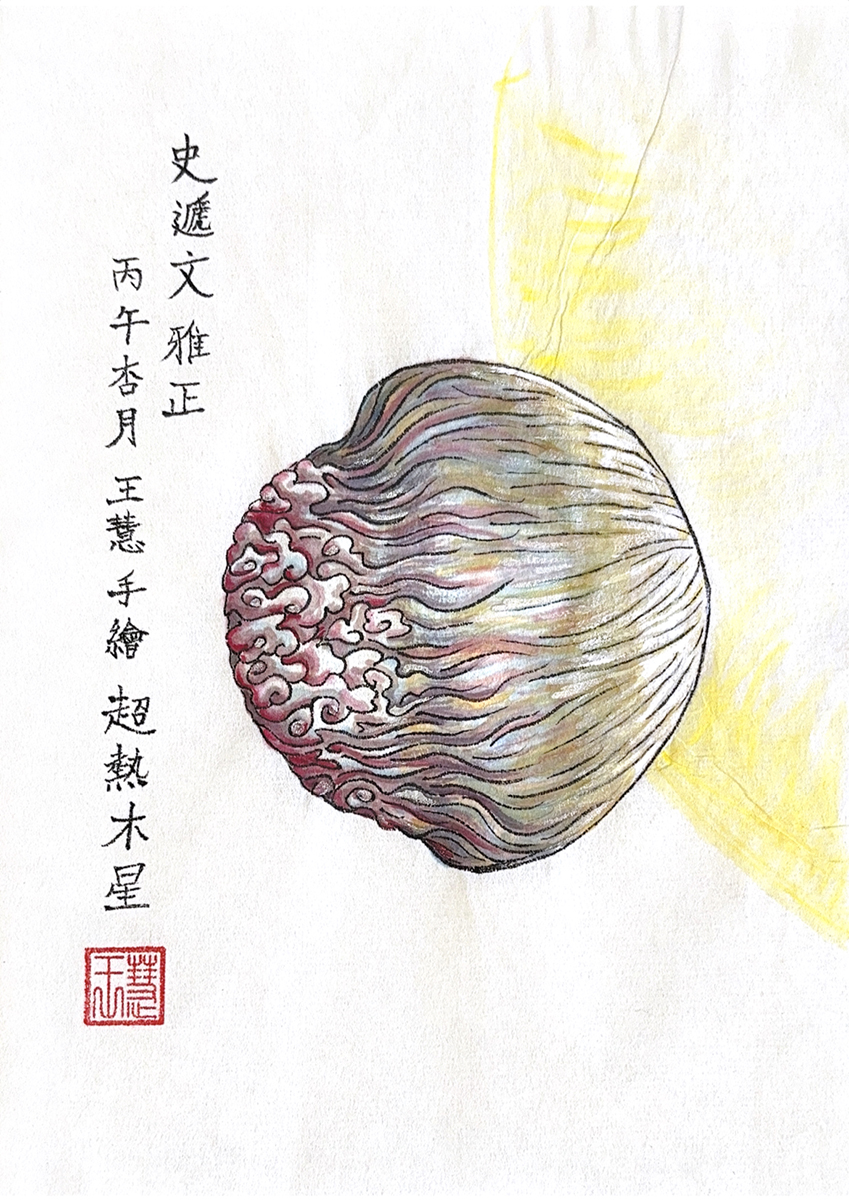
An example of artwork featuring a tydally locked Jupiter exoplanet.
How to cite: Wong, E.: Celestial Ink: An Oriental Aesthetic Interpretation of Modern Astrophysics, Europlanet Science Congress 2026, The Hague, The Netherlands, 7–11 Sep 2026, EPSC2026-1368, https://doi.org/10.5194/epsc2026-1368, 2026.


