ODAC4 | At the convergence of Art and Science

ODAC4

At the convergence of Art and Science
Convener: Thibaut Roger
Orals MON1
| Mon, 07 Sep, 08:30–10:00 (CEST)|Room Earth (Tango 1)
Mon, 08:30
Come join us in this session to discuss both astronomy-inspired art, and astronomy communication and outreach inspired by art.This session will explore the intersectionality of Art and (planetary) Science from both directions.

Not limited to any rules, interrogating us about our own nature, providing emotional and intellectual insights, impacting the masses and challenging the status quo, Art is the universal language of the people.
On the other hand, defined by clear rules and laws, invariable across time and space, described by ideas, concepts and mathematics more than words, Science is the universal language of our world and universe.

The scope is broad. For instance:
Artists are invited to display their science-inspired or science-driven projects and art pieces, and explain their creative process: why did they choose a specific approach, a specific media, or a specific way to represent a concept.
Scientists are invited to present data visualisation or sonification techniques - projects where art has been generated directly by the science and its components, either by design or by a happy accident.
Science communicators and educators are invited to showcase how they use art to impact various publics, and to inspire the next generation of scientists.

From painting to sculpture, from infographics and video content to generative AI, from video games to music, from photos to comics, all arts and media are welcome to this session.

Orals: Mon, 7 Sep, 08:30–10:00 | Room Earth (Tango 1)

Chairperson: Thibaut Roger
Transforming data into art
08:30–08:42
|
EPSC2026-569
|
Virtual presentation
Luka Ilić, Milica Jovičić, and Cristóbal Ulloa Cotapos

Introduction

Atmospheric models produce large, high-dimensional outputs that communicate with precision to specialists but remain challenging to interpret to the public. The Dust Protocol is a science-driven opera that challenges this boundary: it translates real outputs from the MONARCH atmospheric dust model into live musical performance, making the invisible dynamics of mineral dust transport perceptible through sound and voice.

This work converges art and science by generating art through a direct, systematic pipeline from model output to sonic structure.

Scientific foundation: the MONARCH model

MONARCH (Multiscale Online Non-hydrostatic AtmospheRe CHemistry model) is an operational atmospheric dust forecasting and research system developed at the Barcelona Supercomputing Center (BSC). It simulates the full life cycle of mineral dust aerosols: emission from arid source regions, long-range transport driven by atmospheric dynamics, and deposition across ocean and land surfaces. Dust aerosols play a significant role in Earth's radiative balance, ocean biogeochemistry, air quality, and regional climate.

The data-to-performance pipeline

The Dust Protocol was built around a structured methodology for translating MONARCH simulation outputs into musical parameters. From a comprehensive set of output variables that describe dust, the optical properties are selected as representative of dust mineral composition and interaction with solar radiation. The values of optical depth and single scattering albedo (SSA), are mapped to sonic dimensions such as pitch and velocity. This mapping is not arbitrary: physical relationships within the model inform the compositional logic, so that the sonic experience encodes genuine scientific structure rather than mere aesthetic association.

The soprano voice (Milica Jovičić) functions as a melodic and expressive foreground, while the electronic sonic environment constructed by Cristóbal Ulloa Cotapos is shaped in by model data. The result is a live performance in which the audience perceives, through sound, the behavior of an atmospheric system: dust rising from the Sahara, crossing the Mediterranean, settling over the Atlantic.

Methodology as transferable framework

A central ambition of The Dust Protocol is that the pipeline constitutes a generalizable methodology, not a one-off artwork. The systematic variable-to-parameter mapping, physically motivated compositional logic, integration of scientific output into live performance are transferable to other model types and other scientific domains. The approach offers a template for science-driven sonification that maintains fidelity to the underlying data while producing aesthetically coherent and emotionally resonant work.

Performances and reception

The Dust Protocol has been performed at El Palace Hotel (Barcelona), and an art+science festival (Belgrade) and presented at scientific conferences. Performances have engaged audiences spanning atmospheric scientists, performing arts communities, and the public. Qualitative reception across these contexts suggests that sonic translation of model data produces forms of scientific understanding that are distinct from, and complementary to, conventional visualization: audiences reported perceiving the duration, weight, and directionality of dust transport in ways that graphs and maps do not evoke.

Discussion: what data-driven art can do

The Dust Protocol raises questions this session is well-positioned to address. When scientific data is the compositional material rather than the inspiration, what is gained and what is lost? Does sonic fidelity to the model constrain artistic expression, or does it open compositional possibilities that purely aesthetic choice would not reach? And what does it mean for scientific communication when an audience experiences a model output rather than interprets it?

We argue that science-driven performance offers a mode of public engagement with atmospheric science that complements outreach, education, and visualization reaching audiences for whom data plots are inaccessible, and producing forms of embodied understanding that persist beyond the concert hall.

Conclusion

The Dust Protocol demonstrates that complex atmospheric model outputs can be systematically translated into live performance without sacrificing scientific integrity or artistic coherence. We present the data-to-performance pipeline as a methodological contribution to the growing field of scientific sonification, and invite reflection on the role of art-science convergence in making planetary science legible and felt beyond specialist communities.

How to cite: Ilić, L., Jovičić, M., and Ulloa Cotapos, C.: The Dust Protocol: A Science-Driver Electronic Opera, Europlanet Science Congress 2026, The Hague, The Netherlands, 7–11 Sep 2026, EPSC2026-569, https://doi.org/10.5194/epsc2026-569, 2026.

08:42–08:54
|
EPSC2026-1381
|
ECP
|
On-site presentation
Emily Costello

Cosmic rays continuously collide with the Earth and Moon, whirled into isotropy by galactic magnetic fields between here and their origin at distant high‐energy cosmic events such as collapsing stars and jetting black holes. Every cosmic ray is like a note or a written chord, which, when struck, sings a complex, ringing harmonic. When an ultrahigh-energy cosmic ray enters a solid, particulate material such as regolith or the atmosphere, it produces a relativistic cascade of secondary charged particles and an intense, coherent, wideband, linearly polarized electromagnetic pulse via the Askaryan Effect. This electromagnetic pulse is physically analogous to a sonic boom. Each electromagnetic pulse propagates through and is reflected and refracted by subsurface geophysical structures. Thus, cosmic rays serve as a pervasive, natural, non-destructive electromagnetic source for planetary subsurface geophysical sensing.

That is, cosmic noise can be interpreted. With the right ear, the noise is interpretable, decipherable music, which communicates a story about something that would, without art, remain too abstract or obscure to understand. Here, I present an overview of a novel planetary remote sensing and in-situ measurement approach that listens for the electromagnetic music made by cosmic rays via the Askaryan Effect and their detectable, interpretable radio signals, drawing on the fundamental connection to sound and music to communicate this beautiful and abstract physics.

This presentation is supported by the NASA Early Career Award in Planetary Science (80NSSC24K1214).

How to cite: Costello, E.: The Music of Cosmic Rays, Europlanet Science Congress 2026, The Hague, The Netherlands, 7–11 Sep 2026, EPSC2026-1381, https://doi.org/10.5194/epsc2026-1381, 2026.

08:54–09:06
|
EPSC2026-362
|
On-site presentation
Yamila Miguel

The Mequation is an art–science collaboration between astrophysicist Yamila Miguel and artist Thijs Biersteker that explores different ways of communicating astrophysics and exoplanet science to the public through immersive installations. The project combines scientific concepts related to exoplanets, habitability and biodiversity with interactive digital art to create a personalized experience for visitors.
The installation consists of a 1.5-meter circular mirror made of analog flip-board displays. Using sensors and real-time data streams, the artwork calculates a continuously updated “probability of existence” for each visitor based on a custom equation inspired by the Drake equation and developed specifically for the project. The calculation incorporates astrophysical quantities such as the number of galaxies, stars, stars that can host habitable planets and potentially habitable planets, together with demographic and biological factors linked to human individuality and presence in a specific place and moment.
In this contribution we will discuss the construction of the Mequation and its meaning, the development of the collaboration, including the process of translating scientific ideas into an interactive artistic experience, the challenges of combining scientific rigor with public engagement, and the role of real-time data in the installation. We will also present first experiences from public exhibitions and discuss initial audience reactions and engagement with the work.
The Mequation aims to explore how immersive art can provide alternative pathways for science communication, particularly for topics such as exoplanets and the search for life in the Universe, where the scales and concepts involved are often difficult to communicate through traditional outreach approaches alone.

How to cite: Miguel, Y.: The Mequation: An Art–Science Collaboration Connecting Exoplanet Research and Human Experience, Europlanet Science Congress 2026, The Hague, The Netherlands, 7–11 Sep 2026, EPSC2026-362, https://doi.org/10.5194/epsc2026-362, 2026.

Art inspired by science
09:06–09:18
|
EPSC2026-1368
|
ECP
|
On-site presentation
Emily Wong
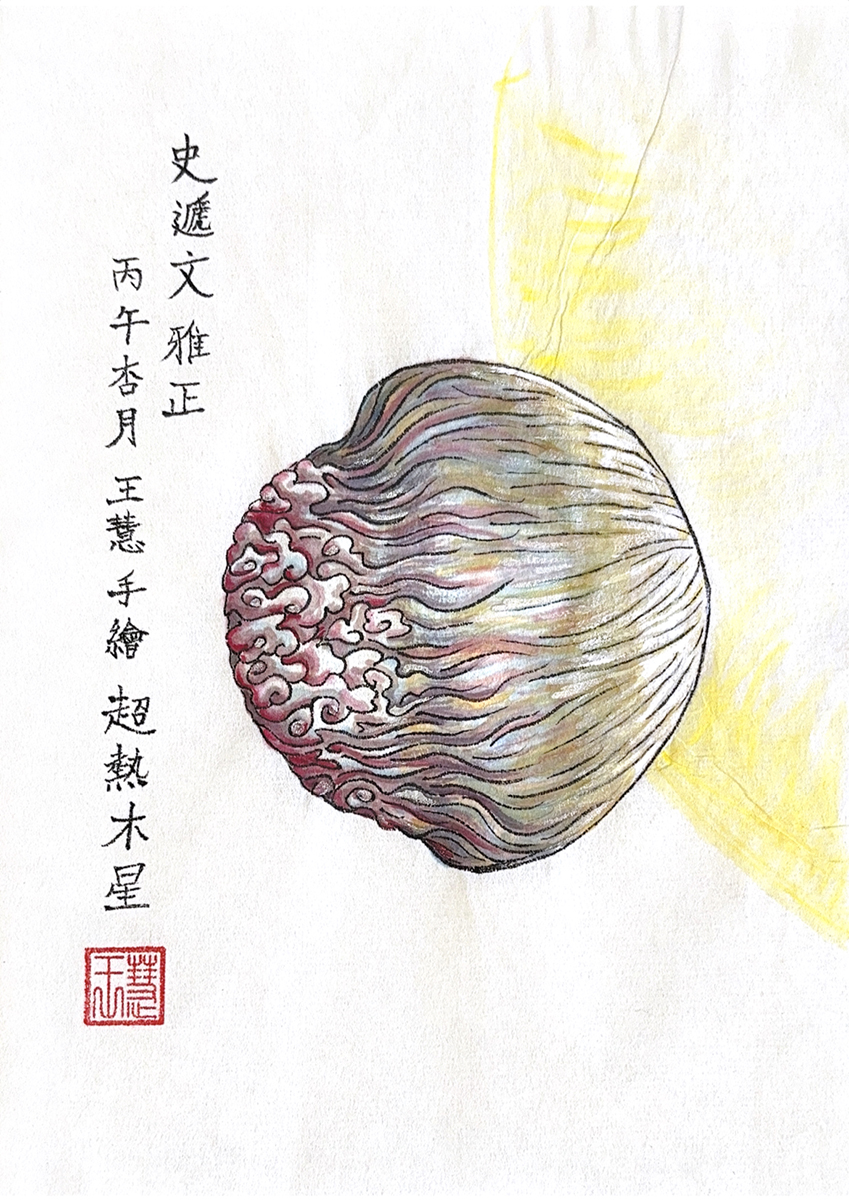
Our telescopes reveal the universe with increasing precision, yet perhaps art is what allows us to emotionally recognise it. Inspired by traditional Chinese and Japanese watercolour painting, I explore a different visual language for astronomy and astrophysics — one that departs from the realistic or photorealistic styles commonly associated with astronomical imagery and instead embraces abstraction, negative space, and the wave-like rhythms characteristic of Oriental ink painting.

My paintings emerged informally and personally. I paint occasionally as birthday gifts for colleagues, but the works also serve as subtle invitations to conversation. By asking my friends to explain their latest projects and discoveries, the artistic process transformed into a dialogue between science and visual interpretation. The series includes paintings inspired by the Earth–Moon system, EULAR observations of young planets, direct imaging of hot Jupiters around brown dwarfs, mushroom-shaped ultra-hot Jupiters, potentially tidally locked ocean worlds around Proxima Centauri, the TRAPPIST-1 system, and conceptual diagrams of planet formation. In several pieces, planets dissolve into mist-like textures, while stellar light becomes empty space rather than illumination.

By introducing East Asian watercolour traditions into astrophysical imagery, this work explores how cultural artistic perspectives may expand the visual language of modern astronomy beyond conventional photorealistic representation. Rather than simply illustrating astronomy, these paintings reinterpret contemporary astrophysics through traditional Oriental visual aesthetics.


An example of artwork featuring a tydally locked Jupiter exoplanet.

How to cite: Wong, E.:  Celestial Ink: An Oriental Aesthetic Interpretation of Modern Astrophysics, Europlanet Science Congress 2026, The Hague, The Netherlands, 7–11 Sep 2026, EPSC2026-1368, https://doi.org/10.5194/epsc2026-1368, 2026.

09:18–09:30
|
EPSC2026-131
|
On-site presentation
Kala Perkins

The use of performative art for teaching about the reality of our cosmic immersion and identity is a powerful lever of transformative consciousness through culture. People are fascinated by both the physics and the psychological implications of our own and our planetary cosmic origins. Carl Sagan vastly popularized the understanding of our origins as “Star Stuff” and yet the profound reality of this stellar ancestry continues to fascinate and expand people’s consciousness. That the amino acids which imbue life and living systems on Earth, as well as the water that saturates our planet, originated from comets and asteroids like those sourced from comet Bennu, intrigue the inquisitive mind seeking its own identity. Further, that we are incessantly and perpetually immersed in the radiation from the first impulses of our universe, via the Cosmic Microwave Background, is a potent magnet impelling the individual awareness to inquire deeper into our integrity with the Universe as a whole, and subsequently the integrity of the global and universal eco and biosystems. These realities can be elegantly communicated to both youth and the general public through performative arts; dance in particular can be used as an immediate story telling devise to communicate these realities in an impactful and inspirational way, both engaging the thinking mind and the culturally resonant intuitive capacities. This presentation explores a series of astronomically based motifs that can be, or have been utilized to inspire an experiential understanding of our integrity with cosmos.

How to cite: Perkins, K.: Dance of the Cosmos: Exploring our cosmic origins and integrity through performative arts, Europlanet Science Congress 2026, The Hague, The Netherlands, 7–11 Sep 2026, EPSC2026-131, https://doi.org/10.5194/epsc2026-131, 2026.

09:30–09:42
|
EPSC2026-962
|
ECP
|
On-site presentation
Julie Nekola Novakova, Zdeněk Urban, and Anna Steward

This year marks the 30th anniversary of the death of the renowned astronomer, science communicator and writer Carl Sagan. It is a global opportunity to bring science closer to the public and the media, to celebrate and highlight Sagan’s legacy in research, promoting scientific literacy and inspiring public interest in science, and to showcase exciting research in astronomy, planetary science and astrobiology.

We are organizing Carl Sagan Month, a multi-institutional event commemorating the anniversary across multiple cities and countries. A series of talks, panels, workshops, screenings and art showcases are going to highlight Sagan’s scientific and cultural legacy, promote contemporary research in Europe and beyond, and strengthen public engagement with science.

The European Astrobiology Institute acts as the international coordinator of the event, and science art is a key component of it. Sagan himself collaborated with visual artists and engaged in writing science fiction. These activities highlight the importance or art and popculture in reaching the public and conveying science further, and we will pay homage to them by organizing a contest for visual artists, arts workshops and performances as part of the Carl Sagan Month from November 20 to December 20, 2026. Other institutions are welcome to join in the event.

How to cite: Nekola Novakova, J., Urban, Z., and Steward, A.: Carl Sagan Month: At the interplay of science and art, Europlanet Science Congress 2026, The Hague, The Netherlands, 7–11 Sep 2026, EPSC2026-962, https://doi.org/10.5194/epsc2026-962, 2026.

09:42–09:48
09:48–10:00