
 4,
4,- 1National Astronomical Observatories, Chinese Academy of Sciences, Beijing, China (zhouq@bao.ac.cn)
- 2Department of Earth and Planetary Sciences, University of California at Davis, One Shields Avenue, Davis, USA
- 3Department of Earth, Environmental, and Planetary Sciences, McDonnell Center for the Space Sciences, Wash-ington University, St. Louis, USA
- 4State Key Laboratory of Lithospheric Evolution, Institute of Geology and Geophysics, Chinese Academy of Sciences, Beijing, China
Introduction: Since 1969, six Apollo missions, three Luna missions, and the recent Chang’E missions have returned ~385.6 kg of lunar samples, providing a robust dataset for reconstructing lunar surface processes and geologic history [1-2]. However, despite advances from Chang’e-5 and Chang’e-6 [e.g., 3-5], direct sampling remains geographically restricted to specific landing sites. Lunar meteorites- which likely originate from unsampled lunar regions-offer complementary records that advance our understanding of the Moon’s origin and global evolution [6-7].
Samples: Dhofar 1442 is the second most KREEP (potassium, rare earth elements, phosphorus)-rich lunar meteorites known (after SaU 169). Its geochemistry points to the Procellarum KREEP Terrane (PKT) on the nearside, which hosts the Moon’s primary KREEP reservoir and records prolonged magmatic activity. Unlike the limited sampling from Apollo 12, Apollo 14, and Chang’E-5, Dhofar 1442 offers complementary insights into KREEP magmatism and impact history.
Methods: The in-situ U-Pb dating of zircons were performed on a Cameca IMS-1280/1280HR at the Institute of Geology and Geophysics (IGG), Chinese Academy of Sciences (CAS). A 3-5 mm O2- primary beam at ~0.2 nA was employed in single-collector mode, with a mass resolving power of 7000 (50% peak height definition). Pb/U fractionation was calibrated against zircon standard M257 via the power relationship between 206Pb/238U and 238U16O2/238U. Common Pb was corrected using modern terrestrial value.
Results: Dhofar 1442 is a glassy-matrix regolith breccia containing a variety of mineral, lithic and glass clasts. The most abundant lithic clasts associated with zircons are granulitic, noritic, and impact melt breccia (IMB) clasts.
Granulitic clasts are metamorphic rocks formed at depth during large impacts. They exhibit a well-equilibrated mineral assemblage dominated by pigeonite, Na-rich plagioclase (average An73) and Si, K-rich glass, with minor ilmenite, Fe-Ni metal, troilite, phosphate and zircon. Zircons from these clasts yield an upper intercept age of 3848 ± 29 Ma (Fig. 1a). After excluding highly discordant points, the remaining analyses give a weighted average 207Pb/206Pb age of 3848 ± 22 Ma. This age records a metamorphic event at ~3.85 Ga and provides a lower limit for the consolidation age of Dhofar 1442.
Norite clasts comprise roughly equal proportions of low-Ca pyroxene and plagioclase (average An85), with minor ilmenite, troilite, phosphate and zircon. They preserve primary igneous textures (subophitic to granoblastic) and lack shock features. Zircons in these clasts give an upper intercept age of 3957 ± 26 Ma (Fig. 1b). After excluding discordant points, the weighted average 207Pb/206Pb age is 3945 ± 11 Ma, which is interpreted as the crystallization age of the noritic clast. This younger age records a later episode of magnesian magmatism on the lunar nearside, possibly linked to thermal effects from the Imbrium impact at ~3.92 Ga.
IMB clasts contain mineral and lithic fragments set in a fine-grained crystalline matrix. Pyroxene compositions vary widely, encompassing enstatite, pigeonite and augite. Plagioclase spans a range from An57to An93 (labradorite to anorthite). Zircons in IMB clasts yield an upper intercept age of 4342 ± 20 Ma (Fig. 1c) and a weighted average 207Pb/206Pb age of 4337 ± 9 Ma. This well-constrained age provides evidence for significant impact activity on the Moon pre-3.9 Ga.
In addition to lithic clasts, zircons also occur as matrix fragments. Although direct petrographic links to specific lithic clasts are limited, their 207Pb-206Pb age distribution closely resembles that of the lithic clasts, with prominent peaks at ~ 3.82, ~3.95, and ~4.32 Ga (Fig. 1d). This striking similarity suggests that matrix zircons are largely derived from the granulitic, noritic, and IMB clasts.
Discussion: Early Apollo studies identified the “lunar cataclysm” or Late Heavy Bombardment (LHB) at ~3.92–3.85 Ga [8], but pre-3.9 Ga impacts are increasingly recognized [9-10]. In Dhofar 1442, the ~4.34 Ga age of IMB clasts suggest a major impact. A similar ~4.35 Ga in other lunar meteorites such as Kalahari 009 and NWA 2995, is attributed to basin-forming impacts [10-11], though Borg and Carlson (2023) [1] proposed it as late Moon formation. Given our IMB zircon ages, we prefer an impact origin rather than Moon formation. As the South Pole-Aitken (SPA) basin is estimated at 4.25- 4.33 Ga [9-10], the impact recorded by Dhofar 1442 may be associated with SPA basin formation.
As a polymict regolith breccia, Dhofar 1442 provides a more representative record of lunar impact history than monomict specimens. Zircon age distribution indicates that impact activity at ~4.34 Ga was at least as intense as that during the ~3.94 Ga, with peak intensities decreasing progressively from ~4.34 to ~3.95 Ga and then to ~3.82 Ga, which is consistent with a declining impact flux over time [12].
Pre-3.9 Ga impacts are also recorded on Vesta (Ar-Ar: ~3.4–4.1 Ga; U-Pb: ~4.2 Ga) [13-14] and Mars (large basin: 4.10–4.25 Ga; NWA 7034/7533: 4.44, 4.35, 1.44 and 1.35 Ga) [15]. The 4.35 Ga zircon age in NWA 7034 is close to the oldest Martian basin [16], indicating major impact disturbance of the U-Pb system. These independent records support that significant bombardment began earlier than ~3.9 Ga, though establishing a synchronous chronology requires integration of multiple sample suites and geochronological techniques.
References: [1] Borg and Carlson, 2023, Annual Review of Earth and Planetary Sciences, 51, 25-52. [2] Neal et al., 2023, Reviews in Mineralogy & Geochemistry. [3] Li et al., 2021, Nature, 600, 54-58. [4] Cui et al., 2024, Science, 386, 1395-1399. [5] Zhou et al., 2025, Nature, 643, 371-375. [6] Joy et al., 2023, Reviews in Mineralogy & Geochemistry, 89: 509–562. [7] Korotev et al., 2005, Geochemistry, 65, 297-346. [8] Cohen et al., 2000, Science, 290, 1754-1756. [9] Su et al., 2025, National Science Review, 12, nwaf103. [10] Joy et al., 2025, Nature Astronomy, 9, 55-65. [11] Terada et al., 2007, Nature, 450, 849-852. [12] Yue et al., 2026, Science Advances, 12, eady9265. [13] Bogard, 1995, Meteoritics, 30, 244-268. [14] Zhou et al., 2011, 42nd LPSC, 2575. [15] Yin et al., 2014, 45th LPSC, 1320. [16] Marchi et al., 2021, The Astronomical Journal, 161, 187.
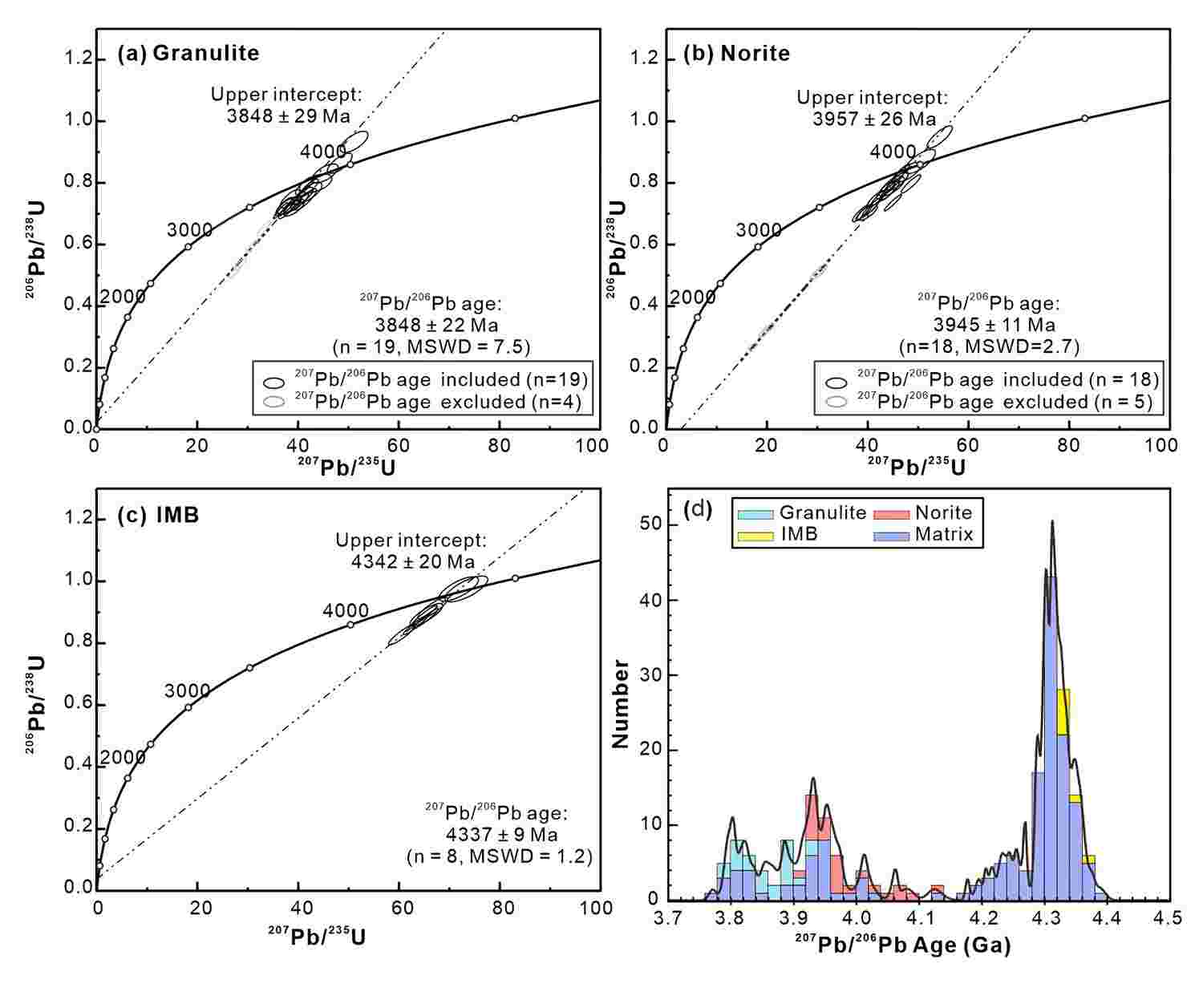
Figure 1: U-Pb concordia diagrams (a-c) and 207Pb/206Pb age probability density distribution (d) for zircons from different lithic clasts in Dhofar 1442. All uncertainties are reported at the 2σ level.
How to cite: Zhou, Q., Yin, Q.-Z., Zeigler, R. A., Jolliff, B. L., Li, Q.-L., and Li, C.: Zircon U-Pb Geochronology of Lunar Meteorite Dhofar 1442: Implications for Lunar Impact History and the Late Heavy Bombardment, Europlanet Science Congress 2026, The Hague, The Netherlands, 7–11 Sep 2026, EPSC2026-140, https://doi.org/10.5194/epsc2026-140, 2026.


