
 1,2,2,2,4,5,2,6,3,
- 1Faculty of Geo-Information Science and Earth Observation (ITC), University of Twente, Enschede, the Netherlands
- 2Department of Physical Geography, Utrecht University, Utrecht, The Netherlands
- 3Faculty of Aerospace Engineering, TU Delft, Delft, The Netherlands
- 4Institute for Biodiversity and Ecosystem Dynamics, University of Amsterdam, Amsterdam, The Netherlands
- 5Faculty of Science and Engineering, University of Groningen, Groningen, The Netherlands
- 6Department of Mineralogy and Petrology, Granada University, Granada, Spain
Introduction
The question if life exists outside of Earth has been an important driver of Solar system exploration and exoplanet research in the last few decades [1-3]. Although terrestrial analogue research provides insight into this question [4-5], no definitive evidence of life outside Earth has been found at this moment [6]. This raises the question whether the current methodology for analogue research is sufficient, or needs changes.
To answer this, we use AI to systematically analyse 2500 papers that use terrestrial analogues or analogue research methods to study life outside Earth. For each, we determined the used methods, scales at which they are applied, and investigated research questions. This gives new insights in which methods are used and underused, and which methods should be used in combination to improve the methodology towards understanding and detection of life outside Earth
Methods
A systematic literature search was performed for analogue research related to life outside Earth. The resulting initial set of articles were analysed manually to determine the used methods, scales, and research questions. Then, articles referred to in review papers were collected to complete the literature compilation.
This literature compilation was then analysed by using the Ollama framework [7] in combination with Langchain [8] to run the qwen3:0.6b LLM [9]. Analysis uses the following pipeline: 1) conversion to text-containing pdfs, 2) extraction of text sections 3) extraction of method sections from other sections 4) asking a series of binary question on sections relevant for methods, scales, and research questions to check the usage within each single article.
Results
The initial compilation included ~700 articles, ~100 of which could be classified as reviews. The manual analysis showed the following:
- Interdisciplinary research is done, but remains limited. This hinders finding connections between biosignatures and other observables.
- Research on how to span different spatial scales, ranging from molecular to planetary scales and exoplanetary scales, is lacking. Here, especially the field-scale is underutilised, which may provide importance in linking potentially habitats to actual biosignatures.
- There is no clear separation between inhabited, uninhabited, and previously inhabited but no longer habitable environments. This affects the reliability of biosignature interpretation. Both false negatives and false positives are overlooked, with almost no research focusing on false negatives.
The reviews increased the dataset to a total of ~2500 articles. These were all analysed by AI, with the initial set functioning as a control. AI-analysis deviates significantly from manual analysis, overall indicating higher numbers for each used method, scale, and research question. However, AI confirms that there is a small number of papers that utilises the field scale, indicating at least an agreement with the manual analysis that this scale is underutilised.
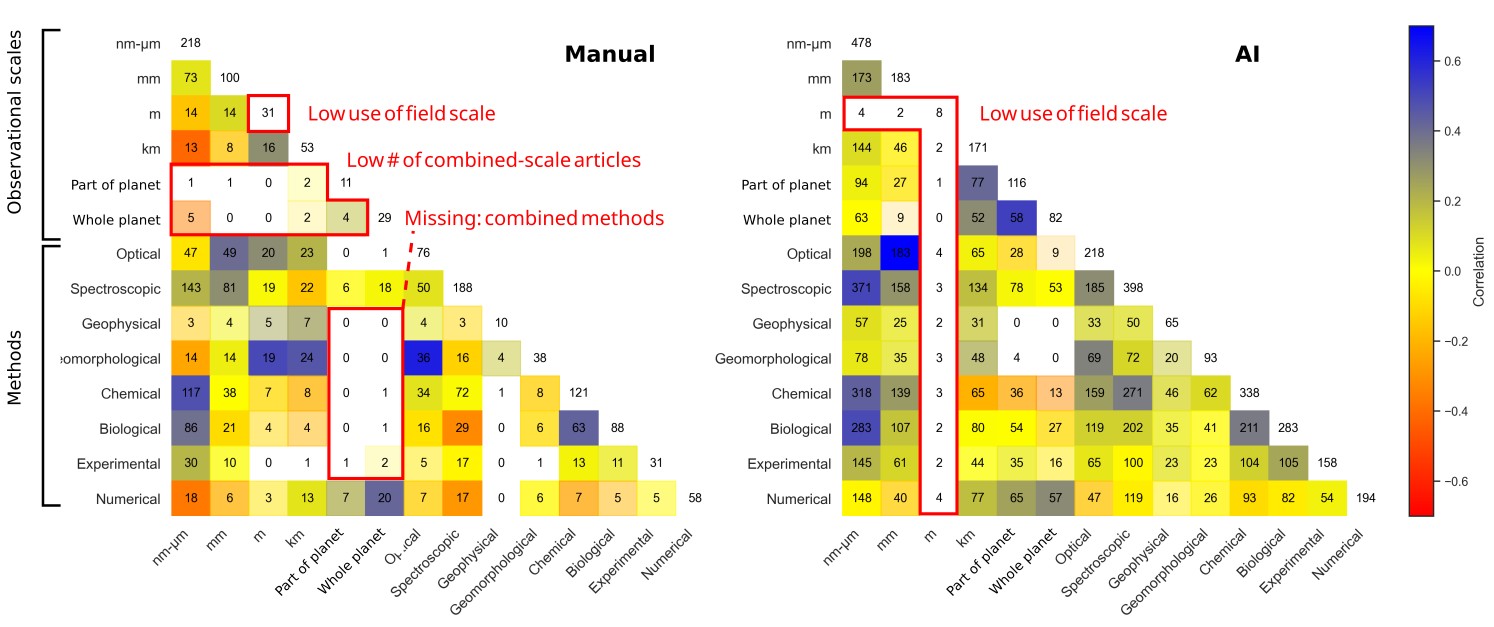
Figure 1 Correlation diagram showing usage of observational scales and methods. Colours represent that certain methods or scales are used in the same paper (blue) or that they tend to be used separately (red). Light colours to white indicate underused methods and scales. Note that the AI tends give overall higher usage of methods and scales throughout papers, but does not find the same relationships as in the manual analysis.
Discussion and conclusion
The research gaps resulting from the manual analysis indicate the need for an integrated, multi-scale framework to advance life-detection strategies. This is partially supported by AI, although improvement of the AI-analysis is needed before final conclusions can be drawn. As examples of suggestions for future research, biologists or biochemists should collaborate with geomorphologists, geophysicists, and imaging spectroscopists, in order to determine the relations between biosignatures on laboratory to field and remote-sensing scales. Futhermore, geologists and biologists should work with exoplanet researchers, to give them insights into the atmospheric processes and exclude false positives and negatives in exoplanetary signs of life. Such collaborations will prove essential to improving the methodology for the search for extraterrestrial life.
References
[1] C. S. Cockell et al. Astrobiology, 9, 1. (2009). [2] J. Matthey, Platin. Met. Rev., 20, 3. (1976). [3] D. Schulze-Makuch, J. M. Dohm, A. G. Fairén, V. R. Baker, W. Fink, and R. G. Strom Astrobiology, 5, 6. (2005). [4] A. G. Fairén et al. Astrobiology, 10, 8. (2010). [5] F. Biagioli, S. Bay, A. Zerboni, and C. Coleine Int. J. Astrobiol., 24, e29. (2025). [6] J. E. Brandenburg “The Discovery of Microbial Life on Mars.” Int. J. Immunol. Microbiol., 2, 2. (2025). [7] Ollama, Ollama’s documentation. Retrieved from: https://docs.ollama.com (2025). [8] H. Chase LangChain. Retrieved from: https://github.com/langchain-ai/langchain (2022). [9] Qwen Team “Qwen3 Technical Report.” Retrieved from: https://arxiv.org/abs/2505.09388 (2025).
How to cite: Alsemgeest, J., van Ruitenbeek, F., ten Kate, I. L., Kleinhans, M., de Vet, S., Braat, L., Jansen, B., Lichtenberg, T., Roelofs, L., Sánchez Román, M., Shukla, S., and van der Tak, F.: Terrestrial analogue research for finding extraterrestrial life and how to use AI to find research gaps, Europlanet Science Congress 2026, The Hague, The Netherlands, 7–11 Sep 2026, EPSC2026-1405, https://doi.org/10.5194/epsc2026-1405, 2026.


