

- Universität Braunschweig, Institut für Geophysik und extraterrestrische Physik, Germany (r.schraepler@tu-bs.de)
Dust particles in protoplanetary disks assemble into highly porous, fractal aggregates whose resistance to compression remains poorly quantified. We present the first direct laboratory measurements of gas–driven compaction in highly porous, fractal dust aggregates under microgravity conditions carried out with the ICAPS‐SRE payload aboard a sounding rocket. We quantify how highly porous, fractal dust aggregates compact under ultra‐low‐pressure gas flows and temperature gradients. Micrometer sized agglomerates first assembled into millimeter‐scale clusters with initial filling factors of order 10-4. Subjecting these aggregates to convergent thermophoretic force field whose constant part was counterbalanced by a gas stream, we tracked their evolving solid‐volume fraction and established a continuous pressure–compaction curve. Remarkably, this experimentally derived relation aligns closely with the analytical description of the numerical model of Tatsuuma et al. (2023), despite our tests probing filling‐factor is an order of magnitude below their simulations. We further demonstrate that once compaction occurs, the aggregates resist re‐expansion under divergent flows, a behavior we attribute to an increased coordination number that raises tensile strength and locks in the higher density. By leveraging the Tatsuuma et al. framework, our results can be extrapolated to different grain sizes and compositions, providing a unified description of low‐pressure densification. These data furnish the first direct, quantitative proof of gas–induced compaction in fractal dust agglomerates, offering crucial benchmarks for models of planetesimal growth (e.g., Okuzumi et al. 2012; Michoulier et al. 2024), and carrying implications for atmospheric aerosol dynamics (Bhandari et al. 2019) and industrial filtration of soot (Sipkens et al. 2024).
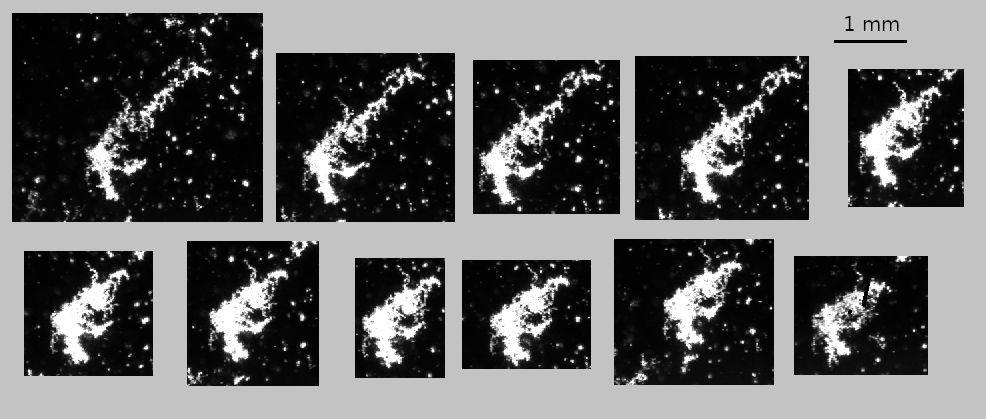
Figure: Camera frames of a dust agglomerate undergoing compression over a 15 s sequence. The aggregate is driven by a converging thermophoretic gradient from the upper right toward the lower left, with the gradient’s steady component counterbalanced by a controlled gas flow.
This work was part of the ICAPS mission, which was supported by the Deutsches Zentrum
für Luft- und Raumfahrt (DLR Space Agency) under Contract nos. 50WM0336, 50WM0636,
50WM0936, 50WM1236, 50WM1536, 50WM1846, and 50WM2146. and the European
Space Agency (ESA) through their SciSpacE programme for this project and the TEXUS-56
Sounding Rocket flight. The Belgian Science Policy Office and the ESA PRODEX Programme
are kindly acknowledged for their support.
The authors used an AI-based language-editing tool to improve the English clarity and style of this manuscript.
Tatsuuma, M., Kataoka, A., Okuzumi, S., Tanaka, H.: Formulating Compressive
Strength of Dust Aggregates from Low to High Volume Filling Factors with Numer-
ical Simulations. ApJ 953(1), 6 (2023) https://doi.org/10.3847/1538-4357/acdf43
arXiv:2306.09259 [astro-ph.EP]
Okuzumi, S., Tanaka, H., Kobayashi, H., Wada, K.: Rapid Coagulation of Porous Dust
Aggregates outside the Snow Line: A Pathway to Successful Icy Planetesimal Formation.
ApJ 752, 106 (2012) https://doi.org/10.1088/0004-637X/752/2/106 arXiv:1204.5035
[astro-ph.EP]
Michoulier, S., Gonzalez, J.-F., Price, D.J.: Compaction during fragmentation and bounc-
ing produces realistic dust grain porosities in protoplanetary discs. A&A 688, 31 (2024)
https://doi.org/10.1051/0004-6361/202449719 arXiv:2406.15622 [astro-ph.EP]
Bhandari, J., China, S., Chandrakar, K.K., Kinney, G., Cantrell, W., Shaw, R.A., Maz-
zoleni, L.R., Girotto, G., Sharma, N., Gorkowski, K., Gilardoni, S., Decesari, S., Facchini,
M.C., Zanca, N., Pavese, G., Esposito, F., Dubey, M.K., Aiken, A.C., Chakrabarty, R.K.,
Moosmüller, H., Onasch, T.B., Zaveri, R.A., Scarnato, B.V., Fialho, P., Mazzoleni, C.:
Extensive soot compaction by cloud processing from laboratory and field observations.
Scientific Reports 9(1), 11824 (2019) https://doi.org/10.1038/s41598-019-48143-y
Sipkens, T.A., Corbin, J.C.: Effective density and packing of compacted soot aggregates.
Carbon 226, 119197 (2024) https://doi.org/10.1016/j.carbon.2024.119197
How to cite: Schraepler, R. and Blum, J.: A microgravity experiment quantifies the compaction of fractal dust agglomerates by rarefied gas forces, Europlanet Science Congress 2026, The Hague, The Netherlands, 7–11 Sep 2026, EPSC2026-141, https://doi.org/10.5194/epsc2026-141, 2026.


