
 1,1,1,
- 1TU Braunschweig, IGEP, Braunschweig, Germany (c.knoop@tu-braunschweig.de)
- 2Universität Bremen, ZARM, Bremen, Germany
- 3University of Amsterdam, Anton Pannekoek Institute for Astronomy, The Netherlands
1 Introduction
Modern planet formation models rely on the efficient conversion of micrometer-
sized dust grains into porous and eventually compacted pebble-like aggregates.
These pebbles are essential for processes such as streaming instability and pebble
accretion, but their formation pathways, physical properties and abundance
remain poorly constrained by observations and existing laboratory experiments.
Within the ERC Advanced Grant project Ground Truth for Pebbles in Planet
Formation (GT4Pebbles), a new experimental and numerical framework is being
developed to investigate this early stage of planet formation. The central goal is
to provide experimental ground truth for the growth, restructuring and physical
characterization of macroscopic dust aggregates under controlled laboratory conditions.
2 The Braunschweig Levitation Chamber
At TU Braunschweig, a new large-scale levitation chamber experiment is being
built to study the collisional growth of protoplanetary dust analogues. The
setup consists of a gas-filled rotating vacuum chamber with an inner diameter of 2 m [see Figure 1].
Dust particles are injected into a rarefied gas atmosphere of about 100 Pa pressure and
follow circular trajectories determined by their gas-coupling or stopping times.
Particles with different stopping times occupy slightly shifted trajectories,
which leads to controlled low-velocity collisions under conditions ((flow regime, velocity-size relation) equivalent to those in protoplanetary disks .
In this way, the experiment is designed to follow the evolution from initially
micrometer-sized dust grains to larger, highly porous fractal aggregates (see Figure 2) and
eventually into the restructuring regime. The large scale of the experiment
increases the stability time of the dust against centrifugal drift cloud and allows aggregate growth to be
observed over extended timescales.
Figure 1: CAD drawing of the large-scale levitation chamber experiment at TU Braunschweig. The 2 m wide and 0,22 m thick rotating vacuum chamber will enable controlled low-velocity dust-aggregate collisions in a rarefied gas environment.
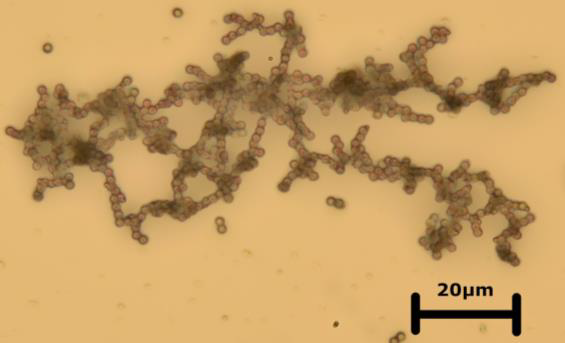
Figure 2: Optical image of a dust aggregate grown in a small scale (0.5 m diameter) levitation-chamber ex-
periment. Such aggregates illustrate the highly porous and irregular structures
that are expected during the early stages of dust growth.
3 Diagnostic Units and Measurement Concept
The levitation chamber provides a controlled environment for observing a stable
and growing dust cloud. A suite of diagnostic units will be used to characterize
the temporal evolution of the cloud and the physical properties of the forming
aggregates. The Overview Observation System will provide wide- and narrow-angle
imaging of the dust cloud. It will be used for particle tracking and mor-
phological studies of individual dust aggregates.The Light Scattering Unit will measure the angular scattering behaviour
of the evolving aggregate population at selected wavelengths. These mea-
surements will help to determine whether and how the optical properties
of the dust cloud change during growth. The Infrared Spectro-Photometer will monitor characteristic dust fea-
tures, in particular the silicate band around 10 µm wavelength. Changes in these spectral features
can provide information about the structural and optical evolution of the
growing aggregates. The Dust Sampling Unit will collect grown dust aggregates after an exper-
imental run. The collected samples can then be analysed using microscopy
and further laboratory methods to determine their morphology, structure
and mechanical properties.
Together, these instruments will provide access to cloud morphology, ag-
gregate trajectories, growth behavior, optical properties and post experiment
structural information. The experiment will therefore form an experimental ba-
sis for validating dust-growth and compaction models and for constraining the
properties of pebble-like aggregates in planet-forming disks.
4 Outlook
This contribution presents the current status of the experimental setup, its diag-
nostic concept and its role within the GT4Pebbles framework. Once operational (expected by end of 2026),
the GT4Pebbles experiment will allow the systematic investigation of dust growth
from micrometer-sized monomers to larger fractal aggregates under controlled
collision and realistic conditions. The resulting measurements will provide key input for nu-
merical dust growth models and for the interpretation of pebble-like aggregates
in planet forming disks.
How to cite: Knoop, C., Kreuzig, C., Timpe, M., Blum, J., and Dominik, C.: Ground Truth for Pebbles in Planet Formation:A Large-Scale Levitation-Chamber Experimentfor Dust Aggregate Growth, Europlanet Science Congress 2026, The Hague, The Netherlands, 7–11 Sep 2026, EPSC2026-157, https://doi.org/10.5194/epsc2026-157, 2026.


