
 1,3,3,1,1,4,5
- 1Royal Belgian Institute for Space Aeronomy (BIRA-IASB), Planetary Atmospheres, Uccle, Brussels, Belgium
- 2Rhein. Institut für Umweltforschung Köln, Freies Institut für Planetenforschung (RIU-FIP), Cologne, Germany
- 3INAF - IAPS, Istituto di Astrofisica e Planetologia Spaziali, Via del Fosso del Cavaliere, 100, I-00133 Rome, Italy
- 4Department of Aerospace Engineering and Engineering Mechanics, The University of Texas at Austin
- 5SSC Space Spain services for the European Space Agency (ESAC), Madrid, Spain
1. Introduction
In this study, we analyse Venus zonal winds derived under the cyclostrophic approximation using the complete temperature sounding datasets from the VeRa [1,2] and VIRTIS [3,4,5] instruments onboard Venus Express. We compare winds retrieved from these complementary temperature sounding techniques, using two wind retrieval methods, and cross-validate the results against cloud-tracked and ground-based wind observations.
2. Mesosphere dynamics
As a slowly rotating planet, Venus mesospheric circulation is largely governed by the cyclostrophic regime, in which the zonal winds can be reconstructed from the temperature field through the thermal wind equation [6]. In addition to the zonal super-rotation, which extends from the surface to the lower mesosphere and reaches maximus speeds near the cloud tops (~70 km), the mesosphere is characterized by a strong variability both on day-to-day as well as longer timescales, and the presence of wave motions that are thought to contribute to the maintenance of the atmospheric circulation [7].
3. Temperature retrievals
The thermal structure of Venus mesosphere was investigated by two complementary experiments on board Venus Express: VIRTIS (Visible and Infrared Thermal Imaging Spectrometer) and VeRa (Radio Science Experiment). The VIRTIS-M dataset spans December 2006 to January 2010 (orbits #23 to #843) and includes nightside observations between 65 and 86 km (100 – 1 mbar). Temperatures were retrieved on 67 pressure levels, with hundreds to thousands of profiles per orbit [4,5].
VeRa provided broader temporal and vertical coverage from July 2006 to January 2014, delivering more than 900 temperature profiles on both day- and nightsides between 45 and 90 km with a vertical resolution of 500 m. In addition, VeRa retrieved vertical pressure profiles [1,2]. Both instruments mainly sampled the Southern Hemisphere, with fewer observations in the Northern Hemisphere due to orbital constraints.
Figure 1 shows the latitude-altitude temperature fields for both datasets. Both experiments reveal a consistent thermal structure, including a pronounced temperature inversion (cold collar) poleward of 60°. Above 75 km (≈20 mbar), temperatures generally increase toward the pole.
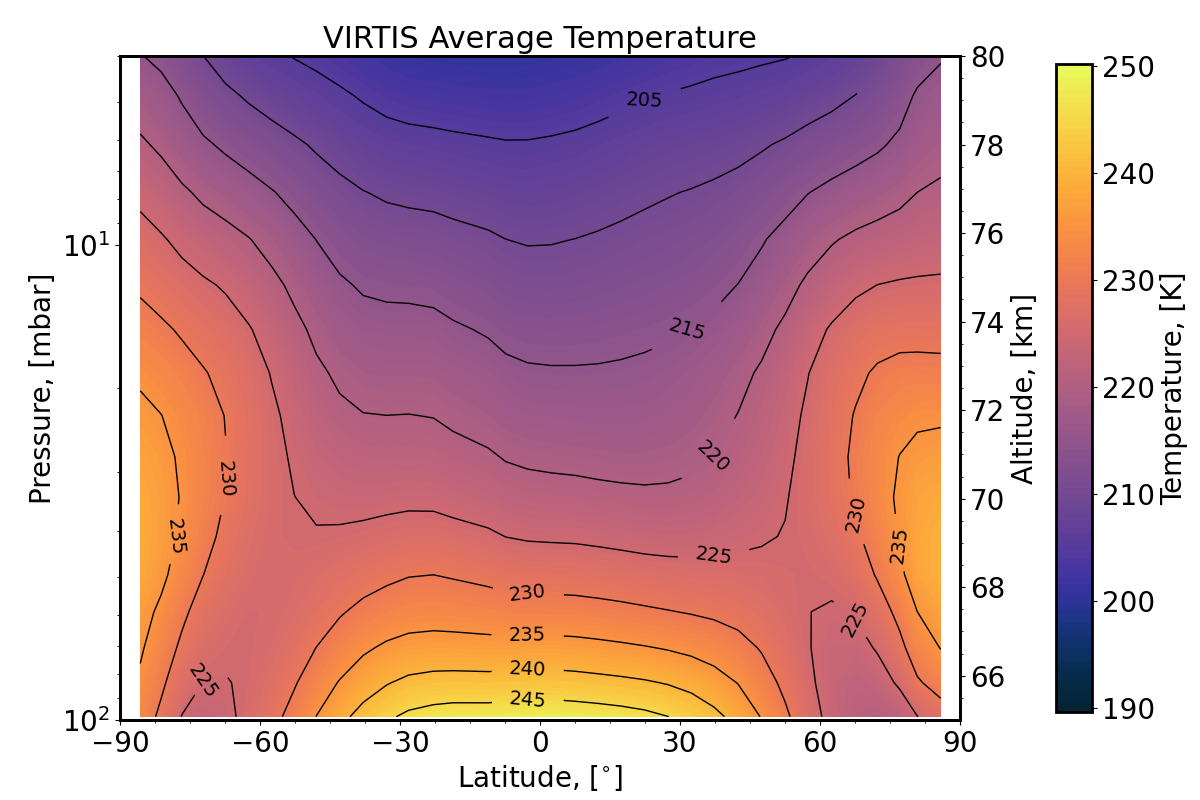
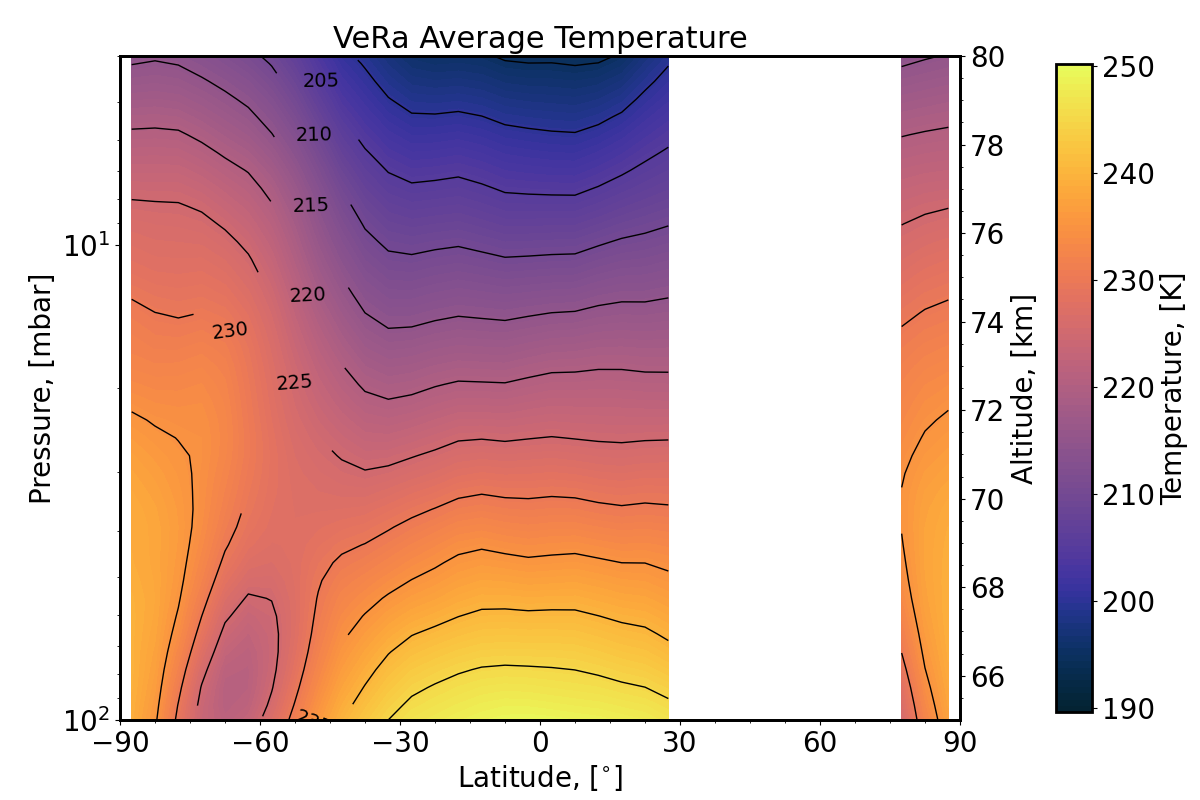
Figure 1: (Left) Temperature cross-section obtained combining the whole VIRTIS-M dataset. The data was acquired between 14 May 2006 and 15 August 2008 (orbits 23-843). (Right) Temperature cross-section obtained combining all VeRa observations. The data was acquired between July 2006 and January 2014.
4. Zonal Wind Structure
Zonal thermal winds were derived from VIRTIS and VeRa temperature soundings using the thermal wind equation [8,9]. The retrieved circulation shows: (1) a midlatitude jet between 30° and 60° latitude, peaking at 110-160 m/s near 40 mbar; (2) a rapid decrease in wind speed poleward of 60°; and (3) decreasing wind speeds with altitude above the jet.
Figure 2 shows zonal wind cross-sections derived from the VIRTIS (left) and VeRa (right) temperature fields. Both datasets reveal similar circulation patterns, although VeRa derived jet reaches higher velocities (>160 m/s). As discussed in [9], these differences may result from the different temperature sounding techniques.
Future work includes comparisons with cloud-tracked and ground-based winds, and the application to VeRa data of an alternative retrieval method based on the meridional slope of pressure surfaces, which, unlike the VIRTIS wind retrievals, does not require a lower boundary condition.
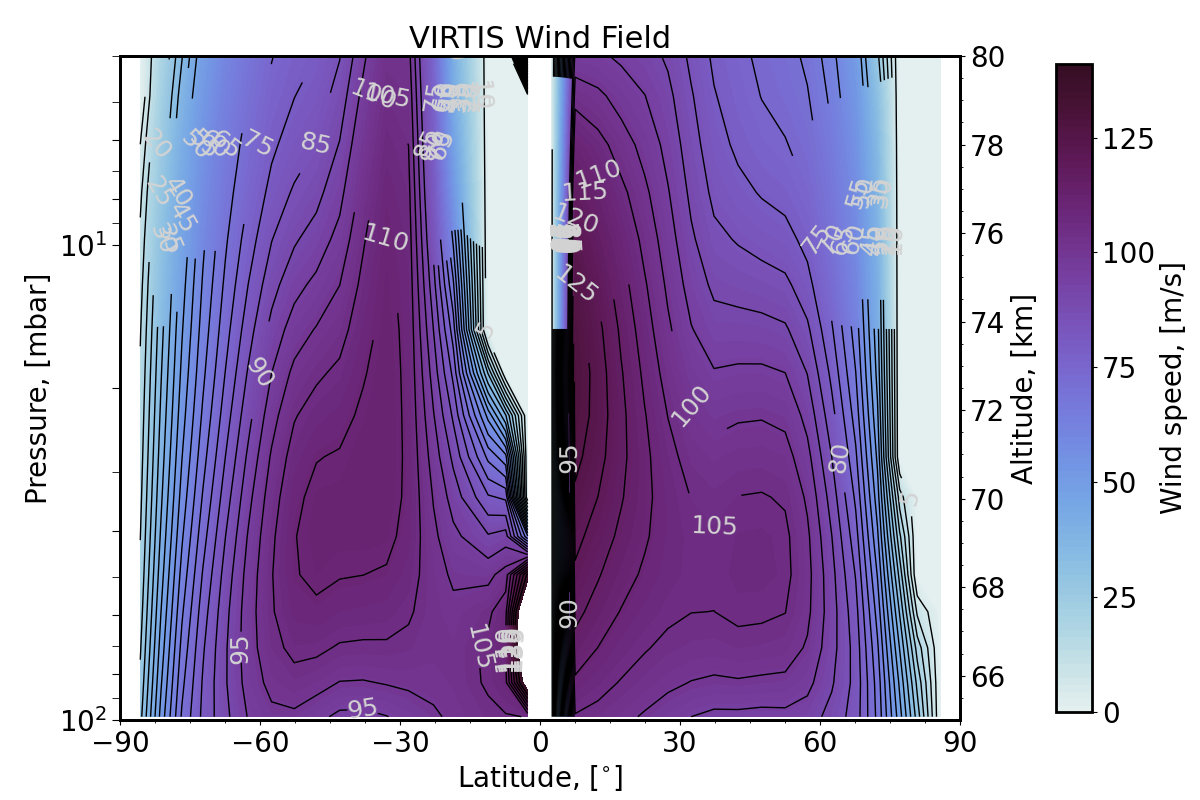
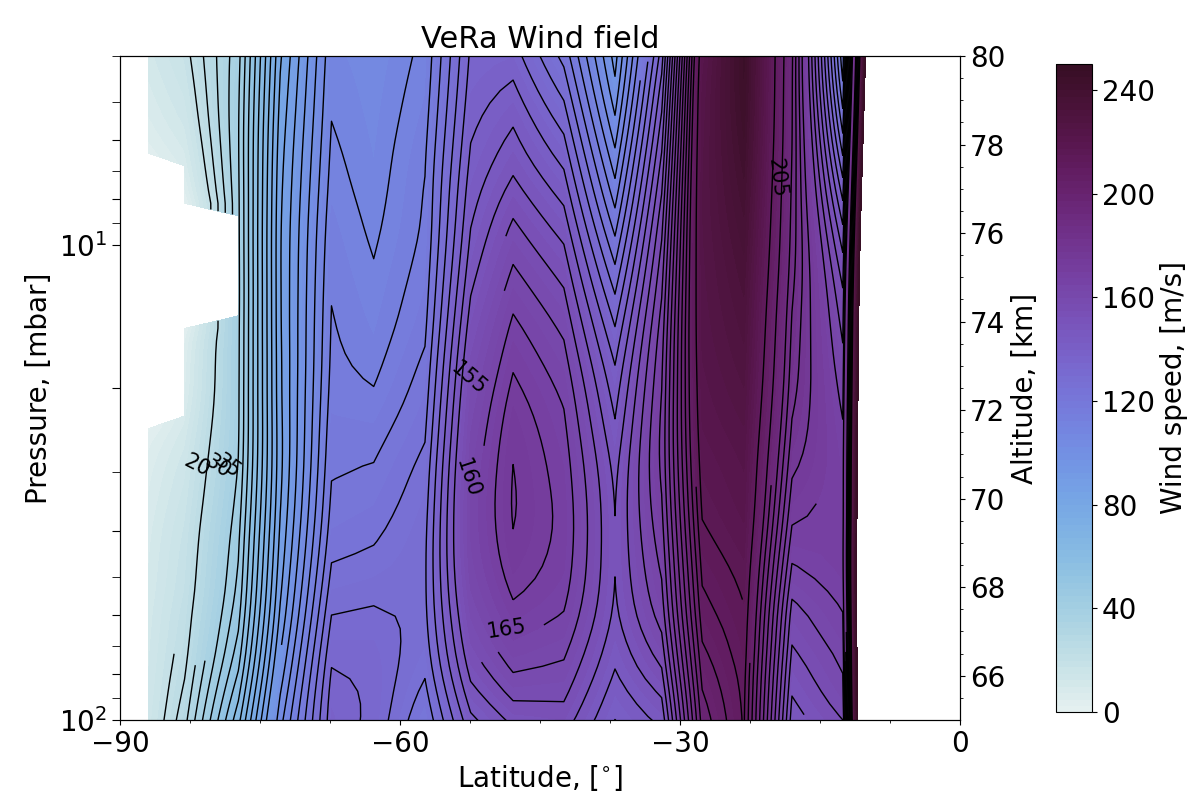
Figure 2: Zonal wind cross-sections obtained from: (Left) VIRTIS temperature field, and (Right) VeRa temperature field.
References
[1] Tellmann, S., et al., J. Geophys. Res., 114, E00B36, doi:10.1029/2008JE003204.
[2] Tellmann, S. et al., Icarus, doi:10.1016/j.icarus.2012.08.023
[3] Drossart, P. et al. (2007) PSS, 55:1653–1672
[4] Grassi D. et al. (2008) JGR., 113, 2, E00B09.
[5] Migliorini, A. et al. (2012) Icarus 217, 640–647.
[6] Newman, M. et al. (1984) J. Atmos. Sci., 41, 1901-1913.
[7] Sanchez-Lavega, A. et al. (2017) Space Science Reviews, Volume 212, Issue 3-4, pp. 1541-1616.
[8] Piccialli A. et al. (2008) JGR, 113,2, E00B11.
[9] Piccialli A. et al. (2012) Icarus, 217, 669–681
How to cite: Piccialli, A., Tellmann, S., Grassi, D., Migliorini, A., Piccioni, G., Pätzold, M., Robert, S., and Mahieux, A.: Thermal winds in Venus mesosphere derived from the VIRTIS and VeRa temperature soundings, Europlanet Science Congress 2026, The Hague, The Netherlands, 7–11 Sep 2026, EPSC2026-167, https://doi.org/10.5194/epsc2026-167, 2026.


