
 1,3,3,5,8,9
- 1Institute of Space and Astronautical Science (ISAS), Japan Aerospace Exploration Agency (JAXA), 3-1-1 Yoshinodai, Sagamihara, 252-5210, Kanagawa, Japan (caminiti.emma@jaxa.jp)
- 2SSC Space for ESA, European Space Astronomy Centre, Madrid, Spain
- 3Institut d’Astrophysique Spatiale (IAS), Université Paris-Saclay, CNRS, 91405 Orsay, France
- 4Université Grenoble Alpes, CNRS, Institut de Planétologie et d’Astrophysique de Grenoble (IPAG), 414 rue de la piscine, 38400 Saint-Martin d’Hères, France
- 5European Space Agency (ESA), European Space Astronomy Center (ESAC), Madrid, Spain
- 6Centre de Recherches Pétrographiques et Géochimiques, Université de Lorraine, 15 Rue Notre Dame des Pauvres, Vandœuvre-lès-Nancy, 54501, France
- 7Department of Geology, University of Liège, 4000 Sart Tilman, Belgium
- 8LIRA, Observatoire de Paris, Université PSL, CNRS, Sorbone Université, Université de Paris, Meudon, France
- 9Institut für Planetologie, Universität Münster, Wilhelm-Klemm Str. 10, Münster, 48149, Germany
Mercury's surface is classified into several units according to its geological (Denevi et al., 2013), compositional (Weider et al., 2015, Vander Kaaden et al., 2017, Peplowski et al., 2019), and spectral properties (Robinson et al., 2008, Denevi et al., 2009, Murchie et al., 2015). Units do not necessarily correlate, limiting our understanding of the geological history of the planet. Several processes act simultaneously to modify the spectral properties of Mercury, which complicates the identification of the origin of the spectral units. Isolating the contribution of each process requires laboratory experiments that aim to reproduce Mercury-like conditions as closely as possible. As an airless body, Mercury is subject to space weathering leading to modifications in the surface spectral properties. Laboratory spectral studies of space weathering effects on Mercury analogues are typically conducted under a single geometrical configuration (Caminiti et al., 2024), which limits direct comparison with remote sensing observations (Rubino et al., 2022). Remote sensing instruments onboard space missions frequently observe the same area at different local times and from varying angles (incidence, emission, and phase angles), resulting in measurements acquired under diverse geometrical conditions. Constraining the effects of the geometry of observation of the space-weathered surface of Mercury is particularly relevant in the context of the ESA-JAXA-BepiColombo mission (Benkhoff et al., 2021), which will reach Mercury's orbit in 2026. The Visible Infrared Hyperspectral Imager (VIHI) channel (Filacchione et al., 2023) from the Spectrometers and Imagers for MPO BepiColombo Integrated Observatory SYStem (SIMBIO-SYS) payload (Cremonese et al., 2020) will map the surface from the visible to near-infrared (400-2000 nm). SIMBIO-SYS will operate in nadir-pointing configuration with variations of the incidence angle and the possibility of off-pointing to measure specific targets of interest during the extended phase of the mission. These observational conditions differ significantly from the NASA-MESSENGER-MASCS instrument's measurements obtained at large phase angles (Izenberg et al., 2014). To compare both datasets and eventually observe changes at the surface of Mercury in the last decade, additional laboratory activities are required. This study presents the VISNIR spectral analysis of a Mercury simulant to understand the impact of space weathering and observation geometries on the spectral properties of Mercury surface.
We used the “Mercury mix” simulant combining aubrite material with natural and synthetic minerals to better reproduce the composition of Mercury's crust (Leon-Dasi et al., 2025). We performed ion irradiation using the SIDONIE electromagnetic isotope separator (IJCLab, France) (Chauvin et al., 2004) interfaced with the INGMAR (IrradiatioN de Glaces et Météorites Analysées par Réflectance VIS-IR, IAS, France) vacuum chamber (P ~10-7 mBar) (Lantz et al., 2017). We used 20 keV He+ with fluence up to 1017 ions/cm2. Bidirectional reflectance spectroscopy was performed at IPAG (France) using the SHADOWS spectro-gonio radiometer (Potin et al., 2018) to analyze the effect of the geometrical configuration. The illumination angle ranged from the nadir to grazing illumination (0°, 20°, 40°, and 60°). For each illumination angle, we acquired spectra with an observation angle of ~ -70° to +70°. Spectra were acquired at room temperature, in the visible to near-infrared (600-2000 nm).
The BRDF shows an increase in reflectivity around the specular configuration (e~ i) with an angular width of about 20°, and towards e~-i for large incident angles (Figure 1). R750 and R1450 both decrease with increasing phase angle until ~70° (backscattering) and increases towards higher phase angles (forward scattering). The analog presents a darkening in the VIS (R750) which is limited in specular conditions (Figure 1), a reddening in the VISNIR (VISNIR_Slope) after 20° from specular conditions, and a possible brightening in the NIR (R1450) after ion irradiation. The effects of ion irradiation on the reflectance are stronger with increasing phase angle (Figure 1). Thus, we expect future SIMBIO-SYS data to be less sensitive to space weathering than MASCS data. The fresh sample shows few changes in spectral slope induced by the observation geometry. This supports the idea that slope changes are poorly affected by the emission angle compared to changes in reflectance (Leon-Dasi et al., 2025). However, the irradiated sample is more sensitive to variations in emission angle.
Overall, the measurements demonstrate that irradiation‑induced changes in spectral parameters are strongly dependent on observation geometry. Under certain geometries, fresh and weathered units can appear spectrally similar, while under others they diverge markedly. These results identify optimal viewing conditions to assess space‑weathering effects on Mercury’s surface, providing timely constraints on surface evolution and valuable guidance for BepiColombo science off‑pointings.
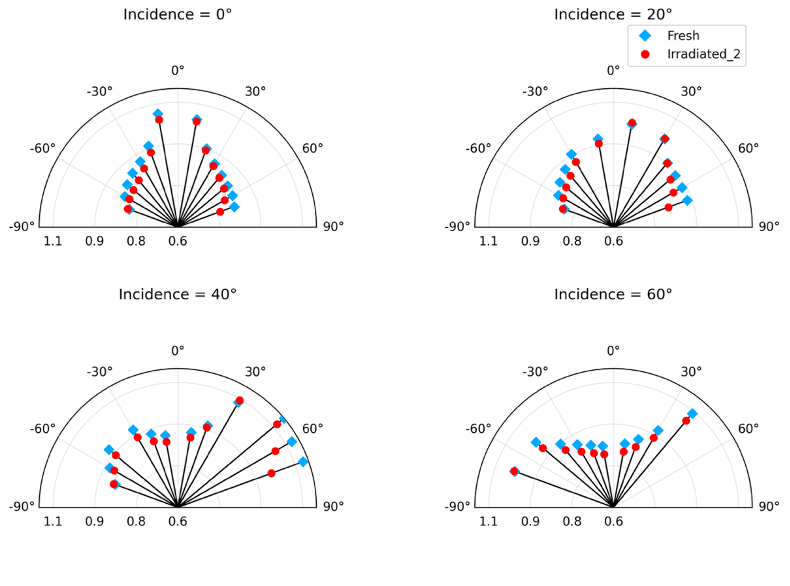
Figure 1: Evolution of the normalized reflectance at 750 nm under different optical geometries for fresh and He+-implanted pellets. Uncertainties are not visible; this indicates that they are smaller than the symbol.
References:
- Benkhoff et al., Space Sci. Rev. 217.8, 90 (2021).
- Caminiti et al., Icarus 420, 116191 (2024).
- Chauvin et al., Nucl. Instrum. Methods Phys. Res. A 521.1, 149–155 (2004).
- Cremonese et al., Space Sci. Rev. 216.5, 75 (2020).
- Denevi et al., JGR Planets 118.5, 891–907 (2013).
- Denevi et al., Science 324.5927, 613–618 (2009).
- Filacchione et al., IEEE Trans. Geosci. Remote Sens. 61, 1–12 (2023).
- Izenberg et al., Icarus 228, 364–374 (2014).
- Lantz et al., Icarus 285, 43–57 (2017).
- Leon-Dasi et al., Icarus 436, 116582 (2025).
- Murchie et al., Icarus 254, 287–305 (2015).
- Peplowski & Stockstill-Cahill, JGR Planets 124.9, 2414–2429 (2019).
- Potin et al., Appl. Opt. 57.28, 8279–8296 (2018).
- Robinson et al., Science 321.5885, 66–69 (2008).
- Rubino et al., Icarus 376, 114887 (2022).
- Vander Kaaden et al., Icarus 285, 155–168 (2017).
- Weider et al., Earth Planet. Sci. Lett. 416, 109–120 (2015).
How to cite: Caminiti, E., Leon-Dasi, M., Lantz, C., Brunetto, R., Beck, P., Besse, S., Cartier, C., Llado, L., Doressoundiram, A., and Benkhoff, J.: Effects of observation geometry on the visible to near-infrared spectra of a space-weathered Mercury simulant, Europlanet Science Congress 2026, The Hague, The Netherlands, 6–11 Sep 2026, EPSC2026-176, https://doi.org/10.5194/epsc2026-176, 2026.


